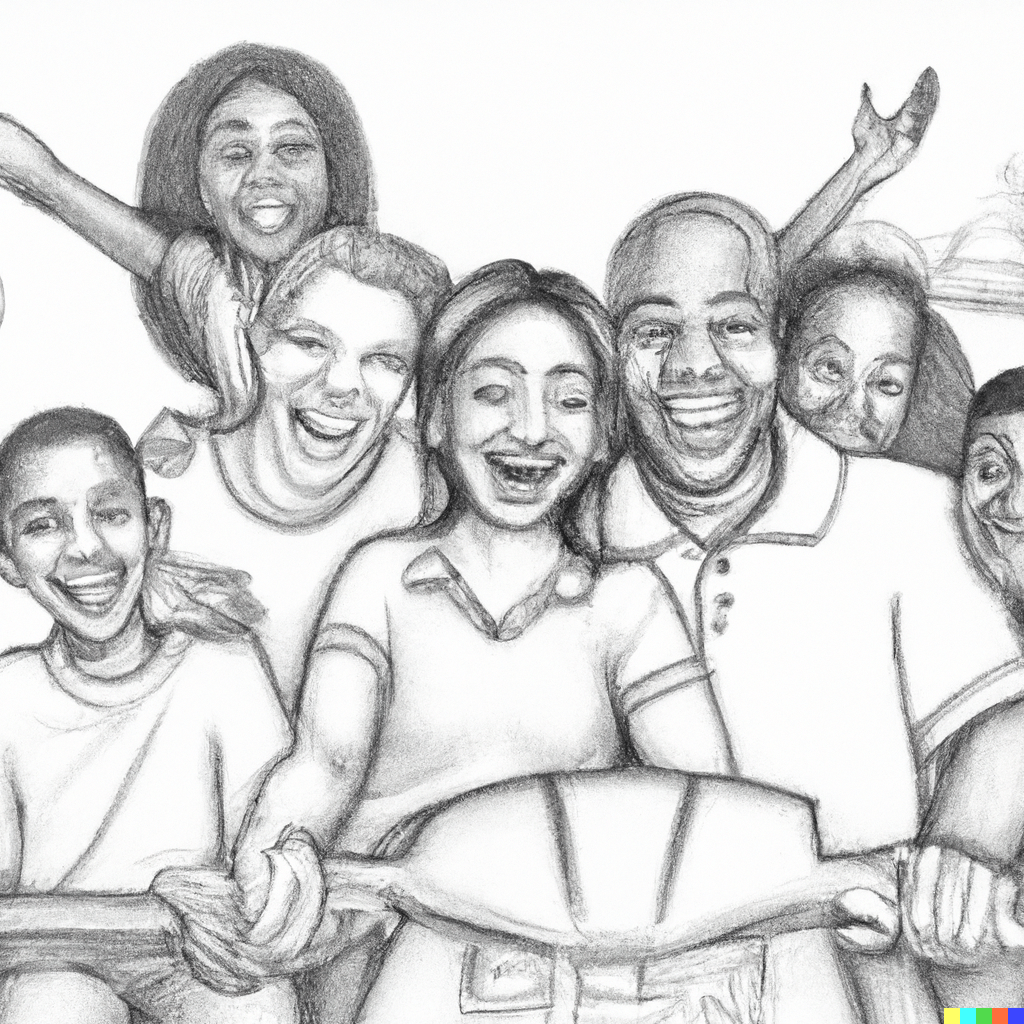
In the movie “Along Came Polly” Rueben Feffer’s Dad did not say a lot, but when he did, he nailed it.
The question has always been how to establish a mindset whereby ‘the ride’ can be enjoyed because throughout human history it has been understood that some who would appear to have so little reason for happiness are the most jovial, yet those who apparently have so much should be happy yet appear so unsatisfied. The line works because there are many Sandy Lyles among us (sadly Philip Seymour Hoffmann, who so brilliantly brought Sandy to life on our screens, is no longer with us).
Now anxiety for humanity’s future is not just reasonable it is inappropriate to not be concerned. The pendulum has swung to such an extreme of late, and the consequences of it so apparent, that not many possibly could, and nobody should, ‘enjoy the ride’.
This is what a contact wrote when they read my movie treatment – bear in mind this person is one of the greatest economics minds in Australia, is a world-renowned author, and a frequently published economics commentator (on Bloomberg, The Guardian, etc):
“I don’t think it is possible to change anything as people are generally not interested, being preoccupied with the minutiae of humdrum trivialities. It is unwise to set yourself an Sisyphean (sic) task which you will come to regret and it will ultimately poison your life in ways you perhaps do not appreciate. I fully expect that in your children’s lifetime the world will become an unpleasant place- chronic food, water and energy challenges (sic), financial instability on a scale that is unimagined, climate change will make large parts of the continent difficult to inhabit, wars and conflicts of different sorts will proliferate. Australia -the Lucky Country-may find its good fortune does not last (without massive mineral exports Australian living standards would be 20-50% lower). I am happily at the end of my life. I do not envy those who will have to deal with what is now inevitable.”
As someone who made the choice to bring life into this world, I feel that I do not have a choice but to do all that I can to make things better. The more of us committed to it, the better the world will be for those who follow us.
In “As He Saw It”, Elliott wrote that when his weary Dad was reunited with his Mum, Eleanor, after the Yalta conference – just a few months before he died, after FDR had led the most powerful nation, and consequently broader humanity, through one of its most turbulent periods in modern times – he warmly and proudly exclaimed:
“Look at the communiqué from the Crimea: the path it charts! From Yalta to Moscow, to San Francisco and Mexico City, to London and Washington and Paris! Not to forget it mentions Berlin! It’s been a global war, and we’ve already started making it a global peace!”
I can barely read these words without tearing, not just because I feel his pride as warmth in my own chest, but also because I – like Elliott did already in 1946 when he wrote of his experiences – feel the disappointment at the way humanity was turned away from the better path.
All too often we have been led by (mostly) men who have acted from self-interest in pleasing subsets of humanity, not just their own national electors, but even smaller subsets within their societies.
Rather than uniting people, these leaders seek to divide us for their own personal and narrow-interested gain, in doing so often giving the appearance of indifference if not visceral hate of those who they seek to subjugate.
Others take the idea of market-based capitalism to the extreme and suggest that political leadership is outdated and unnecessary in lieu of individual entrepreneurship. If it were in fact true, then this would invite the question for why societies should be levied to pay their expensive political salaries and for Government operation of an apparatus that has relinquished its role in leading, even if the greatest payoff to such self-interest is achieved in their post-public career when they really cash in on their political influence.
Of course, such contentions are absurd, and are indicative of an extreme form of capitalism where self-interest is not just accepted but is perversely applauded.
Moreover, the lack of leadership by those meant to provide it is in no small part the cause of the anxiety felt in many societies just as anybody aboard a rudderless vessel in a broad ocean would feel as they meandered directionless even in favourable ambient conditions, let alone when a squall arose.
Three decades of dereliction of duty to lead by our public leaders has occurred since the collapse of the largest communist state in the Soviet Union, and the adoption of ‘state capitalism’ in China which proved tentalising for Western businesses operating solely on the profit imperative and out of self-interest by executives and owners while that nation rapidly developed into the world’s second largest economy and became less ideologically-open since their current leadership came to power in 2010.
The truth, however, is that this dereliction is not just the fault of political non- or anti-leadership.
Where the individualism meme is correct is that we must all take responsibility for allowing these leaderless societies to have devolved from the 1980s, almost as if we had felt that a perfect state had been achieved, not considering all of the systemic bias that kept marginalised people and geographic regions (and nations) down, and at the same time being tantilised by the dream of wealth beyond imagination emanating from (the perception of) free capitalist markets even if it was at the cost of a hollowed-out middle class meaning that the probability of achieving social mobility upwards, or even maintaining it within the middle class, decreased.
Humanity now confronts our most serious challenge in our short history, compared with many other species, in the climate crisis from a position of compromise where we have traded away our innate and learned advantages – our social skills and empathy, and our technology to record, research, learn, and teach the lessons of history – for the chance at short term gains, and leaving ourselves more vulnerable than ever before to manipulation to create division.
We need leaders who actually want to lead within society, who share FDR’s love and optimism for humanity, and who seek to unite rather than divide both on a regional basis and globally.
Leadership must also be dispersed throughout society in the form of parents and other mentors.
The future of humanity is now too critical and too finely balanced to be allowed to drift directionlessly and remaining at the whim of random circumstance associated with the natural and anthropogenic realities of our existence, principally the life and death even of great human beings, and the potential for divisive people to ascend to positions of great power and influence. Here I am thinking especially of the impact of the timing of the death of FDR, and specifically about Elliott Roosevelt’s final sentence in ‘As He Saw It’:
“If Franklin Roosevelt was a great President, it was – in the main – thanks to the articulated intelligence of the American people during his terms in the White House.”
We know from history that there will always be those amongst us who have an unquenchable thirst for power, who will seek to drive the pendulum swing to extremes out of self-interest, so if we are to counteract their forcefulness then we need societies to be fortified by education and critical thinking skills, diffuse and inclusive leadership, and above all else, compassion from connection.
The key to human progress will always lie in the quelling of the amplitude of the pendulum swing so that more of our collective energy and capability goes into steepening the trajectory of progress, progress that is not measured in material wealth – though that will no doubt follow – but in societal advancement in terms of inclusion and contentment.
Humans, especially politicians whose main aim is to retain their grip on power, are very good at moving on and forgetting about ideas of the past, even those with significant merit. Politicians see an idea that was fostered but not quite accepted by the electorate as ‘poisoned’, something that political capital was risked for but ultimately wasted on. Thus, they are typically reluctant if not outright unwilling to again risk their political capital again for that idea or policy.
Especially in the developed world, Humanity was ‘stripped bare’ during WWII and that created a burning desire to rebuild global society, and the economy on which it depends, on sustainable foundations in the hope that mistakes leading to war would not be repeated.
Many ideas were debated, and institutions created, from the collective lessons. Compromises were necessarily made for reasons and conditions that may or may not remain valid.
One idea that has floundered is the idea of a world government, even though the solid reasoning behind it, enunciated by one of the greatest minds of the past century, Albert Einstein, remains as true today as ever because it is based on the nature of human behaviour over millennia, including over the past 80 years. This and many other ideas need to be revisited.
It might easily be said that this podcast is posing the question of what might have been made of the peace so bravely and catastrophically fought for in WWII had FDR survived. That certainly is true to an extent, but the underlying question is much deeper. Equally it is worth pondering what might have been our collective experience if more women – or even one woman – true to her/their individual nature/s rather than becoming masculinised to ascend to positions of influence within aggressively dominating patriarchal systems – were actively involved with negotiations for peace.
In truth, that one question can be extended ad infinitum to the full diversity of the human experience with its basis in one truth, that the character of society remains narrow-minded and non-inclusive.
The real underlying question is how might things have been different if the character of society were changed to not be based on dominating and discriminating, along racial and other lines, patriarchy but was based on deep appreciation, respect, and love for the full diversity of humanity.
To understand that this is indeed the question at the core of the issue we must acknowledge that we have failed to develop our societies to a level where we can be optimistic of addressing problems as they arise because society is not cohesive and cooperation is not only rare but it is actively discouraged!
If this is agreed, then it also follows that we have been stuck in a social stasis this past century where progress has been minimal and so weak that it is at continual risk of setback with the emergence of the next megalomaniac able to pull the strings of nationalism or religious extremism or racism to seize power out of self-interest.
I could easily be provocative and conclude this podcast series by saying that we, humanity, are almost out of time to get things right. That may in fact be the case – with the climate crisis and issues surrounding artificial intelligence and technology – but my opinion on that is no more valuable than that of many others.
What I do know is that it is past time that we do get back on the right track.
Moreover, we have certainly reached the stage of technological development where the odds have increased significantly that our collective actions or those of a small number can imperil us all and our way of life. We have lived in that knowledge now for ‘four score years’, long enough for humanity first to be numb to the reality of the risk of nuclear warfare, then become appropriately fearful, and back to ignorantly indifferent such that now all risks, including newly apparent or re-emergent ones, are typically considered by a majority as exaggerated.
Sleepwalking is a particularly apt analogy.
And yet the very plain truth is that the answer is really quite simple. In fact, it is one word.
Love. Love for ourselves and for all others.
We all simply must choose love over hate. When we observe ourselves being fearful at difference we need to remain calm and search our hearts first before withdrawing or responding with aggression and/or anger. When we see difference as interesting and exciting, not scary, then we appreciate the richness that variety adds to our lives. There is nothing inherently frightening about difference, after all we all appreciate choice in our consumer products, eliciting excitement when a new variety of one of our favourite products becomes available.
We must observe difference in our human form – in our appearance and our custom – for it is real and significant. Nobody wishes to be seen in a way that is not true to them, as others wish to observe them for their own benefit, or alternatively ignored as if they do not exist. Instead of becoming insular and retreating we must be curious and seek authentic connection, first with open hearts and then open minds for the latter is entirely contingent on the former.
Every individual human being continually makes decisions which determine their behaviours, and additively these decisions amount to either a good version of themselves or a less good version. These decisions are based on a personal value system – what is right or wrong, good or bad behaviour – taught to us by our mentors from our earliest existence. Thus, our value systems are deeply embedded in our psyche, but that does not mean that we all have the same values or that we each apply that system strictly. The degree to which we strictly apply our value system is itself related to those values.
People more closely associated are more likely to share the same or similar values depending on the stage of life and related ‘impressionability’, the length of association, and the circumstances of their association. This is how cultures develop within groupings of human beings, from familial relations to geographical and now technologically, and biologists and anthropologists believe it to be an important aspect of our evolutionary biology through creating cohesion and co-operation to overcome adversity.
Circumstances and how closely they relate to the way in which we learned or previously applied our value system are important to deciding how we behave. If the circumstance is different to any which we have confronted we may feel anxiety at having to apply our value system to the new circumstance, and that will be strongly influenced by our perceptions of how other human beings are behaving, more so if we have some level of association with them.
Pride and shame are self-reinforcing elements in how we apply our value systems. While all healthy human beings have a predisposition to feeling pride over shame, shame is an emotion most human beings find challenging to consciously confront and so many will attempt to ignore those feelings, and thus memories of actions which trigger them, which then creates subconscious guilt. Guilt and shame work in a circuitous manner in the subconscious to disrupt our wellbeing, but their power in our psyche is such that we are likely to repeat those shameful behaviours in a vain attempt to prove to ourselves, and potentially to others, that our actions or behaviours ‘must’ have been right because otherwise, logically, we would not have repeated them, creating yet more subconscious shame and guilt.
Our modern understanding of neurodiversity informs us that some among us will have difficulty in making these judgements through benign autism, which must be respected, while others exhibit increasingly malign sociopathy, narcissism, psychopathy, or megalomania.
Absent these conditions, the great majority of human beings who behave in a non-cooperative and thus non-cohesive manner are well aware of it and in doing so have made an active decision to act without love in the heart and thus to not be the best version of themself.
This in no way suggests that we human beings would ever or should ever think or behave identically or programmatically like robots. It is the open expression of diverse ideas, which become increasingly broad with diverse experiences, that ploughs the field and plants the seeds for human progress.
However, it is only when our hearts are filled with love for others and the natural world that our minds can be truly open and we hear and properly consider those diverse ideas, so that those fields are the most productive possible.
No individual or society can ever reach their full potential – the best version of themselves and ourselves – until those hearts are filled with love. In a manner which is authentic to our infinitely diverse individual innate and learned personalities, and absolutely not in an inauthentic ‘Pleasantville’ or otherwise unrealistic utopian manner, this is the only way in which we need be consistent and uniform for humanity to progress inclusively and sustainably, best able to overcome any challenge which we confront.
As a professionally trained biologist I know that I would be disingenuous in the extreme if I were to suggest that climate change will lead to the extinction of all species including us human beings. Even though the accumulated effects of our activities on Earth is currently causing a mass extinction event, not all species will become extinct and life on Earth will go on. Nor will human beings become extinct over the next several centuries from the climate crisis.
Before the naysayers cheer and say “I told you so”, though, ponder for a moment what will that world be like if a lassez faire approach to addressing the climate crisis is taken (or continued?). I won’t detail it in scientific terms, I will simply state it in a way most will recognise. Humanity will increasingly take on characteristics inherent in a ‘Mad-Max-like’ Darwinian struggle for existence which, even if the physically endowed might pine for it believing that such conditions will favour them over the ‘intelligentsia’ elite, will leave nobody – not a single human being let alone a group of human beings based on geography of residence, for instance – better off than the fortunate human beings that lived especially in the developed regions at the end of the second millennium (of the Gregorian calendar). Some areas, however, will be even worse impacted than others, and in truth the signs of such a dystopia are already apparent to those with minds refractive of dissonance.
Mass (illegal) migration is one such expression of Darwinian survivalism even if most often it is discussed from the perspective of it being a significant problem for the receiving country. By doing so the much more important issue is left unaddressed – why is there such an enormous disparity between their lived experience of life in their region of origin and their perception of how their life will be elsewhere that these people will risk everything, including their lives and the lives of those they love most, for a chance at that different life? Because it is a ‘problem’ for the receiving nation, in their literal islands of prosperity, my own country of Australia is teaching the strategies that have been so callously employed to keep out these desperate people. These are the strategies that made me feel so ashamed of my ‘home’ when I was living in Europe as an international research scientist.
Since we live in a world where aggressive patriarchy remains the norm, to produce rapid results it is justifiable that the masculinised analogy be drawn that we need to declare war on climate change if we wish for humanity to have semblance of a chance of enjoying that earlier standard of living enjoyed by the post-WWII generation through their, in the case of those in developed nations, fortunate lives. At the same time global inequality must be addressed so that quality of life is not determined by the lottery of life, that being the region in which one is born or is permitted to immigrate.
When in history a leader has progressed their society to a better position or place, it is understandable that they only, or predominantly, see this position in the context of that moment in time or the near future. When FDR set out his ideals for the post World War II peace, and as America being the dominating and discriminating force for that peace, he assumed America would stay in that image – or at least his perception of it. Little was he to know that he would not continue to shape American society and policy to the end of his 4th Presidential term.
The constant problems FDR faced in his tenure, while giving him experiences that few other Presidents could fully appreciate, were simply too great for him to fully contemplate the myriad challenges, and potential paths that follow consequentially, that might befall America and broader humanity in the decades that followed WWII. What he envisioned, and which he led a significant way towards, was a global system that had the best chance of facing humanity towards a sustainable and peaceful co-existence, with his greater conviction being power and prestige maintained by a benevolent America.
But human history has continually proved the saliency of Lord Acton’s statement, “Power corrupts, absolute power corrupts absolutely.”
Perhaps it is understandable that a leader of nation would have a predilection to optimism about the nature of the human beings they lead and thus the decisions they and their descendants will make in the future, and certainly trust that faith in deities of various kinds would hold man to a greater authority has continually been proven misplaced, or at least vulnerable to manipulation by human beings for their personal ends, but the events that have transpired over the 80 years since the end of WWII suggest to many that nationalism inherent with one nation being the most powerful over humanity is not in the best interests of that humanity.
Equally friction between powerful nations is not likely to provide the cohesion that leads to sustainable peace.
The point in our progress is here when commitment to humanity, to each other, is significantly more important than a commitment to a nation, or a religion, or any other grouping of human beings that can be considered.Our political leaders can certainly walk while they chew gum, and those that say that the issues are too big, that there are no ‘silver bullets’, and assorted other cliches justifying their inaction, need to adopt the attitude that FDR brought with him to the White House in 1932: Try!
Try with urgency, like lives depend on it, because they do!
Chapter 6 – ‘Roosevelt Weather’ (Next)
Chapter 4 – A Future Of Our Own Making (Previous)
Gained value from these words and ideas? Consider supporting my work at GoFundMe
© Copyright Brett Edgerton 2023
 MacroEdgo
3 thoughts on ““Reset”: Chapter 5 – “There is no point in going through all this crap if you’re not going to enjoy the ride””
Comments are closed.