I’ve finished reading “Spare” by Prince Harry and I relate to his story so very well, although our lives are miles apart, literally and figuratively, even more than I did when I wrote “For A Moment Consider That Meghan Might ‘Complete’ Harry Not ‘Contaminate’ Him“.
I found the way in which Harry presents the dialogue between him and his older brother a little disconcerting – too close to my own deep scars – he referring still boy-like to “Willy”, and in return he always referred to in an authoritative tone as “Harold”.
I am the youngest of three with my brother eight years my senior. His names for me were, when I was pre-teen, blancmange, and then later, toadie. Both were slurs at my childhood weight.
Nowadays I understand that my brother was to me, most of the time, bullying both physically and psychologically, even though I chose not to dwell on it at the time. I still sort his approval and respect.
In my very early teens things went from bad to worse in our family, as the financial stress from trying to keep the family farm as we went backwards after commodity prices fell precipitously in the early 80’s continued to build, and the emotional stress was expressed in us as confusion, hurt and anger.
When I was 15 my then 23-year-old brother, almost out of control with rage, pinned me up against farm machinery and yelled in my face, “be careful, you’re still only a little boy!” We were doing a chore we both hated, but we had been witnessing a great deal of emotion in our home without any guidance on what was happening or how we might deal with these emotions as a family or as individuals.
When I moved away to go to university I saw that other people had lives not filled with stress. Nor were they obliged to return some weekends and every holiday to work for the family. Still I prepared to return to the family farm once I completed my undergraduate degree, that was until I met the love of my life in my final year while she was in her first.
At that point there was sufficient reason to hurt my family and not return to the farm.
For the first time, I chose me. I was not sorry.
I was made to feel guilty for not returning to the farm, however, by my parents, and especially by my brother who saw my return as his way out. My brother’s anger boiled over in the way he spoke to me, most often referring to me as “college boy” – after I started my postgraduate studies – with such a deep level of resentment that I would always see in my mind’s eye him sitting for hours on tractors frothing over my ‘good fortune’ and his torment.
During that first year after I had completed my undergraduate degree we had a family function and I was at the smorgasbord table with my brother. He looked at me and motioned at my plate saying that I was not the ‘bloke’ I used to be. I was then 21.
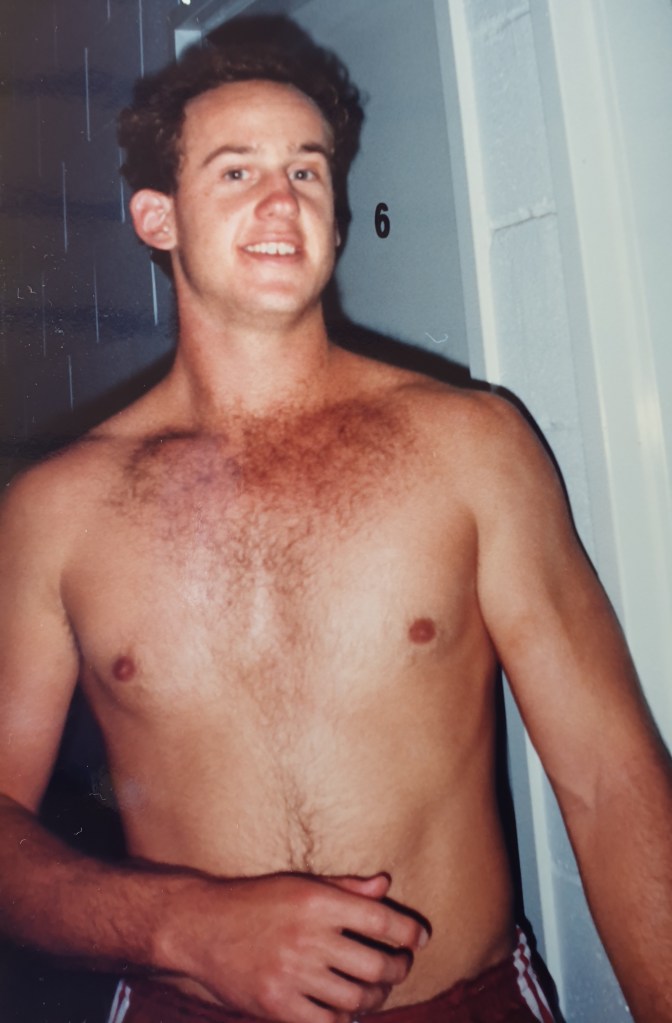
His words hit me in the gut. I explained that I did not have a lot on my plate because my appetite had not recovered after having Ross River Fever the year before (the photograph above was taken a couple of months after I had ‘Ross River’), and I explained that I had caught just about every bug that was going around since, even giardia which is normally only caught by immunocompromised patients.
After he left the smorgasbord table, I piled more onto my plate and over-eating became habitualised.
When I was 18 I had visible abs and I could lift 200kg in a deadlift. I wanted to compete at the university games in power lifting but did not have the money to travel, but when I saw the results I was lifting more in training than the winner of the 89kg class which I would have competed in.
I was also considered one of the most talented young rugby league players in my home town – a place known to unearth a few stars.
That was the only period in my life that I felt my brother was proud of me… sometimes. We went out together a couple of times when I was an undergraduate and often people pulled us up and said we had to be brothers, to which my brother would say “yeah twins, he’s Arnie and I’m Danny Devito”.
Now he was disappointed that I did not have that same persona, that I had broken free of how many people saw me from my upbringing in my home town. He told me that he would have done anything to have the talent I had at rugby league, yet I wasted it by ceasing to play while I began studying towards a PhD.
But, as the years went by, I gradually realised that his disappointment in me went even deeper, and he also saw me differently, because I was in love with a woman of colour, an Asian woman. I believe my whole family did.
I had been brainwashed with the family mantra that our life was all about the farm. As I explained in “How Farmers Lose Perspective“, it had become my family’s reality that the farm was more important than the family itself, certainly more important than any one member of the family, and all of our resources should go towards our common cause of keeping the farm.
When I did not return to the farm, I had a great deal of difficulty in letting go of the guilt that I was not using my resources for the highest family priority of keeping the farm. Being a postgraduate student with no scholarship, I worked some part time jobs to help my future wife and I get by, but we were just subsisting, while I was deeply committed to my research which was going so well that I was quickly on my way to becoming a leader in my field.
My sister, having completed university, was now back at home earning an income. I was resentful that she was earning an income and not sharing it with Mum and Dad so that they could survive while still on the farm. It was also my guilt driving me to think of ways for them to be better off while I was not working on the farm. I told my sister of my disappointment in her and we had a huge argument, me telling her that she was selfish.
How deluded was I?
Still that was how things were in our family, in reality.
On the back of 2 years of researching towards a PhD without any stipend I was successful in a grant proposal which provided me with a scholarship. A year later I proposed to the love of my life to become my wife. We had a short engagement.
Not only did we refuse a contribution from my parents towards the costs of our wedding, or for them to pay for an engagement party, as my siblings had had, I insisted on paying them back more money in addition to other money that I had given to repay them for helping me to get through the final 2 years of my undergraduate degree.
Moreover, soon after, when I was informed that things were especially tight, I insisted on lending Mum and Dad money, the same money we had earlier lent to my sister and her family to fly to America to participate in the first meeting of a group of children with a rare and newly described genetic disorder which my beautiful niece had just been diagnosed with. When Mum and Dad tried to repay that money I refused to accept it.
My beautiful, caring wife never once voiced objection to any of this, even though the disparity between our two families could not have been more stark.
I will always be proud that we were able to help my sister’s family in their moment of need.
But how deluded was I to feel so deeply indebted that I needed to pay all of this money back to my parents when I had seen so many helped much more by their parents, when they did not work every holidays from daylight to dark, 7 days a week, and had worked as hard as a man from early teens.
It was the first money that my wife and I managed to save, and we could have used to set up for our own family.
Oh guilt…
Worse still, when I sort for my family to at least acknowledge my hard work towards their cause, they laughed off my contribution to working hard on the farm, out of their own guilt or something. I had continued to respond to their annual request to come home and work for a month in the busiest period, leaving my wife and my research, into my mid-20’s. And the year I finally declined their request and told them I needed to concentrate on getting my PhD finished, well that was extremely difficult. I wished they had resisted the urge to ask and not forced me to into the position of having to say no to them.
Things went on in a tense and awkward manner. In relaying a story of grievance to extended family an ‘in-law’ called a shop assistant an “Asian-bitch” which deeply hurt my wife and I. Suddenly we were the trouble makers, however, for letting it be known that it was offensive. It was followed by the obligatory conversation over whether that really was a racist thing to say!
That night I received the most emotionless hug I have ever experienced in my life which let me know that my connection with all of my family will never be as close again, or as close as I had deluded myself to believe it once was.
So then, inevitably, something happened so that I became totally estranged from my brother and sister, which obviously had the effect of pushing me out of my family.
Suddenly I was the one who was only concerned with money…
My brother did not even acknowledge the birth of my second son with flowers or in any way.
Things can be bad, but when you cannot bring yourself to acknowledge the birth of a family member, your nephew, then I don’t think there is any hope left.
We continued to send gifts to our 5 nieces for Christmas and their birthdays, my sister reciprocating, and my brother not.
After one Christmas my mother said that she did not know why I even bothered, which I took as an indication, from somebody who had observed how our gifts were treated, at least to my brother’s daughters, that it was utterly pointless.
So I phoned my sister and said we had considered everything and thought that it was probably best if we stop exchanging gifts for our children since neither side knows us.
Her response struck me the moment I heard it: In an even and calm tone she said, “I respect your decision”.
And there it was… “respect”… I felt like crying… one of my siblings, my big sister, respects me…
I have a PhD. I am considered a global expert in my field. I am a husband and a father. I am liked by many for being a decent and good human being.
But I never had the respect of my older siblings.
For the youngest sibling, the desire to be respected and loved is enormous. It is embedded deep in our psyche because it drives our behaviours from our earliest moments of life.
Conversely, the power to withhold that respect is the greatest power that older siblings will ever have over their younger siblings.
A little brother literally craves the acceptance of his big brother as much as depleted lungs crave oxygen.
That is one of the strongest themes that I observed in Harry’s narrative of his life. He knows it’s there, surely, but I suspect he does not yet fully understand the depth of it.
If only “Willy” could understand that enough for it to pierce his armour, layered with his ‘British’ fear of vulnerability, his experience of the events that shaped his life, and his desire to protect himself from hurt. I will also say this, with only judgment of my own in-laws not Harry’s, “Willy” will be aided enormously if his greatest support were able to do likewise.
If only “Willy” could really mean it when he says that he “respects” Harry… Then there might actually be hope, for both of them…
I have to admit that I am not a ‘royal watcher’ by any measure. I could not be bothered with such ridiculous soap operas, and I understand the complicity involved in actively engaging in the gossip. Almost all of what I read was new to me.
Perhaps one of the longest-lasting memories of reading “Spare” will be how we all absorb this stuff, however, even those who say they are uninterested by it, and that became apparent to me through many channels, especially reading social media, in the intensity of views towards Harry and Meghan held by so very many.
My observations from these interactions is that while ‘idle gossip’ was beneath all, especially about such ‘unworthy and privileged’ people, most emotion surrounded transference about what is appropriate to discuss publicly from and about personal family relationships.
This is a point I am sensitive to because, like Harry, I have shared much about my own upbringing and thus about the relationships that were most important to me when young.
I have occasionally shared stories with my sons and wife, sometimes sanitised to reduce hurt to them, less sanitised nowadays. Until recently, however, I had not explained to my youngest son the depths of my anguish about my upbringing as I had done at a similar age with my eldest son.
I needed to explain how it felt as a 15-year-old to edge down a dark veranda, my terrified mother nudging me along and shielding behind me, and then into an even darker room, alone, to take my father’s pistol from his hands to stop him from ending his life if not first the life of everyone else in my family that was present that night (As I discussed in “How Farmers Lose Perspective” and “For The Sons Of Deeply Insure Men” amongst others).
I did not want to take the chance that his curiosity might cause my very intelligent and inquisitive son to look through my blog and read what happened without my guidance or without an opportunity to discuss any issues or questions it raised for him.
I believe that sharing this pain gives my sons a little of the experience, to learn the lessons from it, without suffering the trauma first hand. Moreover, it explains why I am the father I am – telling them constantly that I love them, frequently rubbing their arms and back, speaking to them gently, and always showing my emotions as openly as I can manage – even though this is the polar opposite to how I was raised.
It cut through for both of them to understand the importance of being brave and to show vulnerabity when it is appropriate and safe.
We spoke about why I chose to talk about it with him now.
I also told him that I had long planned to speak openly about my experiences in the hope that I might help other young men come to terms with similar upbringings and experiences, and I also said that I hoped it might help fathers to stop and think before they lose perspective on what should be the most important priority in their life…
Family.
(For those who do not understand that irony in the objections of many who talk about how Harry was disloyal to his family, yet miss the point that his greatest hurt is that others did not place their family as the highest priority in their lives, and objected to him then prioritising his own family with Meghan, then that just highlights the extreme degree of tainting by poisonous drippings from the soap opera, a real life Truman show.)
I told my son that at first I intended to write in detail about my upbringing after my father’s death, to not embarrass him, but then I realised that would be disrespectful, dishonest and dishonourable. I decided that I should write now in the knowledge that he may read anything or indeed everything that I wrote.
Unlike Harry, my words are not written for his benefit, though, because so very much time has passed that I know that none of it will make one iota of difference in my family.
Although I literally saved my family, I was cast out and I became the lightning rod for all that was wrong with the family and each of my sibling’s lives.
I have come to accept that has much to do with racism.
I believe Harry still carries the unresolved trauma of a man that hopes that he will somehow earn the right to feel the love and respect of his male mentors, while he knows deep in his heart – as it was for me, so deep that it hurt to acknowledge and then accept it – that is unlikely to ever be his lived experience.
Ultimately what I said to my sons is that all of this is simple – if we are all good human beings, good to each other and especially those we love, then we should not be afraid of any truthful account of our actions, and if there are things of which we are embarrassed, then we should have the decency, love and respect for ourselves and others to acknowledge these and seek to make good with those who were affected.
It’s really not that difficult to understand, and it has nothing to do with loyalty or absence of it.
As a final point, I held this back to post on R U OK? Day 2023 because I wanted to briefly touch on something extremely important.
Confusion, unsurprisingly, was one of the strongest emotions that remained with me after that terrible night when I was 15. I was confused, however, not just about the actions of my parents and especially my father, but my own. Actually it was my inaction that confused me. Why did I not react initially knowing that my father had gone into his room when I knew exactly what he would be doing there? Then after I had gone into his room and taken the pistol from him, and my parents were in the living room fighting, my father surging to go past my mother to take the gun back from me while she kept punching him to stop his advance, why did I just stand there crying holding the gun limply in my hand as if it were there for him to take back if he chose to?
It was not until my brother came up from the shower room that he took decisive action to take the gun away.
The truth is that through discipline and culture in our family I had come to accept that my life was at the control of my parents, and if my father should choose to take it from me, since he had conceived me, that was his prerogative. I felt I had no rights.
This was brought home to me when I saw my sons for the first time, each both around 5 to 6 weeks post-conception during an ultrasound of their mother’s womb. As soon as I saw them and saw their flickering heartbeats I had the overwhelming sense that already my sons have rights! I want to emphasise that – from the moment we knew of their existence, they had rights as human beings!
(Yes, the reader can read into this statement that I have very mixed feelings about abortion, but I do understand also that reproductive rights are a vexed and nuanced topic that is not advanced by extreme views.)
This is something that I have stressed to my boys all of their lives.
We owe our parents much, but not our lives.
Tragically every year in Australia there are still men who make the statement that they control their family’s lives, their children and their partner. Often it is their final statement, resulting in heart-breaking catastrophe.
The work of freeing men from the harmful chains of masculine pride will be long but incredibly rewarding for humanity, none more so than for boys and young men…
Gained value from these words and ideas? Consider supporting my work at GoFundMe
© Copyright Brett Edgerton 2023
 MacroEdgo
You must be logged in to post a comment.