Preface: I wrote this article while overseas when I left the country two days after the failed Referendum. In saying that I am well aware of my privilege in being able to escape the issues that lie behind the failed Referendum, not only in being fortunate enough to afford to travel, but also in not carrying intergenerational trauma from Australia’s racist history extending into modern reality which left the great majority of First Nations Australians in despair.
This article has been sitting in ‘drafts’ since that time while I wondered whether I should even release it.
The events stemming from the NRL opening round, including Jonathan Thurston’s emotional allyship of Ezra Mam who was deeply impacted through retraumatisation from a typical racist slur, has convinced me that I should publish it.
I did not change a word from how I left the article over 4 months ago.
Instead I say here in this brief preface that I believe that Ezra’s and JT’s strong reaction is in part a response to the still raw feelings of rejection that almost all First Nations Australians felt as the results of the Referendum rolled in, and it just underlies the points I make in this article.
We need to recognise this. We failed First Nations people in the Referendum, and that leaves question marks over our nation and us that will never be right until we have the courage to face them honestly.
(I intended to release this 13 March. Even though this is not at all critical of Billy, I opted to hold it back a few days. My thoughts are with he, Nicole and their families.)
This is a post that starts out about rugby league, but blossoms out to a much broader conversation which is so necessary post-referendum. Please consider.
In my YouTube video “Alter Edgo’s TED talk with Billy the Woke Kid and JT’ abone“, my racist alter ego – Alter Edgo – not as much a character I developed as a version of myself I would have much more closely resembled had I dropped out of university at the age of 17, gets to the heart of issues that the Queensland State of Origin teams will need to address if their success is to continue.
The key question is this: will a team that prides itself on fighting for everything until the death for the pride of Queenslanders continue to feel the same way when many in that team will feel that the Queensland people, whose non-First Nations people voted in the greatest proportions against constitutional recognition and voice to First Nations people, did not reciprocate in kind and ‘show up’ and fight for them?
In that TED Talk special, where JT’s character is a teddy bear dressed in a Cowboys jersey, obviously modelled on Johnathan Thurston, and Billy (the woke kid) Slater is a stuffed toy elephant with maroon shirt and beanie, both voiced over by me, Alter tells JT that he has his back because when First Nations players have a maroons jersey on, they’re HIS abbos.
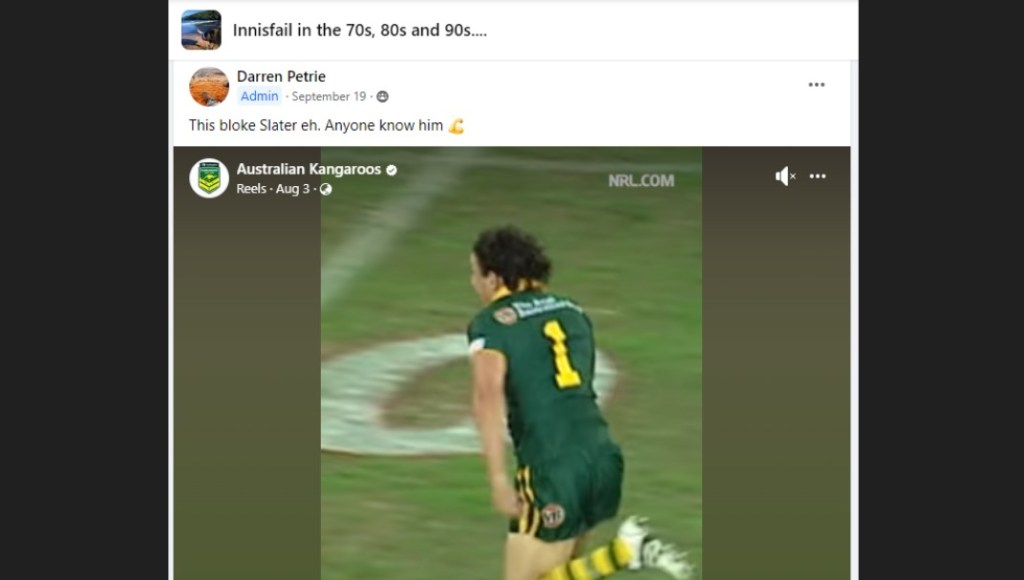
This was intentionally written to be jarring and confronting because that is the reality of racism which I was exposed to and learned in my formative years growing up in the township of Innisfail which claims the Queensland men’s SOO coach Billy Slater as their own, and even gave him a ticket tape parade after scoring a try in a 90’s SOO game, and where the Tabone family is also well known for developing a crocodile farm which after many years, and many photos of Mick Tabone sitting atop his mate Gregory, a giant reptile, was sold to Louis Vuitton.
My learning racism started early, even before I learned to say the “N word” in rhymes in the playgrounds, or when I was teased from 6 years of age for sitting next to a First Nations child in my Year 2 school photograph.
That special episode from the first series of “Alter Edgo and His Bloody Woke Kid” was inspired by insights given by a First Nations elder on the local radio station 4KZ many years ago when he talked about his confusion and trauma as a young man at being the hero of the town on Sunday after playing a pivotal role in a great rugby league victory, either for his club or for the whole town in the Foley Shield, even being shouted drinks by the white men of Innisfail and surrounds in their own intoxication from alcohol and high on the win, but then on Monday once again being a “no-hoper abbo” up town and ignored by the very same people.
I suspected that attitudes had not changed much in Queensland from my early years. And I felt it would be intellectually dishonest if the discourse around the referendum did not reflect these truths. Equally I knew that if the targets of that racism were forthright about it in the lead up to the referendum, then there would be a backlash – involving all the usual tropes around angry black people especially men – that would lessen the message and potentially impact the outcome.
So I took the job on myself – a white, middle-aged man raised in the privilege of a colonial family deeply ensconced in the sugar industry of North Queensland, raised on the property my Great Grandfather owned from around 30 years after the rainforest MaMu-speaking people were driven from their lands.
I did so willingly and in full knowledge that it would probably be the final straw that estranged me fully from my family, a process that began over 30 years earlier when I fell in love with a woman of colour who migrated from Asia as a small girl. Though undoubtedly loved, now along with our sons, my family’s connection with her and ultimately with me was never strong enough to overcome the deep-seated racism that runs through our familial and societal culture so that their need to connect with others in the community I left was more important than their connection with me and my family.
When I was 17 and in my first year away at uni I developed a crush on an older college friend. I asked if it would be okay if I (fell in love with and) brought home this First Nation’s girl, and the response was devastating but unsurprising: “Obviously, we would prefer it if you didn’t”.
I never allowed it into my foreconscious, but I always feared – and deep down knew – that the girl I did fall in love with and bring home was only more ‘preferable’ in their eyes.
But I digress because while it was a little about me and us, it was always about the big picture. I know that people learn best when they can relate so I hoped that my experiences and those of my family might open just a few eyes. In the early days of the Yes campaign – when I wrote to First Nations friends explaining my intentions and hoping for their support, which I was gratified to receive – I dared to hope Alter Edgo might help secure a victory for the Yes. However, I knew mostly this is a process with a very long lead time.
And so it must go on now, irrespective of the referendum which revealed our greatest anxieties.
We must look forward and to do that I feel I am about to go out on a limb and say something potentially controversial, but that’s what I do and it’s why I will always be an ‘outsider’.
It will jar with key Yes allies who argue so strongly for stories of trauma from racism being centred on black or otherwise minoritised peoples because their stories are under-represented as another consequence of the racism that has caused that trauma.
I understand that entirely, but there is a really big BUT and it should be obvious to everyone.
The answer is above and in my video series and some other specifics of my background and life circumstances. However, firstly I must explain that I understand it is absolutely imperative that I differentiate my argument from an instance of “all stories matter”.
About the only criticism of the Yes campaign that holds any credibility for me is the “preaching to the choir” mantra. And now in the post referendum washup we have First Nations leaders talking about the real issue – racism – in a manner they could not during the campaign after we saw a taste of that ridiculousness in the discussion over Prof. Marcia Langton’s comments.
My videos were unapologetically directed straight into the racist den that I knew so well in my upbringing and I put whatever privilege I had in my home community on the line to authentically show the truth of the racism I was taught growing up there and what have been the consequences of that racism on my families – the one I was born into and the one I created with my beautiful wife – and thus on communities and me, personally.
I knew that for very many non-First Nations people who were raised in the culture in which I was raised, with hushed conversations in the main street of town about Aboriginal “advantage” when their disadvantage was patently around us, and listening always to the racist anthem “Livin’ Next Door To Alan”, and when in recent years I had a story repeated multiple times with righteous indignation about how they with others had objected so forcefully to the commencement of a meeting with acknowledgement to country that the speaker was made to cry, it would be too big a leap to show empathy and compassion to First Nations people and Vote Yes without having their eyes opened some way to truth and to acknowledging past wrongs.
I felt that the only chance of reaching some, in full knowledge that many never will be capable of that personal growth and decency, was to make the consequences of racism relatable to them, and that is why I spoke up so strongly willing to expend whatever remaining ‘social capital’ I still retained from being born into one of the best known pioneering and colonialist families in the town.
Now I can’t even offer any anecdotes, and I certainly have no capacity to search for evidence of a measurable impact from my campaign through polling booth analyses, which will struggle to disentangle proportions of First Nations people’s votes in any case, and ultimately I have to admit that I did not have a lot of social capital left in any case since I went to university in my late teens and had little contact with the township from my mid 20’s when I finished studying for my PhD in nearby Townsville and then especially as connection with my family broke in large part because of racism.
Sadly in the electorate of Kennedy along with the other north Queensland electorates south of Cairns the Yes vote was a measly 19%, which, allowing for above average representation of First Nations people who have been shown to have voted overwhelmingly Yes, means that certainly less than 1 in 6 and perhaps less than 1 in 7 non-First Nations people voted Yes.
Surely you see the issue for the Queensland SOO teams?
But I digress again, or do I? Because there’s another middle-aged, white man whose contact with Innisfail reduced through life circumstances similarly to mine but whose social capital is out the wazzoo, in technical terms – I have a feeling you might know his name. And most towns have similar heroes.
I totally get the immense pride and desire of having wonderful First Nations sporting heroes such as Johnathan Thurston and Cathy Freeman headlining the promotion of this important reform for First Nations people. That was absolutely the way it should be.
But I do consider it a mistake to centre the official campaign only on these First Nations heroes if the aim of the Yes campaign was to win by maximising their chances of speaking intimately and honestly with the majority of Australians.
Moreover, we all knew racism was a huge factor, and if there was to be success – especially in the absence of the bipartisan support which would have acted to quell somewhat the conservative racist element – then a more realistic strategy to counter the formidable racist undertow was vital.
Given that white people turn off to discussions of racism when it is black and otherwise minoritised people speaking their truth, even though it is not the ideal we all want for the future, it was always necessary that strongly allied white Australians carried the torch on that one, as I did.
A group of very high profile white Australians – heroes to the nation and in their communities – should have been formed and have been central to the campaign to reflect that truth of underlying racism back on white Australians, which would have had the added benefit of informing newer migrants of that patent truth.
Now I have zero idea whether Innisfail’s Billy Slater would have agreed to be a part of such a group. I have no idea, really, whether he would say the words I wrote in the script for Billy the woke kid for Alter Edgo’s TED Talk special, but I do know this: If Billy authentically followed the Ubuntu philosophy which formed the basis of the cohesive Queensland men’s SOO winning culture, then he absolutely would have and what’s more he would have stood strongly on the side of right – Yes – in the referendum. He would have even used his enormous political capital in our shared home community and spoken truth to community that in massive proportions remains resistant to hearing it.
Would it have been enough to sway the referendum. I don’t know. Nobody does because these strategies are as much about timing and momentum as anything else. It would have been more difficult for the No campaign to tear them down, however, especially if they were in large numbers.
These questions around authenticity of allies and loyalty to a disloyal public are the questions that the Queensland SOO teams – especially the First Nations players – will be asking themselves until the next series when we will all will get our first indications of what was the result of those deliberations.
The implications of this question are far-wider reaching than rugby league, however.
I believe that this is a moment where all Australians working to create anti-racist and inclusive culture must think very deeply on what are the messages in the referendum for them.
It would be a great pity if they failed to see they need to centre more real allies in this work so that relatability to those we need to convince is enhanced, and I feel I must say, if their trauma leads to trust difficulties, then it is my solemn wish that watching “Alter Edgo Finale: Exclusion” might help to bridge those feelings.
And the recently released video by Arnold Schwarzenegger, where he strongly speaks out against his own father who was a Nazi, should also be taken as a support of this contention on the direction we must take if we really want to have a world free from hate and prejudice.
Racism, prejudice and hate lessens and hurts all of us, that is the simple truth.
We on the right side of history, who understand that humanity’s true nature is always desirous of true progress even when change can at first appear daunting, need to stop imitating the other side who stir up those anxieties only to protect their privilege in perpetuity.
We cannot fall into the trap of creating our own echo chambers for ours is the voice of reason and love, and we must sing loudly, clearly and widely so we echo through the gorges and canyons, welcoming it’s bouncing off walls, and carrying on through the ages. We will continually weaken the barriers of those gathered together in the long but very narrow echo chambers where the wily but weak try to shepherd the fearful into that backsliding on progress.
We must not choir to a few, but encourage all to sing freely so that our choir grows broader, surer and evermore welcoming.
Next June, being a lifelong rugby league fan and ardent Queensland supporter, I will be observing closely to see just how woke is Billy the kid, and for indications on whether he was able to look the young Queensland men – and especially the First Nations men like baby-faced and freakishly talented Selwyn Cobbo – in their eyes in a way that is possible only if he is truly authentic and a real ally, or whether like for so many others that allyship is entirely contextual as it was for Alter Edgo before his woke kid convinced him to start out on the path towards being a better version of himself. Whether Billy, too, has learned and risen above the hometown throng who adore him and have taken him in so close to their hearts yet whose hearts remain firmly closed to others with whom they have shared their whole lives – or co-existence? – through good times, triumphs and loss, simply because they were born blak.
Gained value from these words and ideas? Consider supporting my work by contacting me on LinkedIn.
© Copyright Brett Edgerton 2024
 MacroEdgo
You must be logged in to post a comment.