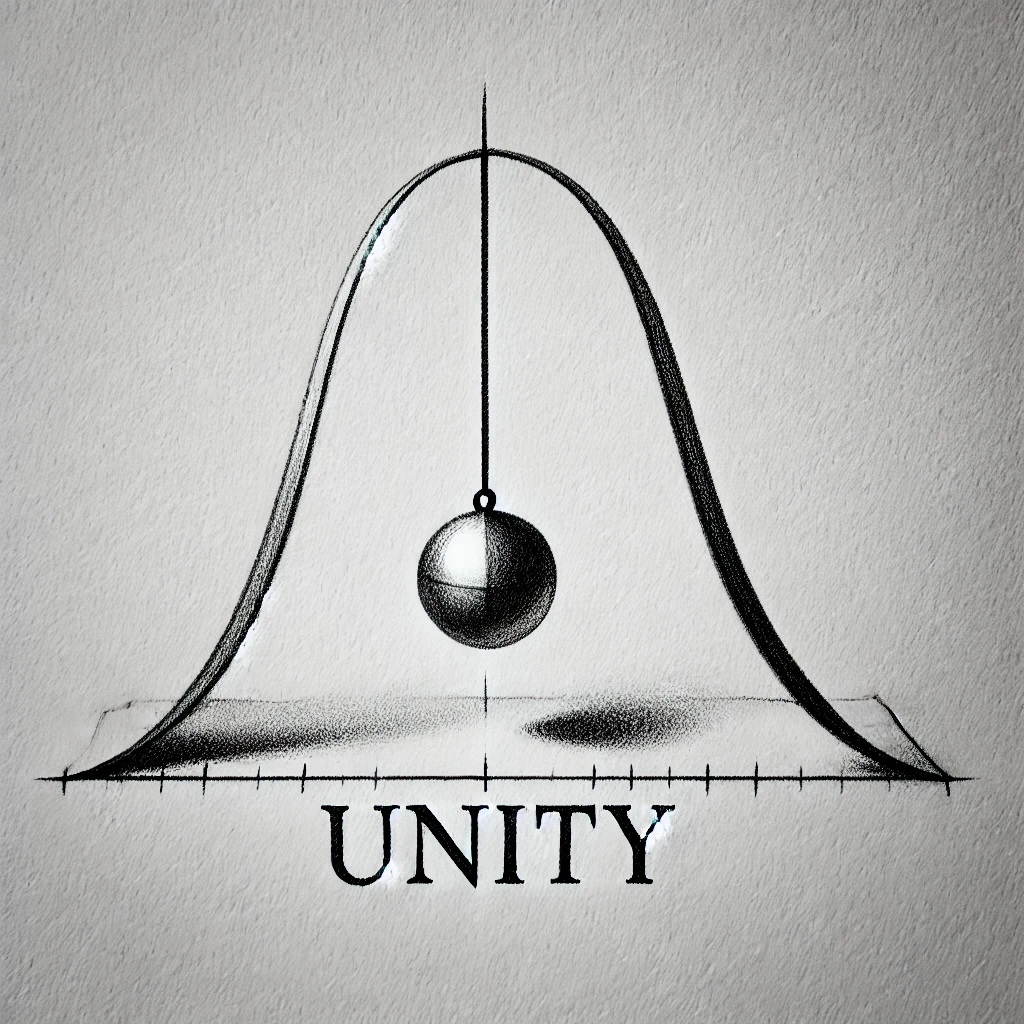
In “The Unity Bell” I discussed how the forced grading of employees’ work performance into a normal distribution bell curve to reward and punish the few deemed by their managers at either end of the distribution is well known to demoralise the majority thereby worsening productivity instead of improving it.
Moreover, I stated that a very obvious implementation of the bell curve within organisations to actually improve productivity is to apply it retrospectively to the tasks that each employee does to eliminate the many ‘just in case’ tasks required of them that have caused high levels of burnout through overwork and demorilisation as they know that these tasks – many of which would also fit the definition for ‘bullshit jobs’ as described by David Graeber – do not add value to the ‘bottom line’ or mission statement/vision of the organisation.
I discussed the reasons for the proliferation of ‘just in case’ and bullshit jobs through this long period of increasingly Extreme capitalism in “The Unity Bell” and also “If Quiet Quitting Results In Reduced Productivity – A Big ‘IF’ – Then It Was Production That Was Never Paid For” as well as through much of my writing relating to the Great Reset.
‘Just in case’ and bullshit tasks are created by self-interested managers intent on using the resources available to them to ‘win’ status by advancing in their careers and attaining other status rewards including remuneration. The implementation of a ‘Unity Bell’ and other bottom up feedback channels are resisted in many organisations, or when implemented are usually perfunctory and ineffective, because they run counter to the top down direction of power and authority in Extreme capitalism.
Through these past five decades of increasingly Extreme capitalism the drive for worker efficiency has been relentless with nowadays most organisations remaining in an almost perpetual state of restructure and head count reductions. It has been collectively assumed by executives that their top down drive for efficiency will force that prioritising of tasks so that pointless or low return ones are eliminated as employees have already been pushed to their limits on how much work they can perform. However, as I discussed in “Reset” Chapter 4: “A future of our own making“, the experience of the past few decades has been that workers have been the pressure valve that has had no choice but to absorb more and more pressure as they are squeezed between the top down drive for efficiency from executives and the upward drive of aspirational bosses. Consequently, the actual number of tasks performed are little reduced even as employee numbers are reduced.
Consequently, real productivity is little improved but worker burnout has gone through the roof.
Workers are effectively treated like machines and are noticing – especially with the pause for reflection that occurred during the COVID-19 pandemic – that the meagre rewards on offer come with significant costs to wellbeing living in this system of increasingly Extreme capitalism.
This is the basis for my thesis that we have entered a new paradigm, which I refer to as ‘The Great Reset’, whereby many are re-evaluating what it is that is truly important to them in their lives.
This push back by employees is creating tension within organisations where executives and/or their boards refute the desirability of adopting a more compassionate and balanced work culture. There is a gap opening up with more progressive organisations driving change such as fully flexible working conditions and reduced work hours including moving to a routine 4 day work week at the same remuneration after being stubbornly stuck at a 5 day work week for almost 100 years.
Implementing a’Unity Bell’ involves a systematic process to prioritise actual work tasks completed in a manner where all are accountable to eliminating ‘just in case’ and bullshit tasks so that all effort goes towards tasks benefitting bottom line organisational goals.
Whether explicitly outlined or not, prioritisation of work tasks is the essential process implemented in organisations that authentically seek to drive efficiency through reducing work hours.
I chose to name this process the ‘Unity Bell’ as a pointer that it is a process to create unity and team work to improve productivity in contrast to the division and competition created by applying a bell curve to perceived employee performance in a harmful and self-defeating manner.
Herein I give a high level outline on how the ‘Unity Bell’ can be implemented in all organisations.
In Extreme capitalism the link between worker tasks and bottom line outcomes of the organisation are corrupted by self-interest of those who have immediate control of those labour and other resources. Of course the degree of this (mostly) legalised but highly inefficient corruption is dependent on the nature of the workplace – likely far more common in white collar settings – and in the overall culture of the organisation.
This corruption produces a positive skew to the tasks performed by the average worker in an organisation where the typical few tasks performed which adds very significant value for the organisations bottom line or mission statement/goals are dwarfed by the very many tasks that are unlikely to add very much real value if any (Figure 1).

In especially inefficient or toxic workplaces this large right tail to the distribution comprising of tasks unlikely to add real value to the organisation requires workers to consistently work beyond their normal and legislated reasonable work hours (Figure 2).

Being required to consistently work unreasonably long hours is damaging to wellbeing even when fully engaged within the role and the vision of the organisation, but knowing that that extra work is essentially pointless is especially damaging to wellbeing.
It is in this long thick tail where employees’ wellbeing is seriously harmed. They first lose their ability to clearly see how they can improve efficiency in their role – in all of their tasks including the critical ones that do actually add real value – and have no bandwidth left to bring about change even if through the cognitive fog they manage to recognise potential improvements. They then develop a sense of helplessness and go into survival mode feeling utterly and continually fatigued.
They have been burnt out.
Implementing the ‘Unity Bell’ process requires ordering on a retrospective basis those tasks that were performed in order of those that created most value to the organisation through to those that created the least thereby allowing workers and managers to work together to cull and minimise the low reward tasks.
Tasks are recorded in real time by an employee in a diary with the amount of time spent on each task and who initiated the task, along with the employee’s immediate assessment on the likely impact of the work (an assessment on likelihood that the work will find it’s way to the bottom line of the organisation and how much potential impact it will have). There is another column for outcome assessment if the outcome is soon apparent. Work that was dropped through change of mind or drafting out, etc, would most often have a near zero impact.
Note that this can be a personal diary as employees can feel insecure about being specific about exactly how much time they spend on particular tasks which is natural especially with the threat of AI hanging over (almost) everyone these days. The data should be collated in relative terms, i.e. in percentages, such as “this week I worked 43 hours in total and 10% of my time was devoted to X which I assessed had a likely impact of very high” – with 100% of their time accounted for and presented in tabulated form. The detail required should be, in their confidential diaries, down to the 6 minute segment as for professional billings to provide sufficient granularity. This would force, for example, an assessment of how much value was added in tasks that consist of many small repeated subtasks, such as reading and addressing emails, where the entry might be “reading emails – low impact (all largely irrelevant)” which if a common entry would point to a need to improve communication standards.
The manager would have a chance to record their own assessment of the likely impact of the work, which in some cases may carry higher credence if it relates to higher order strategy that the subordinate may not be privy to, but this should be rare as in well functioning teams the import of strategy and consequent work should be understood by all.
Over a month or more of ordering these tasks from highest (likely) impact to lowest these data will allow the filling out of a distribution curve which will reveal how much time was actually spent on high, medium and low impact work and where, how and why low impact work is being generated so that it can be eliminated.
What will be found is that once low impact work is peeled back and employees feel engaged and empowered to contribute to improved efficiency and productivity, that space will provide them with extra bandwidth in a virtuous cycle of improving efficiency.
Instead of the distribution curve of tasks having the fat right tail simply cut off, what will happen is that this virtuous cycle of improving efficiency will push the distribution of tasks into a true normal distribution bell-shaped curve where the great majority of tasks are flowing significantly through to the bottom line outcomes for the organisation. It will enable significant reduction in work hours – allowing a reduction in work days to a 4 day work week – with at least equivalent work output at likely a higher quality level ensuring that remuneration is maintained on the same trajectory. And, critically, that thin right tail will not consist of low likelihood of low impact work – it will consist of ‘moonshots’ – ideas that are unlikely to work out but will have a hugely positive impact if they do (Figure 3).

It is these creative moonshot ideas, that are unlikely to ever be replicated by AI, that bring real value to organisations and turn them from ordinary into extraordinary.
The cohesive and collegial work culture will improve employee wellbeing and produce significant additional benefits flowing through to the bottom line organisational goals through greater employee retention and engagement producing a win-win-win situation for all stakeholders.
Gained value from these words and ideas? Consider supporting my work by contacting me on LinkedIn.
© Copyright Brett Edgerton 2024
 MacroEdgo
You must be logged in to post a comment.