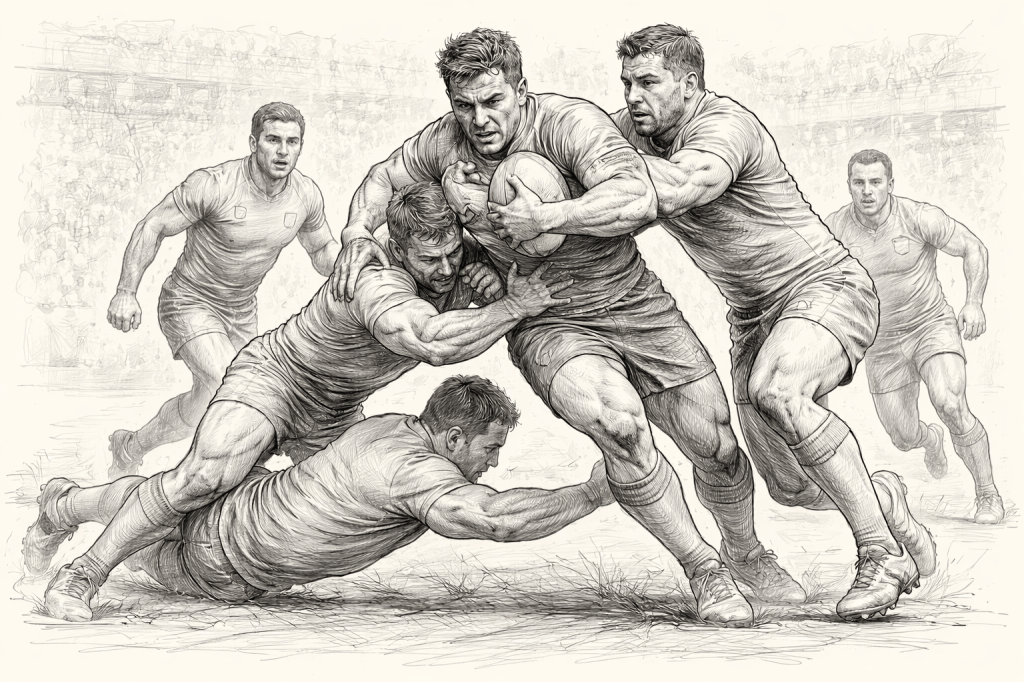
Just imagine watching the 2035 NRL grand final beamed live from Las Vegas.
Gone from NRL games are boring things like post-try conversions, penalty goals or field goals.
It was once believed the breaks in play created by these, which allowed commercials to be shown during broadcasts, kept them safe from the incessant bastardisation of the game which accelerated in the 20’s under Peter V’Landys*, the horse-racing executive who also ran the NRL (as Chairman of the ARLC board and is considered by many the most powerful person in Australian sport due to links with the wagering and entertainment industries).
That was wrong.
No, breaks for advertising and gambling were fostered by another ‘innovation’ discussed below.
The introduction of the scoring team kicks off rule in the 2026 season was the final straw holding back the pretense that the NRL game is a tactical balance between offense and defense.
A little like how nobody really goes to see a T20 game to see bowlers do well – fans just want to see sixes and lots of them. The bowler is just the person who lollies the ball up for the batter to smack over the fence into the roaring crowd! The lack of skill by their athletes to play multiple innings over multiple days saw the actual game of cricket die years earlier.
So too with Rugby League.
According to V’Landys, ‘fans’ just want to see all out attack (offense) and tries, and lots of them. Defense is seen as just an unfortunate legacy from Rugby League that has only one role in the NRL – to extract from an offensive team a more exciting or flashier try, such as a winger leaping above defenders to catch a crossfield bomb or an athlete sprinting the length of the field off a quick tap before defenders managed to get onside.
That 2026 rule change was to arrest a team’s offensive momentum – since offense was already so favoured over defense from earlier rule changes which continually sped up the game – to prevent boring one-sided score blowouts.
It turned games into a turn-about try-a-thon.
With tries being so common the other means of scoring points – from place kicks and drop goals – became trivial, and given they were also of lower entertainment value, they were finally eliminated in the late 20’s.
At the same time it was agreed that not all tries are equal.
It was argued that a front rower crashing over after one pass off the dummy half was not as exciting as seeing a winger outsprinting the opposition on the outside over the length of the field to score. Since anything of low entertainment value was to be discouraged, it was immediately understood that there needed to be a way of differentiating between tries so that points awarded for each try was related to its entertainment value thereby incentivising teams to score more exciting and entertaining tries.
But how to that?
Follow the money, of course!
This is where synergies between its various commercial interests were unlocked for an incredible commercial boon to the NRL.
Through real time betting flows on the officially-aligned wagering apps the number of points for each try is adjudicated, with 4 points awarded to the flashiest, most exciting tries down to just one point for the least exciting tries.
By the time the commercial stations return from ads to live coverage and/or the ex-player commentators have finished pontificating over replays of the try the actual points awarded are flashed across screens eliciting further excited howls from the crowds and punters.
Effectively the punters have become the judges and adjudicators, giving them the perception of having real input into the outcome of each game from their seat in the stands or their couches in their own homes.
Revenues soared especially through the NRL’s partnerships and profit-sharing with wagering app companies.
With such integrated and explicit involvement of the wagering industry formalised into the NRL, there really was only one place in the world where the GF could be hosted – Vegas baby!
Woohooo.
For the players there is now greater differentiation between those capable of providing entertainment moments through setting up highly coached and choreographed plays, mostly considered to be the playmakers in the ‘spine’, and the others being essentially the dumb muscle/power athletes around them who just need to be able to wrestle with opposing offenses and catch and pass. It’s the power athletes who are interchangeable commodities, capable of playing anywhere outside of the spine, and who have had their playing careers shortened by increased numbers of head knocks in the manic speed NRL.
The spine players receive most of the financial rewards from the commercialism of the NRL through their playing careers and often through entering the media afterwards. But there is never a shortage of dumb muscle power athletes** amongst the growing disadvantaged sectors of society keen to fill other positions for an opportunity to earn a lifetime of income over a professional playing career spanning around 5 years on average. Sometimes they even have enough left to cover some of their medical bills which begin to show up by the end of their careers and which leave many of them severely debilitated by their 40s.
In recent years the NRL’s innovation has raised its profile in North America where the simplified game strategy and rules have increased its followship dramatically.
The NRL really pulled off a coup for this year’s GF with Supreme Deputy Leader Vance in attendance. A 5 minute silence was held to acknowledge the greatness of Supreme Leader Trump who remains in the White House in a vegetative state of senility (which was acknowledged recently after not being seen in public since January 2033 during the third commemoration of “Trump 2 (infinity)” which is held 4 yearly – for some inexplicable reason – though renovations of the east and west wings done 10 years earlier were in preparation for this eventuality).
* From Gemini
The ownership and governance of the National Rugby League (NRL) have evolved from a fierce corporate battle into a centralized, independent structure.1 Today, the league is governed by the Australian Rugby League Commission (ARLC), but the influence of the Murdoch family (via News Corp) remains a significant part of its history and current landscape.
1. Current Ownership: The ARLC
Since 2012, the NRL has been owned and operated by the Australian Rugby League Commission (ARLC).2 This body was created to provide a single, independent point of governance for the entire sport in Australia.3+1
- Structure: The ARLC is a public company limited by guarantee. It acts as the “trustee” of the game.4
- Members: The “shareholders” or members of the Commission are the 17 NRL clubs, the NSW Rugby League (NSWRL), and the Queensland Rugby League (QRL).5
- Independence: The Commission is led by eight independent commissioners (currently chaired by Peter V’landys) who are theoretically not supposed to represent any specific club or interest group.6
2. The Murdoch Family & News Corp Links
The relationship between the NRL and the Murdoch family is deep-rooted, stemming from the “Super League War” of the mid-1990s.7
The Super League War (1995–1997)
In 1995, Rupert Murdoch’s News Limited (now News Corp Australia) attempted to buy the broadcasting rights for Rugby League to bolster his fledgling pay-TV service, Foxtel. When rebuffed by the existing governing body, News Limited formed its own breakaway competition called Super League.8 This split the sport in two for several years, nearly destroying it financially.
The NRL Partnership (1998–2012)
To heal the rift, the two rival competitions merged in 1998 to form the National Rugby League (NRL).9 For 14 years, the NRL was a 50/50 partnership between:
- The Australian Rugby League (ARL): The traditional governing body.
- News Limited (News Corp): Representing the Murdoch interests.
This gave the Murdochs a direct seat at the table in running the game until they agreed to exit the partnership in 2012 to allow for the creation of the independent ARLC.
Current News Corp Influence
While News Corp no longer “owns” the NRL, it retains massive influence through two primary channels:
- Broadcasting Rights: News Corp-owned Fox Sports (via Foxtel and Kayo) is the primary broadcast partner of the NRL. These multi-billion dollar deals are the lifeblood of the league’s revenue.
- Club Ownership: News Corp Australia remains the majority owner (approximately 68%) of the Brisbane Broncos, which is the league’s most commercially successful and only publicly listed club.10
3. Summary of Club Ownership Models
While the ARLC governs the league, the 17 individual clubs have diverse ownership structures:
| Ownership Type | Examples |
| Private/Corporate | Brisbane Broncos (News Corp), Melbourne Storm (Private Syndicate), Manly Sea Eagles (Penn Family). |
| Member-Owned | South Sydney Rabbitohs (75% owned by Russell Crowe, James Packer, and Mike Cannon-Brookes; 25% by members). |
| Leagues Club-Owned | Penrith Panthers, Parramatta Eels, Canterbury Bulldogs (Owned by their respective licensed social clubs). |
What this means for you
Because News Corp is both a major broadcaster and a club owner, the “Murdoch link” is often a point of debate regarding potential conflicts of interest in how the game is scheduled or promoted in the media.
The power structure of the Australian Rugby League Commission (ARLC) is designed to balance the interests of the clubs with the need for independent, corporate-style governance. While the individual 17 clubs (and the state leagues) are the “shareholders,” the real power lies with the eight Independent Commissioners who act as a Board of Directors.
1. The Core Power Structure
The ARLC is a “company limited by guarantee.” This means there are no private owners profiting from the league; instead, revenue is reinvested into the game.
- The Shareholders (The Members): There are 19 members of the ARLC: the 17 NRL clubs, the NSWRL, and the QRL.
- The Board (The Commission): Eight commissioners who are meant to be independent of clubs and states. They make the final decisions on TV rights, rule changes, and expansion.
- The Executive: Led by the CEO (Andrew Abdo), who manages the day-to-day operations of the NRL under the Commission’s direction.
2. Key Figures and Corporate Links (2026)
The current board is heavily weighted toward individuals with deep ties to finance, law, and the racing industry.
| Name | Role | Primary Corporate/Professional Links |
| Peter V’landys AM | Chairman | Chief Executive of Racing NSW. Known as the most powerful figure in Australian sport, he maintains massive influence in the wagering and hospitality sectors. |
| Andrew Abdo | NRL CEO | Former Director at Deloitte. He focuses heavily on the commercial strategy and financial sustainability of the league. |
| Dr. Gary Weiss AM | Commissioner | Executive Director of Ariadne Australia. A prominent corporate raider and chairman/director of multiple companies (including Coast Entertainment and Estia Health). |
| Tony McGrath | Commissioner | Founder of McGrathNicol. A leading figure in corporate advisory and restructuring; former partner at KPMG. |
| Professor Megan Davis | Commissioner | Pro Vice-Chancellor at UNSW. An expert in constitutional law and Indigenous rights; a key architect of the Uluru Statement from the Heart. |
| Kate Jones | Commissioner | Former Queensland Cabinet Minister. Currently holds executive roles in the travel and tourism industry (formerly with Expedia/Wotif). |
| Hon. Peter Beattie AC | Commissioner | Former Premier of Queensland. Provides deep political connections and experience in major event procurement. |
| Wayne Pearce OAM | Commissioner | Former NRL legend and high-performance consultant. Represents the “footballing” perspective on an otherwise corporate board. |
| Alan Sullivan KC | Commissioner | One of Australia’s leading Barristers. Specializes in commercial litigation and sports law. |
3. Corporate Interests & Influence
The power structure is often criticized or praised based on its proximity to three major sectors:
- The Wagering Industry: Because Peter V’landys also runs Racing NSW, the NRL has developed extremely tight commercial ties with betting agencies (e.g., Sportsbet, Tabcorp). This is a primary revenue stream but a point of public debate.
- Media Giants: The Commission must constantly negotiate power with News Corp (Fox Sports/Daily Telegraph) and Nine Entertainment. While the Murdoch family no longer “owns” a share of the league, their control of the broadcast rights and ownership of the Brisbane Broncos gives them a “soft power” seat at every major table.
- Government Relations: With figures like Peter Beattie and Kate Jones, the ARLC is highly effective at lobbying state and federal governments for stadium funding and grants (most recently seen in the $600m+ deal for the PNG expansion).
Summary of Power
If you want to understand where a decision comes from, it almost always starts with V’landys (the political and commercial strategist) and is vetted by Weiss and McGrath (the financial heavyweights).
** This is obviously written to be provocative, but the sad reality is that these powerful young athletes, who consider themselves almost indestructible by virtue of their mental and physical conditioning to play in the NRL, are in reality extremely vulnerable to manipulation and exploitation by powerful commercial interests.
Gained value from these words and ideas? Consider supporting my work by contacting me on LinkedIn.
© Copyright Brett Edgerton 2026
 MacroEdgo
You must be logged in to post a comment.