No, She Won’t Be Alright Mate

OK, I have tried to be a “team player” and not be (seen to be) alarmist but it’s time to start YELLING (well talk sternly, anyhow).

It seems that I am not alone in feeling like this (actually, I have noticed that I am getting a regular reader from Switzerland, and I have noticed an echo of some key words that I have used, so hello if you are reading…)

This is Dr Tedros’, Director General of the WHO, tweet from earlier today:

Whether it is cognitive dissonance – the inability of people to come to terms with possible events that are just too frightening for them to be able to contemplate – or whether it is the dumbing down and distraction of society trying to live beyond its means under a weight of personal debt, or whether it really is an Australian “she’ll be right mate” laid back nature preventing people from waking up to the reality that confronts us, IT NEEDS TO END NOW!

Consider these 2 facts: Most countries’ worst case scenario in the COVID-19 pandemic is 70% of their population becoming infected; and yesterday Dr Tedros tweeted that for COVID-19 the case fatality rate (i.e. the proportion of people diagnosed who die) is 3.4%.

Unfortunately right now not even the experts (e.g. Prof Leung from the WHO collaborating laboratory in Hong Kong) can determine what is the actual mortality rate for COVID-19, but the best guess is that it is worse than bird flu but not as bad as the 1918 Spanish flu which had a mortality rate of 2-2.5%.

A mortality rate of 2.5% might not sound a lot, but if 70% of a population becomes infected then 1.75% of that population will die. That is about one in every 60 people, or over 400,000 contemporary Australians gone.

Case fatality rate estimates can vary significantly through an epidemic – for SARS it was initially estimated at 2% but it became 17%. Mortality rate is even harder to know because in this case many asymptomatic infections will not be detected.

Another issue that would be impolite to discuss, especially in Hong Kong, would be the confidence placed in the mainland China data which at this stage represents a very significant proportion of the dataset. I would suggest the number they are more likely to massage would be the mortality number attributed to COVID-19, which would have the effect of lowering the case fatality estimate and ultimately the mortality rate.

What is known is that we are dealing with a very serious pandemic.

I realise that many readers will immediately fall back on the cognitive dissonance and say that it won’t happen in Australia.

Why? Because you wish it won’t? Because it will be really bad?

Factor this into your thinking, too. As I said in my first comments on the pandemic, in “Social Cohesion: The Best Vaccine Against Crises“, we in Australia are in an especially precarious situation heading into a full winter season which favours transmission of respiratory viruses.

It is going to be a very, very difficult winter regardless of what happens hereon in Australia.

But if we go on to have 70% of our population become infected by the coronavirus that causes COVID-19, then it is going to be more bleak than Bill Murray’s character found Ground Hog Day in the famous movie when he realised that he could not escape it!

What will be the economic costs of that? And what will be the political ramifications?

So what’s the point of this other than to scare people.

Well let me suggest that we have a choice to make.

We can follow the path of South Korea where they have done the absolute best they could do by their citizens in the way that they have responded to the crisis. If they are lucky to have a respite as the weather warms, then they have a good chance of getting on top of the outbreak. They have tested an absolutely enormous number of people.

I won’t say the other path is Iran because that would never happen in a developed democracy, and we have made a much better start. But the US is not acquitting itself well. It bungled its tests and is starting from well behind the eight ball, even though its health officials are now allowed to test possible cases of community transmission which was precluded right up until the point that the first such patient died.

Morrison’s desire to minimise impacts on the economy is obviously forcing health bureaucrats to not be as frank with Australians if they might have been working with another Prime Minister. Yesterday Morrison cut the Australian Chief Medical Office off from talking about the worst case scenario that they have factored in by saying that they are not going to talk hypotheticals and scenarios.

Morrison gives all of the indications of following the Trump playbook where Trump has repeatedly opted to downplay the threat, initially seeking to trivialise it by comparing the threat to that of a normal flu, and overnight he almost suggested that Dr Tedros was engaging in spreading fake news!

If I am polite I would say these leaders are not being as constructive as they could be. If being less polite I might suggest they should wise up and act in the greater good, or bugger off!

And Mr Morrison, be in no doubt that with a long hard winter approaching you will be the first of the group to face up to that reality lest you find your road to Damascus, quite literally…

I will leave the final words to Prof Leung from his presentation today. When asked why they shut schools when they still do not know whether children are infective to adults he responded:

Because of the precautionary principle: We cannot afford to be wrong.


Gained value from these words and ideas? Consider supporting my work at GoFundMe


© Copyright Brett Edgerton 2020

Politics and Biosecurity

This is an article that I always intended to write on my site. I just never imagined that it would be this poignant, no, critical for Australians…

It is January 2001 and I am sitting in the office of my then boss, Dr Bernie Robinson, in the Edmund Barton Building in Canberra along with his boss, Dr David Banks, Head of Animal Biosecurity Policy. On speaker phone is Malcolm Roberts, Chief Ministerial advisor to the Minister for Agriculture and Fisheries, Warren Truss.

As the Senior Policy Officer in charge of the Prawn Import Risk Analysis (IRA), I had been under sustained pressure since we released the draft report which recommended a strong increase in biosecurity measures aimed primarily at white spot virus.

I was under pressure because the prawn farmers were putting pressure on Minister Truss. They wanted uncooked prawns banned from entering Australia. In the years preceding this the Asian aquaculture industry had swung to producing a more productive species and our farmers were finding it difficult to compete.

Mr Roberts was speaking to David Banks on speaker phone and I was present for technical input. The real purpose of my atypical presence at such a high level discussion was to intimidate me to change my scientific opinion to suit what the minister wanted, to appease the prawn farmers and ban the importation of uncooked prawns, leaving the lucrative fresh prawn market to Australian producers.

During that conversation a ministerial staff member interjected to inform Mr Roberts that a prawn farmer was on the phone wishing to speak with him, at which point the Advisor said bluntly into the phone, “That’s the seventh prawn farmer who has called me today! Why can we not ban uncooked prawns!”

The Risk Analysis panel met later that week, and I intentionally walked with the two external scientists from their hotel accomodation to the Edmund Barton Building. I explained that we in Animal Biosecurity were coming under a great deal of pressure, but they should feel free to express their opinion. I informed them that I intended to do likewise irrespective of the pressure being placed on me.

During that meeting the Minister’s office faxed a paper that had been faxed to them by the Prawn Farmers’ Association.

The meeting finished with the panel agreeing to stand firmly behind the draft recommendations as there was no new substantive evidence which changed our views on risk.

I finished up at Biosecurity Australia within a fortnight of that meeting as I left to take up a fellowship from the CNRS in France to work with JR Bonami, incidentally in the laboratory where Dr Shi Zhengli did her PhD, the Wuhan virologist who identified the coronavirus cause of COVID-19. Zhengli and I are friends and we have been in email contact during the COVID-19 outbreak.

Within a month of my departure the department announced a significant strengthening of biosecurity measures on prawn imports which went well beyond the recommendations of the draft IRA. The prawn farmers were rewarded for their persistence.

In 2018 an outbreak of white spot virus occurred in prawn farms in southeast Queensland. The outbreak led to a costly program which aimed to “erradicate” white spot virus.

How was it that Australia suffered an outbreak of white spot disease in prawn farms after 17 years of very strict biosecurity protocols on prawn imports?

Remember that we know very little about the baseline health status of our wild crustaceans. In the 90s I worked on the first-described virus of freshwater crayfish, which are keystone species in Australian fresh waters, and I found half of the next 10 viruses found in this group of animals. My final proposals to Government funding sources were aimed at better describing the health status of our crustacean stocks, including screening widely for white spot virus. My failure to obtain funding was the primary reason for me retiring from scientific research at 34 when I was considered one of the global experts in the field.

The truth is that state and federal fisheries bureaucrats do not appreciate researchers finding new pathogens in livestock and native animals because they fear the consequences to trade in animal and plant commodities. They are concerned with politics not science.

My view is that white spot virus may have long been present in wild crustaceans in Australian waters, and there is little way of being confident that it does not occur here. You can be certain that there is no interest in finding the virus in wild crustaceans if it was present.

Now with COVID-19 we have similar political considerations that health officials are weighing up even though the consequences are far greater. There are  some similarities and some disparities with my own experiences.

On one hand the inclination to play down the risk of COVID-19, to minimise concerns within the public thereby having an effect on economic activity, is palpable. This is the opposite to the situation with IRAs where politics usually favours an exaggeration of the risks and consequences of disease introductions.

I was particularly interested by recent developments in the US. What was stated with the passing of the first American due to COVID-19 was that the CDC criteria for testing of people for the presence of the causative virus had to be extended to people who show symptoms of COVID-19 such as respiratory complications. Before this the criteria for testing was that the person had to have returned recently from China or had been in contact with such a person.

In other words the criteria for testing precluded the detection of community transmission cases. Sound familiar? I do not consider this to be an oversight.

The pointing at others by Western nations suggesting political interference is hypocritical to say the least. I certainly assume that Australian health bureaucrats will be under significant pressure from their political masters, especially given the nightmare summer the federal Government has stumbled through.

My major concern is that conflicted academic institutions, concerned with revenue falls from travel restrictions on full fee-paying foreign students, have joined with other interests to weaken arguments for our typically very high biosecurity standards during the COVID-19 pandemic.

One has to wonder just how many daily phone calls the respective Ministers are receiving from the education and the tourism industry representatives agitating for travel restrictions to be lifted. 

Given our advantageous geography as an island continent, the Government should in fact be considering strengthening the travel conditions. We certainly make full use of this virtue when marketing our animal and plant products as being clean and green.

The disparity is stark, and as we are talking about human lives instead of the health of prawns and bananas, for example, it is all the more concerning.

As WHO is strongly asserting, the window of opportunity to prepare for the arrival of the COVID-19 pandemic in thus far lesser impacted countries is rapidly closing.  

Other countries are talking about the issues I raise.

Jeremy Hunt, the chairman of the Commons health committee and former Tory health secretary, succinctly explained on national radio the “social and economic trade-offs” Britons needed to decide on to contain Covid-19.

“In Wuhan, it appears that it has peaked at less than 5% of the population getting it. And we are having to make contingency plans for 70% of the population getting it, and in terms of the number of lives lost, there is a massive difference, hundreds of thousands of lives difference, if you can contain it to less than 5%.”

“And, so, the question we have to ask ourselves, and I think the government is right to start to spell this out – but I think they need to go further – is what are the social and economic trade-offs that we are prepared to make to keep the spread of the virus at that low level.”

It almost beggars belief that our political, bureaucratic, academic and business elites believe that they can make decisions of such import to all Australians without even discussing the matter openly.

We are, afterall, talking about the lives our children, brothers, sisters, mothers, fathers, uncles, aunties, grandparents and friends!

It really is becoming increasingly apparent that our elites are morally bankrupt.

One has to wonder whether they have really thought through what will be the political implications when thousands of Australians suffer serious illness and death due to COVID-19 when so much more could have been done to minimise the societal impacts, i.e. to minimise the number of deaths of people who had so much more to contribute to Australian society.


Gained value from these words and ideas? Consider supporting my work at GoFundMe


© Copyright Brett Edgerton 2020
Dealing with the COVID-19 Pandemic

Firstly, I initially said that I was going to restrict this to only people who signed my petition, Je suis Chinois, but the reality is that I do not have it in me to restrict important information. If I did that then I would be no better than those who seek to divide us. All I will do is appeal to the reader to please sign my petition if you have not done so already.

Having done that as your first task, I will now suggest that your second task is to let any friend that you know who may be from a minority, to ensure that they know, that you will stand by them in a tough time, as we are likely to experience over the next little bit, so that they do not feel isolated in our community. As well as nourishing your own soul, that will also broaden and deepen your own personal security net.

Remember that viruses do not discriminate. Everybody is susceptible to infection, and at this stage – with known community transmission going on throughout the world – no one person or group of people is more or less likely to be infected. In actual fact, and this should make parents of young children feel a little better about the situation, some early reports have noted that children do seem to be less likely to develop severe infections. However, presumably they are just as likely to be infected, it is just that they might not become ill or even show any signs.

Before I say anything more I should make something clear about myself. I will never be accused of being a neat freak, I can assure you, and I have never been a “germ-a-phobe”. I was the guy that picked up the dummy off the shopping centre carpet and wiped off the crud and stuck it back in my baby’s or toddler’s mouth, because I knew that the probability of pathogens being there was practically zero and because I knew that exposure to a broad range of harmless (to humans) “bugs” improved immunity.

What I am about to say, therefore, is not my typical behaviour, and much of it I am having to train myself to do, and I look forward to forgetting it all when this pandemic passes.

Before moving onto some biosecurity measures, and bearing in mind that I am not a GP, I think it is clear that staying in good health leading into this Australian winter is critical. I note that Government has recommended people get the current flu vaccine. And when I recently saw my GP he suggested that I take some natural immune boosters. Those who have medical conditions are well advised to get ahead on their medicines – not stockpiling, but just staying well ahead of what you need in case it is difficult to get to a pharmacy, or at a future point you would prefer not having to go there (I am avoiding places where ill people frequent unless absolutely necessary).

It is probably also a good idea to stock up on the usual cold and flu remedies that you prefer. With that covered, I will move onto standard biosecurity to mitigate risk of infection.


People who do not like maths may not like to read this, but it really comes down to a numbers game. If you reduce by 50% the number of activities that you undertake which may expose you to the virus, then you reduce the probability of becoming infected by 50%. How you make those decisions is your own personal choice, and for all of us practicalities of day to day life means that we will need to come into contact with other people, and most of us would hold true to a philosophy that life without any contact with others is pointless.

Keep in mind that this is not a permanent situation. This will pass, and things will go back to normal. But it probably is going to take a year or two for that to happen. And I personally think that none of us will be the same again – we will all live in the knowledge that we humans are not invincible and that our life is just as tenuous as other organisms on this planet when it comes to acts of nature.

So social distancing or reducing social contact will involve visiting shops less, and possibly visiting less busy shops, not sitting around in cafes, reducing time spent in other crowds like at sporting events and so on. As I said, this is a personal decision. However, the Government may make some blanket decisions if it becomes necessary.

I am not wearing face masks, and I cannot imagine feeling the need to do so in the future, because my family and I have significantly minimised the probability of exposure with our behavioural changes. If I felt that the virus was so prevalent that wearing a mask would be a good idea, we would cut down our social exposure very significantly again.

You want to develop safe spaces for yourself and your loved ones which includes your home and your car if you have one because we all need the security of knowing that we have places where we can feel truly safe. This is going to be a protracted campaign, so I feel this is very important.

There are two ways that the coronavirus can enter that safe space – physically on surfaces of objects or people, and within infected people.

When out and about in public make a conscious effort to not touch surfaces with your fingers (or face), and be especially aware of your hands to ensure that you are not “self-inoculating”, i.e. transferring whatever is on your fingers to your mouth, nose or eyes. Be especially aware of what your children are doing in this regard. Kids are like sponges – they like to rub their hands all over all sorts of surfaces. 

Although it seems a little impolite, it is probably best to just try to manage a few metres of space around you clear of anybody except those with you. It can be difficult to quickly shift to avoid walking through a spray from a sneeze or cough. Remember, treat everybody identically – nobody is more likely or less likely to have COVID-19.

If you are eating in public it is really important that you wash your hands well before eating, especially something that requires you to touch the food. It is best to carry some hand sanitiser – it will give you that added security that you can sanitise your hands whenever you choose and if there are no facilities easily used.

Also have some sanitiser in your car. As soon as anybody enters your car after being outside of your “safe zone”, i.e. from a public space, then hand disinfection should be carried out before touching any other surfaces in the car.

Then on entering your home it is best to disinfect hands again, either with sanitiser or disinfectant hand wash. Also it is important to ensure that nails are kept short to ensure that germs are not caught in slightly overhanging nails.

For use around home it is a good idea to have a range of disinfectants ranging from mild (though still effective) products to use on surfaces, often within cleaning products, or including tea tea oil, vinegar, etc. For more serious disinfection buy some ethanol (I bought 70% ethanol from Big W which is what is used in laboratories to wipe down benches) or methanol (metho). And for large serious disinfection tasks – e.g. if someone was sick over concrete or something – buy some chlorine or other more “industrial” disinfectants. Of course, these can be corrosive or bleaching so use common sense on what should be used when.

So that should help you to physically keep the virus out from your personal spaces so that you can feel confident that you have done everything that you can to manage any current and future risks.

With the issue of somebody carrying the infection, well I will leave that up to the reader. That is really a personal decision on how that is managed, and it will largely depend on how you live your life – how social you are – and how you wish to engage within your social circles. I read some weeks ago about somebody who was telling friends that she considered were not taking the threat from COVID-19 seriously enough that she did not want them visiting. I did not think this an over-reaction. I recognise everybody’s right to make this call for themselves.

To summarise, this is what I have done with my family, and you will think of a whole range of things that will apply to you and your loved ones given the way in which you live your life:

  • everyone has their own cup and the children realise that they are being disrespectful to their family member if they use their cup instead of finding their own.
  • all males are keeping fingernails well clipped to minimise germ accumulation under them
  • we have strongly cut down on visits to shopping centres and cafes (a favourite pass-time for our family), and when we eat out it is always takeaway
  • we have reduced the kids sporting activities, not eliminated them; for example they are not training as often but are still enjoying playing their sports (this is under continual consideration as developments within Australia occur)
  • attendance at school is also under continual assessment – I will not hesitate to keep them at home if I feel that Australian politicians are too slow to act
  • we are doing more activities together like going for walks together or riding
  • we have never been big social mixers, but we have reduced further our social mixing to very close friends and family
  • we value our safe zones and disinfect our hands immediately on entry to them
  • we wash our hands more frequently
  • we reduce our touch of surfaces and minimise touch of eyes, nose and mouth
  • we look out for each other even more, reminding the other if we have slipped into a bad habit

The final thing that we are doing is talking openly about the pandemic – about our observations and our fears – so that everybody is as well informed as possible and nobody is surprised, which would cause a sudden surge in anxiety, by events that are taking place.

I sincerely hope that this helps.

One final reminder, if you have not already done so, please sign my petition Je suis Chinois.

I am for a united humanity!

Are you?


Gained value from these words and ideas? Consider supporting my work at GoFundMe


© Copyright Brett Edgerton 2020

Australian politicians care more about the health of our prawns and bananas than about people

Australians need to wake up – your politicians right now are deciding between jobs and high house prices on the one hand, and a higher death rate amongst over 40 year olds on the other. Between economic activity and people’s lives.

In this time of global pandemic, Australia has a choice. Use our significant advantage of isolation and our adept biosecurity knowledge and skill to fight tooth and nail to minimise the impact of the rapidly spreading coronavirus pandemic on our citizens, thereby ensuring more of our parents and grandparents live out a full life. Or choose a “lighter touch” with lesser impacts on our economy while accepting that a consequence of that will be a higher level of mortality amongst our citizens and especially those over 40 years of age. 

The really sad thing is that the people who are best able to stand up and bring this dilemma to your attention – the same people who bought the serious but long-term threat of climate change to our clear attention – are some of the most conflicted within our society, or at least their employers are, given it is their own economy that our academic institutions are concerned about due to the impacts on their revenue from restricting entry of foreign fee paying students.

In the last 24 hours we have witnessed all major western countries acknowledging what I have been publishing at MacroEdgo for the last 3 weeks. That it is inevitable that this coronavirus will become pandemic and cause significant numbers of deaths throughout every country in the world.

So none of this is new information to anybody with even a cursory knowledge of infectious disease who has been paying attention. 

Already the concern of what a loss of confidence would have on economies has led to most political leaders downplaying these risks that were obvious from the earliest information emerging from the outbreak in China.

For those who still unwisely attempt to play down the situation and compare it to the typical flu, please realise there is a 1,000 to 2,000%, perhaps even more, greater chance of someone with COVID-19 dying than there is of someone dying with a typical flu. In highly susceptible groups that probability is even higher. COVID-19 is not to be downplayed, and already most people are getting a sense that our world has changed.

Sure the pandemic will eventually pass, within a few years, but we will be forever changed by what occurs with the pandemic and those who endure it will live in the knowledge that we humans are far from invincible on this wondrous planet. This is the event of our lifetimes.

I guess we should be grateful that it is finally being acknowledged now by our political “leaders”.

However, along with accepting that inevitability, some seem to suggest that it is also inevitable that we must choose our economy over our people.

This is what Ian Mackay Ph.D., a virologist and Associate Professor at University of Queensland, had to say in Fairfax press today:

However, we’re suffering a daily economic impact on our tourism, education and export sectors and this may not be sustainable for much longer. At some point, travel will resume, and we should expect new COVID-19 cases. This is inevitable.

Is it really “inevitable”?

This is what another group of Australian scientists said at The Conversation about Australia’s pandemic emergency response plan:

We would expect phase two to be put into place when we’re seeing community transmission occurring in Australia. In this second phase, the current strict border measures and quarantine for arrivals will likely be relaxed as “keeping it out” becomes futile. 

Gee that is a defeatist attitude if I ever saw one. Makes you wonder why, no?

When we sell our primary products abroad, our meat, seafood, fish and vegetables, we trade on our image of being clean and green. Part of that message is being free of many of the diseases present in other regions of the world. And it is true, largely because of our isolation being an island continent. I should know all of this – I once was a part of the team developing biosecurity policy to maintain the good health status of our primary industries.

Think about it for a second. How much is spent each and every year keeping it that way – have you ever seen such a significant quarantine effort at airports elsewhere in the world (and at ports and in many other efforts that the general public do not see daily)? And when we do have an animal or plant disease incursion – when a disease that occurs overseas is introduced to Australia – we go to great lengths to eradicate it.

If we are prepared to go to such extent and spend so much money on keeping out and responding to animal and plant diseases, why would we not throw the kitchen sink at preventing a serious disease of people?

It makes no sense at all!

It really does suggest that the Government is only interested in marketing!

Australia’s isolation really is a huge advantage for us, and it is time that we made use of that very significant advantage. As COVID-19 begins to rage globally, we should strongly consider whether we should close our borders to people flows and tightly manage vessels carrying freight to and from Australia.

It really is as simple as that; we could close our borders and significantly cut down the opportunity to reintroduce the virus while we threw everything at containing the virus within the country. That would minimise the human cost while we wait for a vaccine to become available.

There is no doubt that we have the biosecurity know how to manage a very significant program.

The politicians just have to decide to enact that program.

China’s politicians clearly set their minds to that and have launched an enormous containment program when they already had very many cases which has proved very successful. They were prepared to take the economic”hit”.

Nobody can say that we have not been forewarned. It seems hugely inconsistent to act defeated before the pandemic even reaches our shores, or at least before we are aware of its presence.

Being very much a globalist and extremely pro multiculturalism, I do not say such things lightly. These measures need to be enacted in a way that makes it clear to the world that in this time of crisis we are doing our best to combat the disease not only for our people but for all of humanity. As comments from the World Health Organisation make clear, every country has a responsibility to all other countries to proactively manage this outbreak in their own country. Where we can, we should also assist other countries that could do with the help as the WHO has been pleading.

So in enacting any such program it must be made crystal clear that this is absolutely an extraordinary and temporary measure, and that when the pandemic is over we will proudly open up and take in even more people from the rest of the world, especially our brothers and sisters from our Asian neighbourhood, to continue proudly building one of the most successful multicultural societies in the world.

But right now it is up to Australian citizens to decide – how much is your world record high house prices worth to you? The life of your grandparents or maybe even your parents?

Be in no doubt, that is what is at stake here.


Gained value from these words and ideas? Consider supporting my work at GoFundMe


© Copyright Brett Edgerton 2020

Repeat After Me, This is NOT SARS: COVID-19 is much worse

If I had a dollar for every 5 minute expert in the business media calling for a V-shaped recovery, like occurred after the SARS outbreak 17 years ago, I would be rich even before I took it and added to my growing portfolio of shorts…

The reference to my short portfolio is not made flippantly, I assure the reader. I have used shorts – specifically Put Options – previously as a hedging strategy, or insurance policy, and in my opinion this is extremely necessary at the current juncture. I have a fairly dire view of the consequences of this outbreak, and I am somewhat disillusioned by the inability or unwillingness of analysts to articulate this reality to their audiences.

Perhaps they just do not understand – perhaps they do not have the capacity other than to mentally cut and paste what happened on a superficially similar event in the past into their play books. About the best that I have heard is a reference to China being far more important to the Global economy and to the way contemporary businesses function, i.e. the global supply chains, thereby amplifying the risks to the many exposed businesses and to the Global economy.

This is only the tip of the iceberg, unfortunately, to borrow the metaphor du jour in use by the WHO. I can assure the reader that this event is unlike SARS in 2003 because the virus is all the more serious to humanity. Barring a miracle of nature, i.e. a surprising attenuation to lower virulence by the virus, or a highly unlikely rapid cure being developed, this virus will be with us for much longer than SARS was and its direct consequences on people will be far more serious (i.e. will produce greaters numbers of mortalities) which will necessitate prolonged biosecurity measures.

These were the clear conclusions of my very first statements about the outbreak, and the information arising out of Japan, South Korea, the middle-east, and now Italy, is providing insights into that reality which are only just beginning to be widely appreciated, if not necessarily by market participants.

Next I will explain why just considering the secondary effects via the China channel, which are significant and were discussed in the previous post “Politics Vs Society in the Coronavirus Outbreak“, is missing the point.


So why is COVID-19 so much more serious than SARS – was not the latter more virulent?

Yes, SARS was more virulent than COVID-19 producing a mortality rate of around 10% compared to a preliminary figure of around 2% for COVID-19. Nonetheless, a 2% mortality rate is serious in a population and the most severe acute pandemic in modern history was due to the Spanish Flu at the conclusion of World War I and it had a mortality rate of around 2%.

The issue comes down to transmissibility and the likely spread of the virus. The Spanish Flu was our most serious acute pandemic of the previous century not just because it killed 2% of people who contracted the infection, but because a lot of people became infected. Many believe that it occurring at the completion of WWI was a contributing factor to its severity. The world was less connected then, with rapid international travel not yet possible, but the Great War brought together many peoples from disparate geographies who returned home after the war thereby enabling its widespread dispersal. Moreover, the people carrying the flu were stressed by the conditions under which they had lived for the previous few years and were more susceptible to all sorts of infections. Because of the co-occurence of the flu with WWI it is difficult to pinpoint the exact number of mortalities due to the virus, but credible estimates are as high as 50,000,000 (in a global population that was around one quarter of what it is now).

So clearly a virus producing a mortality rate of 2% can be serious, and the question is whether COVID-19 is more likely to behave like the Spanish Flu or like SARS in 2003, especially in the context of our contemporary knowledge on infectious disease and spread.

Unfortunately, it was clear early on – as I stated in my initial report “Social Cohesion: The Best Vaccine Against Crises” – that the characteristics of how COVID-19 was spreading and ultimately causing fatality in some cases was indicative of a virus that was going to be extremely challenging to contain.

Firstly from earliest reports of the outbreak it was made clear that asymptomatic transmission was highly likely. This was unlike in the SARS epidemic where transmission was far more likely by symptomatic cases, including the so-called “super-spreaders” who infected large numbers of people. The significance of this is that biosecurity measures – either systemic and imposed by authorities, be they national, local or otherwise, or self-imposed quarantine – will be far less effective because it is impossible for even the infected individual to know that they are spreading the virus let alone those made responsible to detect infected individuals. The only way to detect infections thus would be to test each individual, and of course on flights and in many other contexts that is entirely impractical. Moreover, testing would still not be 100% effective due to the certainty that there would be some false negative results.

Secondly, the data suggested that there was a reasonably prolonged incubation period, meaning that the lag between infection and being obviously unwell created an extended period when asymptomatic transmission was occurring.

Finally, the cases that are now being detected in developed countries, which at this stage have the capacity to carry out full traceback and follow up on those who came into contact with infected individuals, already shows that the few number of cases studied have a high involvement of what was considered “super-spreader” events almost exclusively by asymptomatic carriers. One of the first cases in Europe involved a UK citizen who contracted the infection at a conference in Singapore after which he visited a ski resort in France, where he infected individuals from France, Spain and the UK. When he was informed that a colleague at the conference was infected he was tested, and he is now free of infection having never shown any symptoms.

These factors contribute to why SARS only infected around 8,000 people, and even though it killed 10% of those cases, so it produced 800 fatalities, with modern knowledge and skill at infectious disease containment it was brought under control within around 6 months and it never really got a foothold outside of Asia.

At the time of writing confirmed COVID-19 cases had reached 78,811 with cases in 28 countries and causing 2,462 deaths.

Already it is clear that COVID-19 is spreading outside of Asia including the middle-East and in Italy where the number of confirmed cases has tripled in recent days.

At this past weekend (21-22 February) it was clear that US disease specialists are increasingly prepared to state their concerns in the American press, including in the Washing Post, “Coronavirus Edges Closer to Pandemic Status“, containing these statements:

If we went across the whole world and had a magic ball and were able to detect everyone who’s positive, we’d see it in lots of countries… It’s never clear until it’s happening

Michael Mina, an infectious disease specialist at the Harvard T.H. Chan School of Public Health

I think we should assume that this virus is very soon going to be spreading in communities here, if it isn’t already, and despite aggressive actions, we should be putting more efforts to mitigate impacts… That means protecting people who are most likely to develop severe illness and die.

Jennifer Nuzzo, an epidemiologist and senior scholar at the Johns Hopkins Center for Health Security

Note the schools to which these experts are associated – not exactly establishments known for hyperbole!

So let me repeat myself once more – if you hear a fool who tries to downplay this outbreak on the basis that it produces a mortality rate of “only” 2%, or if they try to suggest that it will all be over “within this quarter, or perhaps early in the next – as it was for SARS” then you can safely disregard all that they have said (and make a mental note to never take notice of that analyst again for they either speak before they have sufficient knowledge to do so, or they are biased towards always playing down risks to ensure fund flows are maintained from which they obtain their “rents”).

The consequence to national and global populations of people should be clear to all readers. As the human cost of the pandemic becomes increasingly clear Governments will be forced to attempt to minimise those impacts in ways that I spelt out in my Coronavirus Outbreak update on 11 February, and these are increasingly in use in Japan, South Korea and Italy, which include school closures, discouraging/banning public gatherings, workplace closures, public transport curtailment, and/or further border restrictions. Besides the human costs, the direct impacts on national economies are obvious.

Next I will discuss what are my views on the economic impacts of the COVID-19 outbreak globally and in my home country of Australia.


If the reader considered me pessimistic above, then I am about to get down right depressing (pun intended).

For the last decade I have marvelled at how we have gotten so desensitised to extraordinary measures that Central Banks have taken to revive economies after the Great Recession or Global Financial Crisis (being an Australian I will use the “GFC” from hereon).

While many suggest that the echoes of the GFC still affect animal spirits amongst the general populations, I would suggest that the echoes of The Great Depression are having a far greater impact on monetary policy decisions. I believe that all central bankers are petrified of what occurred in the mid 1930s when the recovery was choked off sending most economies into the grips of The Great Depression. Consequently, they have over-egged asset markets, sending sharemarkets to record highs built on nothing more than a belief that the central bankers are omnipotent and consequently it is a gamed market where it is impossible to lose.

Well, until now it probably has been as it became clear that the Paul Volcker era essentially marked the high point for central bank independence from political interference, and everyone knows what all politicians prefer from their asset markets. President Trump is far from unique in that regard.

Of course we in Australia have been more concerned about our casino-fied residential property markets, but the Australian stock exchange has done some catching up in recent years.

The point is this – there is not a great deal of legitimate price signalling going on in our markets with prices paid having been separated from fundamentals some time ago.

There has been much talk about central bankers having depleted – I would say wasted – their ammunition which would necessitate even more creative measures in any future economic downturn.

However, I would hope that a reasonable person having read the analysis above on COVID-19 would realise that this is no garden variety economic issue. This is undoubtedly a Black Swan event of nature’s making. This is a very, very big problem in a marketised world where everybody has been prepared to play the game of pretending that the central bankers are Gods while the profits and capital gains flow in.

All of that is going to be reversed, and because the natural event is characterised by exponential spread, this is going to happen a lot quicker than anybody can imagine.

Now I have no doubt that national teams have been active in the market over the last few weeks, whether they be sovereign wealth funds of various descriptions (in Australia ours is the Future Fund), or whether they just be major financial institutions told to carry out their social license to operate by being “constructive” in this time of need.

It is this reality that complicates timing for any shorting activities that an investor might undertake. (For disclosure reasons I will state now that I am short FMG, QAN, CWN, MQG and CBA.)

However, before long that sense of holding up the market will be overtaken by self-interest and a desire to protect wealth and business will win out.

I understand that a financial panic on top of a growing panic about an increasingly obvious pandemic will be devastating.

I know that. And for that reason I do understand why Governments, even though they always prefer to egg on markets, will be right in trying to prevent it from happening. However, that propensity to always seek higher asset prices has led to great vulnerability in Global markets, and I think that the consequences of that are about to be revealed.

Next I will discuss the specific case of my own country, Australia.


The Imperial College has produced some more nice research which it released 21 February, with case data up to 17 February, comparing the number of cases detected amongst air travellers relative to the monthly volume of passengers received from Wuhan by various countries. It revealed that Singapore, Finland, Nepal, Belgium, Sweden, India, Sri Lanka and Canada had relatively high rates of detected cases amongst those who travelled on flights relative to other countries receiving flights from Wuhan. To save countries which did not fit into this group embarrassment they were not named in their graphics, but it was simple to work out which dots represented Australia. Whilst Australia was not amongst the worst at detecting infections, the study suggests that we have been about as successful as Japan at detecting infections amongst airplane travellers and that if we had detected infections at about the same rate of the more successful countries then we would have detected around 50% more infections. Of course, this is only a relative measure and even those countries detecting cases at the highest rate undoubtedly would have missed some cases.

So just like the American experts are warning that COVID-19 is likely already spreading within the US, so to in Australia as I pointed out in my report of late last week “Politics Vs Society in the Coronavirus Outbreak“.

In my report I discussed how the continual obsession by our politicians and central bankers with maintaining very high house prices, and thus personal debt levels, had left the nation incredibly vulnerable.

Consequently, as the impacts of this pandemic are increasingly felt, first via the indirect “China Channel”, and then directly within our nation, I expect to see unprecedented actions by our central bank. Quantitative easing will be here quicker than anybody ever thought was likely, especially from where we were sitting just a month or two back.

As I said in that 11 February update, Governments likely will seek to stimulate economies with fiscal spending also. However, the problem will be that most of the spending in the playbook will run counter to good policy to restrict the spread and the impact of the pandemic. There is not a lot of point to giving cash handouts to consumers when you do not want them to go out to the shopping centres in large numbers. Constructing an effective fiscal stimulus will prove challenging.

So if this will not be a “V-shaped” recovery, then what is likely?


To understand the ongoing impacts on people and thus on the economy we need to go back to the virus. Without the rapid emergence of an effective therapeutic treatment for COVID-19, amongst already developed treatments or those in the very late stages of development, the pandemic is likely to progress until either it spreads so widely that the majority of people have become infected or an effective vaccine is developed, produced and delivered en masse. This may take several years, so it is possible – probably even likely – that we will be living with this pandemic for a prolonged period.

If we are really unlucky, as some have suggested, it is even possible that the virus may develop the influenza characteristic of mutating sufficiently within a year so that immunity from prior infection does not make the person refractory or immune to infection when exposed the following year.

All in all, this is a very serious problem and we are in a wait and see pattern. However, it is clear that things are going to get far more serious over the short to medium term before things get better.


Gained value from these words and ideas? Consider supporting my work at GoFundMe


© Copyright Brett Edgerton 2020

Politics Vs Society in the Coronavirus Outbreak

Anybody with a rudimentary understanding of infectious disease should have understood by the start of February or earlier that the coronavirus outbreak had not been contained to Wuhan or wider China.

While the Chinese Government has come under fire from some quarters for not acting quickly to report the outbreak and to enact containment measures, on the one hand I understand that the political considerations that they faced are not unique to their autocratic country, and on the other hand I am amazed by the speed and intensity of their actions once the political decision was made to respond.

Having worked for a period in biosecurity policy development in Canberra, I have seen first-hand how the tentacles of politics extend throughout all functioning of Government even those areas that are apparently fire-walled off from interference by the existence of Global agreements (as in the rules governed by the World Trade Organisation with respect to biosecurity of trade) or intra-Government agreement (as in the Reserve Bank of Australia).

I am very prepared to point out the inadequacies of autocratic Government, as is clear on my website, but when it comes to China’s response to the coronavirus outbreak I consider criticisms largely unwarranted and in this essay I will show how they have responded better than many other Governments have and likely will in the near future. 

Before moving on, though, being a humanitarian, I do have to say that I have some concerns about the rights of people infected by a virus. Then again, this is an issue that humanity has struggled with throughout our history and that is a very vexed question to answer when faced with the crisis that China has faced, and that Japanese authorities faced with the Diamond Princess passengers. It will be interesting to see how other countries handle it.

First I will discuss China specifically.


The details of how this virus jumped species into humans is yet to be determined. I would assume that my friend Dr Shi Zhengli is already working very hard to determine those very specific details.

The point is this. Those likely 100,000+ infected people in Wuhan that have been infected to this point of the outbreak – note that the total number of infected people will be much higher than the official figure because many infected people remained subclinical before losing the infection – spread from a single or very low number of original cases where the virus jumped to humans.

I think you get the picture… the epidemic in China blew up from a single or very low number of events of the virus jumping into humans. That is how epidemics work – the number of cases increases exponentially until the pathogen either attenuates to be less virulent or transmissible, or it runs out of new hosts to infect. Biosecurity aims to work on that latter factor, but it has to be eliminated from those that were infected, and it needs to be prevented from being reintroduced to those that were not infected, for biosecurity containment to work.

China has enacted truly extraordinary measures, and even beyond that the Chinese people began implementing their own measures of reducing social contact early in the outbreak. Clearly the memory of the SARS outbreak in 2003 remained strong in their conscious thoughts. The footage on Bloomberg of their presenter walking alone in Beijing hotels and shopping malls is truly astounding.

It is an enormous feat that virus’ spread has been slowed in China to the degree it has, but any reasonable person must question whether it can be maintained and at what cost. We are, afterall, talking about a population where there is a great deal of inequality and the majority of citizens need regular income for the necessities of life due to low accumulated wealth and weak social safety networks.

China has managed to put a lid on the outbreak but how can it keep this up without crippling its economy? 

Without testing every single person in China, with a test that is 100% accurate (which they never are, either in terms of obtaining samples with the virus and then detecting the virus at low levels or with other complications), to ensure that the virus was eradicated, once these extraordinary measures are eased so that workers can begin to restart the wheels of commerce, then more people are going to become infected and the outbreak will start all over again, but likely all throughout the country. And here is the thing – even if by some miracle it had been eradicated in China, now that it is gaining a foothold in neighbouring countries, no doubt especially in poorly developed countries, but also in highly developed ones like Japan and South Korea, how can China prevent the reintroduction of the virus without effectively closing its borders (especially when it has complained about other sovereignties closing their borders to Chinese people.)

Hopefully the reader is beginning to understand the reality of this situation. 

I have to admit to being flummoxed by the response of markets, the media and by most people that I speak with about this outbreak.  I cannot understand why everybody is so slow to understand the rather obvious realities of the situation and the serious implications. It really does seem to me that the movie “Idiocracy” is not a Sci Fi but a work of non fiction and one would have to have travelled forward 50 years in a time machine to the present day to realise it. Is it that humans, when faced with a scary situation just cannot accept that it is real? Is it that our arrogance has reached such heights that we really believe nothing from nature can genuinely affect us until after the event?

Before I move on I will make a few comments on how I think China will respond going forward. I suspect that the very top of the CCP will have decided that the costs to the economy, because of the consequent risk to the stability of their leadership, will be too great if this very high level of biosecurity measures are maintained. So, even though loosening of measures will undoubtedly result in there being more cases throughout China and deaths, I expect that a plan will be developed to bring back on-line industrial production while at the same time increased propaganda will be used to airbrush over the reality of increased mortalities in their general population, as was done at other times in their history such as the Cultural Revolution. Xi’s recent move to centralise even more power would fit with the game plan.

Next I will discuss the situation in Australia.


I am of the view that there may be hundreds of people infected by the coronavirus in Australia as of the time of writing, that being 21 February 2020. (Note I always state such opinions beyond the first few paragraphs of my writing because I know the superficial masses will have stopped reading paragraphs earlier.) To make myself accountable, I will say that I will be very surprised – and wrong – if there are no reports of people ill with coronavirus in Australia by 7 March. And I would expect that many who present as unwell with coronavirus throughout March have not been to China.

That is what I meant when I said that by early February it was clear that containment in Wuhan, and broader China, failed.

How can that be the case when we have not seen any cases reported from the general population in Australia to this point?

Well just look at what is happening in more proximal countries with good health care systems like Japan (not including the specific case of the Diamond Princess passengers) and South Korea. Beginning only a few days ago, cases are surging in these countries and the sources of original infections coming from China are now unknown for most. One couple in Japan returned from a holiday in Hawaii! And today The Guardian has a story on possible infections in Papua New Guinea in two villages which are so remote that they can only be accessed via boat. Clearly very specific circumstances were required to spread the virus, if it is confirmed, to such a remote locality, but the odds are very high that very open localities with much movement of international travellers has many infections already, that will be spreading, that will come to light in the near future.

Surely the epidemiologists providing analyses to Government have been saying that for weeks now. It is clearly articulated by the WHO where the plain language for several weeks infers a certain level of inevitability to the pandemic. For instance, at the Munich Security Conference the Director General of the WHO, Dr Tedros, praised China saying:

“We are encouraged that the steps China has taken to contain the outbreak at its source appear to have bought the world time, even though those steps have come at greater cost to China itself. But it’s slowing the spread to the rest of the world.”

He does go on to specify some encouraging developments, but in my very first post on the outbreak “Social Cohesion: The Best Vaccine Against Crises” I stated that the WHO was working on slowing the spread of the pandemic, not containment, and the comment above confirms that view.

So let us next look at a very basic cost benefit analysis for Australia in responding aggressively to this pandemic.


In my “Coronavirus Outbreak” update on 11 February I said:

Presently every developed country will be asking themselves these questions:

– what is our capacity to test everybody displaying flu-like symptoms and at what point do we start and at what point do we stop (and devote resources elsewhere)

– at what point will we stop large public gatherings (sports events, conferences, concerts)

– at what point will we close schools

– at what point will we stop public transport and encourage employers to ask employees to work from home

– how will we ensure that we can continue vital services such as health, water, electricity

– at what point do we close the borders completely to all non-citizens or residents

I could understand if Australians looked at that list and thought I was “off my rocker”, these measures must have seemed so alien to them. But if careful consideration is given to the situation and what is occurring in other countries nearer to the outbreak it quickly becomes clear that this is just standard response to a severe disease outbreak.

Now over the years that I have been blogging and in my submissions to Government inquiries, and most recently on MacroEdgo.com, I have stated my serious concerns about the structure of the Australian economy, specifically an over reliance on household wealth from high house prices relative to incomes and consequently high household debt (both world records according to some analyses).This has left our economy incredibly vulnerable in its own right, highlighted by the pressure that the recent brief fall in house prices placed on the national economy, but consequently especially susceptible to an external shock.

There is no doubt that that external shock is now here in the form of the coronavirus pandemic. Already the effects on Australia via the China channel is showing and it has only just begun as my analysis above shows. However, the pandemic will begin to have direct impacts on the Australian economy in the near future, regardless of which or whether any of the measures mentioned above are enacted in Australia locally in response to focal outbreaks or nationally.

The sooner these measures are enacted the greater the chance of limiting the human impact on Australians, and, in fact, playing a role in preventing the spread throughout broader human populations. However, the politics of these actions are significant and even the WHO can not avoid them in that they did not recommend the closing of borders with China even though they knew that not doing so would lead to increased dispersion of the virus.

On the other hand, the sooner these measures are enacted the greater the impact on the Australian economy and especially some specific businesses. And economic impacts certainly do have society and human impacts.


I want to be clear – I am in no way qualified to make these calls on how the cost/benefit of economic impacts to actions can be weighed against human and societal impacts. Then again I do not really believe that anybody is qualified. Sometimes people find themselves in extraordinary situations and they need to make a call not knowing whether it is even likely to be the right one. Sometimes in life decisions just need to be the best that can be made at the time.

Even if we do strip things down to a bare cost/benefit analysis for society – if it were ever possible to totally eliminate politics, both broad systematic politics and interpersonal, social politics (essentially of egos) – how does one weigh up the costs and benefits of a certain level of economic activity versus a certain level of deaths amongst a society. And even then there are cross-contaminating issues, where economists will quickly point out that the stress of economic hardship results in costs to the health of populations and then to deaths.

I just wish that I had witnessed behaviour worthy of faith and trust in the political leadership of this country instead of a continual erosion of it over the last two decades…


Gained value from these words and ideas? Consider supporting my work at GoFundMe


© Copyright Brett Edgerton 2020

The Coronavirus Outbreak in Japan

In my first comments on the Coronavirus outbreak within my essay “Social Cohesion: The Best Vaccine Against Crises” which I published two weeks ago, on 3 February 2020, I stated my belief that the virus had already escaped the biosecurity net and that a global pandemic was, unfortunately, likely. I stated that the characteristics of the virus – its relatively long incubation period with asymptomatic transmission – made it very challenging to contain, and that the true cost to humanity would be determined by how virulent it proves to be. And finally I suggested that it would first be introduced to neighbouring countries, and that especially in developing countries it would likely spread rapidly due to the socioeconomic realities of their populations.

Then in my first regular update on the coronavirus outbreak on 9 February I mentioned that the situation on the Diamond Princess would bear close watching as we would get an excellent indication of transmissibility and pathogenicity of the virus under what might be considered optimal conditions – for the present – for detecting and treating infections.

In that same report I detailed what I had managed to gather from the ships schedule published online, but I was in the dark on the details of the first known infected passenger on the ship. All I knew was that the passenger disembarked at Hong Kong before the ship sailed onwards making stops before being placed in quarantine at Yokohama. The Wall Street Journal journalists have now followed up and have provided a reasonably detailed history for that passenger which I include below along with a handy map showing the passage of the ship from the moment the first known infected passenger boarded the ship up until it went into quarantine.

But firstly I will give a brief overview of the situation in Japan.

Background: Why is Japan Important to Watch?

Japan is important to study for a few reasons. It is the closest highly developed country to the outbreak, with very significant movement of people between the two countries.

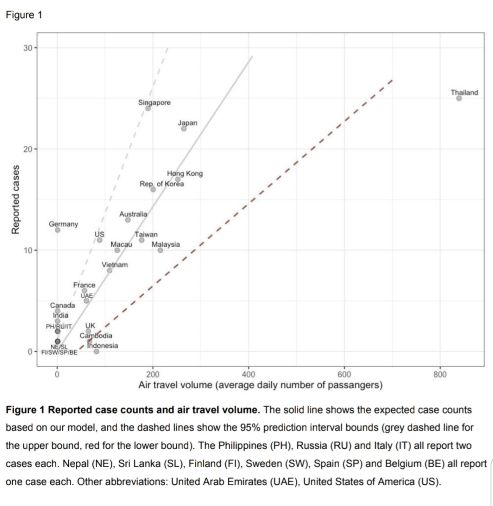
Unsurprisingly that included movement between the city at the centre of the initial outbreak, Wuhan, and broader Japan as can be seen in the figure below taken from an early paper by Salazar et al (2020), epidemiological researchers out of the Harvard TH Chan School of Public Health, which looked at the number of reported cases relative to the volume of air travel between that country and Wuhan. Now the case data, of course, is well out of date, as the epidemic is moving so quickly, but what I really want the reader to note is the X axis which shows the average daily number of passengers travelling from Wuhan to other countries. Note that Thailand receives by far the greatest volume of passengers from Wuhan, but Japan is second.

Secondly, Japan is a highly developed country with a sophisticated health system, and its people enjoy a high standard of living which affords them a high underlying health state. Observing case fatality rates here should provide an indication of what is likely to be the situation in other highly developed nations, perhaps a few weeks in advance of the progression of the outbreak in countries receiving less movement of people from the initial site of the outbreak.

Up-To-Date Information on Cases in Japan

In recent days there have been several reports of seriously ill people infected with the coronavirus that have not travelled to China and have not had any known contact with people who have.

On 15 February The Japan Times detailed three separate cases unrelated to travel to China. One cluster of infections was around a hospital in Wakayama Prefecture where 2 doctors, one of their wives, and two patients were found to be infected. Another cluster occurred in Tokyo where 7 people infected by the virus travelled in the taxi of another infected person. An eighth Tokyo resident, a businessman who travelled on a bullet train while unwell, was also found to be infected. And a husband and wife in Nagoya were found to be infected shortly after returning from a holiday in Hawaii.

Health officials are now concerned about being swamped by people concerned that they are infected by the coronavirus and have released recommendations on when and how to access health services. The fact that seasonal flu and cold viruses will also be circulating complicates matters.

Below I will track the Japanese case data reported in the WHO Situation Reports released daily.

  • For 17 February: Confirmed cases 59 (3 new); Total cases with possible or confirmed transmission outside of China 33 (6 new); Total deaths 1 (0 new)
  • For 18 February: Confirmed cases 65 (6 new); Total cases with possible or confirmed transmission outside of China 39 (6 new); Total deaths 1 (0 new)
  • For 19 February: Confirmed cases 73 (8 new); Total cases with possible or confirmed transmission outside of China 42 (5 new); Total deaths 1 (0 new)

The Diamond Princess Case Study

This history is directly from the article Fear and Boredom Aboard the Quarantined Coronavirus Cruise Ship in the Wall Street Journal published 14 February 2020.

The first known infected passenger, an 80 year old Hong Kong man, boarded on 20 January at Yokohama (there are no details on how he got to be in Yokohama, though the story says that 10 days prior to embarking he travelled to Guangdong). He boarded with 2 daughters and they had a sauna while onboard.

At the first stop in the Kagoshima the man joined a bus tour with 40 other passengers. When the ship docked in Hong Kong, the man left the ship earlier than planned and 5 days later he went to hospital.

Route for Diamond Princess from 20 January 2020 when first known infected person embarked at Yokohama through to when the ship entered quarantine near Yokohama on 3 February 2020. The portion of the route in yellow designates that the first know infected passenger was onboard. From the Wall Street Journal.

After Hong Kong, the ship made stops in Chan May and Ha Long Bay in Vietnam, in Taiwan and in Okinawa (Japan) before going into quarantine in Yokohama on 3 February. The WSJ article details some of the tours that took place while in Vietnam.

Commencing 5 February passengers remaining on board the vessel have been restricted to their cabins in order to restrict the opportunity for transmission between those remaining on board. However, unfortunately one of the shore team that was assisting has also become infected. It is difficult to understand what proportion of the passengers that are now being found to be infected by the virus have contracted the infection after the quarantine period began. Evenso, the possibility of infection must have been significantly reduced by these quarantine procedures, so very many of the infected passengers must have been infected prior to quarantine commencing.

Below is a daily synopsis of events since the Diamond Princess entered quarantine on 5 February with 3,711 passengers.

  • 5 Feb – +10 – 10 confirmed cases, 31 tested
  • 6 Feb – +10 – 20 confirmed cases, 102 tested
  • 7 Feb – +41 – 61 confirmed cases, 273 tested
  • 8 Feb – +3 – 64 confirmed cases; 279 tested
  • 9 Feb – +6 – 70 confirmed cases; 336 tested
  • 10 Feb – +65 – 135 confirmed cases; 439 tested
  • 12 Feb – +40 – 174 confirmed cases; 492 tested (4 people in intensive care)
  • 13 Feb – +44 – 218 confirmed cases; 713 tested
  • 14 Feb – +4 – 222 confirmed cases
  • 16 Feb – +67 – 289 confirmed cases
  • 17 Feb – +66 – 355 confirmed cases; 1,210 tested
  • 18 Feb – +99 – 454 confirmed cases
  • 19 Feb – +92 – 542 confirmed cases (2,404 test – 169 infected passengers still on ship)
  • 20 Feb – +79 – 621 confirmed cases

A few things are clear from the 2 weeks that the Diamond Princess has been in quarantine. Firstly, it is clear that the virus indeed is highly transmissible. The first known infected individual was onboard for only 5 days, and the vessel continued on for just 8 days more until it entered quarantine. While cruise ships are known to be environments where viruses are quickly spread between passengers, this is clearly a highly transmissible virus.

Secondly, this case is beginning to suggest that the incubation period and time to morbidity and mortality is reasonably prolonged, which I suggested in my initial reports, thus making biosecurity containment challenging.

This case bears very close watching and I will be updating this page daily.

Now that most countries are transporting home those that did not exhibit symptoms and/or tested negative for the virus, it may be challenging to put together exactly what happens with this cohort of people. Nonetheless reporting will likely mention the origin of these cases and I will do my best to put it all together here.

The US took home their citizens first. There was a hickup as only uninfected individuals were to be on the flight, however on transit to the plane it was learned that 14 in the group had tested positive. They were allowed to join the group and sat separately on the plane, which is a common sense approach as it is highly likely that there will be more infections found amongst those who tested negative (and there may be some who were not tested prior to flying in any case who are not yet showing symptoms). The Centre for Disease Control in the US has stated that all people who were passengers on the ship should be tested for the virus.

On 20 February NHK released that 2 Diamond Princess passengers in their 80s had died from the coronavirus infection.


Gained value from these words and ideas? Consider supporting my work at GoFundMe


© Copyright Brett Edgerton 2020

The Introduction to “As He Saw It” by Elliott Roosevelt

By way of background, Elliott Roosevelt is the son of President Franklin Roosevelt (commonly referred to as FDR) who led the United States of America through its most challenging period of the 20th century from the Great Depression through to World War 2, from 1933 to his passing on 12 April 1945 as the war in Europe was ending and before the first atomic bomb was dropped on Japan.

Elliott Roosevelt explains why he was the only person who could give an accurate depiction of events, negotiations and deals brokered, and his own father’s viewpoints on these. I think most would agree that a loving son would faithfully seek to have his father’s vision for the world remembered accurately when events transpired which made it clear that promises were broken and that vision was not being enacted.

Introduction quoted in full, with my emphasis in bold, from “As He Saw It” by Elliot Roosevelt, 1946, Publishers Duell, Sloan and Pearce, New York, Third Printing, 270 pages, pp xiii – xviii.

Introduction

This will be, only incidentally, a book about the war. It is designed, more importantly, to shed some light on the peace.

The events which I propose to describe in this book, the conversations which I remember, the impressions and the incidents which have formed my present convictions, took place – roughly – from the war’s outbreak until shortly after the meeting of the Big Three at Yalta in the Crimea. At the time they took place, let me assure you, I had no intention of writing a book about them. The decision to write this book was taken more recently and impelled by urgent events. Winston Churchill’s speech at Fulton, Missouri, had a hand in this decision; the meetings of the Security Council at Hunter College in New York City and the ideas expressed at those meetings were influential; the growing stockpile of American atom bombs is a compelling factor; all the signs of growing disunity among the leading nations of the world, all the broken promises, all the renascent power politics of greedy and desperate imperialism were my spurs in this undertaking. (my emphasis)

The tempo of our times is such that our opinions are net keyed to history but to headlines. Whether we trust or distrust Russia is not conditioned by that nation’s mighty contribution to our victory in the war, still the greatest single fact of our lifetime; rather is it molded by the scare-print on the front pages of three or four days’ newspapers – newspapers often irresponsible in the past, and therefore surely doubly to be doubted in the tremulous present. Our ideas about the loan to Britain are formed in the long memory of the buzz-bombs that fell on London, nor even in the critical knowledge of continuing British austerity-meals, but in an atmosphere of uncertainty over Britain’s imperial intentions. The unity that won the ward should be, must be, a fact today, if we are to win the peace. This is simplicity itself: any thinking grade-school student can write a moving and persuasive essay on this theme. But more and more, since V-E Day, and since the atom bomb first fell, this unity has disappeared.

It is because I doubt that we have only drifted (his emphasis) away from this unity, it is because I am convinced that we are being shoved away from it, by men who should know better or – in Walter Lippmann’s phrase – “little boys playing with matches,” that I felt it important for me to write this book.

Well – and why me? What have I got to offer? After any great world upheaval like this last war, there is bound to be a great spate of books. Generals, ministers, war correspondents, all fly to the typewriter or the not-very-sharp pencil. Nevertheless, for my book I can stake out a small but still quite definite space which is wholly individual.

My qualifications begin with the biological fact of my being my father’s son. Like every privilege, this relationship had its drawbacks. I remember his telling me once about these drawbacks – it was in Hyde Park, at a time when he was still Governor of New York, a month or so before his nomination to the Presidency. He was keenly alive to the publicity that attends every action of the children of a man in public life – especially when the man has bitter political enemies. There was to be sure, little he could do or wanted to do to control our actions. He took the position that our lives were our own, to do with what we wished and what we could. I imagine that, like any father, he wanted to believe that we would stay out of jail, grow up to be responsible citizens, and be happy, successful people according to our individual lights. But he was careful to give us plenty of rope.

At any rate, taking the rough with the smooth, all the drawbacks of being a President’s son must be weighted in the balance against my second qualification for writing this book, which is that it was given to me to be present at and a witness of some of the most important meetings of the war, indeed of our lifetime. Father wanted and needed someone whom he knew well and trusted, a member of his family, if possible, to be with him whenever he was overseas for a wartime conference. This is not to suggest that he didn’t know official advisers well, or that he didn’t trust them; but with one of his sons he could wholly relax. He could talk as though he were talking out loud to himself – and he did. Of his sons, I was most often in a position to be drafted as his aide. Thus, when he first me Churchill off Newfoundland, I was attached to a reconnaissance squadron at Gander Lake, Newfoundland,; when he came to Casablanca, my outfit was operating out of Algeria; one of our headquarters bases was still in Tunisia when he came to the Near East for the Cairo and Teheran conferences. Only when he went to Yalta was I unable to be at his side.

And of course, in addition to my hours with him at these meetings, there were times during the ward when I came back stateside, once on sick leave, twice on official business, once on leave. Each time I was able to spend some nights at the White House, which meant hours of conversation with him.

As his aide, then, I sat in on most of his appointments, conversations, and conferences – military, political, diplomatic – performing the combined duties of message-taker, errand-runner and note-compiler. In this semi-official capacity I was able to listen to the give-and-take, both formal and informal, of the representatives of all the warring Allies. Churchill, Stalin, Generalissimo and Madame Chiang Kai-shek, the Combined Chiefs of Staff, the commanding generals and admirals in every theatre and every branch of the services, Smuts, de Gaulle, Giraud, Hopkins, Robert Murphy, Molotov, the kinds of Egypt, Greece, Yugoslavia, and England, emirs and shahs, sultans and princes, premiers, ambassadors, ministers, caliphs, grand viziers – I met them at the door, ushered them in, sat down while they talked with Father – and then listened to his impressions of them, after they had gone.

And when the long conference days were over, and Father had bid his last caller good night, there was hardly an evening that we didn’t spend some hours, just the two of us, before he turned out his light to sleep, talking about what had happened that day, comparing notes, pooling impressions. Occasionally he’d question me about what I’d been doing as a photographic reconnaissance officer; more often I’d question him about anything that was troubling me, all the way from what was doing with the Second Front to what did he think of Madame Chiang. He had sufficient confidence in me to tell me the results of his bargaining with Stalin before he had told even his chiefs of staff or his Secretaries of State. Our relationship was one of great good companionship; he had come to like me, I believe, as a respected friend as well as a son.

My opportunities to witness these conferences, then, were on two levels; one as an official Presidential aide, the other as a most intimate friend to the man who was primarily responsible for the unity of the United Nations. It was on this second level that I shared his most intimate thoughts and listened to his most cherished aspirations for the world of peace to follow our military victory. I knew what conditions he predicated for the structure of world peace; I knew what conversations led to them; I knew of the bargains and promises.

And I have seen the promises violated, the conditions summarily and cynically disregarded, and the structure of the peace disavowed.

That is why I write this book. For my help I have had the official log of the various conversences, which I have supplemented from notes which I took myself, at the time, and from my memory. I have depended more on my notes than on my memory.

I am writing this, then, to you who agree with me that Franklin Roosevelt was the wartime architect of the unity of the United Nations, who agree with me that Franklin Roosevelt’s ideals and statesmanship would have been sufficient to keep that unity a vital entity during the postwar period, and who agree with me that the path he charted has been most grievously – and deliberately – forsaken.

I am writing this in the hope that it will be some service in getting us back on that path. I believe it is possible. I am fearful of the alternative.

Indeed Elliott Roosevelt was right to be fearful of the alternative, and unfortunately his heart-felt pleas were not met with a response. Perhaps there has not been another Statesman of his father’s calibre since his passing.

The implications of this are contained within my recent essay “The Conundrum Humanity Faces: But Nobody Admits“.

To understand Franklin Roosevelt’s ideals they are brilliantly articulated in his Fourth Inauguration Speech which he delivered less than 3 months before his passing.

To learn my views of on the current state of American politics you can view my prior posts on President Trump and my recent post “The Secret Sauce of American Economic Dynamism was Not Personal Greed“.

Gained value from these words and ideas? Consider supporting my work at GoFundMe


© Copyright Brett Edgerton 2020

The Magic Sauce of American Economic Dynamism Is Not Based on Personal Greed

Without doubt the United States of America is an incredible nation.

Many successful Americans, along with those that “made it good” in America, talk about a “magic sauce” that has created the economic dynamism that drives American business and society. One of the greatest proponents of there being a “secret sauce” is Warren Buffett, widely regarded as the greatest investor of all time, whose confidence in the US economy and society is often relied upon in challenging times such as during the stockmarket turbulence heralding the Global Financial Crisis or The Great Recession.

In this essay I do not dispute the existence of special characteristics that made the US economy the envy of the world which might be defined as a “special sauce”. I question what is the character of that “special sauce”.


The US became the predominant power at the end of the Second World War when Britain knew it had no chance of winning without the assistance of the US. By the conclusion of WW2 there was no doubt which country was the dominant power in the world, and with the fall of the Berlin Wall it became clear that there had been no real competitor to that hegemonic status. The feats of the American nation need no repeating – they are very well understood throughout the world.

All peoples throughout the world are familiar with US society through various media. It is accurate to say that for many, via this saturated channel (television, movies, music, sports, newspapers, internet, etc), they understand American culture second only to the culture in which they live.

I have never lived in the US, and I have not spent more than a few weeks at a time there. What I have observed during those visits largely confirms the perceptions that I have gathered through the media.

We in anglophone countries tend to take even greater notice of American culture and trends because what takes place in the US affects us. The media saturation means that the cultural influence is enormous especially on our youth; our need to maintain ties for security reasons ensures that we are certain to support the US on major security operations including major conflicts; and our business and political ties are so great that trends emanating from the US are certain to arrive at our shores very quickly indeed. 

Thus what is occurring in the US today is likely to become our reality tomorrow.

The inequality in society that is occurring in the US is quite alarming with rich becoming richer and the middle class being hollowed out as the owners of capital (the already wealthy) have long been taking a greater share of profits than the workers. The rate of income increase from senior executives has also outstripped that of “ordinary” workers by several orders of magnitude. And the response to The Great Recession (GFC) has made the wealthy vastly more wealthy.

The Wikipedia page on Wealth Inequality in the United States provides stark reading.

This trend has made a position in the American middle class very precarious. We frequently hear stories of how the low level of Government-payments, a mix  of minimal health and employment or social support financing, means that all middle class American families are just one serious illness, marriage breakdown and/or recession away from homelessness.

It was unfathomable to me, as an Australian who has enjoyed the benefits of a free quality public health system for my entire life, to comprehend how those on the right of politics were able to mobilise some of the most financially precarious Americans to rally against President Obama’s health care reforms. In other words those that stood to gain the most from the measure became the foot soldiers for having it minimised and then reduced. How on Earth did that come about?

The only conclusion that I can reach is that it is an indictment of the degree of anxiety these people felt because of their financial and societal precariousness. It could only be that they have become so used to having social supports stripped from low and middle-class Americans through their lives that they could not countenance a Government actually seeking to improve support. Sadly, it is the most vulnerable – those anxious skeptics – that are most susceptible to misinformation campaigns. Consequently they lost a rare opportunity to have their social support significantly strengthened.

Citizens of other western countries are often confused by why the US is upheld as the country that an aspiring migrant would want to go in the hope of entering the middle class. Perhaps it is a testament to the brilliant selling job the media, or “the market”, has done on espousing the virtues of the US culture.

Sure, if you want to be super wealthy, then it is the best place to go in the world. European old money is not highly regarded and anybody can make it big in the US. But on a balance of probability and risks – to attain a comfortable level of financial security for your family enduringly – then it is one of the least desirable developed nations to seek to migrate in comparison with other Anglophone or European nations.

Current affair programs showing the emergence of the working poor with tenuous accommodation and people getting paid for their blood (which they do several times a week for their survival) is a stark reminder of a harsh existence for many in the lower classes.


For a while I thought that this harsh reality, juxtaposed by the ostentatious displays of wealth by the one percenters holding up the promise of what is on offer to those who find their own perfect mix of hard and smart work, might be what was the base recipe for that magic sauce. I suspect that it is the common perception that it is, based on my observation of how anybody who believes in a fairer society in America is immediately attacked for being a “socialist”.

Then I read Rutger Bregman’s book “Utopia for Realists” and I learned that US society was very different 50 years ago – which encompasses at least the 20 years that followed it being recognised as the mightiest nation on Earth, able to swing the outcome of the toughest war of the last 600 years and land humans on the moon.

In the late 60s the US almost implemented a Universal Basic Income (UBI). It is almost surreal to consider that the developed country with the most precarious middle class, with weak national social safety networks, might have introduced what might be considered the ultimate social safety program 50 years ago!

The virtues of a UBI are only just beginning to be discussed again, and unfortunately it is such a great departure from what has occurred over the last 50 years in the US that even many Democrats simply can not fathom how it could work. I heard Larry Summers talk about his view of how Americans need to work for a sense of self worth. Well, as Bregman discusses, just because people do not need to devote as many hours to income-generating activities does not mean that they will be idle at other times!

Bregman details the history of the UBI debate in American politics in the late 60s and highlights that both sides of politics supported its introduction. In fact, it was the Republican President Nixon that first supported its introduction, and the only reason it failed was because the Democrats felt it did not go far enough!

It is amazing to then consider how far American culture and beliefs have drifted since the late 1960s.

Undoubtedly there will be much propaganda thrown at why a UBI “cannot be done”, as there has been for two centuries. Finland’s recent trial will be highlighted, especially the decision to end it because impacts were minimal. Anybody inclined to accept that as proof that it should not be implemented in the US should compare the standard social safety network within Finland and the US. The issue in Finland is that its social safety network is already about the best in the world – in part the reason for why they were so open to testing an actual UBI – so strong, in fact, that the benefits of the UBI were difficult to detect. Still, when it begins to be implemented elsewhere, they will still go ahead and implement, of course.

In the 80s there was the emergence of the Gordon Gekko “Greed is Good” credo. While Oliver Stone put his finger perfectly on the emerging trend, and Michael Douglas and Charlie Sheen brought the characters to life so luminously, it was far from sufficient to bring the trend to screeching halt. In fact, perhaps it was swallowed in some way by the middle class that thought it was worth putting at risk enduring security for the chances of untold riches.

Then again, I don’t know how it happened. I am not here to speculate on that.

But what I am pointing out is that the greed of the 1% and the vulnerability of the 99% was not in any way the magic sauce that made the US the dynamic superpower that was so strong as to become the hegemonic state 80 years ago.

Moreover, the drift in American society over the last 50 years – since the late 60s when there was a political consensus on the benefits of a UBI – has most likely weakened that magic sauce.

As well as the rightful push back on China’s emergence as a global power, while it remains autocratic and suppresses its peoples, the US needs to admit that it has allowed itself to weaken by its own lack of societal progression.

Anybody who truly wants to “Make America Great Again” must pick up the momentum towards the course that was in place until the 70s and begin to work on a truly inclusive and open society.

One person who I would feel confident would agree is Warren Buffett because he has regularly argued over the last decade or more that he and other wealthy people should be paying far higher taxes than they currently do. Perhaps, instead of just using Warren at times of national anxiety, the roof should be repaired in the fashion Warren suggests before it rains.


Gained value from these words and ideas? Consider supporting my work at GoFundMe


© Copyright Brett Edgerton 2020

“60 Minutes” Letter

Read by Peter Harvey after the 2010 Federal Election

On Saturday in the federal election I voted informally along with a lot of other Australians. It was the first time in the 22 years that I have been voting that I did so. And in discussing my decision with others I learned that many were doing the same thing for the same reasons.

There is a palpable feeling amongst the people that politicians are not there to represent us. That no matter who is in power – and that is the operative word – Power – they look after exactly the same people – themselves and their parties, and thus the donors to their political parties.

That they myopically focus solely on winning the next election and they neglect the greater good over the medium to long term.

My decision was a deliberate choice to not be forced to ultimately decide between two major parties, and the individuals that their members have chosen to lead them (not us).

For too long their game plan has not been to prove that they want to lead the country and do right by the people. Instead in their respective shifts to the centre they set out to persuade the public that they are the least bad option.

Australians deserve much better than the least bad option!

I had been thinking of voting informally for a while but, like others I spoke to, was reluctant to “waste” my vote.  But equally I felt passionately it was a waste to vote for a local member for whom I had no greater expectation than to tow the party line and ultimately a party that is more interested in gaining or retaining power than doing what is right for me, my fellow Australians and other members of the human community.

Mark Latham’s comments on 60 Minutes did cement it for me – not because he said to do it – but, because somebody had publically framed the reasons for voting informally, it had as much meaning – actually, more meaning – than simply tossing a coin to decide who was the least bad option.

The election result is a perfect indication of the mood in the public. Each is as bad as the other and with a great many people desperate for avenues to voice their disapproval at what our democracy has become.

This is a historic opportunity for all politicians to listen to the overwhelming mood of the people and instigate the changes that are needed to ensure that that they and our future representatives are incentivised to work for the greater good over the short, medium and longer term.


Gained value from these words and ideas? Consider supporting my work at GoFundMe


© Copyright Brett Edgerton 2020