Redux: MacroEdgo’s Coronavirus Update of 11 February

I quote this particular update so frequently that I thought it prudent to have it in a separate post for quick and easy access. It also adds perspective to a great many aspects of the pandemic. Note that as of today I wrote this update 47 days ago. Then there had only been 1 death outside of China. In the WHO situation report for today the Global death toll stands at 30,000 with 26,700 outside of China. Just soak that in for one moment before reading on to my update from less than 7 weeks ago!

11 February

My optimism/pessimism level – from 10 to 1 in decreasing optimism – stable at 2

This is a scale that can move daily depending on latest developments. Extreme pessimism of 1 would entail confirmation that the virulence of the virus is such that infections result in a mortality rate of 1% or greater (10x the virulence of severe flu) even under optimal conditions, continued indications of very high transmissibility (a reasonable proportion of infected individuals infect several people), and a lack of effective treatment and/or prevention (vaccination).

WHO Situation Report 21 for 10 February (released at 6am 11 February Brisbane, Australia, time)

China: 40,235 (3,073 new); 6484 (296 new); 909 deaths (97 new)

Rest of the World: 329 (12 new); 1 death (0 new)

Because the WHO is compiling the data globally the Chinese Government data is more recent and I will include that here also:

Deaths in China in previous 24 hrs: 1,021

I get these figures from Bloomberg television when they are released at around 8am Brisbane time. Bear in mind that politics will play a part in how data are treated and publicly released. It is the case in all countries, though the degree of effect varies.

Significant developments over the last 24 hours:

  • another 66 people that were on the Diamond Princess in quarantine in Yokohama have tested positive bringing the total of cases to 136 (the total on-board population was around 3,700)
  • the WHO Situation Report 21 states that around 50% of confirmed cases in Singapore, of a total of 43, were cases “with possible or confirmed transmission outside of China”
  • UK has declared the coronavirus outbreak a serious and imminent threat to public health, meaning that people with coronavirus can be forcibly quarantined and will not be free to leave, and can be forcibly sent into isolation if they pose a threat to public health.

Those people on the Diamond Princess complaining about their conditions need to accept that quarantine is not about the people held in quarantine, it is about protecting the broad population, as the UK directive makes clear. Perhaps they should be grateful that if they do contract the infection then they are in about as favourable a position as one can be given it will be detected early and they will receive excellent treatment within a sophisticated and well resourced medical environment. Other people should be so fortunate!

We remain in a wait and see situation but everybody should be taking this threat very, very seriously.

I asked my 11 year old son yesterday whether the children at his school were talking about the outbreak. He said that initially there were jokes in the school grounds, but now nobody has said anything for days. I asked if he thought that was because they were not worried – he said he thought it was the opposite. He said he thinks that the parents are not talking about it so that is making the children more scared.

I can understand in some ways why the parents are not talking about it with children, because the Government is not talking about it, probably for political reasons (concerned about impacts on opinion polls coming after the bushfires, and concerned about the impacts on the economy which would also impact on views of the Government). 

It is time these people realised that anxiety builds in people when they sense a threat. (Jo Hockey might think it is OK to abrogate leadership to the Facebook masses which lead the politicians via them picking up on trends through focus groups – as he said on 7.30 recently – but unsurprisingly what people need most is real Leadership, with an intentional capital “L”.) Not talking about scary things only amplifies that anxiety because people assume that the threat is very serious (anyway) if they are not being told about it. And they have no information on which to confront those fears.

I understand that it is a very challenging situation to handle. But, as usual, prioritising political self interest will always result in inferior outcomes for the people. And I am concerned for the psychological damage being done to the young who sense the anxiety within society at present.

Finally, and I place this last because on the one hand the range of estimates is so wide to make the work very preliminary (as the authors note), and because those likely to see the glass half full will jump on the low range of estimates (as has been reported in the press today), while others more inclined to the see the glass half empty may be frightened by the high range of the estimates. The Imperial College London, the WHO Collaborating Centre for Infectious Disease Modelling, has produced their latest research providing case fatality ratio (CFR) for three categories of coronavirus infection from this outbreak.

“For cases detected in Hubei, we estimate the CFR to be 18% (95% credible interval: 11%-81%). For cases detected in travellers outside mainland China, we obtain central estimates of the CFR in the range 1.2-5.6% depending on the statistical methods, with substantial uncertainty around these central values. Using estimates of underlying infection prevalence in Wuhan at the end of January derived from testing of passengers on repatriation flights to Japan and Germany, we adjusted the estimates of CFR from either the early epidemic in Hubei Province, or from cases reported outside mainland China, to obtain estimates of the overall CFR in all infections (asymptomatic or symptomatic) of approximately 1% (95% confidence interval 0.5%-4%).”

The authors qualify these results with the following statements:

“All CFR estimates should be viewed cautiously at the current time as the sensitivity of surveillance of both deaths and cases in mainland China is unclear. Furthermore, all estimates rely on limited data on the typical time intervals from symptom onset to death or recovery which influences the CFR estimates.”

Those figures are concerning to say the least – I do not believe that I need to unpack these data any further.

Today I am going to discuss likely actions by Governments, likely economic impacts and discuss any reasons for optimism.

Likely Actions by Governments

Authorities in all countries will have been drawing up plans for many years on how to deal with this type of event. This represents the most serious challenge to that planning.

Presently every developed country will be asking themselves these questions:

  • what is our capacity to test everybody displaying flu-like symptoms and at what point do we start and at what point do we stop (and devote resources elsewhere)
  • at what point will we stop large public gatherings (sports events, conferences, concerts)
  • at what point will we close schools
  • at what point will we stop public transport and encourage employers to ask employees to work from home
  • how will we ensure that we can continue vital services such as health, water, electricity
  • at what point do we close the borders completely to all non-citizens or residents

As I said in my original post, being in the southern hemisphere – heading into the seasonal flu period – and our proximity and links to the original outbreak area – will mean that there will be greater pressure on our authorities to act decisively. They will be balancing up the impacts on society – the damage of scaring people when it is clear just how concerned authorities really are about this outbreak versus the significant benefits to slowing the spread of the virus within Australia. They will also be balancing things in relation to impacts on the Australian economy which is incredibly vulnerable (I have been talking on MacroEdgo and in earlier blogging activities for the previous 12 years about those vulnerabilities.)

I expect that this outbreak will take over a year to clear – we may well be living with it for several years if none of the current anti-viral drugs are effective and if there are challenges to developing and producing a vaccine.

Economic Impacts

Bad… very bad… under virtually all reasonable scenarios from where we are now.

I expect that central banks will try absolutely extraordinary actions (as opposed to the already “extraordinary” actions that we have become desensitised to over the last decade). The problem will be how to safeguard the economy by creating activity when most activity runs counter to the best way to reduce the spread of the virus. We hardly want more people out and about shopping, or even working together. As I said above, I believe most workplaces will need to either put people on paid leave or working from home.

Any stimulus to create activity will need to be activity that does not require people to come together. Thank goodness for electronic communication, if our networks hold up.

In the developing world, I wonder what might happen. It might be that they have no choice but accept the mortality rate as it is while their people go about their business relatively normally. As I said in my original report, these people need to work in order to eat. A 2% mortality rate is not such a huge departure from their normal life experience unlike those lucky enough to live on “islands of prosperity”.

This might even end up being the case amongst blue collar workers in China, though I suspect that nobody is going to want to take delivery of products out of factories where there has been no biosecurity efforts. So who will they produce for?

The realities of an inequitable world!

Reasons for Optimism?

At this stage I have not seen any data or anecdotal evidence that I would trust which increases my optimism. What is being said about a levelling off in case numbers in Wuhan and the relatively few deaths in the rest of China thus far does not provide a lot of comfort – the political situation in China now decreases the incentives for accurate reporting of any data which would suggest a worsening of the situation. In any case I would imagine that diagnostic capacity in China and definitely Hubei would be fully stretched (as I discussed in my initial report).

For me all eyes are now on what happens in countries where we can have more trust on the reporting of the outbreak (based not just on incentives to report accurately – or less inaccurately – but on capacity to do so). How quickly will it spread and how virulent is it really. There are no good indications on either of these points pointing to a more optimistic outcome, unfortunately, not yet anyhow.

Will any of the antiviral drugs currently available or in late stage development be effective? Will a vaccine be relatively straight-forward to develop, manufacture and administer?

I am certainly not qualified to estimate about pharmaceutical responses, but I am guessing that even experts within these fields will have a great degree of uncertainty around their views.

Eventually humanity will emerge from this event. We will never be the same, as I made clear in my initial report. That is sad.

We will all suffer loss. We already have. But humanity will go on. Even if the mortality rate turns out to be greater than 2%, the majority of people infected will survive the infection even if we (they) need to endure its spread for several years.

Nobody is immune and viruses do not discriminate. Our elderly and young are more at risk.

Let us hope that humanity can get its act together after this event.

I am for a united humanity!

Are you?


Gained value from these words and ideas? Consider supporting my work at GoFundMe


© Copyright Brett Edgerton 2020

People Before Money

Why are our right wing political “followers” so reluctant to choose society over economy – people over money – saving lives over more deaths?

The answer is simple…

Because their political power comes from the elites, the people who use their power within society to get what they want from it damn others, the people who send their children to the elite schools to build those powerful connections, the people who were bailed out in the GFC and then gave each other massive bonuses while the ordinary people felt the direct pain from their blunders, the people who do not send their own sons and daughters to war but agitate for expansion of influence and power to increase sales and wealth.

And these are the same people that will be in the front of the queue for any COVID-19 vaccine and/or effective treatments when they become available while others will have to wait in the hope that it arrives for them in time in an affordable manner.

There are few people in Australia who can talk with greater authority on this subject than me, and while that might sound brash, if you stick with me through this I will explain in personal detail why and I doubt that you will see it that way by the end.

When Morrison cries for business owners and employees I know it to be either crocodile tears or misinformed or naive.

Why do I know that? Because I grew up in a household which lived under the chronic stress of financial pressure so intense that we had become certain that any day the bank might foreclose on our business and our home, a family farm that had been owned originally by my Great Grandfather.

The pressure was so great that as a teenager I had to have the courage to stand up and literally save the people that I love from catastrophe. To save those people from embarrassment I will not go into detail of what I was called on to do, but believe me when I say that it is truly shocking and it has impacted my entire life and was a major factor in me having a breakdown and feeling overwhelmed by other life pressures as an adult.

What I kept repeating that night, while I was still yet to complete high school, was “how could you do this?”

For over a decade I did not process what had occurred, and it was never discussed again by the people involved. It was like a fuzzy dream, in reality a nightmare that even as I began to recall the events to a psychologist many years later were disjointed in my recollection. I began to understand the impact only in my 30s when visiting I lay awake all night alert to any movement throughout the rooms in case it was going to happen again.

Now I know that hard-hearted right wingers will be jumping for their faux tissues and suggesting that all of this supports their argument of needing to save the economy and livelihoods even if the cost of doing so is losing the lives of some more vulnerable people, the elderly or those with existing conditions.

Now that I have resolved all of what happened to me I realise that my repeated question that night – “How could you do this?” – was much deeper than related to that one incident.

In reality my question was how could you allow this to happen, that a family has been transformed into believing that what it does is more important than the family itself. 

That the external thing – the business, the farm (though in other families it could equate to infinite other things like the house) – was more important than the family. 

That somehow none of us was as important as keeping this “thing”, and that our lives and us as individuals was just collateral damage to that aim.

It took me a long time to stop being angry about that, and in truth there are times when that anger can be aroused again. 

Mostly I feel sad. Sad for what was lost; what I lost; and what we all lost.

So I tell anyone who is prepared to listen, I do not underestimate the stress that financial hardship causes for I know it well. But I equally know that we, especially in English-speaking countries, have progressively come under the spell of the “greed is good” credo that sees most of society competing to get one up on others.

We must realise that money and things are not the most important aspect of our lives. It is not our “things” that will be sitting next to us, tears streaming holding our hand to comfort us, when we depart this world. What we will have in our hearts is people and we will remain in theirs.

If there is anything positive to come from this pandemic, let if be that people are more important than money! And let humanity together live in that realisation!


Gained value from these words and ideas? Consider supporting my work at GoFundMe


© Copyright Brett Edgerton 2020

Investment Theme: Defence and Military Spending

The ordering of this investment theme after the environmental theme was intentional. While the first theme – geopolitics – plays a part, in my mind climate change will be the primary cause of defence-related spending going forward.

Some of this defence spending will be humanitarian in recognising the need for multi-national responses to increased climate catastrophes.

Unfortunately, much of it will occur through national security – i.e. insecurity – relating to increased pressures on national borders and sovereignties brought about from the severe impacts of climate change.

Any reader of my essay “Xenophobia Must be Challenged for an Effective Response to Climate Change Inclusive of Global Population Growth” would have read between the lines that, unless humanity is prepared to remember the lessons of history and become united to overcome this serious challenge to our way of life on Earth, then all of our futures are bleak.

While I am optimistic in humanity, current events suggest that divisive populism has the upper hand at present so defence budgets are going to be increased for this reason alone in the immediate to medium-term future. 

Certainly human history is splattered with the blood of hordes manipulated by megalomaniacs that wanted to transform the world to their vision. But a far more serious threat to humanity is desperation, a loss of faith in global order, and a loss of hope in the future.

If a young student in Sweden feels so desperate and at risk of being disempowered by the mostly grey-bearded Caucasian world order, then just imagine how angry and desperate millions throughout the developing world will become once the reality of climate change becomes undeniable. 

On the divided humanity course, those more fortunate ones who through the fortune of birth or earlier immigration live on an island of relative prosperity will seek to protect and defend that relative prosperity. That desire will only increase the more people become displaced from their homes due to climate change. Perhaps it is reasonable to assume that the openness of a sovereign’s border – through legal and illegal means – will be inversely proportional to the amount of resources spent on defence. 

On the other hand, sovereignties worst affected by climate change, when faced with serious weakening or total loss, may consider that there is little to be lost in using whatever means it has left at its disposal to attempt to use force to acquire more resources to give themselves a chance at survival by increasing defence spending.

The relative-fortunates are also likely to face more turbulence within those islands of relative prosperity, whether at home or when travelling to other islands, originating from the increasingly desperate “unfortunates” which will require increased defence spending within national borders.

I cannot escape the conclusion that a divided humanity ensures a truly awful future for all of us, and even anti-immigration proponents will find difficulty in arguing that we have a genuine quality of life when we feel far less safe than we have for the last 70 years and our relative prosperity is maintained at the point of a gun and is relative to a widespread misery that has not been experienced in centuries, perhaps millenia.

United or divided, humanity will demand very significant defence-related spending for many decades. 

Whether you wish to invest in this theme, that is a question for you.


Gained value from these words and ideas? Consider supporting my work at GoFundMe


© Copyright Brett Edgerton 2020
Australian “Followship”

The majority of material in this report was the basis of Coronavirus (COVID-19) update 22 March. For me, it tells the story of Australia’s response thus far to COVID-19. Independently, these disparate data and opinion pieces add up to damning evidence in support of what I have argued on this site for 6 weeks that the Australian Government has failed to reasonably protect Australian lives.

Firstly, let’s start with some raw data. Now my family had been noticing a fading out of national data being reported in Australia – instead individual state data was being reported – but that has reversed in recent days, in part because the media was complaining about having difficulty in accessing these data.

According to WHO situation reports, on 19 March Australia reported 199 new cases, an increase of 39% to 709. On 20 March that increased another 164 to 873. And on 21 March the latest reported number of cases stood at 1,081. So within 3 days the number of cases more than doubled from 510 to 1,081. And remember – remember! – that the Government strict rules on who can be tested precludes people being tested unless they have travelled overseas or had contact with a confirmed case in the previous 14 days (though on Friday it was broadened to allow testing of people in aged care facilities).

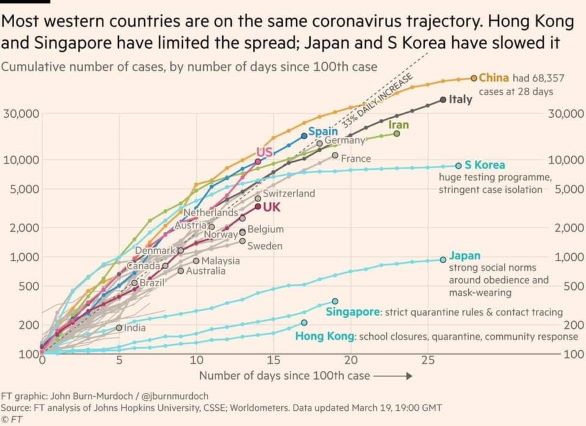
So how do we stack up compared to other Countries?

Answer – not well, and remember, these data are dependant on how much testing is going on. (Please note source of this graphic is FT).

But if you listened to Mr Morrison on television last night, on 22 March, you heard a different story, one of a bureaucracy at the top of their game and responding well. So let’s address that.

The information on which he based those comments are contained within AHPPC coronavirus (COVID-19) statement on 22 March, published early morning 23 March.

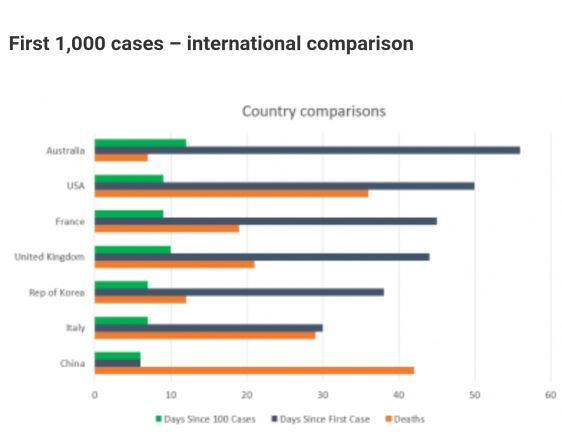
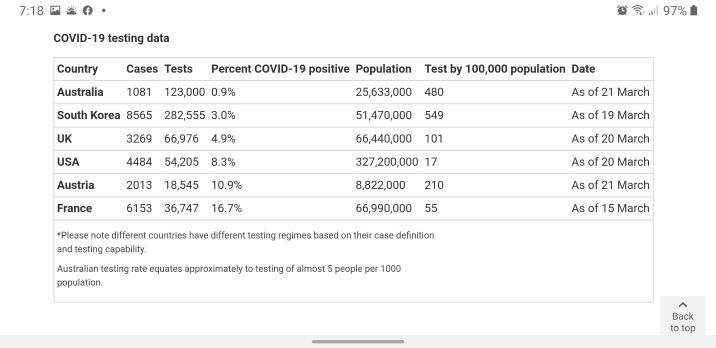
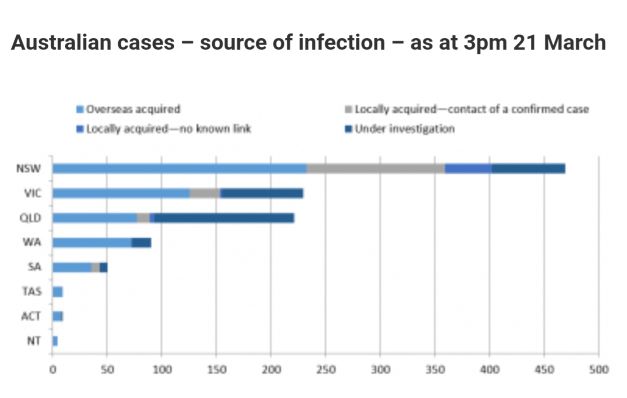
This report contains much information on how Australia has done an excellent job thus far, and concentrates heavily on testing efforts. It contains these graphics supportive of that contention.

So far so good, and I do have to give credit where it is due – this is a great job by the people on the ground doing the testing!

But look at the note on the table “different countries have different testing regimes based on their case definition and testing capability”. In Australia it remains the case that in order to be tested the patient either needed to have travelled overseas or had known contact with an infected person, and only last Friday was it extended to include people from nursing homes irrespective of fitting the other criteria.

Technically other people who acquire the virus from unknown sources can not be detected by the testing regime, but many are beginning to be detected now based on these graphs, first from the NHPPC update on 17 March and the latest one on 22 March.

Either this growth in cases is due to the testing of people in aged care homes, which would be a real worry, or doctors are making the call themselves – against comments by the Chief Medical Officer in recent days due to a concern for running out of test kits.

And you would think that this would all be important news to inform the public on. No. Buried in this report, towards the end of the text is this passage:

Nationally, Australia is close to 50% community transmission at this time

Also note in the two graphs immediately above that the indication in the ramp up in local transmission from unknown sources in recent times was readily visible in the first (the reduction in the blue portion of the bars denoting “overseas acquired” and the growth in the green portion for “under investigation” which is essentially a synonym of locally acquired source unknown). However, the later graph is a cumulative graph of ALL cases detected thus far so it gives no indication of how COVID-19 is increasingly spreading within Australia. So, when it is said that the majority of cases remain to be from travellers that is factually correct but it is getting less and less the case every day.

And here is the thing about politics and spin these days. Everybody knows that information will be cherry-picked to tell the story that suits the politicians, and anything that is detrimental to the case they are presenting is either not reported, is reported in a confused and difficult to decipher manner, or is buried to be less visible and less likely detected.

Another key point, let’s play a little game of “which one of these things is not like the other” from my favourite childhood television program: in the table comparing the testing intensity of all countries, which country is unique? Regular readers should know this because I have stated it repeatedly from my very first report “Social Cohesion: The Best Vaccine Against Crises“. Hint: think hemispheres. Yes, Australia is the only southern hemisphere country and we are heading into what will be a very long and challenging winter period where other respiratory viruses will be circulating making the COVID-19 response all the more challenging.

This is a much understated issue, in fact I have not heard any of the officials mention it! We need to be on our game!

Here is a graphical representation of how our response measures match up around the world.

Increasing intensity – yellow-green-blue – denotes increased containment measures.

This graphic indicates that our containment measures at 19 March were better than PNG and central Africa, and on a par with Brazil, Mexico, Burma, Russia and UK.

So we did not act with caution and implement anywhere near stringent-enough biosecurity protocols to clamp down on the introduction of COVID-19, even though concerned voices were attempting to be heard. As I explained in “Politics and Biosecurity” and my open letter to PM Morrison, and I said it above but it really does bear repeating, Australia has certain geographical advantages that would have been extremely useful to preventing pandemic here – most notably being an island and our biosecurity infrastructure – but were not fully utilised.

So where to from here?


These are the options still available to us as laid out in a great piece by John Daley of the Grattan Institute, and my regular readers will notice a very clear echo in the Option C which Daley chooses as the prefered way to go.

Still Australian political and bureaucratic followers dither and either fail to grasp the full scale of what is heading our way or refuse to react in a way which would ensure minimising lives lost in Australia.

Next an article from George Monbiot, a columnist at The Guardian UK, explaining why the politics of Australia, the UK and America “isn’t designed to protect the public from COVID-19” (and note that right through my discussions on these pages I have lumped these major Anglophone countries together, as recently as in my post on Friday “The First Victim of War is the Truth” which I wrote and published before finding Monbiot’s great piece).

Finally to what has been the effect in Australia to the dithering, confused and self-interest-predominating response of our Australian politicians.

This is a video that I recorded from live television, CNBC, on Saturday morning (Australian time, from New York early evening Friday) where a business person operating across 11 countries notes the extreme level of nanchelance from key Australian team members.

As I said in “COVID-19 Elephants in the Room” with reference to the GP in Victoria who was criticised by their Health Minister for treating people when unwell after returning from the US before the depth of their problem was understood, the level of complacency in Australia is a direct result of the political and bureaucratic followers deliberately seeking to understate the risk that this pandemic poses to Australia to lessen economic impacts.

So on the one hand professional people who are failing to comprehend the scale of the problem heading our way is understandable, along with young people heading to Bondi for day at the beach, and on the other hand a public only now coming to grips with it and fighting over toilet paper and stripping shelves bare to stockpile in case of shutdown, is all related to inept leadership in Australian which has become “followship” (as Mr Hockey actually admitted during his last visit to Australia).

OK, I have just about exhausted myself in prosecuting this case. I do not know whether I will manage it, but my aim is to cease pointing out the defincies in the Australian response because I fear it is all pointless at this stage. Our advantage in battling the pandemic was not taken. And some times it is just too difficult to fight against the reality that “The First Victim of War is the Truth“.

I aim to add some more positive pieces to assist my nation and broader humanity endure this our toughest immediate challenge.


Gained value from these words and ideas? Consider supporting my work at GoFundMe


© Copyright Brett Edgerton 2020
The First Victim of War is the Truth

The world is at war. Not within humanity but against a common foe – a disease, and more specifically the virus that causes the disease COVID-19.

That makes it difficult for families to decide what is best for them, especially with regards to important decisions around schooling for children.

On these pages I have been scathing of the Australian Government’s response, and I have included some choice comments for the American administration under President Trump.

The latter in particular has been quick to point blame to China, the first victims of this lethal virus new to mankind, and in recent days he has returned to this strategy by referring to it as the “China virus”.

The major Anglophone countries of the USA, UK and Australia all appear to have been slow to respond to the emerging pandemic, even though it was clear early on just what a threat this virus represented, and as I showed in my first report on 3 February 2020 “Social Cohesion: The Best Vaccine Against Crises” the virus had characteristics which ensured that it had already escaped the biosecurity efforts to contain it to Wuhan and China.

The reason for the slow response by these Anglophone countries is clear – not only did they observe the impacts of this virus on the Chinese people, they noted the obvious economic impacts that would ensue from the biosecurity measures that were necessarily employed to contain and/or slow its spread. In an Anglophone world where “greed is good”, and human beings are always considered foremost as “consumers”, that threat clearly predominated the thinking of the national “followers” (I can no longer even call them leaders with lowercase l’s – these people are anti-leaders – followers).

Stepping outside of the Anglosphere propaganda, and listening to the World Health Organisation (WHO) and others, there is a valid narrative emerging that the Chinese people – under the direction of the Chinese Communist Party – made enormous economic and social sacrifices to slow the spread of COVID-19 out of its borders to buy the entire world time to get prepared for the onslaught.

Over the last fortnight the WHO has continued to express dismay at the response by some nations and has implored nations to “not hoist the white flag” and to “pull out all stops” in their fight to contain the virus, and in the last few days has added to those messages by saying nations must “test, test, test” for the virus. This is an area that all of those aforementioned Anglophone countries have fallen short, especially the USA, but none has even come close to achieving what South Korea, Singapore and Hong Kong has managed in this vital task to track the prevalence and incidence of the virus in populations.

Instead in the UK, and a lesser degree Australia, there has been the emergence of a concept of “herd immunity” which involves minimal responses to protect the wider public, while enacting biosecurity to protect the most vulnerable, so that a proportion of the population becomes infected and then presumably develops immunity so that there will be no recurrent waves of infection. In my previous post “COVID-19 Elephants in the Room” I discussed some issues which throw serious concerns over such a strategy, and many epidemiologists and physicians have stood up to argue against the wisdom of such a strategy. And my comments about the elephants in the room are being reinforced.

My view is that this is usual political self-interest. These national followers baulked at rapid implementation of the necessary biosecurity measures out of fear of the economic impacts, and now fearing a backlash against them as the societal consequence become clear in other jurisdictions, they have gone in search of and latched onto this narrative to justify their (in-)actions.


I do not think that anybody could accuse me of favouring the politics of any particular country – I would not visit China again because I imagine that the CCP would be displeased by at least some of what I have written – and I recognise that I am fortunate to reside in a country where I am free to point out the failings of my own and other political followers with virtual impunity. 

Moreover, I am under no illusion that any of this is happening in a vacuum somehow separate from the cold war with China that has been ongoing but has only recently come into our collective consciousness – and that relates equally to actions by Chinese politicians as well as Anglophone politicians.

This is how, I believe, we landed at a point where the Australian political editor of the left wing paper “The Guardian” wrote a piece yesterday largely giving Australian Prime Minister Scott Morrison a big free kick over his past failings on the response to COVID-19 and almost suggesting that we need to wipe the slate blank in this crisis and get behind him. (And yes, I remain a little skeptical on why they did not publish any of my early material on COVID-19.)

I, for one, can not because, besides an obvious change in tone, following a similar move by Donald Trump at the weekend, and indications that he is thinking a great deal more about providing political coverage for his actions, I see little change in Mr Morrison’s actual performance and outcomes.

That view was all the more reinforced in watching the debate at the National Press Club Wednesday where Dr Kamalini Lokuge clearly had the better of her (much more bureaucratic-focused – political insiders) opponents Jodie McVernon and Vanessa Johnston. 

This suggests to me no change in focus from the top – just more political spin. And I have to say what really annoys me when some intelligent people debate it just becomes about winning, not necessarily nutting out ideas that can be of value to society. Dr Lokuge debated with great compassion, humility and intelligence – my impression was that her two opponents lacked the former two qualities.

So while I remain open-minded to Morrison finding his road to Damascus, I see no genuine evidence of it as yet. And for that reason I am entirely satisfied in myself on how I am handling this crisis for myself and my family. That is what I will discuss next especially within the context of decisions over school closures.


As I discuss the strategies that I have chosen for my family there are a few things that are specific and which inform my decision-making. All families are unique and these factors need to be carefully weighed.

Firstly, we were not young parents so I am now 50 with a child each in primary school and high school.

Secondly, with family histories of asthma several of us are especially prone to developing severe asthma, requiring courses of the strong corticosteroid Prednisone, whenever we contract a upper respiratory tract viral infection.

This places our family in a higher risk category, and me especially so.

As is clear from my writing on MacroEdgo I was very early to realise the threat that this virus poses to global humanity. The WHO recommends that people in high risk categories undertake social distancing strategies, and they list high risk categories as people of 60 years or older, OR people with underlying health conditions including hypertension, diabetes and/or respiratory conditions (including asthma).

In my Coronavirus update of 11 February (note carefully that date and that of the next quote) I said the following:

Presently every developed country will be asking themselves these questions:

– what is our capacity to test everybody displaying flu-like symptoms and at what point do we start and at what point do we stop (and devote resources elsewhere)

– at what point will we stop large public gatherings (sports events, conferences, concerts)

– at what point will we close schools

– at what point will we stop public transport and encourage employers to ask employees to work from home

– how will we ensure that we can continue vital services such as health, water, electricity

– at what point do we close the borders completely to all non-citizens or residents

The sooner these measures are enacted the greater the chance of limiting the human impact on Australians, and, in fact, playing a role in preventing the spread throughout broader human populations. However, the politics of these actions are significant and even the WHO can not avoid them in that they did not recommend the closing of borders with China even though they knew that not doing so would lead to increased dispersion of the virus.

On the other hand, the sooner these measures are enacted the greater the impact on the Australian economy and especially some specific businesses. And economic impacts certainly do have society and human impacts.

And in my update of 18 March I said:

I am privileged to have close contact into one very small Italian community by virtue of the fact that I own a holiday home there – hence my upcoming post – so I am able to gain a view on the challenges that they face in confinement. And remember this is an impoverished area that has done it tough for a long time. But even so, when we are asked whether we in Australia are yet in lock down, and respond that we are not, they find it difficult to believe given the examples that are abundantly clear on what has happened in China and now in Italy and broadening in Europe.

Last week I decided I was placing my family at a level of risk that I was uncomfortable with by following the Australian Government directive to continue to send our children to school, without qualification other than if required to self-isolate according to the Public Health Act 2020, rather than following the WHO recommendation of higher risk people (thus families) initiating self-isolation strategies.

As I stated in my paper “Social Cohesion: The Best Vaccine Against Crises” that first weekend in February we shopped early and we bought a little more than usual. We have continued doing that since – we shop much less often, and when we do we go early before many people are present and when surfaces are less likely to contain viable virus than later in the day, and we have continued to buy a little more than usual so as to build up a bit of stockpile of necessities gradually so as not to impact others who have only recently been alerted to the need to do so.

Again, this is something that I warned about, especially in comments at The Conversation in early February, because it was always clear that this was going to be a major problem and the longer that the Government downplayed the issue the sharper was going to be the realisation to people that unprecedented actions would be required by the Government and by households.

Equally important to discuss is how to talk to somebody who does not understand the deep implications of what has and will occur. The WHO is being more frank about the situation than all Governments. Our world has changed – I have spoken up about the consequences of that (see “Social Cohesion: The Best Vaccine Against Crises”) – but keeping people in the dark while praying for a (political?) miracle will only increase anxiety not decrease it. Politicians have cynically divided people for too long and the consequences of that are already on display with the numerous reports of increased xenophobia since the outbreak. Information on the outbreak (and my background) at macroedgo.com

So last Thursday I informed my sons that Friday would be their last day at school for a while. Even though they were aware that this might happen, they were still shocked to learn that we had arrived at that point. And it is fair to say that they experienced a few days of grief that their lives as they knew it had changed.

Obviously I made this decision, and begun to enact it, before PM Morrison’s new communication strategy was implemented which included an all out assault on those arguing for a lockdown of Australia where school closures have become the key area of debate. Instead this grouping of political followers, including state premiers, have argued that social distancing can be achieved within otherwise normal school environments, which was immediately dismissed as unworkable by those who would have to implement.

I will not wipe the slate blank so quickly and acquiescently as the Guardian’s Australian political editor, and I can confirm that my family remains of the view that the Prime Minister is accountable to families personally impacted by the COVID-19 pandemic by the loss of a loved one as I detailed in my open letter.

I will say this, however. In Queensland we are two weeks away from the end of term school holidays. If we are following the trajectory that Italy followed, which I fear we are, then we are at a time where there is significant community transmission going on which will be expressed by a rapid acceleration in the number of unwell people presenting at hospitals and other health care facilities in two to three weeks. This is why Dr Lokuge was so stridently arguing for increased testing as the WHO has implored of nations.

I cannot see any real reason why schools could not be shut 2 weeks earlier than otherwise to see how things develop over the period until when school would normally be commencing term 2. If there is no acceleration in the number of cases and seriously ill people, then what is lost – really? But if there is a serious deterioration in the situation then we can all be thankful that the decision was made earlier than it would otherwise have been made.

And if the potential length of confinement is really an issue, with mention of it potentially lasting 6 months, is an extra 2 weeks really significant, especially when we are observing through the media what were the consequences elsewhere in jurisdictions that enforced lockdowns later in their own pandemic curve?

My view is that this is all a very clear indication that the political followers absolutely will die in a ditch over this. But if you look back through all of my writing of the last 6 weeks, you will notice that I have called all that has happened well in advance, and the Australian PM has found it necessary by circumstance to acquiesce – including closing the borders – as the human reality confronts the public. 

School closures will be no different. 

In concluding my post “politics vs society” I said:

I want to be clear – I am in no way qualified to make these calls on how the cost/benefit of economic impacts to actions can be weighed against human and societal impacts. Then again I do not really believe that anybody is qualified. Sometimes people find themselves in extraordinary situations and they need to make a call not knowing whether it is even likely to be the right one. Sometimes in life decisions just need to be the best that can be made at the time.

Even if we do strip things down to a bare cost/benefit analysis for society – if it were ever possible to totally eliminate politics, both broad systematic politics and interpersonal, social politics (essentially of egos) – how does one weigh up the costs and benefits of a certain level of economic activity versus a certain level of deaths amongst a society. And even then there are cross-contaminating issues, where economists will quickly point out that the stress of economic hardship results in costs to the health of populations and then to deaths.

I just wish that I had witnessed behaviour worthy of faith and trust in the political [followship] of this country instead of a continual erosion of it over the last two decades…

While I am not qualified to make decisions on behalf of the nation, I am qualified to make decisions on behalf of my family and I have done so.

And while I say I acknowledge that I am not qualified to make decisions on behalf of this nation, I comfortably put forward the historical account of my forecasts on the development of this pandemic against historical comments by those of this nation’s political and bureaucratic health followers.

I am far from convinced that the human tragedy has yet gotten through to the Australian political and bureaucratic followers, and my fear is that shock at the consequence of their slow and reluctant decisions will only confront them when our physicians are drawing up arbitrary decision trees to determine which Australians will be given a respirator and thus a chance at survival.

Morrison will need to backtrack to find his road to Damascus, but it is still there for him if he chooses to wise up.

Even if or when he does, though, there is no question he is on the hook for lives lost because he was much, much too slow to choose society over politics.


Gained value from these words and ideas? Consider supporting my work at GoFundMe


© Copyright Brett Edgerton 2020
COVID-19 Elephants in the Room

Something has been in the back of my mind – a nagging concern – that I did not really want to acknowledge even to myself.

This is a new viral disease to humanity. The very basics are barely understood such as what type of disease does it cause and how severe is it, how does it transfer, and how do people become unwell and how many will become so unwell that they will die. There is still very much unknown. My friend Dr Shi Zhengli only discovered the viral cause of the new pneumonia-related disease, now referred to as COVID-19, just over 2 months ago.

Now think about HIV and how long it took for scientists to get a reasonable understanding on how it caused disease in humans. Sure, our tools have improved since early in the HIV pandemic but that virus was tricky compared with other viruses then known to science.

So what has been in my mind is that the superficially apparent aspect of disease visible as the pandemic ramps up may not be the only aspect of how this virus causes disease in humans. If we were unlucky, there could be some more chronic element – perhaps more chronic disease leading to mortalities or disability, or foetal defects – who knows, almost anything is possible.

Now many politicians would already consider me to be non-constructive – to their politically-oriented messaging – so I saw no point in talking about left field hypotheticals which are essentially infinite and of little value discussing other than to say that anything is possible.

That was until I went looking for an update on my friend, Zhengli. (I have not had a response to my emails over the last 2 weeks and I was a little concerned, hence my googling for recent activity by her – the last activity by her was some weeks ago when she found it necessary to defend herself from baseless accusations that she or one of her colleagues was the cause of the outbreak, from a lab accident or some other nefarious activities – that may be the subject of another post soon.) In doing so I came across a Lancet preprint from 2 March, which Zengli co-authors, entitled “Caution: Clinical Characteristics of COVID-19 Patients are Changing at Admission“. The concluding statement is:

All [of the mentioned observations] provide clues that the new coronavirus may gradually evolve into an influenza-like virus, or it may be latent in some asymptomatic carrier for a long time.

What will be the consequence of those latent infections will not be understood for some considerable time.


Having addressed that rather large elephant in the room, I want to go on and address the other elephant in the room – the mortality rate due to COVID-19. I am not going to discuss it in epidemiological terms, i.e. what current data suggests it might be – with the all of the inherent caveats including confidence over the quality of those data – and what may be the consensus views in several years when the dust has settled on this pandemic. Obviously, I am not qualified to do so, and whatever anybody suggests about the value of my writing here, I am trying to be constructive and not go beyond what my experience – in science (through my professional training) and economics (through my long passion during my adult life as shown in my public contributions over a decade or more) – allows me.

Firstly, surely common sense must tell any observer that this clearly is more serious than any other respiratory pathogen that has emerged in recent decades, and certainly more serious than the typical flu. Not anywhere in the world have we witnessed, to put it crudely but accurately, people dead in the street due to a respiratory virus.

This is the problem for deniers – like Donald Trump – where the obvious reality does not tally with what he is saying. Perhaps these types can get away with it on a medium-long term issue like Climate Change, but this crisis is so fast moving that these denials are quickly shown to be both ridiculous and dangerous.

Perhaps the markets like to work on narratives, and smart money likes to have ebbs and flows in narratives so that money can be made from volatility within medium to long term trends, but this is too fast-moving for such management of participant psychology to maximise profits to ticket clippers.

What I want most to talk about is the narrative that is being portrayed to the citizens of countries and I am going to use some examples from the UK because they do seem to be having a public debate about the right types of issues, even if there are some mixed messages.

There the Chairman of the Commons Health Committee and former Tory Health Secretary, Jeremy Hunt, on 28 February spoke on national radio of the need to balance the societal costs in terms of lives lost and the economic impacts. Mr Hunt spoke about how China managed to stem the spread of the virus in Wuhan and limit infections to 5% of the population, and made the point that that represents an enormous number of lives saved compared with it infecting 70% of the population.

On 8 March Prof Tom Solomon of the Walton Centre NHS Foundation Trust said that the coronavirus causing COVID-19 may ultimately infect 50-80% of Britons.

Thus based on these two comments there seems to be a view in the UK that the worst case scenario indeed may involve 70% of Britons infected by COVID-19.

Also on 8 March The Sunday Times reported that Government Ministers were preparing for up to 100,000 Britons to die with COVID-19 and were trying to make plans without spreading panic. Note that this was said to not represent the worst case scenario, but it is considered their “central scenario”, presumably meaning that it is considered a likely outcome.

That sounds like an awful figure, and there is no doubt that 100,000 deaths of group of people for any reason is absolutely a human tragedy.

Let us look at how the numbers run out on this to see how they have arrived at this figure.

The calculation for the proportion of people in a population who will die will be the proportion of people who become infected (let’s call this X) by the proportion of these people who die from the infection, or mortality rate (let’s call this Y). Thus:

X x Y

To arrive at the number of people in a population who will die you then have to multiply this by the total number of people in that population (N). Thus:

X x Y x N

As we know the population of Britain is 66,000,000 and we know the number that the Government has calculated may die from the infection, we can easily work out the proportion of the population which they are suggesting may die.

= 100,000/66,000,000 which equals 1 in 660 people or 0.15% of the total population of Britain.

To arrive at this figure, if it was actually calculated as opposed to it just being pulled from thin air (which is always possible, too), we know that it is the product of X and Y. So what may be some of the combinations of X and Y that may arrive at a figure of 0.15%.

Before we do that, however, note that it is vastly different to the figure that I used in my comment on The Conversation Australian website (which I repeated on Facebook) last week when I multiplied 70% of population infected by 3% mortality rate = 2.1%. In fact, the figure which UK officials are using is less than 10% of this figure, and it would be interesting to know what was their worst case figure, but in reality there is low value in publicly discussing worst case scenarios other than in trying to focus attention on pulling out all stops to throw the kitchen sink at the response.

Here are some combinations that will produce 0.15%

Infection rate/mortality rate

10%/1.5%

30%/0.5%

50%/0.3%

70%/0.21%

If I had to have a guess they might be working on 30% of the population infected with a 0.5% mortality rate, but it really is just a guess.

Given that COVID-19 is more infectious than the flu, and that is abundantly clear from the history of this pandemic without reading any analysis or modelling by epidemiologists, it is clear that to limit infections to under one-third of the population is going to require a very significant and ongoing quarantine effort.

Remember, also, that nobody really knows what will be the actual mortality rate.

So now we arrive at a discussion about my own country, Australia.


To pick up on one of the main issues of recent days, unlike the Health Minister for Victoria, I can understand how a GP recovering from what he thought was a cold which he acquired on a trip to the US would turn up to work and consequently interact with large numbers of patients and others.

Let’s think this through in the context of what I have written here over recent weeks about especially the consequent dangers of understating the risks associated with this pandemic.

The GP acquired the infection in the US which has been extremely slow to respond to the pandemic and with a leader who has continually sort to downplay the risks. The US has allowed this pandemic to get a good head start on it by bungling their diagnostic kits and that has meant that there has been little awareness of the circulation of the virus in American communities. So it is only recent visitors to the US that have been aware of the wide geographic spread of COVID-19 in the US.

The Australian GP only tested himself out of curiosity. As these health officials are continually telling us, 80% of cases have very minor symptoms if any symptoms at all. This much has been well known for a long time, so if we do not have blanket screening protocols, then why would someone with minor symptoms even consider the need to test for COVID-19. Moreover, there were press reports at the weekend of people feeling quite unwell and being refused testing for COVID-19. It is reasonable to say that the only reason why this gentleman was tested is because he is a GP and he did so in the belief that it was a very low probability that he had COVID-19.

How many people over recent weeks in Australia have had what they thought was a minor ailment, after travelling from a country that then was considered a very, very low risk for acquiring COVID-19, have gone about business as usual and may never know that they were infected. This GP would not have known himself but for his curiosity, and if he did not do the test he would have been none the wiser. And even when some of his patients fell sick, in trace back analysis it might never have been clear that he was the original source of infections.

The health officials and politicians really should not be pointing the finger at others for not having taken the threat seriously when they have sort for weeks to calm people by giving all indications to the effect that it may prove to be a storm in a teacup.

GPs are members of society as well, and they also receive those calming messages. It took a conversation with me for my GP to be woken to the risks posed by COVID-19 a few weeks back. And in a conversation with a mate who did his PhD on flu vaccines, no less, I was amazed by how complacent he was about the threat.

A lesson for me is just how much people are willing to accept at face value the messages put out by Governments and bureaucrats, and how little of their own intellect people put towards critically thinking through those messages.

It is certainly very rich for politicians and/or bureaucrats to then turn around and to suggest that anybody should have known better than to be lulled into a false sense of security when that has been the intention of the communication strategy that they, themselves, are prosecuting.

Finally, all of the above only goes to highlight how critical it is that Australia pulls out all stops and throws the kitchen sink at containment of COVID-19 as we head into winter. It should have been done on the precautionary principle, now it should be done on a growing weight of evidence of just how serious COVID-19 has proven to be, even before we begin to consider all of the unknowns.


Gained value from these words and ideas? Consider supporting my work at GoFundMe


© Copyright Brett Edgerton 2020

No, She Won’t Be Alright Mate

OK, I have tried to be a “team player” and not be (seen to be) alarmist but it’s time to start YELLING (well talk sternly, anyhow).

It seems that I am not alone in feeling like this (actually, I have noticed that I am getting a regular reader from Switzerland, and I have noticed an echo of some key words that I have used, so hello if you are reading…)

This is Dr Tedros’, Director General of the WHO, tweet from earlier today:

Whether it is cognitive dissonance – the inability of people to come to terms with possible events that are just too frightening for them to be able to contemplate – or whether it is the dumbing down and distraction of society trying to live beyond its means under a weight of personal debt, or whether it really is an Australian “she’ll be right mate” laid back nature preventing people from waking up to the reality that confronts us, IT NEEDS TO END NOW!

Consider these 2 facts: Most countries’ worst case scenario in the COVID-19 pandemic is 70% of their population becoming infected; and yesterday Dr Tedros tweeted that for COVID-19 the case fatality rate (i.e. the proportion of people diagnosed who die) is 3.4%.

Unfortunately right now not even the experts (e.g. Prof Leung from the WHO collaborating laboratory in Hong Kong) can determine what is the actual mortality rate for COVID-19, but the best guess is that it is worse than bird flu but not as bad as the 1918 Spanish flu which had a mortality rate of 2-2.5%.

A mortality rate of 2.5% might not sound a lot, but if 70% of a population becomes infected then 1.75% of that population will die. That is about one in every 60 people, or over 400,000 contemporary Australians gone.

Case fatality rate estimates can vary significantly through an epidemic – for SARS it was initially estimated at 2% but it became 17%. Mortality rate is even harder to know because in this case many asymptomatic infections will not be detected.

Another issue that would be impolite to discuss, especially in Hong Kong, would be the confidence placed in the mainland China data which at this stage represents a very significant proportion of the dataset. I would suggest the number they are more likely to massage would be the mortality number attributed to COVID-19, which would have the effect of lowering the case fatality estimate and ultimately the mortality rate.

What is known is that we are dealing with a very serious pandemic.

I realise that many readers will immediately fall back on the cognitive dissonance and say that it won’t happen in Australia.

Why? Because you wish it won’t? Because it will be really bad?

Factor this into your thinking, too. As I said in my first comments on the pandemic, in “Social Cohesion: The Best Vaccine Against Crises“, we in Australia are in an especially precarious situation heading into a full winter season which favours transmission of respiratory viruses.

It is going to be a very, very difficult winter regardless of what happens hereon in Australia.

But if we go on to have 70% of our population become infected by the coronavirus that causes COVID-19, then it is going to be more bleak than Bill Murray’s character found Ground Hog Day in the famous movie when he realised that he could not escape it!

What will be the economic costs of that? And what will be the political ramifications?

So what’s the point of this other than to scare people.

Well let me suggest that we have a choice to make.

We can follow the path of South Korea where they have done the absolute best they could do by their citizens in the way that they have responded to the crisis. If they are lucky to have a respite as the weather warms, then they have a good chance of getting on top of the outbreak. They have tested an absolutely enormous number of people.

I won’t say the other path is Iran because that would never happen in a developed democracy, and we have made a much better start. But the US is not acquitting itself well. It bungled its tests and is starting from well behind the eight ball, even though its health officials are now allowed to test possible cases of community transmission which was precluded right up until the point that the first such patient died.

Morrison’s desire to minimise impacts on the economy is obviously forcing health bureaucrats to not be as frank with Australians if they might have been working with another Prime Minister. Yesterday Morrison cut the Australian Chief Medical Office off from talking about the worst case scenario that they have factored in by saying that they are not going to talk hypotheticals and scenarios.

Morrison gives all of the indications of following the Trump playbook where Trump has repeatedly opted to downplay the threat, initially seeking to trivialise it by comparing the threat to that of a normal flu, and overnight he almost suggested that Dr Tedros was engaging in spreading fake news!

If I am polite I would say these leaders are not being as constructive as they could be. If being less polite I might suggest they should wise up and act in the greater good, or bugger off!

And Mr Morrison, be in no doubt that with a long hard winter approaching you will be the first of the group to face up to that reality lest you find your road to Damascus, quite literally…

I will leave the final words to Prof Leung from his presentation today. When asked why they shut schools when they still do not know whether children are infective to adults he responded:

Because of the precautionary principle: We cannot afford to be wrong.


Gained value from these words and ideas? Consider supporting my work at GoFundMe


© Copyright Brett Edgerton 2020
Politics and Biosecurity

This is an article that I always intended to write on my site. I just never imagined that it would be this poignant, no, critical for Australians…

It is January 2001 and I am sitting in the office of my then boss, Dr Bernie Robinson, in the Edmund Barton Building in Canberra along with his boss, Dr David Banks, Head of Animal Biosecurity Policy. On speaker phone is Malcolm Roberts, Chief Ministerial advisor to the Minister for Agriculture and Fisheries, Warren Truss.

As the Senior Policy Officer in charge of the Prawn Import Risk Analysis (IRA), I had been under sustained pressure since we released the draft report which recommended a strong increase in biosecurity measures aimed primarily at white spot virus.

I was under pressure because the prawn farmers were putting pressure on Minister Truss. They wanted uncooked prawns banned from entering Australia. In the years preceding this the Asian aquaculture industry had swung to producing a more productive species and our farmers were finding it difficult to compete.

Mr Roberts was speaking to David Banks on speaker phone and I was present for technical input. The real purpose of my atypical presence at such a high level discussion was to intimidate me to change my scientific opinion to suit what the minister wanted, to appease the prawn farmers and ban the importation of uncooked prawns, leaving the lucrative fresh prawn market to Australian producers.

During that conversation a ministerial staff member interjected to inform Mr Roberts that a prawn farmer was on the phone wishing to speak with him, at which point the Advisor said bluntly into the phone, “That’s the seventh prawn farmer who has called me today! Why can we not ban uncooked prawns!”

The Risk Analysis panel met later that week, and I intentionally walked with the two external scientists from their hotel accomodation to the Edmund Barton Building. I explained that we in Animal Biosecurity were coming under a great deal of pressure, but they should feel free to express their opinion. I informed them that I intended to do likewise irrespective of the pressure being placed on me.

During that meeting the Minister’s office faxed a paper that had been faxed to them by the Prawn Farmers’ Association.

The meeting finished with the panel agreeing to stand firmly behind the draft recommendations as there was no new substantive evidence which changed our views on risk.

I finished up at Biosecurity Australia within a fortnight of that meeting as I left to take up a fellowship from the CNRS in France to work with JR Bonami, incidentally in the laboratory where Dr Shi Zhengli did her PhD, the Wuhan virologist who identified the coronavirus cause of COVID-19. Zhengli and I are friends and we have been in email contact during the COVID-19 outbreak.

Within a month of my departure the department announced a significant strengthening of biosecurity measures on prawn imports which went well beyond the recommendations of the draft IRA. The prawn farmers were rewarded for their persistence.

In 2018 an outbreak of white spot virus occurred in prawn farms in southeast Queensland. The outbreak led to a costly program which aimed to “erradicate” white spot virus.

How was it that Australia suffered an outbreak of white spot disease in prawn farms after 17 years of very strict biosecurity protocols on prawn imports?

Remember that we know very little about the baseline health status of our wild crustaceans. In the 90s I worked on the first-described virus of freshwater crayfish, which are keystone species in Australian fresh waters, and I found half of the next 10 viruses found in this group of animals. My final proposals to Government funding sources were aimed at better describing the health status of our crustacean stocks, including screening widely for white spot virus. My failure to obtain funding was the primary reason for me retiring from scientific research at 34 when I was considered one of the global experts in the field.

The truth is that state and federal fisheries bureaucrats do not appreciate researchers finding new pathogens in livestock and native animals because they fear the consequences to trade in animal and plant commodities. They are concerned with politics not science.

My view is that white spot virus may have long been present in wild crustaceans in Australian waters, and there is little way of being confident that it does not occur here. You can be certain that there is no interest in finding the virus in wild crustaceans if it was present.

Now with COVID-19 we have similar political considerations that health officials are weighing up even though the consequences are far greater. There are  some similarities and some disparities with my own experiences.

On one hand the inclination to play down the risk of COVID-19, to minimise concerns within the public thereby having an effect on economic activity, is palpable. This is the opposite to the situation with IRAs where politics usually favours an exaggeration of the risks and consequences of disease introductions.

I was particularly interested by recent developments in the US. What was stated with the passing of the first American due to COVID-19 was that the CDC criteria for testing of people for the presence of the causative virus had to be extended to people who show symptoms of COVID-19 such as respiratory complications. Before this the criteria for testing was that the person had to have returned recently from China or had been in contact with such a person.

In other words the criteria for testing precluded the detection of community transmission cases. Sound familiar? I do not consider this to be an oversight.

The pointing at others by Western nations suggesting political interference is hypocritical to say the least. I certainly assume that Australian health bureaucrats will be under significant pressure from their political masters, especially given the nightmare summer the federal Government has stumbled through.

My major concern is that conflicted academic institutions, concerned with revenue falls from travel restrictions on full fee-paying foreign students, have joined with other interests to weaken arguments for our typically very high biosecurity standards during the COVID-19 pandemic.

One has to wonder just how many daily phone calls the respective Ministers are receiving from the education and the tourism industry representatives agitating for travel restrictions to be lifted. 

Given our advantageous geography as an island continent, the Government should in fact be considering strengthening the travel conditions. We certainly make full use of this virtue when marketing our animal and plant products as being clean and green.

The disparity is stark, and as we are talking about human lives instead of the health of prawns and bananas, for example, it is all the more concerning.

As WHO is strongly asserting, the window of opportunity to prepare for the arrival of the COVID-19 pandemic in thus far lesser impacted countries is rapidly closing.  

Other countries are talking about the issues I raise.

Jeremy Hunt, the chairman of the Commons health committee and former Tory health secretary, succinctly explained on national radio the “social and economic trade-offs” Britons needed to decide on to contain Covid-19.

“In Wuhan, it appears that it has peaked at less than 5% of the population getting it. And we are having to make contingency plans for 70% of the population getting it, and in terms of the number of lives lost, there is a massive difference, hundreds of thousands of lives difference, if you can contain it to less than 5%.”

“And, so, the question we have to ask ourselves, and I think the government is right to start to spell this out – but I think they need to go further – is what are the social and economic trade-offs that we are prepared to make to keep the spread of the virus at that low level.”

It almost beggars belief that our political, bureaucratic, academic and business elites believe that they can make decisions of such import to all Australians without even discussing the matter openly.

We are, afterall, talking about the lives our children, brothers, sisters, mothers, fathers, uncles, aunties, grandparents and friends!

It really is becoming increasingly apparent that our elites are morally bankrupt.

One has to wonder whether they have really thought through what will be the political implications when thousands of Australians suffer serious illness and death due to COVID-19 when so much more could have been done to minimise the societal impacts, i.e. to minimise the number of deaths of people who had so much more to contribute to Australian society.


Gained value from these words and ideas? Consider supporting my work at GoFundMe


© Copyright Brett Edgerton 2020

Dealing with the COVID-19 Pandemic

Firstly, I initially said that I was going to restrict this to only people who signed my petition, Je suis Chinois, but the reality is that I do not have it in me to restrict important information. If I did that then I would be no better than those who seek to divide us. All I will do is appeal to the reader to please sign my petition if you have not done so already.

Having done that as your first task, I will now suggest that your second task is to let any friend that you know who may be from a minority, to ensure that they know, that you will stand by them in a tough time, as we are likely to experience over the next little bit, so that they do not feel isolated in our community. As well as nourishing your own soul, that will also broaden and deepen your own personal security net.

Remember that viruses do not discriminate. Everybody is susceptible to infection, and at this stage – with known community transmission going on throughout the world – no one person or group of people is more or less likely to be infected. In actual fact, and this should make parents of young children feel a little better about the situation, some early reports have noted that children do seem to be less likely to develop severe infections. However, presumably they are just as likely to be infected, it is just that they might not become ill or even show any signs.

Before I say anything more I should make something clear about myself. I will never be accused of being a neat freak, I can assure you, and I have never been a “germ-a-phobe”. I was the guy that picked up the dummy off the shopping centre carpet and wiped off the crud and stuck it back in my baby’s or toddler’s mouth, because I knew that the probability of pathogens being there was practically zero and because I knew that exposure to a broad range of harmless (to humans) “bugs” improved immunity.

What I am about to say, therefore, is not my typical behaviour, and much of it I am having to train myself to do, and I look forward to forgetting it all when this pandemic passes.

Before moving onto some biosecurity measures, and bearing in mind that I am not a GP, I think it is clear that staying in good health leading into this Australian winter is critical. I note that Government has recommended people get the current flu vaccine. And when I recently saw my GP he suggested that I take some natural immune boosters. Those who have medical conditions are well advised to get ahead on their medicines – not stockpiling, but just staying well ahead of what you need in case it is difficult to get to a pharmacy, or at a future point you would prefer not having to go there (I am avoiding places where ill people frequent unless absolutely necessary).

It is probably also a good idea to stock up on the usual cold and flu remedies that you prefer. With that covered, I will move onto standard biosecurity to mitigate risk of infection.


People who do not like maths may not like to read this, but it really comes down to a numbers game. If you reduce by 50% the number of activities that you undertake which may expose you to the virus, then you reduce the probability of becoming infected by 50%. How you make those decisions is your own personal choice, and for all of us practicalities of day to day life means that we will need to come into contact with other people, and most of us would hold true to a philosophy that life without any contact with others is pointless.

Keep in mind that this is not a permanent situation. This will pass, and things will go back to normal. But it probably is going to take a year or two for that to happen. And I personally think that none of us will be the same again – we will all live in the knowledge that we humans are not invincible and that our life is just as tenuous as other organisms on this planet when it comes to acts of nature.

So social distancing or reducing social contact will involve visiting shops less, and possibly visiting less busy shops, not sitting around in cafes, reducing time spent in other crowds like at sporting events and so on. As I said, this is a personal decision. However, the Government may make some blanket decisions if it becomes necessary.

I am not wearing face masks, and I cannot imagine feeling the need to do so in the future, because my family and I have significantly minimised the probability of exposure with our behavioural changes. If I felt that the virus was so prevalent that wearing a mask would be a good idea, we would cut down our social exposure very significantly again.

You want to develop safe spaces for yourself and your loved ones which includes your home and your car if you have one because we all need the security of knowing that we have places where we can feel truly safe. This is going to be a protracted campaign, so I feel this is very important.

There are two ways that the coronavirus can enter that safe space – physically on surfaces of objects or people, and within infected people.

When out and about in public make a conscious effort to not touch surfaces with your fingers (or face), and be especially aware of your hands to ensure that you are not “self-inoculating”, i.e. transferring whatever is on your fingers to your mouth, nose or eyes. Be especially aware of what your children are doing in this regard. Kids are like sponges – they like to rub their hands all over all sorts of surfaces. 

Although it seems a little impolite, it is probably best to just try to manage a few metres of space around you clear of anybody except those with you. It can be difficult to quickly shift to avoid walking through a spray from a sneeze or cough. Remember, treat everybody identically – nobody is more likely or less likely to have COVID-19.

If you are eating in public it is really important that you wash your hands well before eating, especially something that requires you to touch the food. It is best to carry some hand sanitiser – it will give you that added security that you can sanitise your hands whenever you choose and if there are no facilities easily used.

Also have some sanitiser in your car. As soon as anybody enters your car after being outside of your “safe zone”, i.e. from a public space, then hand disinfection should be carried out before touching any other surfaces in the car.

Then on entering your home it is best to disinfect hands again, either with sanitiser or disinfectant hand wash. Also it is important to ensure that nails are kept short to ensure that germs are not caught in slightly overhanging nails.

For use around home it is a good idea to have a range of disinfectants ranging from mild (though still effective) products to use on surfaces, often within cleaning products, or including tea tea oil, vinegar, etc. For more serious disinfection buy some ethanol (I bought 70% ethanol from Big W which is what is used in laboratories to wipe down benches) or methanol (metho). And for large serious disinfection tasks – e.g. if someone was sick over concrete or something – buy some chlorine or other more “industrial” disinfectants. Of course, these can be corrosive or bleaching so use common sense on what should be used when.

So that should help you to physically keep the virus out from your personal spaces so that you can feel confident that you have done everything that you can to manage any current and future risks.

With the issue of somebody carrying the infection, well I will leave that up to the reader. That is really a personal decision on how that is managed, and it will largely depend on how you live your life – how social you are – and how you wish to engage within your social circles. I read some weeks ago about somebody who was telling friends that she considered were not taking the threat from COVID-19 seriously enough that she did not want them visiting. I did not think this an over-reaction. I recognise everybody’s right to make this call for themselves.

To summarise, this is what I have done with my family, and you will think of a whole range of things that will apply to you and your loved ones given the way in which you live your life:

  • everyone has their own cup and the children realise that they are being disrespectful to their family member if they use their cup instead of finding their own.
  • all males are keeping fingernails well clipped to minimise germ accumulation under them
  • we have strongly cut down on visits to shopping centres and cafes (a favourite pass-time for our family), and when we eat out it is always takeaway
  • we have reduced the kids sporting activities, not eliminated them; for example they are not training as often but are still enjoying playing their sports (this is under continual consideration as developments within Australia occur)
  • attendance at school is also under continual assessment – I will not hesitate to keep them at home if I feel that Australian politicians are too slow to act
  • we are doing more activities together like going for walks together or riding
  • we have never been big social mixers, but we have reduced further our social mixing to very close friends and family
  • we value our safe zones and disinfect our hands immediately on entry to them
  • we wash our hands more frequently
  • we reduce our touch of surfaces and minimise touch of eyes, nose and mouth
  • we look out for each other even more, reminding the other if we have slipped into a bad habit

The final thing that we are doing is talking openly about the pandemic – about our observations and our fears – so that everybody is as well informed as possible and nobody is surprised, which would cause a sudden surge in anxiety, by events that are taking place.

I sincerely hope that this helps.

One final reminder, if you have not already done so, please sign my petition Je suis Chinois.

I am for a united humanity!

Are you?


Gained value from these words and ideas? Consider supporting my work at GoFundMe


© Copyright Brett Edgerton 2020

Australian politicians care more about the health of our prawns and bananas than about people

Australians need to wake up – your politicians right now are deciding between jobs and high house prices on the one hand, and a higher death rate amongst over 40 year olds on the other. Between economic activity and people’s lives.

In this time of global pandemic, Australia has a choice. Use our significant advantage of isolation and our adept biosecurity knowledge and skill to fight tooth and nail to minimise the impact of the rapidly spreading coronavirus pandemic on our citizens, thereby ensuring more of our parents and grandparents live out a full life. Or choose a “lighter touch” with lesser impacts on our economy while accepting that a consequence of that will be a higher level of mortality amongst our citizens and especially those over 40 years of age. 

The really sad thing is that the people who are best able to stand up and bring this dilemma to your attention – the same people who bought the serious but long-term threat of climate change to our clear attention – are some of the most conflicted within our society, or at least their employers are, given it is their own economy that our academic institutions are concerned about due to the impacts on their revenue from restricting entry of foreign fee paying students.

In the last 24 hours we have witnessed all major western countries acknowledging what I have been publishing at MacroEdgo for the last 3 weeks. That it is inevitable that this coronavirus will become pandemic and cause significant numbers of deaths throughout every country in the world.

So none of this is new information to anybody with even a cursory knowledge of infectious disease who has been paying attention. 

Already the concern of what a loss of confidence would have on economies has led to most political leaders downplaying these risks that were obvious from the earliest information emerging from the outbreak in China.

For those who still unwisely attempt to play down the situation and compare it to the typical flu, please realise there is a 1,000 to 2,000%, perhaps even more, greater chance of someone with COVID-19 dying than there is of someone dying with a typical flu. In highly susceptible groups that probability is even higher. COVID-19 is not to be downplayed, and already most people are getting a sense that our world has changed.

Sure the pandemic will eventually pass, within a few years, but we will be forever changed by what occurs with the pandemic and those who endure it will live in the knowledge that we humans are far from invincible on this wondrous planet. This is the event of our lifetimes.

I guess we should be grateful that it is finally being acknowledged now by our political “leaders”.

However, along with accepting that inevitability, some seem to suggest that it is also inevitable that we must choose our economy over our people.

This is what Ian Mackay Ph.D., a virologist and Associate Professor at University of Queensland, had to say in Fairfax press today:

However, we’re suffering a daily economic impact on our tourism, education and export sectors and this may not be sustainable for much longer. At some point, travel will resume, and we should expect new COVID-19 cases. This is inevitable.

Is it really “inevitable”?

This is what another group of Australian scientists said at The Conversation about Australia’s pandemic emergency response plan:

We would expect phase two to be put into place when we’re seeing community transmission occurring in Australia. In this second phase, the current strict border measures and quarantine for arrivals will likely be relaxed as “keeping it out” becomes futile. 

Gee that is a defeatist attitude if I ever saw one. Makes you wonder why, no?

When we sell our primary products abroad, our meat, seafood, fish and vegetables, we trade on our image of being clean and green. Part of that message is being free of many of the diseases present in other regions of the world. And it is true, largely because of our isolation being an island continent. I should know all of this – I once was a part of the team developing biosecurity policy to maintain the good health status of our primary industries.

Think about it for a second. How much is spent each and every year keeping it that way – have you ever seen such a significant quarantine effort at airports elsewhere in the world (and at ports and in many other efforts that the general public do not see daily)? And when we do have an animal or plant disease incursion – when a disease that occurs overseas is introduced to Australia – we go to great lengths to eradicate it.

If we are prepared to go to such extent and spend so much money on keeping out and responding to animal and plant diseases, why would we not throw the kitchen sink at preventing a serious disease of people?

It makes no sense at all!

It really does suggest that the Government is only interested in marketing!

Australia’s isolation really is a huge advantage for us, and it is time that we made use of that very significant advantage. As COVID-19 begins to rage globally, we should strongly consider whether we should close our borders to people flows and tightly manage vessels carrying freight to and from Australia.

It really is as simple as that; we could close our borders and significantly cut down the opportunity to reintroduce the virus while we threw everything at containing the virus within the country. That would minimise the human cost while we wait for a vaccine to become available.

There is no doubt that we have the biosecurity know how to manage a very significant program.

The politicians just have to decide to enact that program.

China’s politicians clearly set their minds to that and have launched an enormous containment program when they already had very many cases which has proved very successful. They were prepared to take the economic”hit”.

Nobody can say that we have not been forewarned. It seems hugely inconsistent to act defeated before the pandemic even reaches our shores, or at least before we are aware of its presence.

Being very much a globalist and extremely pro multiculturalism, I do not say such things lightly. These measures need to be enacted in a way that makes it clear to the world that in this time of crisis we are doing our best to combat the disease not only for our people but for all of humanity. As comments from the World Health Organisation make clear, every country has a responsibility to all other countries to proactively manage this outbreak in their own country. Where we can, we should also assist other countries that could do with the help as the WHO has been pleading.

So in enacting any such program it must be made crystal clear that this is absolutely an extraordinary and temporary measure, and that when the pandemic is over we will proudly open up and take in even more people from the rest of the world, especially our brothers and sisters from our Asian neighbourhood, to continue proudly building one of the most successful multicultural societies in the world.

But right now it is up to Australian citizens to decide – how much is your world record high house prices worth to you? The life of your grandparents or maybe even your parents?

Be in no doubt, that is what is at stake here.


Gained value from these words and ideas? Consider supporting my work at GoFundMe


© Copyright Brett Edgerton 2020