This is my attempt to increase the momentum in support of the Uluru Statement From The Heart especially amongst us non-First Nations Australians.
This past year I have opened my eyes and heart more than ever to the need for progress towards true reconciliation. As the Uluru Statement From The Heart website says, First Nations people make up only 3% of our population and progress will remain slow and prone to setbacks unless greater numbers of non-First Nations people openly and actively accept the beautiful and generous invitation extended to us.
The Uluru Statement From The Heart talks about Makaratta, the coming together after a struggle, which encompasses truth telling. In this spirit I have written my own statement of regret, and as is my own way to attempt to show leadership, I have chosen to share it below.
I would like all to consider writing their own statement of regret for themselves – it does not need to be published because I don’t know what good it would do for each and every one of us to confess our failings publicly.
I offer mine as much as anything as a guide to help others to accept our truths and complicity in wrong-doings.
The most important act any of us can do is honestly open our hearts to our truths – only then can we publicly affirm our acceptance of the generous gift within the Uluru Statement From The Heart.
I have guilt for my wrong doings, but I refuse to be silent in my guilt. As Mohammed Ali famously said “the man who views the world at 50 as he did at 20 has wasted 30 years of his life”.
I chose not to waste mine.
I ask all of my Australian friends and contacts to commit to the objectives in the Uluru Statement From The Heart and be guided by Makaratta to make peace and mend all our hearts and heal our nation.
Simply, and in the same way that much of the power in the statement Black Lives Matter is the absurdity in this day and age that it NEEDS to be stated – laid bare in statistics from life expectancy to incarceration rates including juvenile incarceration to deaths in custody – let’s all agree that there are no Australians amongst us MORE IMPORTANT than those who trace their ancestry here back 60,000+ years!
Write your own truth telling – share it if you wish – but the most important act is to do the work for and with yourself, and then publicly commit to supporting the Uluru Statement From The Heart by sharing this post or by writing your own declaration.
In unity with First Nations people and all people of good character, Brett
Redeeming Imposter
Oh guilt. I cannot let go of his words “What happened to you? When we first met [at 17] You were more racist than me!”.
It is not him that I struggle to move beyond. He is trivial and long forgotten. Pruned. It is me I struggle to forgive.
“I saw the world and it changed me”.
Never one to be outdone, “I also saw the world. It never changed me!”
My greatest shame is that I was no longer a child when he first knew me. I was a lad. A weak, confused fool. A traumatised young man, But still an adult.
I realised, however That my guilt is no reason to stay silent. Yes, I am an imposter. I wish I wasn’t, But I cannot deny it.
I was always an imposter. As a lad my indigenous team mates never understood the prejudice I harboured. If they did they never called me out. Instead they showed me admiration I did not deserve from them. And at uni a group of beautiful, vivacious young indigenous women took me under their wing. They never called me out. They showed me affection and acceptance that I did not deserve from them.
I never felt like a greater imposter than the night these beautiful, caring women honoured me by inviting to a kup murri to feast on dugong and turtle And other traditional foods And share in their culture At university. I now understand just how special that was And what an honour it was that they chose to share that with me. I deeply regret that my immature heart was not properly open to that wonderful experience.
Racism is weird Because the truth is that growing up I did feel bonded with these people. It was always more about what I perceived Others would think of me. That was my weak character.
These guys I always admired and felt connection with, And they were often who I considered the coolest in the school yard Or in the footie club Chinny, Freddie, Jack and Johny Sav, Namok, and many more. And at uni beautiful and funny Wilma, Zelda smart and hard-working, Nola’s wit could run rings around anyone. All brave, funny and inspirational. I don’t know why I allowed there to be barriers within me Which hindered our connection.
In truth I do know why I did – Conditioning by my elders.
Racism is stupid because it continually calls for the disregarding of the observed obvious. The continued judgement of a group Or ‘type’ Of people irrespective of your own personal observation and experience. Worse still, The disregarding of your own feelings.
During my recent reading of bell hooks’ masterful “The Will to Change: Men, masculinity, and love” It was very clear to me that Racist conditioning Is an extension of the “Psychic self-mutilation”, The killing off of the emotional parts of ourselves, The “first act of violence that patriarchy demands of males”, In fact it is demanded of all of us.
Away from home for the first time, I saw the shock in other young eyes When I repeated the filth that my elders had said, Unchallenged by others, In front of me. Truthfully I was just as shocked Because the hurt was written on the faces Of the Caucasian youth Never before exposed To such strong racist comments.
I was never a clever imposter. I was gutless and afraid. It was that cowardice which motivated my deception. And if I got pulled up, I would have shit myself.
I suspect it was the hearts of my indigenous friends Which saw mine And some innate wisdom in theirs told them to look past my failings To see the potential that I possessed To be a future ally. An authentic and strong ally.
As a descendent of a pioneer of the sugarcane industry I must acknowledge that I personally benefitted from your displacement from your custodial lands, And it is further likely that I benefited from the exploitation of First Nations and other minoritised peoples.
For that I wish to extend my heartfelt apology.
My failings extend beyond these, I know, In ways that I now understand And in ways that I am yet to. I know that I have experienced privilege all my life Which means that conversely, Each and every one of you has faced obstacles that I did not.
I cannot change any of this now, So I will always feel like an imposter. It is better to feel like an imposter, And use that to spur me on to be a better person, Than be afraid to admit it to myself Thereby continuing to be one.
I will always try to use that guilt To maintain my humility To be the best kind of ally. An ally that listens And is guided by your voice.
For over half of my life, now, I have considered myself your ally. I have listened to your voices And advocated for you based on what I discerned from those voices. I spoke up against elders and contemporaries when they criticised indigenous culture and practices. Or when they have expressed overt racism. And I have sort to role model to my sons a deep love and respect for all First Nations peoples, Especially our own.
But I know I have been too passive. Too inactive.
I offer this expression of regret In the spirit of Makaratta Described in the ‘Uluru Statement From The Heart’ as “a process of conflict resolution, peacemaking and justice”.
It is my personal response to First Nations peoples’ “aspirations for a fair and truthful relationship with the people of Australia.” It is my truth in the hope that I can make genuine connection with my lifelong friends And with the culture That I love And am so proud has existed in you The custodians of these lands For Over Sixty Thousand Years!
For all of my life I have beared witness to The “torment of [your] powerlessness”. What is more, As above makes clear, I have, regretfully, been a party to Perpetuating your powerlessness. And even when I realised it, I was far too passive.
I know I, too, must Get up Stand up, and Turn up.
And I will!
If we cannot treat right the people who have lived in this country for over 60,000 years, Then really, who can we do right by?
Gained value from these words and ideas? Consider supporting my work at GoFundMe
Obviously Morrison never had my vote by the time he reached the top job. Someone whose biggest claim on ‘leadership’ was ‘stopping the boats’ was never going to wash with me, and his performance as PM has only strengthened my disapproval of him especially through the pandemic (and worse, actually, as he is our first national leader of my generation and I am deeply disappointed he has represented us – especially men – in the way he has chosen to).
I gather many now think along these lines, too, but they are unsure of the alternatives.
I have voted informally in the past as a protest and my letter explaining my reasons for doing so – the lack of leadership, and race to the bottom politics of just trying to be the LEAST BAD option rather than the best – was read on “60 Minutes” over a decade ago. But I consider that after 2 decades of more of the same Clayton’s leaders, and emerging from a once in a century pandemic, we need to be more optimistic and hope for better.
Other forms of protest need to be deeply considered prior to voting – Palmer’s mob is good at telling people things that they are angry about or fear, but are extreme, create division, and worse still, offer no real answers.
Good quality independents are certainly worth close consideration as are the Greens.
My vote, however, will go towards assisting Anthony Albanese to become Prime Minister.
For one I am confident he will be a better leader than Morrison – the pandemic has taught us that things can always take a turn for the worse, but I have seen enough of both of them to be confident Albanese will be a much better leader.
I am certain that Albanese is a decent person. I can’t say the same of Morrison.
And yes, if by some chance the Morrisons invited me to some function I would go – especially if a friend and someone I admired deeply was being honoured – but I would not be there to give the Morrisons a photo op, and unlike them, I would be authentic and act true to my opinions. As did President Macron to Morrison, by the way.
I do recognise that just how good a leader Albanese will be is yet to be determined. But that is always the case. Annastacia Palaszczuk MP was not well known, often described as the ‘accidental’ Premier, but she has been a very good leader and by working closely with Jeanette Young has steered Queensland well through the pandemic.
Premier Palaszczcuk has proven herself to be a good strong leader, absent an aggressive, hard edge that a lot of male leaders have, and I believe that Albanese will be similar.
It would be remiss of me, however, to not be clear that I have been disappointed with some Labor PMs. While I consider Witlam (for societal reasons), and Hawke and Keating (for economic and societal reasons) the best leaders in my lifetime, recent Labor PMs have not met those same lofty standards.
Rudd proved inauthentic and a showman PM – not unlike Morrison – and was a great disappointment to me when he, together with Wayne Swan, made it clear to me personally at an early Community Cabinet meeting in Brisbane that ‘bringing back the fair go’ did not mean truly solving the cost of housing for young and vulnerable Australians. Rudd was deeply irritated with my question in the open forum, and Swan told me to my face I was dreaming if I thought anyone would end negative gearing.
Rudd did, however, lead well through the GFC unlike Morrison through the pandemic. When people saw through Rudd’s inauthenticity he was toppled, but Gillard never got out from the shadow cast by how she became PM.
Albanese, to my mind, may well become a very good Prime Minister – goodness knows we are due one! I expect he will be an open-minded, fair, non-micromanaging leader. My only advice to him is to maintain his authenticity and be real – e.g. minimise the use of ‘boofhead’ – we don’t need a ‘Hoges’ or ‘Strop’, we need someone prepared to step up and lead us to a place where our women and minoritised people feel safe, included and equal, and where our children can feel like they have a future in what has always been a harsh land but is getting harsher every year with the climate crisis. We also need to be constructive and generous members of the international community where our word and our good character can be depended upon, once again, as geopolitics becomes more challenging than it has been for decades.
Once again we have been lucky to escape these ‘lost decades’ without too much damage, but we cannot afford any more of the same – i.e. governments who spend all their energy on retaining power and have forgotten that it is their privilege to lead the nation to a better future.
For me Anthony Albanese has the potential to be the right leader for the times, and I will be very pleased if he is given a chance to remind Australians again what is authentic leadership so that we can once again trust it is possible in this nation.
More than that, actually – that we deserve good leadership, and should insist on nothing less!
Gained value from these words and ideas? Consider supporting my work at GoFundMe
Lately I have noticed something that I find strange and, well troubling, really. I have noticed in a lot of open spaces around the city people gathered in white clothing, some wearing war paint (like many First Nations people traditionally did) or even like Georgians in England. They seemed to be enacting strange rituals bursting into loud cheers and chants every now and then, before all dispersing and spreading out in silent contemplation. At times some ran oddly with straightened arms – not like ‘river dancing’, but more like a windmill. Others seemed to have deformed legs which were thickened their full length – perhaps that is why some were rubbing and scratching intensely (even with rocks) at their groins, thighs, and backsides. Some of them appeared to be bleeding from the groin. I have seen short wooden spear-like things there, but what they throw at each other is a rounded, red rock which some fend off with a flattened, wooden stick. There seemed to be two people who they worshiped because at times suddenly everyone stood still and turned towards these two and yelled ‘how’s that!’ at them. I cannot decide whether these people are friendly to each other or not, or indeed hostile to others who also had gathered with me watching in great concern, but it all seems really strange and I am afraid it might spread and people I am friendly with might start to be taken into this emerging new culture.
Of course this is a parody of cricket, instantly recognisable to anyone who grew up in a commonwealth country when they observe the game being played. Others might not recognise the game, but would recognise it as a sport because it is clearly organised in a park, and so on. If you have ever tried to explain cricket to somebody entirely unfamiliar with it you will understand how strange it seems to them. I often marvel at how strange baseball appears, when I have no idea of what all the signals to each other mean.
What’s the purpose in this? Well imagine if I started explaining here a scientific process like conducting a PCR test. PCR stands for polymerase chain reaction and it amplifies a specific DNA (deoxyribonucleic acid) sequence, if present, exponentially to a point where it can be detected when a dye is included. It can be done also for the other type of nucleic acid, RNA (you guessed it, ribonucleic acid, just drop the ‘deoxy’ from DNA), by first doing a reverse transcription stage which is where a DNA analogue is made of the RNA sequence. This process of transcription occurs in all living cells in nature. Therefore a PCR test for RNA is called rt-PCR (reverse transcription polymerase chain reaction). Obviously the more cycles of exponential amplification in a PCR process, the greater the chances of detecting fewer and fewer copies of the DNA that was present in the original sample…
I am guessing anybody that was still reading after the cricket parody is now bored. Yep, me too. This is old science – it was being done routinely throughout the world well before I retired as a scientist almost 20 years ago.
I am not suggesting that any of this is difficult or tricky. The very great majority of people I have known in my life are more than capable of understanding the theory of it and then following the procedures to do a PCR themselves if they had an interest in it and/or they needed to. (Certainly if you understand how to play cricket you could!)
But most of us are unfamiliar with these endeavours. In fact most don’t understand what is DNA and RNA, other than seeing pictures of it resembling a giant spiral staircase. With no experience in working in laboratories, also, I am sure it all seems very odd and foreign to most.
Then if you add on top of that the major shock that everybody in humanity has received just being alive at this time and experiencing the pandemic, well it feels to everybody a confusing and challenging time.
I have noticed that these conspiracy theories that are being spread, and people who spread misinformation, pick up on little pieces – buzz words like PCR, cycles, etc – to make them seem knowledgeable, but what they say is disjointed and nonsensical to anybody with a background in this work.
However they gain attention because people are afraid of the uncertainty, and in many cases these conspiracists are telling people what they want to hear.
Who would not prefer to go back to our lives as normal after the disruption of the last 2 years?
I truly hope that people can read this and stand back to understand that it is OK that they do not understand all of this but it is still in their best interests, and in everyone’s best interest, to do the things recommended by the people who do.
We can’t all be scientists – indeed, not all scientists can be virologists and immunologists. Neither can we all be doctors or nurses or forklift drivers or grocery assistants or stay at home parents. In fact, we can’t all be the same of anything, no matter how important the role, because we all need a broad range of things to be done for us by others to have the better lives that we have come to expect (which is why everyone craves ‘normal’).
The really important thing that this pandemic has shown us – and the learning that I hope outlasts all others – is that all of our roles, all of us are important! Even the people who are no longer ‘producing’, i.e. the elderly, and those with additional physical and/or mental challenges.
I understand very well that impacts on people have been great, and many may be frightened when deciding what is best for them and/or people they love.
So, if it seems like trusting people on some of these things is a big step because you are confused and scared, can I suggest you sit down and write a list of how many people every day you trust with your life?
Here is my very quick list:
The builders of my home in which I sleep and live,
The people responsible for supplying electricity and water to my home,
The police who enforce property laws and general societal behavioural expectations on people who might otherwise think they should have the Freedom to enter my home and occupy it and do what they like,
The people involved in the production of the food that goes into my meals,
The factory workers that produced any electrical appliances that I used to make breakfast, lunch and dinner
If I travel by bus, the bus driver, and if I travel in my own car my mechanic and everybody else driving on the roads with me or impacting on the road system,
If I work in a high-rise in the city, or as a worker, the individuals who carry out maintenance on lifts and cooling systems, etc, or who make machinery and facilities safe,
My GP and all health care providers who help me to maintain my health,
etc, etc, etc
Over all of that lies the societal system in which I live which provides the governance and regulation that makes it so that all people (working for companies or acting on their own) who do all of the things that I depend on in my life (that I no longer have to do for myself) know that if they do not do things in a way which is safe to me then they will be held accountable.
That’s not to say anything is or ever well be perfect. That is why free speech is so important, and why I am grateful to live in a democracy. But I also accept that if I believe strongly in improvement to societal functioning then I need to convince others with logic and words rather than intimidation and aggression.
The point is this – if we did not trust the society in which we live, the people and the systems we have developed (with governance, regulation and enforcement), then we would have to do everything ourselves. We would have to move back to the middle ages and live on our own plots and become self-sufficient.
Although the pandemic was a great shock to us and many things still seem confusing and challenging because it is largely dependent on what the virus does, and that is up to nature and is not in our control (even if we can do things to aim for better outcomes), the truth is that our systems have been robust and protected us from the worst ravages of the pandemic.
Australians, especially, can be proud of how we have worked together and cared for each other to try to minimise the human loss from this natural disaster. I hope that we can continue to do that, recognising that the conspiracists are very much in a minority of their own making, and people can use the logic I show above to be less confused and more trusting for themselves and for others who they know are struggling.
Others who are embedded in the conspiracist culture of course will not be open to the simple logic herein. They have invested a lot of their identity and ego in their opinions, and we all can understand that they may feel vulnerable and embarrassed if they were to acknowledge that they allowed their fears to overcome rational logic. That’s OK, too.
Please let us all show each other the compassion and space that we all need to move on in our lives, to be curious, well-meaning and caring.
Take care and stay safe
Brett
Gained value from these words and ideas? Consider supporting my work at GoFundMe
I know that I have let the economics and investing element of my blog lapse terribly – I admit that it is an aspect of the ‘Great Reset’ era’s affect on me, along with some personal issues, that have seen me deprioritise thinking and writing about ‘money’ to be less than other more pressing issues, but it is also a reflection that I have found the market uninteresting to write about because my views have not changed significantly since I last wrote on the subject in May 2020 in “Uninvestable Markets” [Actually I did post on the topic 31 May 2021 – see below].
Jeremy Grantham’s latest writing for GMO – “Let The Wild Rumpus Begin (available by subscribing at GMO) and discussed by Bloomberg in “Jeremy Grantham Doubles Down on Crash Call, Says Selloff Has Started” – has encouraged me to say something on FaceBook so that I have (once again) done my part in putting important information in front of friends and more to consider, and for the them to do with it what they will.
My lack of writing on finance has, nonetheless, been on my mind and I have on occasions started drafting a new piece. Looking back through my drafting folder I can see that the last time I sat down and began drafting an ‘investment position update’ was in March 2021. I feel now is the right time to actually complete that, but for the moment here is my FB post:
Change of ‘pace’ – You may not have heard about it yet but the stock market had a bad week. That does not necessarily mean next week will be bad, but I have personally been positioning for the dramatic fall that this ‘legend’ of investing is talking about since the rapid bounce back after the COVID collapse.
I enjoy reading this type of research (Grantham is an ex-scientist, also, and so I am often struck by how similarly we think) but not everyone does.
To put it simply, because central banks have been printing money, and even moreso during COVID, the stock market has been run since the GFC like a casino that has set its odds to pay out. This is a big part of the escalation in inequality in society. It has flowed through into excesses in lots of places besides stockmarkets also – like property (in many countries), bonds (the reason for low interest rates), and other investables like art and precious stones.
And cryptocurrencies, of course.
I have been concerned for how the GFC was handled, and felt things were getting precarious 3 years ago. Around a year ago I wrote at MacroEdgo that I considered investment markets uninvestable because it was all essentially speculation based on one underlying assumption – central banks can and always will rescue markets no matter what.
Investing is buying based on a sound basis of future profitability.
Buying based on the hope that somebody will pay you more in the future for your asset is speculation, and it is extreme when you feel you cannot lose (because the system is ‘rigged’ in your favour).
I never offer financial advice but I suggest a little reading up this weekend, and I suggest a good start is my ‘manifesto‘ piece on MacroEdgo (accessible via the top menu) which explains a bit about ‘sequencing risk’ and how a major loss in investment value within 15 years of retirement can be very difficult to bounce back from. It also explains how ‘buy the dip’ does not always work out (as Grantham also explains).
Most of all consider investment strategies and whether current practices and market conditions are aligned with them.
The difficulty with investment bubbles is that because they are based on questionable logic, if any at all, it is fraught to apply logic to when it will end. Because bubbles come from extremes of optimism, it is hard to find or hear pessimists and it seems that bubbles are only ‘detected’ after they pop and the severe consequences are being felt. Yet we have had so many over the years that nobody can deny that they occur.
But the voices that are loudest when the bubble is in full swing are the people profiting most from it and have the most to lose (either directly from asset price falls or transactional costs from increased funds flow in bull markets – the worst conditions for them are markets where people have lost all interest because of lackluster returns). So they will apply all sorts of superficially appealing logic that the bull market will continue, and that others are doomsayers and those jealous that their risk aversion has caused them to miss the fun and gains in wealth! And, of course, those amateur ‘investors’ who have made so much in the bull market, and are inclined to believe it is due to their intelligence over luck, don’t want to believe that their fortunes are about turn, or risk missing more of the gains – the main US stockmarket increased by some measures by over a quarter last year from already very high levels.
This is pretty much the same story for all bubbles.
Actually, on second thoughts, after having read what I wrote in that draft dated 15 March 2021, almost a year ago now, it is of little use in a new piece so I will place it below for a little ‘extra flavour’:
I am sensitive to the fact that the Macro(economics) aspect of MacroEdgo has been relegated over the past 12 months. I am certain that the poignancy of the times are not lost on my readers, and that I have a voice that I feel needs to be heard on those more pressing issues.
Moreover, the reality is that my opinions over the state of markets has not altered significantly since I wrote relevant pieces 6 months ago including my post “Uninvestable Markets” [ https://macroedgo.com/2020/05/21/uninvestable-markets/ ] published last May and making these key points:
– ….
The fact that science has outperformed my most wildly optimistic opinion on the provision of tools to combat the pandemic – producing vaccines in a timeframe which I dared to hope, when many were sceptical, but at an efficacy beyond what I dared to dream – has improved my views on the economic impacts of the pandemic. Given markets have not been pricing according to fundamentals, but rather on expectations of extraordinary support from central banks, the positive benefits to humanity from these interventions and then on the economy will likely have a less predictable effect on markets.
I have been very inactive in markets and with portfolio movements because my view on the markets has not altered. That has been fortunate as my desire to write on social and socioeconomic issues has never been greater than over the last year. I am now approaching my 100th post, a productivity rate that I never could have predicted when I launched MacroEdgo in October 2019.
Nonetheless, it has always been on my mind that I had not updated my “Current Positioning” page, including updating my annual investment performance to June 2020, since releasing my SMSF Position Update: April 2020 keeping the (gold) powder dry”. [https://macroedgo.com/current-positioning/smsf-positioning-april-2020-keeping-the-powder-gold-dry/]
I will not repeat the points I made there as it pre-dated the above-mentioned post, but I will refer at times to some specific points to compare and contrast with my actions and current views. For transparency I will spell out my portfolio activities to understand how the portfolio came to be positioned as it now is.
Firstly, on my Current Positioning page I have now included my year to June 2020 performance of ??%. I was tracking for better performance at the time that I wrote my April 2020 positioning update, but soon after that I decided to position for another market fall taking profits from pharma companies and selling some gold and placing it into reverse ETFs which would profit from a fall in market pricing. As I described in “Uninvestable Markets”, I saw then – and even more so now – that going long in the market was equivalent to gambling. So I had a choice of either doing nothing and staying in gold, or doing some short-term positioning trying to improve my investment performance. Once I decided to actively position for short-term movements I had to decide which side to be on, and I got my positioning wrong for the time.
In October I gave up on that positioning. Then in November, following good returns (exceptionally, or even too good from one in particular) I decided to liquidate my long holdings with my two preferred fund managers (taking unit trusts down to minimum holdings to keep open). When I saw that particular fund’s returns skyrocketing relative to the market which in itself was already strong, I decided things are probably just getting too stretched and I would rather by totally out of the market.
Unpublished draft of an investment update dated 15 March 2021
What a complete update will show is that I have continued at times to position for a sharp downturn in markets, trying to be nimble to minimise losses as the market moved from simply being a ‘bubble’ into a ‘super bubble’ according to Grantham. That was a possibility I also foresaw back in May 2020 in “Uninvestable Markets” when I said:
To be clear, I am not saying that I believe that stock market indices are likely to fall 90% from current prices. I am saying that the way that the stock market and central bankers are behaving, markets are about as likely to melt up from here as they are to fall to the March 23 [2020] lows or lower. However, if markets do melt up, then I would become more fearful of the consequences for our economies, nations and geopolitics.
I have been reasonably successful at minimising those positional losses and last Monday went short again with that same bearish ETF and will be adding to that bearish position on Monday (a market bounce would be expected before long before heading down even more sharply, if this is the collapse I expect, but staggering the position allows me to cushion losses if this is not quite the time while also capturing much of the fall until I begin taking profits).
Oh, and I still have a high weighting to gold and some silver – to cover both inflation and major market/societal dislocation – and I hope that I can manage to find a way to invest in value in developing Asia (ex-China, which is the problem for a private, small scale investor) described by Grantham, and also in agreement with one of my main investment themes, and if I had the resources to buy a quality apartment in Florence (as mentioned previously) with up to half of my investable asset value I would do that [I knew I mentioned this idea before, and it was here]…
Gained value from these words and ideas? Consider supporting my work at GoFundMe
Like many of us, I am keen to adios 2021 and welcome in 2022 tonight. While my family had a successful year, especially our boys who we are so very proud of, the challenges we have had to face (around prejudice, bias, equity and inclusion) have tired us greatly, and that is before even considering COVID which impeded us from gaining ‘space’ to balance out those stressors and regenerate our energy.
I am, however, optimistic that 2022 will be better, as we each collectively decide how we will live knowing that we will frequently be exposed to the coronavirus which causes COVID due to the spread of the Omicron variant.
As I said in my previous post, Omicron might ultimately be seen as a positive step in the pandemic in the fullness of time, but right now that remains uncertain while the current challenges are considerable.
I realise that many Australians might find this optimism difficult to understand as right now we are experiencing a surge in cases unlike anything we have experienced before – e.g. the jump in cases in NSW reported today to 21,151 was breath-taking.
And some may be especially surprised as they have considered me risk averse since I led my family to significantly reduce risk from early February 2020 when I quickly realised the dangers we faced.
Over the last 2 years we have all had a huge Reset with accompanied changed behaviours and habits. Some of these are positive and I aim to maintain them, e.g. rarely eating out (before the pandemic it was often a quick fix brought on from exhaustion at these stressors, but ultimately it was costly, less healthy and even less rewarding since we are all excellent cooks).
Other habits like reduced social interaction, I have always been mindful, must be temporary risk-reduction measures, not enduring habits, and already after receiving vaccinations I have very intentionally set about readjusting these.
I knew immediately that all our lives had changed, and I knew that we would never be the same.
I also knew it would be an opportunity to effect positive change at the personal and societal levels, and I am determined to do that for myself and those I love.
Simply, it is time to start reliving life now that science has been applied to its fullest to provide the quickest and best vaccines in human history along with other tools to manage COVID.
I recently sat at a table with people who until the pandemic were all frequent overseas travelers, and when I asked who will be planning an overseas trip this year, nobody was even considering it.
I am planning 2 trips to Italy this year, to make up for lost time (our episode of House Hunters International s149 ep 8 is still available for streaming on 9Now).
We will be vaccinated as fully as possible taking boosters whenever recommended and available. And we will be applying appropriate risk-reduction measures at all times.
The tools that we have to protect us are incredible, and while science will keep on making improvements, they will be incremental from here on.
There is nothing left to wait for, and life is too precious to let it slip by without living it to the fullest.
If there is one thing 2020 taught us it is that things can change quickly so we cannot take for granted what we have.
In 2022, take care and stay safe, but also plan and be smart while you make the most of it.
With all my love,
I am for a united humanity!
Brett
Gained value from these words and ideas? Consider supporting my work at GoFundMe
Absolutely nobody can definitively answer this with robust reasoning based on what is known at this point in time, but IT IS a possibility.
We should act with caution but also with hope in our hearts.
Now some explanation, first an apposite anecdote.
My first job after my PhD was researching the viral cause of an epizootic (epidemic in lower order animals) disease in Australian prawn farms which had rapidly brought the industry to its knees with entire crops lost. Basic infection control was used once the disease recognised – emergency harvest the partially grown crop of prawns, kill the remainder of stock along with everything living in the ponds and disinfection of equipment with chlorine (ie eliminate the virus), and biosecurity to attempt to prevent reintroduction.
But there was an incomplete and confused picture of what was causing the disease – though by looking back through early cases I observed lesions which my boss had missed which clarified the picture at least to me (ie the main virus was present earlier than originally believed) – and given our limited range of tools to work with viruses in crustaceans, it really took considerable time to come up with tools to help farmers manage the disease.
Coincidentally, the main causative virus was related to the coronavirus family.
Before we really developed tools to help manage the disease in addition to the general biosecurity/infection control measures, however, something happened in the way the virus interacted with prawns in farms so that the disease became less severe and successful crops were achieved even when the virus was reintroduced (in stock or with other host crustaceans in the environment).In other words, nature solved the problem by facilitating a new equilibrium between the host and virus.
It is this same process that may be at work with Omicron. It is possible that Omicron has stumbled upon – remember, although scientist can talk about evolution in a way that it seems as if it occurs according to some plan but it is in fact random and based on probabilities of surviving to reproduce relative to environmental factors – a form that is highly efficient at spreading itself around while making proportionally fewer people really sick and dying.
AN IMPORTANT NOTE OF CAUTION on Omicron, it remains to be seen if that is true in all populations of people in all regions of the world!
HENCE THE NEED FOR CAUTION, especially given that it seems very clear that Omicron definitely is much more transmissible.
That caution must be heard in Australia where we have proportionally more older, vulnerable people and where we have not suffered the loss and disruption from previous major waves, so we have much less immunity from prior infection. We do, however, have high vaccination rates, though we are still to fully understand how effective will be the vaccines at reducing the likelihood of severe disease from Omicron.
IF Omicron is SIGNIFICANTLY LESS VIRULENT, then it’s emergence and rapid global spread is a major development as it will be similar to quickly vaccinating the whole world – INCLUDING the poor nations which WERE DENIED fair access to vaccines – though we should not lose sight that very sadly some will also be lost to Omicron.
The initial spread will stress the health care system, and especially our brave medical heroes who have delivered so compassionately for humanity, coming as it does in so many regions on the heals of major waves with Delta, but then we might all enjoy a respite as the virus then spreads like a serious cold/flu.
Of course, we will always be prone to flare-ups of different strains, just like for other viruses, but the widespread immunity from Omicron and vaccination might be enough to spare us from further major disruptions, especially since we are all inculcated with a higher level of hygienic understanding and habit than before.
It is also important at this point to recognise that all of this could have been much worse given that the original SARS virus had a mortality rate of 10% of people infected, and the similar MERS virus had a mortality rate of 40%. The best data from the first year of the COVID-19 pandemic showed a mortality rate of 1.25% in rich countries, with greater proportions of older people more susceptible to severe disease, and 0.25% in poor regions.
Clearly we must stay vigilant to the threat these bat and other mammal coronaviruses pose to us, just as my friend Dr Shi Zhengli long argued before COVID-19’s emergence.
Finally, as an Australian, and given I have not held back on the politics surrounding all of this, it is worth pointing out that if this is the course that the pandemic takes, then Messrs Morrison and Perrottet will have been incredibly lucky as their actions in insisting on lessening measures and/or resistance to increasing measures as Omicron began to spread like wildfire was incredibly reckless in my view. Although, being politicians, they will act as if they were all-knowing, and that their plan was successful, they were in fact as clueless as Morrison was in March 2020 when he told everyone to enjoy the opening round of the NRL and the Formula 1.
My hope is that Australians remember this truth.
And if the pandemic does not follow this course, and Omicron proves disruptive without a significant improvement after its wave, ie it is followed by yet another disruptive wave of COVID-19, well just remember everything we have learned and done together to help humanity to minimise loss and human impacts in this pandemic, and know that we can and will keep that up until we see off this threat and prepare for the next ones.
With all my love,
Happy holidays and Happy New Year (to those who observe the Gregorian calendar)
Take care and stay safe
Gained value from these words and ideas? Consider supporting my work at GoFundMe
The Great Reset is the era in human history that we entered (or which accelerated) in the COVID-19 pandemic where connection with ourselves, within society, and to the natural environment, and fairness, equity, inclusion and compassion superseded accumulation of material wealth and ‘winning’ as the primary aspiration within societies leading to more balanced and sustainable lifestyles.
On 30 March 2020, as humanity remained naïve to the implications of the newly recognised pandemic from COVID-19, having exhausted myself in attempting to influence Australian national policy to minimise human impacts from the pandemic, and wanting to give a more optimistic glimpse into what could be our future as an aid to get us through the difficult months that lay ahead, I released my essay “The Great Reset“.
I concluded the essay as follows:
Be in no doubt that there will be hard-hearted factions that want things to go back as closely as possible to the inequitable and unfair world that existed before this war [against this novel coronavirus] because that is the game that they know how to win. That is exactly what was occurring in the post-GFC period. There will even be others who want to tilt things further to their advantage. These are the people that like to say that “a good crisis should never be wasted” and you just need to read Elliot Roosevelt’s “How He Saw It” to understand how that occurs.
Ask yourself this: Do we really want to get through all of this hurt, of the realisation that we are all humans, fearing and hurt by the same things, and come out the other side of this battle against COVID-19 to enter into the same petty argument of the reality of the climate change crisis with hard-hearted right wingers behaving petulantly not accepting that they are in the wrong?
If this battle against COVID-19 proves nothings else it shows that all our fates on this beautiful planet are inextricably linked. The only sustainable way forward for humanity is united and time and effort spent moving in the other direction is an utter waste and dangerous to us all.
Let this be the Great Reset that puts humanity back on the track that perhaps the greatest US President ever [FDR] wanted for us all!
In understanding early what were the biological consequences of the emergence of the ‘novel coronavirus’ outbreak due to my professional training as a research scientist in infectious disease and biosecurity, and having also developed a strong and enduring interest in socioeconomics, I foresaw earlier than others that humanity was collectively entering a period of extreme shock that would cause personal pain through all of the main channels in societies.
I was certain in early February 2020 that our world had changed, and I knew that this shock would cause a ‘psychological reset’ within all but the most emotionally repressed so that humanity would be forever changed.
(To underline just how ‘ahead of the curve’ I was, including in comparison to experts who were being referenced at the time, and to counteract hindsight bias, I recommend that the reader consult my comments on these articles at “The Conversation (Australia)” from late February 2020 to be reminded of the context in which I was writing at the time – one article is by a foremost journalist, and another is by experts who have since become household names in the pandemic.)
I developed ‘the Great Reset’ topic into a series of posts on MacroEdgo which includes to this point:
Beyond these posts, my view that humanity had entered a new era in our collective history catalysed by the COVID-19 pandemic, but not nearly entirely caused by it, is an underlying premise of my writing on MacroEdgo since February 2020.
As I explained in “The Great Reset: Momentum builds with the World Economic Forum agenda“, I have suggested that in the fullness of time this period in human history might best be referred to as ‘the Great Reset’ in the way that ‘the Great Depression’ is used to refer to that historical period. That post is my most thorough description of recent history around the use of the phrase ‘the Great Reset’ with the intention of discussing how I came to use it along with a continuation of my views on the importance of societal progress in a cohesive manner against the divisive forces of Trumpism and other variants of populism.
I should be clear early on that I was very supportive – even flattered – that the World Economic Forum (WEF) adopted ‘The Great Reset’ as the title of their agenda. While I was disappointed to see the extreme left join with the extreme right in rejecting the agenda, due to a suspicion or rejection of capitalism, thus giving the phrase a public relations challenge in its wider adoption, I am deeply respectful of the WEF’s efforts to progress their agenda which is so very similar to that which I and others have espoused.
In short, the problem is not capitalism itself. The problem is the extreme form of capitalism that we have developed over the last half a century.
Evidence is already mounting that the ‘reset’ that I anticipated is manifesting. Though in societies which have managed to protect themselves from the worst impacts of the pandemic, as in Australia where I have resided through it, the signs are perhaps a little dulled and less perceptible, they are more visible through popular culture channels and the various media feeds from broader humanity.
Having placed myself within the broader context of this new era which I refer to as ‘the Great Reset’, I will now describe what are the signs and themes that I am seeing of this new era unfolding. I will then share my optimistic views on how I believe that these trends are set to broaden and deepen within our societies.
The Great Reset era can be expressed in one word above all others in my view. Connection. Everything else flows from that one character of human existence.
My typical Australian upbringing leaves me uncomfortable with the thought of appearing narcissistic or immodest. Nonetheless, in the 19 months since writing “The Great Reset” I have seen so many signs of that reset in connections within our lives that I have grown even more certain that it is well in progress, and I am growing more optimistic that it will be ‘Great’. What follows is a far from complete list of observations by mentioning key actors in this era and what is their significance.
Prince Harry and Meghan Markle are major contributors in this space with their willingness to show vulnerability especially on mental health and to speak up strongly on issues of equity and compassion. Their ability to promote their messages is unparalleled with strong links to the most established of ‘influencers’ such as Oprah. Meghan’s children’s book “The Bench” is one very clear example of how they are having long-lasting, positive impacts:
While this poem began as a love letter to my husband and son, I’m encouraged to see that its universal themes of love, representation and inclusivity are resonating with communities everywhere. In many ways, pursuing a more compassionate and equitable world begins with these core values. Equally, to depict another side of masculinity—one grounded in connection, emotion, and softness—is to model a world that so many would like to see for their sons and daughters alike.
I also noted that in an interview discussing the “The Bench” Meghan says “from scraping a knee, to having a heart broken, whatever it is they [father and son] always reset at this bench and have this moment to bond“, the reference to ‘reset’ being both patent and appreciated.
The release of Prince Harry and Oprah’s Apple TV+ production, “The Me You Can’t See”, was an inspiring moment during the depths of the pandemic in the developed northern hemisphere in May 2021, shining a bright spotlight on mental health and trauma. When Prince Harry and Oprah began collaborating on the project in early 2019 they could never have foreseen the circumstances into which it would be released. It’s impact was marked as evidenced by immediate jumps in Apple TV+ subscriptions and viewership revealing the strong desire of audiences to engage with authentic material and especially fellow human beings who have overcome adversities to connect more deeply with themselves and others.
A key feature of being a leading figure in this new era thinking is being singled out by ultraconservative media and Trumpists for being ‘woke’, or well versed in the vernacular of ‘political correctness’, and Prince Harry and Meghan Markle has rapidly become one of – if not ‘the’ – favourite targets for their attacks, which likely has nothing to do with the English royal family into which Prince Harry was born.
In all of my writing about the Great Reset era I have stated that the ultraconservative political apparatus will fight against all of this change, and there is evidence that the trolling against Prince Harry and Meghan Markle is indeed professional and highly targeted.
It is appropriate to state here, also, some very serious concerns. The role that Prince Harry and Meghan Markle are playing share many similarities to that of John Lennon and Yoko Ono in a previous era, and it is clear that their views and their ability to get their messages out to broader society greatly threaten very many conservatives. I have no doubt that the security issues involved with protecting this family that especially Harry expressed concern about in his discussion with Oprah are very real.
It is a very great shame that through disappointment with their decision to live their lives in the US the decision was taken by the relevant UK and/or royal authorities to cease their obligation to actively protect this wonderful family that has become so important as a globally uniting force. My greatest fear is that tragedy befalls them and it is only then that high-level royals, UK officials, and the broader UK public realise their error and petty-mindedness.
While the very essence of the Great Reset era is a desire for richer, more fulfilling connection, it is my firm belief that very many of us had been in search of that connection leading up to the COVID-19 pandemic. The search for connection was there upfront and centre in my one and only reality television appearance (filmed in June 2019) where it was the factor that outweighed my desire to buy land with a property in Abruzzo, Italy, instead buying in a village to connect with authentic Italians whose traditional lives highly value social and family connection. In my application to the show I referenced some of the issues that I have now fully disclosed in “How Farmers Lose Their Perspective” and “For A Moment Consider That Meghan Might ‘Complete’ Harry Not Contaminate Him“, and the executive producer pushed for me to open up on these issues on camera. Liz recognised that this search for connection, and the underlying reasons for that search, was extremely topical and thus made me ‘relatable’ to the audience, but I was not ready to do that in such a widely viewed manner. I always felt that her disappointment was in part because she, herself, was searching for some answers.
Of course the pandemic and the measures taken, either by mandate or personally, to minimise the chances of contracting COVID-19 have on the one hand highlighted the necessity for human connection in our lives and on the other exacerbated the thirst for that connection.
Much of the discourse around connection does relate specifically to male connection, either males searching for that connection, or the consequences of males not having quality connections.
Male connection has provided a deep but rich vein of emotion for artists to tap into over the years, with some of the more memorable classic songs of the last half century being focused especially on the challenges fathers and sons can face in forming strong and enduring connection. Songs like “Cat’s in the Cradle” by Harry Chapin and “The Living Years” by Mike and The Mechanics tap into the feelings of sadness and loss from inadequate and/or partially fulfilled father-son connections.
Popular anglosphere culture has often, in the past, shone a spotlight on these challenges with comedy. Most of this, however, suggest that these challenges are almost inevitable and that it is ‘normal’ within society to have difficult or largely unsupportive relationships with our most important male mentors during and after our teenage years. In doing so it was almost accepted that this is an issue within society that has no real solution.
Young men were in effect told by society to “harden up” and move on with their lives. And for several generations we did, with the consequences showing up in various ways including what and how young men drive and in other ways in which many young men behave in society.
It is no exaggeration to say that this issue is at the very heart of many of the major issues that Western societies confront today with the hurt and anger that many young men carry – after having suppressed it in relation to its primary cause – expressed in anti-social behaviours leading to movements especially by women and/or minorities such as Black Lives Matter and #MeToo, standing against all forms of racism (overt, covert and systemic), gendered violence, sexual and other forms of harassment, bullying and prejudice.
Here I need to be clear that it is in no way just Caucasian men behaving badly as there have certainly been examples of anger and entitlement expressed in divisive and dangerous ways by others. And I do not infer that inadequate male connection – to males, females and others on the gender spectrum – is the only source of this anger. I do feel comfortable in saying, however, that it is a very significant part of the problem.
That is where societal leaders, especially many from the arts community, have leaned into our collective longing for human connection, exacerbated by the COVID-19 pandemic, by confronting the long-time taboo – soft masculinity – to progress society in the Great Reset era.
I have already mentioned Meghan Markle’s wonderful involvement here, but Prince Harry’s open discussion of his issues with his father – the Prince of Wales, first in line to the throne of England – in his interview with Oprah and elsewhere, has been equally important because it underlines how these challenges can exist for all no matter how privileged their upbringing. Moreover, a consistent theme for Prince Harry is talking about the need to end cycles of trauma to the benefit of the next generation, which is something that I believe drives most men who are speaking up on these issues (and certainly was for me in my writing on the subject including in “How I Re-made Myself After A Breakdown“, “How Farmers Lose Their Perspective“, “For The Sons Of Deeply Insecure Men“, as well as other essays).
Speaking for myself, I never thought that I would open up as I have while my father was still with us. A few factors came into play including a perception that he had felt increasingly conflicted in recent years between the common perceptions of his contemporaries in his community (where I was raised), and being amplified by right wing media and politicians which promote narrow-mindedness and divisiveness, and the more progressive ideals by which I and my family live – and he ultimately chose to be intolerant of us. The final straw came when he said to me “Who would want to live next door to Indians!” Besides the unadulterated racism inherent in the statement, it is a clear expression of unease with being seen with my family since my wife is of Sri Lankan decent, our sons’ first names are from her cultural background, and they are commonly confused for being of Indian heritage.
His choice there broke a lot of loyalty and released me from the guilt that I would have otherwise felt to discuss our complicated and painful history.
More importantly, however, I have been a leader in my community as a stay at home Dad, and being inspired by other men who have found the courage to speak up courageously about what it really is to be a male and father in this modern world, I wanted to share my experiences and thoughts so that I could help others and ultimately my own sons to be freed to be fully and authentically who they are, not just by their upbringing, but within broader society.
Nothing that I have said or done is out of anger for my father. While I cannot deny that I harbour anger and hurt at things that have been said and done, I have spoken up in the hope that it helps humanity to progress to a better place so that boys and men can be released from this cycle of pain from unmet emotional needs and the trauma that sometimes occurs as a consequence of it. I love my father and will always acknowledge that he did the job that he was capable of doing in raising me with the limited toolset he had (I have also acknowledged in my writing why he had that limited toolset). And while I have challenged myself to be a better father to my sons than he was to me, and I am proud in the belief that I achieved that, I have also challenged my own sons to be determined to continue on that improvement if and when they are privileged to be a Dad.
The eagerness of men to open up and show vulnerability, in no small part inspired by the work of Brenè Brown, and talk about the biggest taboo subject there is for men of previous generations – their relationships with other men, and especially their male role models, usually father-figures, has been truly inspiring. Besides Prince Harry I would make notable mention of the podcast by President Barrack Obama and Bruce Springsteen who had a fascinating discussion on their very challenging relationships with their fathers. Both men gave generous and rich insights into the challenges that young men can experience in overcoming trauma that can stem from those dysfunctional and/or absent connections by opening up about their own experiences.
In Australia, and of particular note for its relevance to indigenous men, the book “Dear Son” by Thomas Mayer is a critical resource in this new era. “Dear Son: Letters and reflections from First Nations men and sons” is a collection of heart-felt, moving and incredibly insightful letters written by the broad assemblage of men for their own sons. I was struck by the similarities between mine and Thomas’ story, in particular, and I confess I read only a few paragraphs before needing to put it down for a while because it cut so close to my own experiences. It showed me that regardless of our cultural experiences – me from a Caucasian colonialist background, him from a dispossessed custodian indigenous background – that the challenges of connecting with our most important male mentors transcends culture especially when living in modern colonialist nations.
Writing in Australia other notable mentions of men displaying the courage to be vulnerable and express their full authentic self, sometimes in contrast with common perception or against societal expectations, I would list the withdrawal from Masterchef Australia season 13 by Brent Draper on mental health grounds, and the honest and very open way Luc Longley engaged with the “Australian Story” piece after his role in the success of his NBA team the Chicago Bulls was omitted from the Michael Jordon documentary “The Last Dance”. Luc actually discussed pulling out of the project because he was afraid that he might be seen by the public (and possibly past teammates) as a ‘7 foot sook’.
This on the one hand highlights the impediments that men, in this case Australian men, have placed in front of each other to open up and reveal their honest and deep feelings. On the other hand, that he had the courage to face down those fears and reveal his true self Luc played a very important role in allowing other young men to be their full authentic selves openly and proudly.
Personally I find it especially gratifying when physically large men, or men superficially assumed within society to be hyper masculine due to their achievements in sports or otherwise, display the courage to openly express their vulnerability and the full range of human emotions to broad audiences. When this occurs the impacts in breaking down stereotypes are extremely significant.
In sharp contrast, when we see glimpses of outdated male stereotyping, they now jar more than ever before. As one example I was appalled watching a Foxsports show on rugby league when one of the main male hosts disagreed with an English player being released from his contract on emotional grounds with especially his fiancé struggling with homesickness. She was pregnant with their first baby and it was their second year away from home, not to mention the extra stresses as a consequence of the COVID-19 pandemic. The host’s strenuous objection was that this young man should place the team’s success at a higher priority than the wellbeing of himself and his fiancé, and of his relationship and thus family.
It is this inability to empathise – and the pressure placed on young men to conform with that culture and continue that cycle – that is at the heart of this issue over male vulnerability and emotional repression.
The more we acknowledge our truths as individuals and across broader society the more we free ourselves from our histories and the more light we let into our souls. We become receptive to deep and authentic connection with others, in doing so becoming better people, better friends, better partners, better parents, better leaders, and better contributors to communities.
When I think of my Dad it is easy to see how challenging and frightening that seems to those who have lived a life suppressing emotion. In saying that I am also seeing in my mind’s eye a slide show of especially middle-aged men from the conservative side of the political divide. It is ironic that those who cultivate an image of rugged masculinity and toughness are in fact putting up a protective barrier and are afraid of what should be the least threatening things in life – themselves, their own thoughts and feelings, and the people around them who want to give them love and light.
Indeed these people are worthy of our compassion and understanding, but also our firm assertion that inappropriate behaviour and faulty thinking springing from their fears and misperceptions will no longer be tolerated. Humanity has either run out of time or progressed to the point where it is entirely unacceptable.
Now in the Great Reset era we are forging ahead to a better, fairer, more inclusive world. There is nothing to be afraid of and there is much to be optimistic about even if we face many challenges especially in addressing the climate crisis.
We have relearned through the pandemic that we feel safest and grounded when closely connected with our communities.
That we have angry young men speeding around our streets in never off road 4x4s, harassing others and driving so irresponsibly as to risk their own and others’ lives, committing road rage and so on; requiring courses on how to respect others and especially to understand what is consent; are all symptoms of a lack of connection with society by some of our young men. They have been taught and partly had role modelled to them a way of life that probably never really existed – a mythical time when “men were men” and women, who mostly had no control in the matter, accepted that behaviour as true to their male gender.
Now living in highly organised societies, often cities, where we each perform only a few specific roles required for our collective survival, the majority of young men have nowhere to put to productive use their strength and aggression which once was so vital in protecting our family and small community groups from physical threats (such as from sabre toothed tigers or aggressive neighbouring tribes). In many societies stories of risk taking, larger than life virile male characters of yesteryear often capture the imaginations of especially these young men as an indication of their vestigial potential value to society in certain circumstances. But in contemporary life in developed nations such circumstances are atypical and rare.
There will always be a role for young men to play very physical and aggressive sports as a primordial throwback to when the most powerful and courageous within society competed as a show of political power and for training for actual conflict to protect or expand resources, for a public which appreciates these attributes and associated skills. Similarly nations will always maintain armed forces capable of defending geopolitical interests and, unfortunately still too often, used to project political power and interests abroad. However, even there gender equality has opened up these arenas to all. And for the great majority of young men outside of these roles, the only real way to deal with this long lost role – much to the relief of many parents and broader society – is the redefining of the perception of male’s contribution to society. It is, in fact, a revision of perception above all else because it is in reality an honest re-emphasising of what has always been a significant part of the male contributions to cohesive societies through the ages as aggression and antisocial behaviour within societies is clearly disadvantageous.
Even in contemporary societies the overflow of aggression and other forms of anti-social behaviour from the minority of men professionally engaged in sports or in the defense forces out into broader society is an issue which raises its head from time to time, re-highlighting the need for programs to ensure they understand and respect the boundaries that societies expect of them as on the one hand privileged and on the other hand role models to the very young.
In many ways the imagery around risk-taking and aggressive behaviour is cherry-picking from human history and has been an unhelpful ‘marketing strategy’ to our young men which has added to their confusion over their role in modern societies.
The more popular culture and role models within it display the more common male character of soft masculinity the better off will be our societies and broader humanity. Young men, especially, will benefit enormously by being freed to experience and express, and thus most importantly process, the full range of innate human emotions.
Of course it is the emotionally repressed male role models, made increasingly anxious by their isolation – I first jarringly heard the now oft repeated assertion that “there is no ‘species’ more threatened than the middle-aged white male” from an academic mentor 30 years ago – who remain the greatest stumbling blocks to progress in this area.
I would suggest that their increasing assertiveness is in part a reflection that they know in their deepest recesses that in the Great Reset era they are no more likely to hold back this progress by and for young men then they are to hold back the tide.
I cannot leave this section on male connection without a mention of two of my family’s favourite pandemic entertainment binges – “Ted Lasso” and “Schitt’s Creek” – the former a new production on Apple TV+ released during the COVID-19 pandemic, the latter’s finale airing on CBC Television at the commencement of the pandemic. Both are ground-breaking exposes into human connection: “Ted Lasso” especially exploring father-son connection and pushing boundaries on expression of male vulnerability and racial inclusion; and “Schitt’s Creek” pushing boundaries on class and sexual orientation, and will be long remembered for their brilliant writing and acting which brought male same-sex relationships closer to mainstream audiences. The issues that “Ted Lasso” brought to the fore, in season 2, around the suicide of Ted’s father when he was 16 cut especially close for me.
With connection being the overriding issue in this new era, it is little wonder that many are reflecting deeply on how we make connections and what impedes our ability to connect.
Still early in the Great Reset era, much attention has focused on the changing attitudes and preferences of employees, with employment being a key mediator of connection within society (as both an enabler and a deterrent). The phenomenon has been given a title, a derivation from my name for the new era, ‘the Great Resignation‘. Presently there is much discussion about this trend and many are closely observing how employees and employers each negotiate this new era.
Former US Labor Department Chief Economist Betsy Stevenson was early to spot the employee changed behaviour in an interview on Bloomberg Television in June 2021. Dr Steveson referred to it as a ‘Great Rethinking’ and she summed up the psychological basis of it being in what I originally described as ‘the Great Reset’ saying “we all have had this great big shock, the pandemic, which has caused us all to question what it is we do with our lives“.
As discussed in “The Great Reset Era Theme: Investing in family and community connection“, excerpted from “Full Thoughts On Prof. Michael Sandel’s Meritocracy Discourse: Part 2“, a typical fulltime employee in most developed nations gives (more accurately sells) over 40 hours of their time to their employer of all but a few weeks every year, and that time had been creeping upwards in many societies leading into the pandemic. However they give more than that. With ubiquitous electronic communication, and allowing for time doing tasks required to perform work (grooming and travelling), it is clear that fulltime employees were giving an extremely high proportion of their quality energy to perform paid employment.
The change in routines to home-based working through to periods spent unemployed, to time spent together in safe family and social bubbles or attempting to connect via modern technologies, together with the tragedy of much loss at the personal and societal level, naturally caused a reset of attitudes towards employment. Those reflections are based on some very basic questions: what do I get out of work, what of that really means something to me and people I care about, and what do I lose out of work. It appears that many having undertaken that reflection have decided that their work-life tradeoff was not balanced before the pandemic, or that it could be better balanced, and they are taking action. Businesses that want to be seen as good employers, to create safe and healthy work environments out of social responsibility, and as a competitive advantage to hire who they consider the best employees, have observed these developments closely and are modifying their practices and culture to accommodate these changed attitudes.
That ‘the Great Resignation’ ultimately relates to connection is explained well in a podcast by Russell Brand where he finds much common ground with my writing at MacroEdgo including the senseless use of income on consumerism.
To be absolutely clear, I do not for a moment suggest that prior to the pandemic what I describe as extreme capitalism had totally reversed all of the employee protections hard-won over the previous century. Neither do I suggest that the imbalances were entirely the cause of employers or executives within organisations. It is clear in my writing that I recognised that the balance that was the lived experience of many employees was in large part voluntary as an expression of competing in an albeit imperfect meritocracy and their aspiring to ‘win’ or succeed as a means of building self-esteem and to strengthen personal identity.
Demonstrating how these issues are entwined and interdependent, the issue of identity and self esteem for many relates ultimately to gender stereotypes including around paid and unpaid work. During the pandemic a spotlight was shone on the roles played in households and families and how much of that unfairly remains based in outdated gender stereotypes. It became apparent that over recent decades as more households moved to dual-incomes as mothers’ in traditional nuclear families increasingly became fulltime employees, their roles within the home did not shrink commensurately. As the unfairness of this situation was highlighted through the pandemic, with men especially pressured to take on more of roles which were considered non-traditional for their gender, this again raised the shackles of conservatives who argued strongly for traditional gender roles to be maintained.
The discourse hit a low point when a conservative venture capitalist said, in response to comments about senior US civil servant Pete Buttigieg taking paternity leave, that he viewed any male “in an important position” who took 6 months off from their careers for parenting as a loser. His justification for the view:
In the old days men had babies and worked harder to provide for their future – that’s the correct masculine response.
The ill-considered interjection by this conservative, attempting to create yet more division or polarisation by appealing to conservatives to stand up on such issues, highlighted for many just how unreasonable and unhelpful to our societies are such outdated attitudes based on gender stereotyping. This is an example of how poor role modelling can do as much for achieving progress on an issue as positive role modelling can because the toxicity inherent in the statement is patent and appeals only to those with already extreme views.
The upshot may well be that many more males, who traditionally have not made full use of leave entitlements for caring for partners and family, or generally to enhance their connections, take greater advantage of these employment conditions as well as ceasing to pressure peers from doing so.
Writing in Australia I absolutely must make mention of two personal heroes in Grace Tame and Brittany Higgins who in a broader discussion might be included under the umbrella of the #Metoo movement. Both women have been incredibly strong leaders, while showing their natural vulnerability, in standing against gendered violence. I can not express in words fully just how inspiring and impressive I have found these young women. Grace Tame, by virtue of the platform afforded by being Australian of the Year 2021, has had the opportunity to expound on her thoughts and opinions more broadly and at times has articulated the underlying principles of the new era with clarity and great conviction.
This is also an opportune moment to point out that a writer in a different geography, with different local issues in recent years, would point to the same overarching themes while highlighting other local heroes. It would also be remiss of me as, as a resident of the traditional lands of the Turrbal and Jagera people, not to mention the critical activism by many indigenous leaders and victim families in Australia for justice for aboriginal deaths in custody, which might be included under the Black Lives Matter umbrella, but which has a long and unique history of fighting for justice.
In doing so I must also acknowledge the Traditional Custodians of the land I and my family live and work, and of the many different nations across the wider Brisbane south region. We pay our respects to the Elders, past, present and emerging as the holders of the memories, the traditions, the culture and the spiritual wellbeing of the Aboriginal and Torres Strait Islander peoples across the nation.
Key to connecting with ourselves and others is occupying at a minimum conducive, and preferably highly supportive, environments for living our lives. Even above man-made environments, healthy natural environments are critical as they are the primary sources of most of the necessities of human life. What is more, the COVID-19 pandemic highlights how even with contemporary science we are not yet transformed into post-biologic beings, meaning that we are susceptible to all of the biological hazards that afflict other species. In fact we are accelerating interactions by virtue of our exploitation of the natural resources and that puts us at increasing risk.
In “The Great Reset” I concentrated heavily on humanity uniting to address the biggest overriding crisis – climate change – and perhaps the reader might be surprised that I have not discussed it earlier in this essay. The emphasis in that statement highlights the reason, that an effective response is only possible by humans connecting more deeply and authentically with each other, as I also explained in “Social Cohesion: The best vaccine against crises“, so the first priority has to be on how that connection to each other is strengthened.
Climate scientists are obviously important actors in the Great Reset era because, having already alerted humanity to the crisis through diligent research and robust, well reasoned debate, they hold much of the collective wisdom on what must be done to escape catastrophic consequences. However, bringing people together is now what is really important and again the ultraconservative attack dogs have fired the flare to signal who are the key actors – Greta Thunberg and other young people who are increasingly concerned for their futures.
I am in no doubt that humanity does have many good people in tough jobs ready to pull together to do the work for humanity to place our natural world on a path to sustainability, but it is the strength of our connections that will provide the necessary political backdrop and thus determine our success.
I must mention one more personal hero. I released “The Great Reset: Building the bridge” on 2 January 2021, a few days before the insurgent attack on the capitol which was when Amanda Gorman completed her poem “The Hill We Climb” for the inauguration of President Biden. I was mesmerised by Amanda’s performance and her words, and it immediately occurred to me that perhaps her mention of the bridge may have been a reference to my post from a few days earlier, but I guess I will never know.
If we’re to live up to our own time, then victory won’t lie in the blade, but in all the bridges we’ve made.
“The Hill We Climb” by Amanda Gorman
I readily admit that my writing is not widely read – that is apparent whenever I view my site logs – but my aim never was to be immediately widely read, nor to monetise my writing. That is not necessary to make the impact I hope.
It is far more important to be read by the right people at the right time.
The final group of critical actors in how ‘the Great Reset’ era progresses are those who shape our next generations – parents and the various mentors of young people – who play the most active and important roles in shaping the attitudes of our next generations. In my view there is a growing understanding of how important we are in providing a better way forward to the young people who are in our care, and thus our responsibility to shape the environment which they inhabit and their attitudes.
While this might seem an obvious and odd statement to the contemporary reader, it is a vital factor because it is a departure from earlier generations of parents and mentors who really did not give a great deal of thought to what are their roles and how they should self-monitor their ‘performance’ (for want of a better word, as ‘success’ would read even worse through the modern competitive ‘lens’). They saw their roles in a more perfunctory context – the primary carer, usually mother, made sure the children were well fed and maintained their health and administered their home environment to the fullest, while the ‘bread winner’ was usually the father and his main responsibility was earning the income to provide for those conditions in the most stable and surest fashion possible. They essentially aimed to raise their children as their parents raised them.
This progression can be explained by the changes usually observed in societies as they develop economically and typically the number of children in families fall. When a family is made up of 13 children as my great Grandparents’ was, and conditions were such that some would perish early in their lives, or even as my Grandparents’ with 7 children, and they worked in the fields from daylight to dark to survive, it is hardly surprising that they gave little thought to how any one particular child was feeling emotionally. Neither is it surprising that children raised in those conditions with those role models would parent similarly.
That is why, I contend based on my own experiences and observations, that most in my parent’s generation did not give thought to how well they parented beyond those perfunctory parameters. Certainly they cared whether children were happy or not, but they saw that solutions to any problems lay fully within that context. Emotional intelligence no doubt varied amongst parents, but as a concept valuable in parenting it was years away from being understood or appreciated.
Nowadays we do give a great deal of thought to all of these issues. And we place pressure on ourselves to do the best possible job we can as parents and continually monitor – often judging ourselves too harshly – on how well we are doing at it. Collectively as a generation of mentors we aim to improve on the foundations our own mentors gave us, if not because they were deficient or dysfunctional, as surely they were in some cases as discussed above, but because we have a far greater appreciation of the speed of human progress and that it requires our young people to progress with it.
That we want better for our children and young people means that we continue to challenge those who say that conditions were better in the past while providing spurious and/or harsh and non-inclusive examples.
That is exactly why conservatives harking back to times of intolerance and gender stereotyping is futile.
I sincerely sympathise with emotionally repressed people. I have observed and felt the consequences of emotional repression, and I understand how a ‘Sliding Doors’ moment saved me to an unknowable degree from such a fate.
In the family into which I was born emotions are very repressed and unexpressed. Telling another family member that you love them remains challenging because through our long history placing ourselves in such a vulnerable position was unrewarded or worse still, repulsed because of the awkwardness of dealing with emotions. Resetting these life-long relationships requires such a deep connection that it rarely happens outside of the most significant of psychological shocks that we humans experience which break through those barriers that we have erected from our earliest experiences to protected ourselves from emotional pain.
If that shock ever comes, more often than not it is in the final moments of life, and that is why these stories resonate and speak to us at such a deeply personal level.
I do not expect that everybody will achieve that emotional reset in this lifetime, not by a long stretch. However, the more that these issues are discussed – and they really are being discussed a lot now – the more those who carry emotional scarring from trauma and injuries caused by emotionally barren connection with our most important mentors acknowledge it, and the greater the desire within society to break the cycle of repeating those unhealthy behaviours.
Absent a serious psychological disturbance or abnormality, it is much less likely that any child, irrespective of gender, given unconditional love from mentors throughout their lives, goes on as an adult to hate or exhibit highly anti-social behaviour, or be susceptible to radicalisation by others.
It is this desire in contemporary parents (and other mentors) to improve that makes them open to the changes underway in the Great Reset era, and will play a part in them searching for better work-like balance through to being more open than previous generations to the broad spectrum of the human condition, helping this and subsequent generations to be the most connected and cohesive in human history.
The Great Reset era, in my conceptualisation of it, is not in any way a ‘movement’ or a strategic plan by one or several human beings to change the world, and here I should admit that in my first essay – “The Great Reset” – I could have been clearer on that. In my defense rather a lot was happening at the time. Moreover I concede that the (well-meaning) adoption of the phrase by the WEF for their agenda did lead to a public relations campaign against it by the conspiracy theorist ultraconservatives and far left united in their distrust of ‘elites’.
My writing on the Great Reset era recognises that at the commencement of the COVID-19 pandemic humanity was due, in fact overdue, for a change in course because a multitude of factors had coalesced to make it inevitable. The pandemic was the catalyst that caused that to occur, and that shock to societies being so severe ensured the change of course was stark. In fact a reset. Because humanity will never truly go back to the way we were pre-pandemic, the reset is irreversible.
That is normal human progress. We never can go back to exactly the way things were in the past no matter how fondly we remember it, often inaccurately or incompletely through ‘rose-tinted glasses’. The optimist relishes the truth that change is inevitable, always seeking to make progress and improvements. More commonly, however, people become anxious at the uncertainty that change brings, and with fear of loss well known to be a stronger motivator for action, we are susceptible to manipulation for political advantage.
My challenge to broad humanity that I laid out in my essay “The Great Reset” was to collectively work towards making the ‘Reset‘ which was certain to occur – the new era – ‘Great‘ by adopting the best possible path to improve the lives of all living and future human beings.
The inexorable creep of the extreme form of capitalism being practised in the first two decades of the new millennium, the roots of which had extended so deeply in our Western societies that both the left and right of the mainstream polity had accepted it as the ultimate form of social organisation, had created an ill-feeling in many who had suffered due to inequity and the harsh consequences of finding themselves on the wrong side of market developments. I suspect that malcontent even extended to many of the ‘winners’ it had created who, if they did not feel guilty about the inequity they were party to, perhaps had (repressed) guilt to those close to them for the consequences of their behaviour necessary to hold a disproportionate share of the assets on the monopoly board.
As I write still less than 2 years into this new era, if indeed historians ultimately time its commencement at the start of the COVID-19 pandemic, I am heartened by the changes already amongst our societies along the lines that I had expected and hoped.
As would be expected in a psychological ‘reset’ catalysed by a major global humanitarian shock, the COVID-19 pandemic, the degree of societal change manifested in our societies appears roughly proportional to the human impacts from the pandemic in those societies. The degree to which societies were primed for change by the adoption of extreme capitalism expressed especially in inequality and disadvantage, in itself directly proportional to human impacts from the pandemic, is also likely determinant of the rate and degree of societal change.
As is now characteristic of this globalised world, these trends are already spreading globally rapidly as the main centres and producers of popular culture have been some of the worst affected areas in the pandemic and had developed the most extreme forms of capitalism (i.e. greater inequality and lesser social benefits resulting in precarity). In fact, in Western nations extreme capitalism predisposed them to even greater impacts from the pandemic not just in the societal inequality leaving the many disadvantaged vulnerable, but the extreme capitalists rallied against measures to protect society from the worst impacts of the pandemic such as social isolation measures and even wearing of face masks.
Ironically, to the extent that extreme capitalists were successful in minimising measures to lessen the human impacts from the pandemic they sewed the seeds of discord by proving how modern – i.e. extreme – capitalism fails the majority in society.
This is the interesting juxtaposition that China is keen to show their own population as well as the non-Western nations who they vie against Western allies for hearts and minds for global influence and future geopolitical power. (It is also my greatest miscalculation in this pandemic which reveals my own bias to Western nations being ‘good’ and righteous even if I consider myself lucid enough to acknowledge some of our previous wrongdoings). The clear conclusion is that in their callous short-sightedness these hard-hearted right winger ultraconservatives really did weaken themselves substantially as many of these conspiracists rope in the threat from authoritarianism into their extraordinarily convoluted theories, and their fight for individual liberties in the pandemic – essentially for the right to increase the chances of contracting COVID-19 and thus dying – strengthened the position of the main global authoritarian Government that these individuals feel threatened by – the Communist Party of China (CCP).
That is the nature of conspiracy theory – all emotion and no logic – which reminds me of Voltaire’s “The Story of The Good Brahmin“:
I would not care to be happy at the price of being a simpleton… “that we must choose not to have common sense, however little common sense may contribute to our discomfort.” Everyone agreed with me, but I found nobody, notwithstanding, who was willing to accept the bargain of becoming a simpleton in order to become contented. From which I conclude that if we consider the question of happiness we must consider still more the question of reason.
The problem, of course, now, is that those lacking the wisdom to discern between legitimate and fallacious sources of fact and honesty are no longer contented, due to that extreme inequity in societies where they have been led to believe that they could or should have enjoyed a higher standard of living, and thus they consider themselves ‘philosophers’ and wiser than others and are emboldened by social media.
(I must confess that I deliberated on omitting the above, to be more generous in my thinking, and conscious of my own biases, but then I just cannot cease returning to the thought that anybody who could be led to believe that 5G is spreading a pandemic virus, or that vaccines contain microchips, or that some past US presidents drink blood of children, can only be described as displaying simple-mindedness. That is neither radical or unfair to them, let’s not be ‘politically correct’ about that!)
Recently I discussed that fascinating contradiction with a migrant friend from a developing nation in the middle-east who had observed that Australians appeared so very stressed in comparison with people of his home nation even though the appreciably higher standard of living afforded by our more structured society based on democracy and the rule of law suggested a higher level of contentment and satisifaction would be normal.
Dissatisfaction comes not just from inequality but from unmet expectations of equality, or even (maintained) privilege, in outcomes.
This leads onto the discourse on meritocracy, but I will not go down that ‘chute‘ here again, sufficing to say that I consider Prof. Michael Sandel‘s contribution highly significant.
Reading my favourite blog ExUrbe it is patent just how far humanity has come in 500 years from the environment that Machiavelli wrote his political science treatise, “The Prince“. The world is more connected and so friction points are on a grander scale rather than between the city states of that time, and even go well beyond the earlier ambitions of Alexander the Great or the Roman empire, and even the major global conflicts of last century in World War I and II.
Those who believe, however, that we have arrived at a point in human history where there is a single mastermind or organisation of masterminds that have hatched a plan for global domination is suggestive of someone who has read or watched way too much dystopian science fiction for their own mental wellbeing.
Ada Palmer of ExUrbe penned a brilliant article on who has the power to change the world in a robust historical perspective. While there is no doubt that highly dispersed, individualised/tailored and targeted (social) media does allow for broader manipulation by powerful people, and I myself have talked about the political apparatus that supports extreme capitalism (or neoliberalism), individuals have far more power to effect change than readers of these conspiracy theories believe.
In actuality their own mobilisation proves that point, but what they fail to understand is that their efforts are not broadly supported because the general public has far greater common sense than these ‘protesters’ perceive. One need only consider the overwhelming support within society for measures to protect them from the ravages of the pandemic. Yes, it is easy to notice the few non-mask wearing shoppers and the noisy protests in a city concerned about the spread of a virus, but that ignores the reality that the overwhelming majority have complied with the measures so much so that leaders supporting the toughest measures are most popular (why even our own Prime Minister Morrison was supporting rapid lockdowns until recently).
“The Great Reset”… has already begun and it is irreversible.
High quality, effective leadership will nurture it so that the best outcomes are realised to the benefit of humanity. Scoundrels will try to harness it to bend society to a more warped and less inclusive version. We all must show leadership and engage with the process to achieve the best outcome for ourselves and those we love, and those who succeed us. And we should all prepare to be flexible and supple in thought to make the best decisions that we can with the information that we have as we emerge from the shock of our altered existence [from the COVID-19 pandemic] and as our future comes into clearer focus.”
As I have demonstrated in this essay, that we have entered a new era has become more clear through the pandemic, and the ‘tussle’ for hearts and minds within societies is as intense as I predicted. The Great Reset era, as I began describing it right back in March 2020, certainly has arrived. However, as I have said in all of my writing, that it was inevitable and it is irreversible does not mean that it’s progress is preordained or predetermined. Circumstances made humanity conducive to reflection on our existence, but our path through the Great Reset era will be determined by us all. How we each individually and collectively piece together our thoughts on what is most important to us and those we care most about will be the greatest determinant of the direction our societies take.
For those with powerlust, often harnessing forces at the political extremes, there is much at stake.
It is very clear that ultraconservatives are attempting to bend the curve of the Great Reset era to yield a version of society which conforms with their views, in many ways a return to a perceived better time which, even for them, likely was not matched in reality, and which definitely was not for many including the majority of women and minorities. Those ultraconservatives suggest it is them that is ‘under attack’ from the left, and they are using the discontent and anger of especially lower and middle-class conservative men as a political force, made clear, for example, in this speech by a future conservative presidential aspirant. Cleverly this political apparatus highlights real concerns – addressed also in much of my writing here at MacroEdgo – but does not address the real issues, instead scapegoating others within society and suggesting that the answer is to go back to the conditions which existed before societal progress had eroded some of their privilege.
As is typical of political operatives throughout human history, those within this apparatus do not really care about these people, they simply wish to harness their anger and resentment to achieve power for themselves.
How do I know they do not care? If they did care they would present real solutions to the issues that can be addressed in a modern society. By scapegoating globalisation and civil rights/equal opportunity movements they dog whistle an enthnonationalistic anthem which leads to entirely inappropriate and unrealistic political strategy (I won’t describe it as outdated because even though it does hark back to a reality for many nations, it never was appropriate). Worse still, their divisive agenda is counterproductive to all of the major issues humanity confronts, as I explained in “Social Cohesion Is The Best Vaccine Against Crises” published 3 February 2020 (encompassing my first public discussion of extreme concerns about ‘novel coronavirus’):
it is when we face collective crises that we truly know that we are united together as human beings against our greatest challenges. Please let this be a lesson that we can hold onto and move forward together before we damage ourselves and our wonderful planet to a point where all of the progress of the last century is lost.
The preface to “The Great Reset” published 30 March 2020 opened with:
This is a post of hope. Of promise. Of potential within our grasp if we have the courage to reach for it.
I wrote those words when I had known for almost 2 months that humanity faced an enormous challenge with the emergence of a novel coronavirus, and had begun to process what that meant for myself and those I care about, but while the majority of humanity remained naïve to the threat. My aim was to offer optimism through what I knew would be a dark moment in human history.
Since writing those words we have all witnessed changes within our societies that nobody of a sound a mind would have predicted as 2019 drew to a close. Over the last year and a half, as I briskly walked through a shopping centre in Brisbane, Australia, wearing a face mask and observing the extremely high compliance by others, I have occasionally caught myself imagining what it would have been like to have a flash forward to that view from two years earlier, concluding that the shock would be overwhelming and utterly confounding.
It is easy to concentrate on what we have lost, for extremely good reason, and bearing in mind some have lost much more than others. But the truth is that we have also been witness to remarkable feats from humanity. We have shown that the very great majority of us will act for the common good out of compassion for our fellow citizens. And our science and its practitioners have achieved what would have been impossible just a few decades ago, and even sober and informed analysts thought vaccine development would take considerably longer.
The impacts of our changed circumstances and shock resides in each of us. Those impacts have caused a Great ‘reevaluation’ or ‘reawakening’ or ‘rethinking’, terms used variably and interchangeably by multitudes of observers. Whatever term is used, it is the first stage of ‘the Great Reset’ era and the decisions that individuals make will determine its course.
We are already seeing the consequences of those decisions at the society and macroeconomy level.
If modern organisations undergo frequent evaluation and reorganisation, even though it causes stress through uncertainty for the majority of human beings that make up the organisation and who have come to feel that they have little power or control, why should an evaluation by those same people of how they have organised their lives be threatening?
So I hope what you take away from this is some point of encouragement and hope, and the understanding that we will not make exactly the world we imagine, but the world we’re going to make is going to be an amazing world, and that we are all contributing to making it, not just elite geniuses, but every one of us, every day.
I am neither a genius or a ‘simpleton’. I lie somewhere between like nearly all of us. I am well aware that some conspiracist somewhere has put 2 and 2 together and gotten 500, thinking that here is someone who wants to change the world and is also a former colleague and friend of the head of the laboratory in Wuhan which Trump (and, sadly, now even President Biden) cast dispersions over as causing the pandemic – a ha!
I am a stay at home dad who has spent a lot of time “watching the wheels go round and round” and I am an absolute political and cultural outsider. In many ways I am a social outsider, also, with a very small number of very close friends. I have little time for the meaningless, hollow chitchat – beyond a pleasant chat with a stranger while waiting in line at a checkout – required to spread myself so thinly to maintain regular contact with a large group of acquaintances by giving and receiving the emotional depth of a thin film of water over Kurrimine Beach’s tidal flat sufficient for a skimboard to run freely. I prefer to give to my friends deeply, and because I do, I know that I can lean on them when circumstances require it.
The upshot of all that is that I have no grandiose view of my impact on humanity, and anybody who ascribes that to me is delusional, but I do firmly believe that all of us who have the compassion, intellect and sensibilities to think deeply on these issues owes it to themselves, those they love, and yes, broader humanity, to speak up and share their thoughts openly with humility.
I have always understood that to be the way humanity progresses, one person, one conversation, one reader, one viewer, one listener at a time, in the manner that Ada Palmer at ExUrbe blog describes has always been the case.
And while I know it is always easy to slip into cynicism, I remain very optimistic that humanity is indeed finding its way to that better path. But, as I have underlined in all of my own writing, and as Ada also reminds us, we all need to realise that we can not sit back and leave the work to others, for we each are responsible for the world in which our future generations will connect, including with us.
Gained value from these words and ideas? Consider supporting my work at GoFundMe
JR hosting us and my wife’s family on his catamaran
Yesterday Zhengli informed me of the death on August 8th of Jean-Robert JR Bonami, her PhD supervisor, and for a brief while my mentor. No longer active in the field and within that community, I will express my condolences here in the hope that those to whom it means something will one day see them.
JR was undoubtedly one of my favourite people in the world and I envied his lifestyle, not in a jealous manner but in a fantastical way. JR was one of the last in a generation where if your brilliance shone early you were given the security of tenure and need not worry again about professional or financial security, and you retired only when you really wanted.
When I worked with JR he was dreaming of that time when he would retire and spend every day on his beloved catamaran moored at La Grande Motte. But in total honesty I can say the time spent talking about science with JR was the most densely rich learning experience of my career.
I will forever consider JR the most brilliant scientist I ever met, and I was truly privileged that he found a way to bring me to Montpellier. Early in that year we discussed me staying for several years, and I am in no doubt that if my wife and I had come with, or were quickly able to develop, fluent French language skills then it would have been the making of my career.
Still the year we spent in Montpellier was life-changing and the good memories, many spent with JR on his boat, have lingered much longer in my mind, and certainly my heart, than the memories of the challenges.
JR’s typical work day started at 9 and everyone in the lab joined him for a coffee in the small staff room. After half an hour we would disperse and he would go through his emails. I often imagined how several years earlier many of those emails were from a young Australian PhD student struggling in vain to purify a virus from freshwater crayfish for the first time in history. JR was always generous with his advice, always, even if he knew some had ‘long teeth’ (the French expression for those ‘hungry’ ambitious types that will use people to get what they want).
Mid-morning we would all congregate again in the staff room for morning tea, actually coffee, for another half hour, sometimes more. And often JR would call us all to the staff room for an aperitif, a small glass of wine or some type of liquor, before he headed home to his lovely wife Jocelyn (a brilliant scientist in her own right) for their two hour lunch.
From JR’s arrival back at 2 we repeated the sequence again in the afternoon, though the afternoon aperitif was much more regular.
Anybody who knows me well knows that this is a way of life that I would love and respect.
Quality of everything – work, life, relationships, etc – over quantity.
JR did not do a lot of hours in a day at this stage, but when he ‘switched on’ he was intensely focused and always provided clear, insightful advice. He never pretended to know more than he did, and I never detected a hint of ego. His love for science was very pure.
It also occurred to me early that he was no less productive then many I had seen in other workplaces who did not work efficiently either as they appeared to give the impression of being busy when I knew they were not, or those who were so swamped that I knew nobody could do the job properly to the level it should.
Sadly I was not in a secure position to fully enjoy the time in the professional setting, as I would have been if I were on a sabbatical from a permanent position for example.
When I arrived in Montpellier in 2001 from Australia JR pointed at his old freezer containing samples back to the 1970s and said “the virus you are working is in there somewhere – I have not seen it for decades”. I persevered for months without success.
By half way through the year, after the ‘gloss’ from living in a new culture and trips to Gorges l’Adeche, Pont du Gard, Nimes, Avignon, Carcassonne, etc, had worn off, and after my parents had visited, I began to be concerned about how I might get a professional return from the year so that I could achieve my ultimate aim of becoming professionally and financially secure in Australia.
At a meeting on crayfish conservation near Nantes JR was talking with some local government employees concerned about crayfish deaths near their small villages high in the mountains of Adeche, behind the famous hermitage Syrah (Shiraz) vineyards. I would probably have never spoken with them because of the language barrier. Within a week I visited the small village of Satillieu, with my wife and her family who were then visiting, which allowed us to discover the first virus in French freshwater crayfish even though researchers had been studying the health of French crayfish for over a century.
JR expressed to me how pleased he was that I managed to get some publishable results – he felt responsible for the professional challenges I faced if I had a ‘hole’ in my publication record. I suggested that I needed 3 papers from the year just to ‘stand still’ in my career, and I suspect he understood the pressures we young scientists faced.
I convinced former colleagues at Biosecurity Australia to provide a small grant to fund me to expose Australian freshwater crayfish to white spot virus, but the enormous hassles it brought on created stress beyond what the research was worth.
I eventually managed to find just one crab infected with the virus JR wanted me to study. It was the first virus JR had found in a crustacean in the 70s, and it was like JR’s baby. He was so excited for me when he joined me at the electron microscope to confirm it, and then again when I managed to purify it.
Unfortunately I bungled the DNA extraction phase and lost it (I still do not know how). I had kept half of the purified virus but I lost it in the freezer with everything that was happening at the time, and the stress was beginning to impact upon me.
That is my greatest regret from that time, possibly of my career, that I did not do the job JR entrusted in me. I suspect JR saw a fair bit of himself in me – we were both in it for the pure love of science, and were each genuine ‘virus hunters’. That I let JR down when he entrusted me with his baby was a difficult cross to bear, and some years later I apologised for not being at my best in the latter stages of my time in Montpellier.
In the year that we spent in Montpellier we were hosted in JR and Jocelyn’s home often, including when our parents visited, and we went with him on his boat more than anyone else. To say that we enjoyed his company does not nearly encapsulate how we felt. JR was the ultimate gracious and generous host. Towards the end of the year JR confided in me that one of the reasons he loved me being on the boat was because he felt safe swimming when I was there – he said that he did not think any of the skinny French guys could get him back on the boat if he had a heart attack!
I regularly received Christmas wishes for many years from JR, and he was my only mentor or senior colleague who maintained any contact with me after my early retirement.
For me JR is the father of crustacean virology and everybody who follows in the field stands on his shoulders, like the steel skeleton reinforcing the highest of skyscrapers – built upon and over, but ever formidable and powerfully holding up all that followed.
I will forever be proud that I worked with the great JR Bonami, but most of all I will be proud to say that we were friends. I admired him, I respected him, I envied him, and I loved him. He taught me much more than scientific skills, he showed me a happy and balanced way of living, and I will miss knowing that he is in the world somewhere in the Mediterranean on his catamaran cooking for some grateful friends and sharing wine and laughs.
Gained value from these words and ideas? Consider supporting my work at GoFundMe
My first cartoon attempt – “The Children Left Onboard Affair”…
I wanted to include New Zealand with a ‘ring of steel’ around it and a rainbow, and Jacinda Ardern saying “see you in 8 weeks – good luck”…
Seems strange, does it not, that in a major global catastrophe we are saying “sorry, children to the back of the line please”. Our future, yet we have people that want us to “learn to live with the virus” before our children are protected!
Why? Well they don’t make large purchases and they don’t buy houses, I guess…
Gained value from these words and ideas? Consider supporting my work at GoFundMe


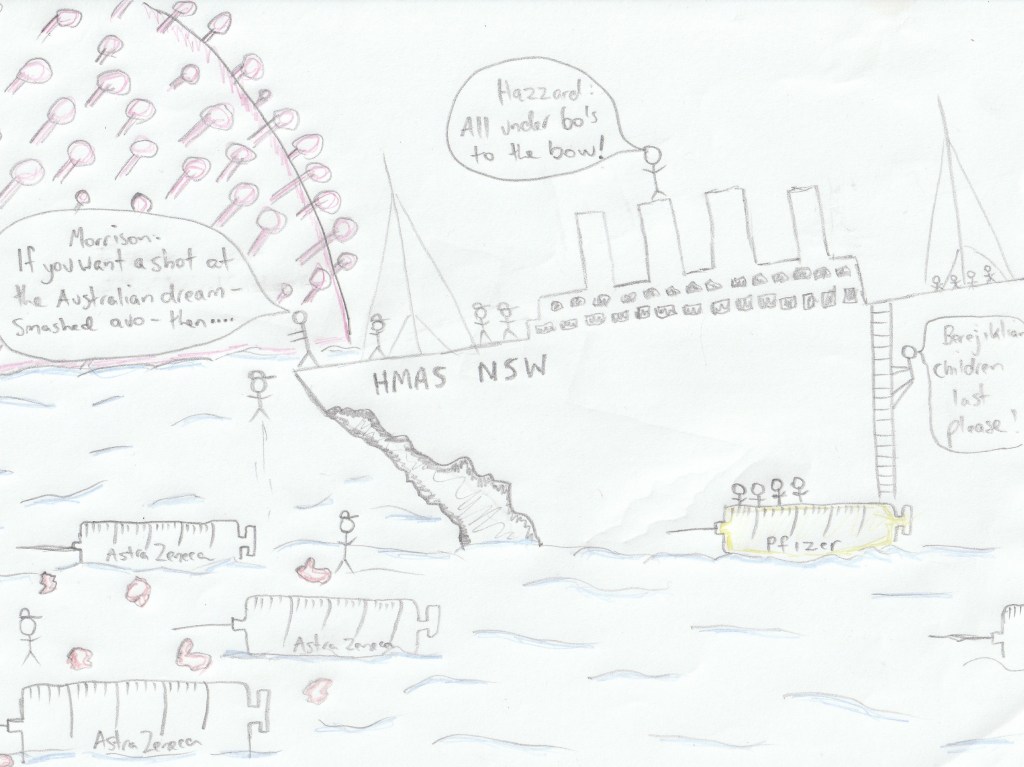
 MacroEdgo
You must be logged in to post a comment.