Note: I sent an earlier draft of this essay to the Editor of The Sydney Morning Herald hoping they would publish it.
With so much being said about the current state of NRL play – I refuse to call the game Rugby League as it now more closely resembles touchfootball with collisions and wrestling – in the runup to State of Origin I decided to watch the very first ‘Origin’ played at Lang Park in Brisbane in 1980 (It’s available for streaming on YouTube – first half and second half).
The game was an exhibition in (mostly) controlled aggression and attrition that held fans at Lang Park and viewing at home on television spellbound. That game spawned the most important sporting series among Australian traditional winter sports and its success was a major factor in the ‘Superleague War’ fought to gain control over Rugby League in Australia which amounted to the right to monetise the game.
Perhaps most notable to me, an avid viewer for all the years between, was the fatigue of the players by the time of the final siren with only one player being replaced, that being NSW secondrower Graham Wynn about 15 minutes into the game.
There were two obvious concussions in the game: Wally Lewis was left very groggy after accidental heavy contact with an opposing frontrower running through as a decoy, and commentators made mention that he had a number of head injuries in recent club games, and Greg Oliphant was heavily concussed trying to tackle a rampaging Graham Eadie alone front on around his hips. Both Queenslanders had outstanding performances.
There were some cheap shots, not as many as you might have expected given the reputation of that era, though Artie Beetson was probably responsible for over half of them. I wondered whether Artie was the only one on the field thinking forward to what it is he was creating. I’m not saying he was trying to create entertainment. No, he was trying to instil and create ‘passion’; it is, afterall, that authentic passion that creates the ‘Origin’ spectacle.
There was no gang tackling with three defenders hitting simultaneously as defensive lines were not condensed as they are nowadays, because they did not need to, and I do not recall seeing a single ‘shoulder charge’.
A young strapping Chris Close was a very deserved man of the match, but big Artie was an extremely close second with a long stretch to third best. If it were picked on sentimentality or crowd expectation, like it is often today, Artie probably would have gotten it. That would have been hard to argue with – described by the Queensland commentary team as “a mobile Cape Canaveral”, at 35 years of age he didn’t stop for the whole 80 minutes, he provided most of the intimidation for the young budding Queensland stars to cut through and open up the game, he offloaded almost at will, and he scrapped and tore at his opposing frontrowers in every scrum and every tackle.
What I appreciated the most was the creativity of the players. There was some one-out running – including a couple of incisive dashes from dummy half by Johnny Lang – but most plays involved at least a second pass if not a wrap-around interchange and there were many offloads. Creativity was necessary to struggle for ground with the ruck tighter due to slower play the ball speed and defenses only set back 5m. Typically each team in a 6-tackle set made 30m of ground including the kick with the heavier leather ball not travelling nearly as far. Under those settings not only did points carry a higher premium but errors in creative play were not necessarily punished which encouraged players to try a variety of tactics in offense.
While watching through the second half it dawned on me just how much that game mirrored our shared existence – gritty, at times messy, but requiring dogged determination, grit and perseverance. A genuine softening up period when the combatants ripped at each other emulated the struggle to get ahead for later, and it was necessary for once all the hard work was done play opened up for the dominant team to gain the rewards of that struggle.
Perhaps this left a level of satisfaction in the fans, that the rewards were somehow earned because they were hard-fought. Even the losing fans were satisfied that their players were exhausted and gave their all in the contest.
Nowadays fans sometimes question whether players really are passionate about the games, because they appear less exhausted, and fans often object to players on opposing teams posing for photographs together afterwards. This mateship before and after, mortal enemies during play, has always been a feature of the game. For many it is a sign of masculine maturity to leave it all on the field.
Fans understand what Roy Masters described in the SMH, that administrators only see games as a ‘product’, an ‘entertainment’ product. And everyone knows that entertainment is usually highly choreographed, and with an outcome if not necessarily pre-determined, much too critical to financial outcomes to leave entirely to chance.
The fans are also acutely aware of the high salaries these entertainers now receive, and so intuitively know they are key stakeholders in the monetisation of the ‘products’, which adds to that feeling of inauthenticity – that players don’t really hate the loss like they did when it was a game and not a product – after all, they’ll continue to receive that high income win or lose as long as the public continues to ‘consume’ the product.
That cynicism fits with our modern social media-addicted society. But fans don’t stop to realise that most players who actually get to play in the NRL have very short careers. In fact, half of all players that have played a game in the NRL ultimately played 37 or fewer games! Outside the high-profile players – mostly in the now much discussed ‘spine’ of playmakers – the incomes of the interchangeable, commoditised other players is much, much lower. It is these other players who most often suffer the repetitive head injuries which we understand better now and so results in shortened playing careers and all too often various cognitive declines while still young people.
In other words, players are very vulnerable – no matter how physically powerful and resilient – and so are prone to manipulation by those in powerful positions.
Kane Evans is a prime example of that vulnerability. A big, powerful, aggressive frontrower at over 110 kg, Kane played 131 NRL games for 3 different clubs and earned representative honours for NSW City, World All Stars and played 13 games for Fiji Bati. His increasingly erratic behaviour earned officiating reprimands prior to his career ending in 2021. This year it emerged that Kane was battling addiction and homelessness and was sleeping rough. He went public in May 2026 announcing that he was 100 days sober!
The Rugby League Players Association is doing an admirable job at ensuring that players and ex-players are supported. But none of us should underestimate just how very vulnerable these young people really are.
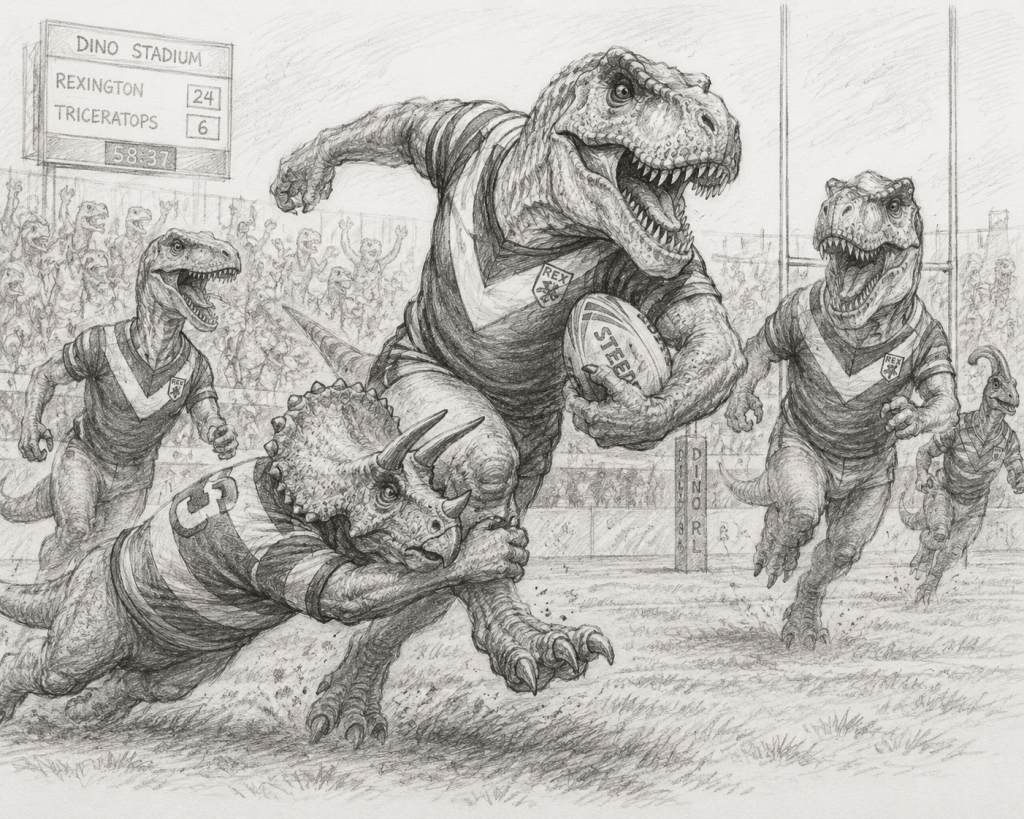
If what I’ve said to this point is not contentious enough, hopefully this will be. I have always been drawn to frontrowers with Tank Duncan in the Brisbane competition, Kangaroo captain Craig Young, and the kiwi Sorensen brothers Kurt and Dane being my first heroes. But frontrowers are now considered by many to be ‘dinosaurs’, and one (recently sacked) NRL coach said that it was good that some of the ‘cumbersome’ forwards were moving out of the game.
Perhaps the highest profile frontrower to leave the game this past year was Nelson Asofa-Solomona who voiced his disappointment saying, “I never stopped loving Rugby League, Rugby League stopped loving me!”
Many of the most highly rated frontrowers of today I don’t consider true frontrowers. While I respect how they’ve developed or adapted their playing style and physiques for success in the NRL (e.g. Addin Fonua-Blake and Terrell May*), I don’t actually respect their style of play because their main objective is to play the ball quickly not struggle for every cm of turf. However, we can’t blame players because they need to adapt to meet career and financial goals. It’s been a matter of necessity or survival, and we hear almost weekly how this player or that – all forwards – has been given the same warning to adapt or accept they will not play (any longer) in the NRL.
Give me a fit Jason Taumololo capable of skittling any defensive line, fit like big Artie was in the first ever Origin to keep grinding away for the whole 80 and not having to backpedal 10m while a dummy half sprints by after 4 previous boring one out runs ‘generated ruck speed’.
That’s Rugby League. The truth is that Rugby League is not played any longer in the NRL!
While this trend of increasingly manic ruck speed continues in the NRL, rule changes will be commonplace, and soon one of them will be that the dummy half can’t score just as it is in touchfootball. Even more likely, with tries so devalued as entertainment due to their high frequency, fans will soon be called upon to judge them before points are decided like in diving or rhythmic gymnastics. Imagine the opportunities for ‘joint ventures’ with gambling apps in that!
The truth, however, is that I’ve seen enough to know that I don’t like the game that is being played and although I love my club and the Maroons, I just can’t bear to watch this Frankenstein touchfootball with collisions and wrestling any longer. And note, I didn’t mention the 6 agains above because the damage was already done before that rule change that appears to have broken the backs of very many other fans.
Unless rule changes and refereeing interpretations which massively favour offense over defense are reversed, I will cease to be a fan and ‘consumer’ of the NRL. To soothe my sadness, next year at Origin time I will create a new tradition in my home – several years ago my family bought for me the full DVD collection of all Origin series, and we will watch together the corresponding game number from the early years of Origin when they still played Rugby League.
There is one question that should be answered for all NRL fans – to what and whose ends are being met with this continual speeding up so that the game now more closely resembles touchfootball with collisions and wrestling?
I can only guess that the adminstrators believe it is the pathway to attracting more marginal viewers and gamblers who have no long term interest in the game.
So a question I believe all other longterm fans of Rugby League should ask themselves – do you really care whether our games out-rate AFL, and do you really want our game marketed to Americans? (I mean all the hoopla by V’Landys over whether Trump likes the game and if he would come to watch it in Vegas says everything!)
Longterm fans of Rugby League never needed others to appreciate our game – we already knew how special it was – now administrators have so bastardised the game that it is almost unrecognisable as Rugby League, so much so that frontrowers are labelled too ‘cumbersome’ to play our game – ‘dinosaurs’.
Seriously, to what and whose ends are all these changes made?
I believe there is only one plausible answer: for the ego of administrators and to make fat cat rich bastards even richer.
That’s the very antipathy of what Rugby League was about. But it is the very essence of what Extreme capitalism is about.
Rugby League, I miss you, but I have to accept that if you can’t come back from the brink of extinction this year, you never will.
* It’s uncharacteristic of me to be critical of individual players so I’ll explain. Real Rugby League fans have always admired those who play ‘bigger’, and here I would include Rueben Cotter (who epitomises this so any fan will immediately know what I mean) and even Pat Carrigan. But the fronrowers I mentioned play ‘smaller’ and it’s a new thing caused by the manic speed of the game.
“We have learned that we cannot live alone, at peace; that our own well-being is dependent on the well-being of other nations far away. We have learned that we must live as men, not as ostriches, nor as dogs in the manger. We have learned to be citizens of the world, members of the human community.” President Franklin Roosevelt’s 4th Inauguration speech, as WWII drew to an end (he died before the atomic bombs were dropped.).
© Copyright Brett Edgerton 2026


You must be logged in to post a comment.