End Racism!

That the statement above the photo is relevant to me as an individual means that it is of equal relevance to my nation… We can never deal with our issues if we lack the courage to “pull back the carpet” and admit to our failings… Admitting errors and failings is what takes true courage, not the toxic masculinity crap that the racists’ “heroes” go on with on their pay tv megaphone… It is time for those with the real courage to stand up and use words, compassion and yes, love (that most frightening thing of all to the emotionally-challenged – vulnerability), to denounce the aggressive and divisive language from those whose egos prevent them from admitting they idolised an “unhinged” turkey in a suit for 4 years… they seem intent on growing their hate in our home so the time for timidity and fence-sitting has passed… It is time that racists really knew they are the true minority in our proudly fair and humble nation…


Gained value from these words and ideas? Consider supporting my work at GoFundMe


© Copyright Brett Edgerton 2021

Racism and Political Correctness

It is time that I explicitly state my views on racism. The issue which I consider goes right to the heart of dealing with racism in Australia is political correctness, which is ironic because political correctness is perhaps the most often stated justification by racists for the need to express their beliefs. 

The racists’ argument infers that it is entirely natural for humans to be suspicious of others who are different, and that turns to anger and resentment when a “higher society” – of intellectual “elites” – enforces a moral political correctness upon all people to behave in a polite manner contrary to this nature. The racists blame this political correctness for causing a bottling up of emotion so that when it comes out in anger, whether from a bald-headed aggressive youth or in the quivering voice of an Ipswich fish and chips shop owner, it is all the fault of those in this “higher society” who impinged on their freedom of speech not through law but through societal pressure.

There is even an element of honour in openly expressing their dislike of minorities, from the racists’ perspective, in that it is morally preferable to behave consistently with their real values rather than to pretend to have the other “politically correct” values. They consider themselves more “authentic“.

Everybody who lived through the emergence of Pauline Hanson knows that her supporters frequently stated that she was just saying what everybody thought. Then living in conservative northern Queensland, I heard it often and I will never forget who were the members of my large extended family who proudly and defiantly told me, with my Asian-Australian wife at my side, how they were Pauline Hanson supporters.

The irony around political correctness and racism is that, while it most certainly is a major factor, the racists are actually benefitting or being aided from it. 

Racists are given a great deal of leeway in their comments and actions because others are timid and reluctant to call them out for what they are for fear of being offensive themselves.

This makes virtually everybody in society afraid of discussing racism and what constitutes racist beliefs and actions. It is impolite to even discuss it in company.

This is perhaps the most serious impediment to defeating the scourge as it is obvious that no problem can ever be truly addressed if there are only ever vague and obtuse references to the issues.

I have a particularly personal but pertinent anecdote to highlight this point.

Last year I received a call from my youngest son’s School Principal informing me that my son had stood up to another student by calmly responding to racist comments that the student made. When I discussed the incident with my son he confirmed it was the student who I knew, from previous incidents, was frequently in disciplinary trouble. The comments made were about Asians and coronavirus, but were not specifically directed at my son. I allowed my son to slowly discuss all of the events and how he felt. Eventually it became clear that this student had made racist comments before, and my son had relayed that as a part of his recount to the senior teacher who had addressed the problem first before informing the Principal.

The real issue became apparent when I asked my son how that senior teacher dealt with it, and how that made him feel. My son felt that the teacher down-played the actions and comments of the student, and that made him feel foolish for objecting to what was said so much so that he felt it was pointless, if not distressing, to stand up to this behaviour.

The next day I rang the Principal and informed him of how this senior teacher had reacted. My son was a School Captain so was highly regarded by the school and worked frequently with the Principal. The Principal defended his staff member, which on the one hand is understandable, but what he said was poignant: he said that it is a fine line for teachers to tread with beliefs taught at home, and so they usually try to steer clear of the issue. 

I informed him that the upshot of the interaction was that my son felt foolish for what was in fact very honourable actions, and that my son needed and deserved positive reinforcement from the school at least privately if not publicly. The other student and their class cohorts also received those weak messages about respecting diversity publicly. The Principal undertook to speak with my son to clarify that message, but never did. My son did, however, receive the leadership award for his cohort which was perhaps a veiled hat-tip to his honourable actions then and through the year. However, avoidance or obtuse acknowledgement is less than satisfactory.

Now in writing this I know that racists will suggest that it is not up to anybody to say who acted honourably in this specific situation.

Therein lies the problem with political correctness over racism – it is clear-cut in Australian society – racism is wrong and standing up against racism most definitely is honourable and should be praised by all.

That is not up for debate and anybody who suggests it is debatable is not being respectful of broad contemporary Australian society.

That political leaders are weak on this message is what breeds timidity – or “political correctness” – on spelling out what is racism in the broad context of Australian society.


This reluctance to explicitly call somebody racist in many ways emboldens racists because they revel in timidity, like all bullies. 

Take, for instance, Trump and his allies. I cannot recall any high-profile journalist or commentator calling Trump a racist, and it was not until late in the Presidential campaign when Biden did. There is also a timidity in calling others around Trump racists.

Trump often even goaded others to go ahead and call him a racist, which nobody did, also a frequent tactic of bullies.

It would seem that the strongest language those acting in a professional capacity use is to suggest that somebody has made comments with xenophobic undertones or that they are in some way associated with xenophobic elements. This is displaying timid political correctness at two levels – it dissociates the acts from that person and who they are or what they stand for, and the term “xenophobe” is a more timid term than “racist”.

The threshold for calling somebody racist is incredibly high.

Just imagine yourself saying the words, “you are racist”. Immediately you will recognise these as very strong words.

Most people have an aversion to hurting or insulting others, and will usually err on the side of caution rather than risking being overly harsh or judgmental.

What has become apparent to me over the years is that the unscrupulous most often commit wrong against others by using the goodness and trust at the core of human beings, whether it be a criminal who waits for an unsuspecting victim to open a door to them or stops their vehicle to help them, or cons who scam victims into providing personal details over the phone, through the internet or directly.

In the same way aggressive racists capitalise on and exploit our timidity in avoiding calling out exactly what and who they are.


This timidity in addressing racism must be counteracted from the earliest moments that children enter broader society and certainly within the education system. Racism is misguided thinking that must be corrected like any other misguided or anti-social behaviour that is addressed within schools by childhood education professionals. Unfortunately, the observations of my children again suggest this is not the case in Australia. 

Now I do not want to be, nor do I wish to appear to be – there’s that political correctness again – overcritical of my sons’ primary school, but this anecdote really does bear repeating.

Both of my sons were taught by an elderly, cantankerous supply teacher who actually used the racist version of Eeny, Meeny, Miny, Moe, which obviously incorporates the “N” word, in her classes. 

Here, I would not be authentic, myself, if I did not make a serious confession. This racist version was actually the only version that I knew from my childhood, and one day when I heard my children saying “Tigger” my initial impulse was to correct them, which of course brought on a conversation with my wife. I had never said this rhyme again since my early childhood, and so I had never thought about what the words actually meant. My initial reaction was to think that that is so shocking that we children would be taught this, and say it so openly in front of everybody – teachers, parents and other adults – that there had to be another meaning for the “N” word. As I sat there and thought about it with my wife, the realisation washed over me – especially as I thought of the context in which the words are said – that in deed it was an extremely racist rhyme. There is no other meaning for the “N” word and it is undeniably racist. It is incredible to think now that we children of the 70s in northern Queensland would recite that rhyme, made even more despicable since we grew up with many indigenous children who were our friends and team mates.

So I have to admit that I can understand a certain level of ignorance can exist. But once an adult says the words, even in their own mind, within a very brief period it should be entirely clear how utterly inappropriate it is. That any teacher in Australia would recite that rhyme to children in the 21st century is almost beyond belief. 

It shows that in Australia the education system must not take anything for granted when it comes to racism, and that rigorous diversity and inclusion programs for all of their staff as well as in the curricula which is taught to children must be implemented as a matter of urgency.

This is absolutely critical as there is a growing awareness of the importance of educating role models on diversity and inclusion as an intervention to racism culminating in radicalisation .

Research conducted prior to the COVID-19 pandemic showed that 1 in 3 Australian Australian school students were the victim of discrimination.

East Asian students reported the highest rate of insults or name calling on the basis of their background at 44%, while 30% of Aboriginal or Torres Strait Island students surveyed reported having students spit, push or hit them on the basis of their race.

Among Anglo-Celtic students 15% said they had been insulted on the basis of their background, while 6% reported being subject to violence.

The report was compiled as part of the Speak Out Against Racism program, which is developing a program to encourage students and staff to address racism in schools.

“We need high-quality, whole-of-school programs – built on evidence and which are tested – that act to directly prevent and appropriately respond to racial discrimination and racism when it happens,” Priest said.


To be entirely honest, I believe this timidity goes even further in that it seems that very many Australians are reluctant to express open support for diversity and multiculturalism in their day to day activities such as on social media. For instance my experience is that few will show open support for underprivileged minorities, or for the poor in developing countries, or for refugees experiencing difficult circumstances.

Perhaps this is a part of the politicisation of refugees and migration by populists or populist-leaning Governments, especially by the Howard Government in the 2001 Australian Federal election, and then the reluctance by mainstream politicians to speak out against the racism inherent in such positions for fear of disenfranchising racist voters.

Thus a reluctance to show support for other struggling human beings, sometimes in desperate situations, is confused by some as being political.

Is it truly being political identifying these people as being worthy of empathy and help?

Or is it just a lack of courage to show explicit support for these people out of fear of being seen as having views outside the range of popular opinion?


Australia has long had a problem with admitting to our racist past along with our contemporary racism. There is a reluctance in admitting the injustices committed upon indigenous Australians and in the long enforcement of the White Australia Policy. Minorities in contemporary Australia face discrimination and bias in many forms, including in the workplace where research has shown that people with obvious minority names are significantly less likely to be contacted for interviews from submitting job applications. 

To get as many interviews as an Anglo applicant with an Anglo-sounding name, an Indigenous person must submit 35 per cent more applications, a Chinese person must submit 68 per cent more applications, an Italian person must submit 12 per cent more applications, and a Middle Eastern person 64 per cent more applications.

Within Australian society, I doubt that there has ever been a poll asking people about how racist they consider themselves – whether overtly racist; or racist within social circles (i.e. making “insider” jokes and snide comments but never expressing those views to others directly or indirectly such as online); or somewhat aware that unconscious biases affect their attitudes, behaviours and decisions; or not at all racist or biased against anybody from another ethnicity.

Now that the reader has likely responded in their own mind on how they might have answered in this hypothetical survey, I am going to challenge that response with personal anecdotes.

My wife and I had two close friends, in different social circles, who were unattached and we thought it might be nice to arrange for them to meet casually. I approached my friend to discretely learn whether there was any interest, only informing them that the person is a great person and is Asian-Australian. Quickly my friend responded that they were not attracted to that “type” of person, and given the only other information they knew was they are friends with us also, it was clear it was because they were of Asian ancestry. 

I am guessing that some readers will immediately consider that there likely was some other reason.

It has certainly been my experience that when I do raise the issue of racism and about racist actions displayed, including by somebody other than whom I am speaking with, the initial reaction very often is to deny that the actions were racist or biased.

So let me introduce a “sub-anecdote” where it was more explicit – not all that long ago a friend/acquaintance of my wife actually said to her “I’m not into Asians” when talking about meeting up with women from Apps.

So here is the simple question – can you imagine yourself developing feelings for and/or being attracted to somebody from any ethnic background?

If you cannot answer yes to yourself truthfully, then I suggest that you need to seriously and honestly look at why that is and consider that in the context of how you answered the initial question.

The other anecdote is something that was said to my wife several times as a young adult by friends in Australia. When the issue of her own differences have arisen in discussion, the friends, no doubt trying to express their affection for and connection with her, have said that they do not consider her black or Asian.

Now this statement is a real double-edged sword to somebody from a minority struggling to fit in. On the one hand it says that they are accepted. On the other it says that they have been accepted in the context in which the friend chooses to see them and not as they truly are. 

Most people from minorities in Australia will recognise this type of sentiment and that it comes with significant pressure to assimilate or conform to societal views on what it is to be “Australian”.

Now it is true that some may have clumsily attempted to express that all that matters is that my wife is a good person, and that her appearance which confirms her ethnicity is no more significant than her hair colour or height (or lack of it!)

Equally, it is worth pondering how the friend might have responded to, “that’s great because I don’t consider you white or Australian”, and whether that might have offended them or given them pause to consider whether that statement was racist or biased.


There are two things that I know with certainty: we as a nation and as individuals can not hold ourselves to account for our racist beliefs and actions if we are not honest with ourselves, and we can not eliminate racism if we do not lose our political correctness around calling out racism when we see or experience it. 

Finally, if the reader is wondering whether I consider my own extended family members who support Pauline Hanson to be racist, you better believe I do, along with others who were “politically correct” enough to not confrontingly tell me of their support for her and for what she stood. I do have to admit, though, that until now I was too politically correct to say so…


Gained value from these words and ideas? Consider supporting my work at GoFundMe


© Copyright Brett Edgerton 2021

The Great Reset: Building the bridge

What would you think if I sang out of tune?
Would you stand up and walk out on me?
Lend me your ears and I’ll sing you a song
And I’ll try not to sing out of key

Oh, I get by with a little help from my friends
Mm, I get high with a little help from my friends
Mm, gonna try with a little help from my friends

Lyrics of John Lennon and Paul McCartney

I have a confession to make. I may be a professionally trained scientist, but when I have an x-ray performed I do not analyse the film myself as I struggle to make head nor tail of it. I guess I have had perhaps 20 x-rays taken in my life of 50+ years and I am just not practiced enough at it to understand what I am looking at. I am certain that if I took the time to study all of the relevant detail I could begin to understand what is involved, but without looking at hundreds of films of various parts of the body, and refreshing those skills regularly, I do not think that I would trust myself to give an accurate diagnosis of any issues I might have when I really needed to.

I have another confession. When I enter the lift of a high-rise building I do not first check the maintenance log to ensure that it has been maintained in good working order. To be totally honest, I am not even really sure how lifts work. I know the earliest ones were based on a counter-balance system, but I suspect these modern ones that move so fast do so with an entirely different mechanism.

Don’t get me started on cars let alone planes. Truthfully, I am just not a very mechanical person. It never interested me. Perhaps in that regard I was spoiled by having a father that could fix anything so when working on our family farm as a lad, if I broke or bogged it, Dad came to the rescue! It was just most practical to him to solve the issue quickly so he and I could get back to work asap. I am sure that if I did stay on the farm I would have developed these skills, as even now I am constantly amazed at what I picked up from observing as a lad how my father worked, but my life took me in a different direction so I have less need of these skills in my day to day life.

I know that it would probably be advantageous for me to understand all of these things, since they are obviously really critical to my health and well-being, but I just do not have the time, nor the inclination to be totally frank. I guess I have just been raised to trust the people who do these jobs for me. And when I think about it, my life is full of, and is entirely dependent on, placing a whole heap of trust on these people who perform these critical roles for me.

I think we all do, and have done since we left caves when life was simpler, but tougher, even though I do not in any way minimise the skill it must have taken to sharpen weapons to hunt successfully for food and ward off danger.

I was once an expert. I was one of the best human beings in the world that you could contact if you had a problem with disease while farming crustaceans, or if you noticed crustaceans dying in a stream or pond. Or even in your aquarium. 

On one occasion, when I lived in France, I met some people whose job it was to manage the natural environment around a small village in a remote mountainous area and they were concerned about the precious and endangered crayfish dying in their streams. I visited their village, just in behind where the famous wine Crozes Hermitage is made, and I collected the dead and dying crayfish for examination. I was able to show, using a light microscope and electron microscope together with the skills that I had honed over the previous 10 years of my life, that all of these sick and dying crayfish were infected by a virus. It was the first time a virus had been identified in this crayfish species, and only the second virus found in European crayfish (I also found the first a few years earlier in crayfish in Finland). 

Very few people in the world had the capacity and skills to do it – some, who even had reasonable training in veterinary science, had tried but were not quite getting things right to be able to find viruses in European crayfish. But I had a passion for it and I was particularly skilled. I guess it is a bit esoteric and very specific or specialised, probably why it was such a struggle trying to maintain a career doing that work, but that is another story. Then again, with a global population of over 7 billion there is a great need for knowledge on a whole heap of apparently obscure fields.

It used to be difficult to find people with these rare knowledge and skills, but the internet has changed that. I had a “Crayfish Diseases” website in 1996!

The truth is that what I do know pales in comparison to what I do not even though all of this accumulated knowledge and skill is imperative to the modern life I live. Essentially my confessions on things that I do not know, or benefit from without really understanding them, could run on ad infinitum

But I actually have a really big confession to make which some who have read my essays, with tightening muscles around the neck and hair bristling on the back with contempt at what I said, might even jump up and down about. I may be a professionally trained scientist, but I did not specialise in an area that is especially relevant to studying and analysing climate change trends. I am keenly interested in the subject, and have read reviews so that over the years I have developed an overwhelming impression that the very great majority of scientists who have specialised in the most relevant fields have increasingly become concerned by the trends that they have observed. 

That concern certainly seems to be backed up by what we are seeing and experiencing in real life, even if it is not particularly scientific to rely on anecdotal observations. I recall that when I spent 3 months in Finland in 1995 during their summer they had a record heat wave so that temperatures went above 30C. My Finnish friends tell me that they have hardly had a Summer since when temperatures did not breach 30C. A few days ago I read about the scientific research showing the shrinking Arctic sea ice and the article mentioned how a town in Siberia recorded 38C this year!

Finland 1995

By now we are all familiar with the forecasts of more extreme weather, sea level rise, effects on animal and plant life, and ultimately on us human beings.

I, personally, place a great deal of trust in the overwhelming majority of climate scientists who argue that humanity confronts a climate crisis. 

This comes from the same place where I gain my trust to do all of the things that I want or need to do in my life. I have a strong belief and optimism in the goodness at the core of human beings, and I understand that human beings specialising in specific roles in societies has been the greatest factor in human progress towards our very successful form of social organisation, free market capitalism. (Though that does not mean that we do not always need to stay alert and engaged to ensure that the system continues to serve us all).

Now, of course, not all of the human beings who have specialised in researching and understanding the natural world and climate trends agree. That would really worry me if there was no place for disagreement. No, free and open debate is absolutely vital in all facets of human endeavour. That there are some who disagree with the majority on climate change is a healthy sign that the system works and that is to be treasured.

Nonetheless, it really is clearcut that the majority of scientists who know the most about the relevant fields agree that humanity faces a climate crisis of our own making.

It really is time to stop acting like this needs to be a unanimous decision, or like any Tom, Dick or Karen who has picked up climatology in their spare time should be listened to even if they have a FaceBook page, or blog, or plain old-fashioned website.

Those still arguing over the need to act on climate change are already well behind. The majority of key decision-makers in Governments, business and across broader societies are moving on with or without them because, frankly, we cannot afford to wait any longer before taking meaningful action.

Any politician, and nation they “lead”, in denial over any of this is becoming increasingly isolated, and that will surely continue for as long as they continue their denial.


We now find ourselves in 2021 heading towards more critical global meetings on climate change. One of the first is being hosted by the World Economic Forum as a part of the initiative “The Great Reset” that I discussed in “The Great Reset: Momentum builds with the World Economic Forum agenda” and which encompasses a broad aspiration of engaging all people in the development of a fair, diverse and equitable, and sustainable future for humanity.

This initiative is essentially identical to what I have called for in my writing at MacroEdgo including in my essay entitled “The Great Reset” which I published two months ahead of the WEF initiative launch.

The WEF initiative has been singled out for suspicion and conspiracy theories by elements aligned with Trumpism. These theories centre around a view that the powerful elites are exploiting the vulnerability experienced by humanity in the COVID-19 pandemic to tilt the playing field – or the Monopoly board – even further to their advantage.

For me it has always been an amazing irony that the most elitist of all, Trump himself, had amassed such a strong following amongst those who have become dissaffected as the already privileged – many of them Trump’s friends – took a greater share of the bounty from their shared society.

The apparatus around Trump and those in his orbit have created a narrative that the aim of the WEF is to impose their agenda in an enormous abuse of power, derived from their wealth, in a dictatorial manner.

In this increasingly polarised world, those who oppose Trump feared that this was actually his playbook, and Trump’s reluctance to accept the election result confirmed as much for many.

That 74+ million American voters wanted another 4 years, at least, of Trump “leadership” speaks loudly of that polarisation and of the resources that this apparatus commands in asserting their divisive agenda.

The obvious response is that, like my own writing continually calling on everyone to engage with discussions on the best direction for humanity to emerge from the COVID-19 pandemic, the WEF is imploring all to engage with the discussion and to express a viewpoint.

Perhaps the greatest irony is that Trump is, and has done since first running for the Presidency, also calling for a reset. He calls it “Making America Great Again”, yet he does not define what made it great in a former period.

My own writing also talks about taking America and humanity back to a former greatness, the vision laid out by one of the greatest US presidents – FDR.

In other words, Trump and his associates could actually be calling for the same thing that I am. 

But we know from Trump’s messaging, and those he courts, that his reset is for a divisive and unsustainable future – the polar opposite of mine and the WEF’s published views on the direction humanity must take.


For an organisation that is painted in these conspiracy theories as secretive and dictatorial, the WEF has not done a good job of keeping a low-profile over the years with their highly televised annual gathering normally held in Davos, Switzerland.

Moreover, that the WEF has devoted so many resources to promote an open discussion on “The Great Reset” initiative, with their significant materials on their website and in a Time Magazine expose, suggestions that they are trying to secretly and dictatorially impose their agenda on humanity are clearly not grounded in reality!

Those who promote these conspiracy theories infer that there is something unusual or wrong about a group or subset  of people gathering to discuss important issues and making important decisions on behalf of all in our societies. But of course that is how human beings have preferred to organise for a long time including in cultures from thousands of years earlier. 

What is more, though we all have an opportunity to be involved with decision-making for many organisations important to us, whether school communities, sporting clubs or other groupings, not everybody has a desire to join committees and other structures that directly make decisions. People tend to prefer to perform certain roles, and obviously not all can be in leadership or decision-making roles.

However, and it is an important however, all within any grouping of human beings need to feel that their desires and views are taken on board by those who lead and make decisions. 

Of course that is the basis of representative Government, and it is the situation in functional democracies and even many autocracies that otherwise would be at risk of overthrow by a disenfranchised populace.

One aspect of the conspiracy theories seems to be that unelected people, from business and non-Governmental organisations, are involved in these discussions – in fact it is businesspeople initiating the discussions – which has been perceived as them having undue influence on decisions.

Again, this is a natural response to politicians withdrawing from their role as leaders, and to them not listening to scientists and to the will of the majority in society who trust the scientists.

What is more, just because the leaders of these organisations (of human beings) have not been elected does not mean that they do not have diverse and broad stakeholders that are able to assert significant pressure when dissatisfied with the direction the organisation is heading. In fact, stakeholder activism is increasingly common, and businesspeople are well aware of it, not least because investment managers have recognised this and some are specialising in such areas. 

Generally the business elites least likely to respond positively to this imposition of broad societal will are those in the Trump orbit, because it challenges their (sociopathic?) need for unchallenged control and power.

The story is deeper, however, because even those on the extreme left – many of whom believe that recent events prove that capitalism is a failed system that cannot be repaired – do not trust the WEF for many of the same reasons and because they find the combined wealth of the business elite offensive in this deeply inequitable world. While I am superficially sympathetic to those feelings in relation to that inequity, I explained in “How Might Milton Friedman Respond To The COVID-19 Pandemic” why this too is flawed logic.

This situation reminds me of a lesson I learned whilst a Humboldt Fellow in Germany in 2002. Over a weekend gathering in Berlin, culminating with a function hosted by the President of Germany, my wife and I befriended two Czeck republic scientists. I recall talking about their opening up after the fall of the iron curtin just over a decade earlier. It was a difficult reality for them to accept that many of the people who were in positions of power under communist rule had managed to keep those or similar influential positions.

The inescapable pragmatism of the situation was that the necessary resetting of their system was highly dependent on utilising those with appropriately developed skills to ensure the continuity of societal functions even if emotionally they might be seen as representing vestiges of a deeply inequitable and often cruel regime. Mao’s cultural revolution in China, sending doctors to villages to be farmers, and other ill-conceived ideas, which led to famine and starvation on an enormous scale, was a lesson for all of humanity.

I see few business elites in as dim a light. Those I do view dimly I perceive mostly as being afflicted with personal greed and toxic aspiration which leads to them acting in their own interest above what is best for broader society.

In “The Great Reset: Momentum builds with the World Economic Forum agenda” I admitted that I consider myself incapable of being a “player” (or a significant “actor”) because I lack political aptitude, that being the skills necessary to influence and lead large groups of people. I do honestly consider them to be rare skills, and not always possessed by those in leadership roles.

Even those with extreme views on wealth must recognise the pragmatism in harnessing the skills of the business elites to enact the necessary deep reforms to place humanity on the surer, equitable and sustainable footing that we desire and require urgently.

Again, what we need is trust and optimism in the goodness at the core of humanity. And a recognition that there really are authentic leaders across all of society.


Specialisation is one of if not the key achievement of humanity. Instead of us all working hard to be okay at all of the skills we need to survive – from securing the necessities of life in water, food and shelter – we have developed societies so that we trust others to do the majority of our vital tasks. That has freed up our minds and time for us to innovate and create both in our roles that we play in our societies and for enjoyment.

The great majority of human beings in most global societies accept and trust the views of the great majority of climate scientists, who have devoted their lives to their work, and who agree that humanity must urgently respond to a climate crisis of our making. 

These scientists even agree on what must be done to address the crisis. 

Now humanity needs the people who are specialised in politics, leadership and communication, together with the people who manage businesses globally and regionally, to lay the background and institute the changes in an urgent manner. And we need the people who really understand people and culture to ensure that diversity, inclusion and fairness is at the centre of all decisions.

Just as we all do not need to understand the engineering and construction of a physical bridge, we all need to show the same trust in those capable of building a strong bridge which we can cross to a better future for humanity.

This year that begins with the WEF “The Great Reset” initiative at its first meeting (of a unique twin summit format) held in January promising an “an open house policy to integrate all interested citizens into this dialogue”.


Gained value from these words and ideas? Consider supporting my work at GoFundMe


© Copyright Brett Edgerton 2021

The Great Reset: Momentum builds with the World Economic Forum agenda

I spent most of February and the first half of March 2020 banging away on my keyboard trying to wake up my fellow Australian residents to the risks of the coming COVID-19 pandemic so that through political self-interest elected politicians would enact policies necessary to protect those within the Australian borders and to help as best we can with international efforts. Events over Christmas 2020, with slow and incomplete responses by New South Wales to a potentially dangerous cluster and by the Commonwealth Government to potentially dangerous variants from the United Kingdom and South Africa, show that work will never be truly complete in this pandemic.

Early in the pandemic the Australian Prime Minister was following his natural ideologues in the US and UK in downplaying the risks. Even in mid-March Mr. Morrison was more interested in ensuring that we attend sporting events than prepare the country for what lay ahead.

This from my “Coronavirus Update” of 3 March fills the canvass:

In Australia our Prime Minister and Chief Medical Officer, counter to Dr Tedros’ recommendations for people in high risk categories to begin reducing social interaction, are encouraging all Australians to maintain their normal practices, with both eyes on the economic data!

The similarities in the COVID-19-related thoughts and actions of Donald Trump in the US, Borris Johnson in the UK, and Scott Morrison in Australia are both striking and concerning.

Oh and Australia is still going ahead with the opening of the Formula 1 season on 15 March. Boy will some be sweating in their shorts about that all working out without (apparent) incident.

Of course the Formula 1 was cancelled on the first day of practice due to COVID-19 infections amongst some teams, with spectators crowded around the entrances.

Eventually the international border of our island continent closed as of 19 March, but the PM still was reluctant to take the necessary measures to take full advantage of our isolation and go for elimination. In “Australian ‘Followship’” published 23 March I was exasperated:

OK, I have just about exhausted myself in prosecuting this case. I do not know whether I will manage it, but my aim is to cease pointing out the defincies in the Australian response because I fear it is all pointless at this stage. Our advantage in battling the pandemic was not taken. And some times it is just too difficult to fight against the reality that “The First Victim of War is the Truth“.

I aim to add some more positive pieces to assist my nation and broader humanity endure this our toughest immediate challenge.

Seven days later on 30 March, almost 9 months ago, I published at MacroEdgo an essay entitled “The Great Reset” which detailed my views on the likely consequences of the pandemic on global societies and I proposed an approach – or a mindset – for emerging from the crisis in a better position by placing humanity on a path to a sustainable future. I also posted the essay at Medium.com on the same day.

The foreword reads:

This is a post of hope. Of promise. Of potential within our grasp if we have the courage to reach for it. The commencement discusses markets because they give a verifiable account of the slow reaction to the threat that COVID-19 posed to humanity. The latter discussion opens up to encompass implications and aspirations for humanity.

In a key passage I explained those aspirations:

I believe that if the current most urgent battle against COVID-19, followed by the equally necessary and increasingly urgent fight against the climate crisis, is handled with adept leadership, we have every chance of having a very rare psychological reset which could set up the global community for the next half century. It will be a much more humane and equitable one if we follow the edict of FDR as brilliantly articulated in his 4th Inauguration speech, and if the lessons of needing to stand up to hard-hearted right wingers and imperialists is heeded from the record of FDRs loyal and loving son Elliot Roosevelt in “As He Saw It” which recounted events immediately after FDR’s all too early passing as WW2 drew to an end and in the immediate post-war period.

I put everything I had into the conclusion:

Be in no doubt that there will be hard-hearted factions that want things to go back as closely as possible to the inequitable and unfair world that existed before this war [against the COVID-19 pandemic] because that is the game that they know how to win. That is exactly what was occurring in the post-GFC period. There will even be others who want to tilt things further to their advantage. These are the people that like to say that “a good crisis should never be wasted” and you just need to read Elliot Roosevelt’s “How He Saw It” to understand how that occurs.

Ask yourself this: Do we really want to get through all of this hurt, of the realisation that we are all humans, fearing and hurt by the same things, and come out the other side of this battle against COVID-19 to enter into the same petty argument of the reality of the climate change crisis with hard-hearted right wingers behaving petulantly not accepting that they are in the wrong?

If this battle against COVID-19 proves nothings else it shows that all our fates on this beautiful planet are inextricably linked. The only sustainable way forward for humanity is united and time and effort spent moving in the other direction is an utter waste and dangerous to us all.

Let this be the Great Reset that puts humanity back on the track that perhaps the greatest US President ever wanted for us all!

I would include the Australian Governments’ actions to further limit employee’s rights – in the name of workplace flexibility – as a prime example of using the COVID-19 crisis to tilt the situation even further to the advantage of the elites.

My “The Great Reset” essay was a further evolution and expansion of my views that I had been developing in earlier essays including “Xenophobia Must Be Challenged For An Effective Climate Change Response Inclusive Of Population Growth“, “Let’s Wage War On Climate Change“, “Social Cohesion: The best vaccine against crises“, “The Conundrum Humanity Faces But Nobody Admits“, and “The Magic Sauce Of American Economic Dynamism Is Not Personal Greed“.

In the second essay in “The Great Reset” series, “The Great Reset: Teaching what we left behind“, published 20 June 2020, I continued to impress that now is a moment for reflection and engagement:

Not everything was better in the past, not by a long shot. But for all of the heartache that the COVID-19 pandemic has caused, for all of the harsh impacts on humanity, we all owe it to the victims of the pandemic and to each other to take a long hard look at where things were heading before the pandemic and to be courageous enough to dream of how we want to emerge. 

Regardless of whether we want certain trends reversed, redirected or accelerated, we will need to be prepared to ensure that we have our views heard and acted upon.

I concluded “How Society Will Change If A COVID-19 Vaccine Is Elusive“, published 17 July, with a reference back to “The Great Reset” era and a restatement of what is at stake:

To this point [in the pandemic] decisions have been made mainly by elected officials. Increasingly going forward those decisions will be made by individuals. Collectively those decisions will have significant impacts on society, and the longer and greater the COVID-19 affects are felt, the greater the change in the way society behaves.

That, in a nutshell, is “The Great Reset“. It has already begun and it is irreversible.

High quality, effective leadership will nurture it so that the best outcomes are realised to the benefit of humanity. Scoundrels will try to harness it to bend society to a more warped and less inclusive version. We all must show leadership and engage with the process to achieve the best outcome for ourselves and those we love, and those who succeed us. And we should all prepare to be flexible and supple in thought to make the best decisions that we can with the information that we have as we emerge from the shock of our altered existence and as our future comes into clearer focus.


Through 2020 I have managed to lay down some views on longer term issues for humanity, but my focus has necessarily been mostly trained on the here and now.

In Australia I have tried to constructively influence authorities’ policies around international border closures, developing an elimination strategy (social isolation, lockdowns and school closures), biosecurity around potentially contaminated processed meat, biosecurity with regards to other animals susceptible to infection, and most recently guarding against complacency and focusing on minimising spread through Summer so that Australia enters the critical Autumn/Winter period in a favourable position. At the same time I have tried to be a supportive friend to somebody who deserves so much more credit than she has received – in Dr Shi Zhengli – as well as support my family through this challenging period.

Nonetheless after publishing “The Great Reset” I remained alert to mentions of a “reset” or “great reset” when reading media and I did notice some echoes of “reset” in the Australian press and in this webinar series in May/June. In October I began noticing mentions of “The Great Reset” in the press and business media. While writing a piece drawing on information from a McKinsey report I learnt that they had adopted it as the title of a series of reports on COVID-19.

It was not until I read an article in The Guardian about the conspiracy theories surrounding the World Economic Forum’s (WEF) initiative “The Great Reset” that I learned that the name for the era that I used in my essay, and now a series of essays, had been adopted in such an important context. I was prompted to investigate the WEF’s initiative in comparison to my ideas, as well as to look into the broader use of the term.


At the time that I wrote “The Great Reset” I was unaware that a book of the same title was written 10 years earlier by Richard Florida. Nor was I aware that John Mauldin had used the term in his writing. I must confess, however, to being a subscriber to John Mauldin’s daily internet newsletter (and a search of my email account revealed I initiated my subscription in January 2018 and my research for this post shows that he wrote articles about “The Great Reset” during 2017). I must also confess, however, that over the years I have subscribed to many economics blogs and newsletters even though I am not a big reader of them these days (my email search shows that I ceased opening those emails in February 2018!) In recent years I have also been a good buyer of books which mostly sit unread on my dresser – this year I have been too busy for reading books!

I admit to being leery of groupthink and I like to keep my thoughts fairly “pure” so that I can be reasonably confident my views are my own, well as much as any observant citizen can be in this media-saturated world.  And to be totally honest, I conducted the great majority of research and reading on others’ views on “The Great Reset”, including the WEF initiative, after I completed writing my previous essay in the series, “The Great Reset: A letter to my father and my ‘sliding doors’ self” published 12 December for that reason. While I receive many daily, weekly and infrequent economics reports from Howard Marks to Jonathon Rochford to Moody’s Alerts, the truth is that I read none of them consistently. (The one exception was Jeremy Grantham whose quarterly reports I consistently read for many years.) Typically I read the first one or two posts after I subscribe and then they annoy me with the rest of them (around 60 daily, not all on socioeconomics/investing) landing in my inbox and I continually think to myself I need to unsubscribe, but never do. I suspect I am not alone.

I also note that, interestingly, in the week to 10 days before I released my essay “The Great Reset“, a number of other bloggers used the term, most often in relation to business, investing or technology implications from the COVID-19 pandemic, including:

While I do not preclude the possibility that I had read the term somewhere before I wrote the essay, I did not recall doing so, and it should be clear from my writing that I do try to be original and ahead of the curve. In fact, priding myself on being a contrarian, I have a natural aversion to being unoriginal. I recall thinking at the time that I needed to promptly release my essay to “claim” the title for the era because I felt it was so fitting and I felt the era, so certain to be marked in human history, would soon be named by some writer. What follows shows that I was correct in that view.

“The Great Reset” by Richard Florida, a Canadian urban economist interested in “the fall, rise and physical and economic reconfiguration of North American cities“, was published in 2010. It’s subtitle “How New Ways of Living and Working Drive Post-Crash Prosperity ” gives the clue that while Florida discusses the resetting of societal views and values as a consequence of the turbulence from the global financial crisis (GFC), with many themes in common with my essay, much of his focus is on how that translates into how cities will look and function as a result. 

Since at least 2017 John Mauldin has written about “The Great Reset” to define a period where the debt accumulation, and pension and other liabilities, held by the US and other Western Governments will face a reckoning. Mauldin also includes the restructuring of economies especially around employment made necessary “because of the massive technological transformation that is taking place”. In Mauldin’s writing he considers mainly the investment implications of what he defines as “The Great Reset”, largely ignoring the socioeconomic implications, and does not touch on the key areas of climate change or diversity and inclusion. His perspective appears to be mainly one associated with creating interest in his investment ideas on dealing with these issues. That is perhaps why Mauldin has written in recent weeks defending his version of “The Great Reset” suggesting that a “Reset of Capitalism”, embedded within the WEF initiative and in my writing, is neither necessary or imminent. No doubt that would appease high net wealth clients who, as I have written about extensively such as in “Your Life: Something the elites have always been prepared to sacrifice for their ends“, are typically threatened by the idea of significant change to socioeconomic systems.

I would humbly suggest that none of these earlier mentions of “The Great Reset” by fellow writers fully comprehended the breadth and intensity of the implications from the COVID-19 pandemic. Moreover, the increased discussion in recent years of a paradigm shift, especially by Ray Dalio, reframing of geopolitical relationships and domestic politics revolving around the US in particular, and the increased awareness of growing inequality, had made many especially business, technology and investment-focused professionals highly aware of the growing momentum for change which had grown since the Global Financial Crisis (GFC).

With markets falling precipitously through early March – by 23 March we had experienced the fastest bear market, in fact the fastest 30% fall, in US stockmarket history – it was clear to all that the COVID-19 pandemic has severe implications for businesses, technology and investing. That many were looking for deeper explanation, meaning and significance is not surprising.

My writing demonstrates that I was well advanced on my thinking even in early February. And by mid-February I was frustrated with the lack of appreciation across society, including in the business and investment sectors, for the implications of the impending pandemic. Besides in posts on MacroEdgo and comments on The Conversation (Australian site), I mentioned these warnings on website blogs by Australian fund managers Montgomery Investment Managers and Forager Funds Management that investors needed to accept that “our world has changed”. I also allowed my frustration to boil over in “Politics V Society In The Coronavirus Outbreak” published 21 February when I (unwisely) wondered aloud whether I might already be living in an “Idiocracy”.

I would further suggest that the World Economic Forum’s “The Great Reset” agenda is the only other writing besides mine to detail the implications of COVID-19 to humanity and to grasp the breadth of reset that humanity confronts, and to recognise that it is imperative that people of good character be active to ensure that outcomes are fair and beneficial to broader humanity.


The World Economic Forum needs no introduction to anybody with an interest in economics, investing and/or business. As an avid viewer of business television I have always enjoyed the spectacle of a snowy Davos becoming the centre of global attention for a few days each year for the WEF gathering.

So let me say from the outset that I have a high regard for the WEF and for Prof. Schwab. Readers who find that surprising, due to my frequent apparent disdain for “elites”, should read “How Might Milton Friedman Respond To the COVID-19 Pandemic” for clarification – when I use the term with derision it refers to the subset who are affected by “toxic aspiration”. 

The first stage of the initiative was the launch on 3 June with a virtual meeting hosted by HRH The Prince of Wales (Prince Charles) and Prof. Schwab, and with statements by UN Secretary-General António Guterres and IMF Managing Director Kristalina Georgieva. The launch detailed a special twin WEF summit in 2021 with the theme “The Great Reset”.

In early July 2020 the book “COVID-19: The Great Reset” by Thierry Malleret and Prof. Klaus Schwab was published in several languages.

The ideas in the background for the WEF initiative is strikingly similar to what I had discussed at MacroEdgo in my essay “The Great Reset” and other essays around humanity’s sustainability. The promotional video released for the launch, brilliantly powerful and moving, hit on all of the main themes of my writing that preceded it, with the key messages that “our world has changed” and that “everybody has a responsibility” to play a part to reset humanity on a more sustainable direction, sandwiching imagery of deeply ingrained global inequality and xenophobia and environmental degradation and catastrophe, echoing my own words intensely.

On 25 March Prof. Schwab wrote about the impacts of COVID-19 on businesses, contrasting businesses following his stakeholder-oriented model with those maintaining a short-term profit imperative, in the Financial Times but he did not take that opportunity to mention a “Great Reset”. Moreover, I would suggest that most readers comparing this article with my essay published just 4 days later would agree that my message was both more ambitious, with broader implications, and more urgent, perhaps hinting that Prof. Schwab’s thinking on the subject developed significantly after he wrote this article and before launching “The Great Reset” WEF initiative. 

I do recognise that the WEF has for a few years been discussing a reset of a capitalism towards a greener future, but there is no evidence that Prof. Schwab or the WEF recognised by April 2020 the full implications of the COVID-19 pandemic in the way that I had laid out in (admittedly) voluminous detail at MacroEdgo before that time.

I would also note that I had very regular readership of my website through February and early March from Switzerland that dropped off sharply once I mentioned it in my post “No, She Won’t Be Alright Mate“. I had assumed that the interest was from within the World Health Organisation head office, but perhaps it was from elsewhere (or both?), and I further assumed that they later used a VPN when accessing my site.

The earliest mention of a “reset” associated with the COVID-19 pandemic that I can find on the WEF website was in a report dated May 2020 entitled “COVID-19 Risks Outlook: A preliminary mapping and its implications” in partnership with March & McLennan and Zurich Insurance group. The 66 page report mentions the word “reset” once:

To not lose the Generation Great Lockdown, but instead enable it to become the Generation Great Reset, with all its opportunities, the public and private sectors should include investing in youth as a driving element of the recovery efforts.


Attempting to influence Australia’s response to COVID-19, I invested no time or effort in attempting to track or determine how much my works were being adopted more broadly outside of Australia. For this piece on 20 December 2020 I performed a quick analysis of Google Trends for search intensity on “The Great Reset” from 12 months prior to the publication of my essay “The Great Reset” – so from March 2019 – through to present time.

New to Google Trends, my ability to mine data from this resource is certainly not as developed as others’. Nonetheless it is clear that search interest in “The Great Reset” was minimal between March 2019 and March 2020 in comparison to the peak of interest in November 2020 (based on media reporting, that coincided with the “conspiracy theory” peak after a mention of the initiative by Canadian Prime Minister Trudeau).

When the focus shifts to the period from 28 January 2020 to 31 July 2020, so that the peak of search intensity is not as high thus allowing more subtle observation of interest levels, it is clear that there is some consistent activity around the time that I published my essay, including the week before, but search interest grew from late May 2020 (in the weeks prior to the launch of the WEF initiative with Prince Charles).

That is evidence that the WEF initiative has brought a high level of attention as would be expected. While my essay was written 2 months prior to the WEF initiative launch, it is reasonable to assume that views expressed in a blog post by a little-known author will require time to move through society in contrast to an initiative by an organisation with vast resources and with the support of the Prince of Wales!

The role that I have played in promulgating these ideas, through my writing, will probably never be known. But I would suggest that the fact that my home nation of Australia went from having a very, very low search interest in “The Great Reset” in the year prior to the release of my essay, based on the above graphs and other data that I examined, and rapidly developed a comparatively very high search intensity would suggest that my essay did have an influence on the spread of these ideas.

Moreover, it is undeniable from my writing about the pandemic from 3 February that I understood extremely early and far better than most the full consequences of this virus having jumped species. I draw particular attention to my first post on COVID-19, “Social Cohesion: The best vaccine against crises“, and my early Coronavirus Outbreak Updates, especially on 11 February; these undoubtedly had an influence on others (including some professionals in funds management and investing circles confirmed by direct feedback).

Finally, in case the old “broken clock is right twice a day” analogy is used, it is important to note that I never had near as serious concerns with the SARS or H1N1 swine flu episodes. For the SARS episode I recall being aware of it and having some concerns when my wife and I travelled back to Australia, after having lived in Europe for 2 years, in early March 2003. But we still went ahead with a several day stopover in Singapore. And for the swine flu episode, being a family with very young children, I thought it prudent to get in early and secure doses of Tamiflu for the family but that was the only measure I took besides keeping up to date with the news flow.

On those occasions I was aware and suitably cautious, but far from alarmed. But on this occasion I knew I had to stand up and tell people to “Repeat After Me, This Is Not SARS: COVID-19 is much worse“. And I do intend to one day write a post detailing everything that I did in February 2020 to secure my family’s safety.


To put a finer and final point on my views, “The Great Reset” was set off by the shock that humanity received due to the pandemic together with its timing coinciding with the build up in potential for a paradigm shift that others had been noting in their writing and which I discussed in detail in “How Might Milton Friedman Respond To The COVID-19 Pandemic“. 

“The Great Reset”, in my writing, refers to the era just as “The Great Depression” refers to an era typically delineated as the period between the stock market collapse of 1929 through to the commencement of WWII (though historians may argue on those markers).

Future historians will no doubt argue on when it was that “The Great Reset” era commenced, whether it was after the global financial market dislocations of 2007-09, along the lines described by Richard Florida, or in 2020 as I described. Note that I discussed this timing in “The Great Reset” itself in analogy with “The Great Depression” saying that if we considered the 2007-09 financial crises as the commencement of the era then there is optimism that we might be closer to the end rather than the beginning.

If 2007-09 were marked as the commencement of the era, then 2020 would be marked as the moment of intensification so that many of the factors and transitions accelerated giving a perception of them coming to a climax.

On the other hand, one wonders whether the conditions for such a strong and marked reset would have been present if not for the shock of the first truly global pandemic in 100 years commencing in 2020 (or a few weeks before it). And it cannot be ignored that between 2009 and 2020 central bankers had managed to create a perception of relative stability, with only occasional tremors, even though some (including myself) remained concerned that underlying issues never were addressed so that pressure continued to build along fault-lines.

There is no doubt that this current era is being marked by a psychological reset. “The Great Depression” did not necessarily need to be “great”. It was made so by policy missteps so that a depression was made greater, in a negative sense.

If the GFC was responsible for the commencement of a reset in contemporary societies it was progressing slowly. During and as a consequence of the COVID-19 pandemic factors coalesced – and the death of George Floyd and the increased momentum for the Black Lives Movement is a major aspect of these factors – for a reset to become significant, or “greater” in intensity and breadth. There is the potential for this current era to be known as “The Great Reset” in a positive sense if humanity manages to place itself on a surer footing to a sustainable and inclusive future. That is precisely why it is an optimistic outlook or mindset.


That the WEF’s “The Great Reset” initiative has been greeted with scepticism by Trumpites with a predisposition for believing conspiracy theories is disappointing and concerning, but not surprising.

Since my earliest writing about “The Great Reset” era I have stated that powerful interests would marshal their supporters, via their now sophisticated and highly developed channels, to take advantage of the flux state that humanity was entering catalysed by the COVID-19 pandemic.

Of course, the more extreme actors in this space are working at convincing their supporters that it is the others who are attempting to take advantage in humanity’s moment of vulnerability.

Conspiracy theorists on the right are suggesting that it is somehow unusual that the leaders within our societies are meeting to decide on global directions for humanity. Of course this is nothing unusual or new – that is how civil society functions and has done for centuries – even if communication is now aided by electronics and is “real time”. Anybody with even a passing interest in history understands this to be the case, and I would implore, again, all to read Elliot Roosevelt’s account of the events preceding and immediately after his father FDR’s death near the end of WWII. It is an excellent account of just what lengths were taken for key decision-makers to meet face to face at such a momentous moment in human history, thus underlying how vitally important it was to do so. It also is a salutary warning on how negotiations and events can go awry when actors, including political leaders, are ultimately inauthentic and fudge on agreements.

Even if not everyone can actually be at the table when decisions are made, we all can have our diverse points of view heard and I encourage all to be active in these discussions. That is the message that I have repeated constantly in my own writing, and it is also a significant aspect within the WEF’s messaging.

But please be determined to do most of the thinking for yourself, and when you do consult experts or disseminated information, please remember to exercise caution to all of it.

As a child a common truism spoken was to believe half of what you saw and none of what you heard. I do not often hear that said anymore. Unfortunately, now with “AI bots” activated by various actors with questionable motives working to disseminate altered information in all forms of communication (text, voice, images and video), it is prudent to very critically parse all that is seen and heard knowing that even experts may be challenged in detecting altered information.

There is no point in pretending this is not a confusing time for many. Discriminating between the sources of information is critical, and for people in society to do that we need to rebuild trust in leadership. That can only occur if leaders are prepared to stand up and lead with authenticity. It also requires honest acknowledgement of the issues and problems experience by many, as I highlighted in my essay “The Great Reset: A letter to my Father and ‘Sliding Doors’ self“.

The vacuum left by the withdrawal of political leadership, including in Australia, has meant that other leaders who have stepped forward are more conspicuous, including activists but also including business leaders. None of that should be threatening to those who continue to exercise discriminating logic. In fact, greater dispersion of leadership within society – which might be termed “diffuse leadership” or “community leadership” – is likely to be an advancement for contemporary humanity. It is vital, however, that it be exercised in parallel with strong, effective and fair leadership amongst those who have the power to institute change for it is only then that the best outcomes will be achieved.

In “How Might Friedman Respond To The COVID-19 Pandemic” I stated my views on why it has been necessary that business elites step into the void left by the retreat of political leadership. While I am as guilty as anybody for bandying about the term “elites”, I would hope that my writing makes it clear that I do – and we all must – make our own opinion on all individuals in the world, including those fortunate human beings who collectively can be considered as belonging to the “elites”.

It can easily be said that there is a concern over unelected officials having a strong voice, but that makes little sense. For one, business leaders are beholden to many stakeholders, and activists are well aware that customers are equally powerful as shareholders (a major point that Prof. Schwab has been making for many years). Secondly, many who object to business elites publicly stating their opinions tend to be the same as those who oppose and reject a 16 year old Swedish school student for standing up and insisting on being heard. These objections show that those maintaining extreme positions will seek to discredit or shout down any other view than their own.

Especially in democracies we all can be heard if we choose to be. And, personally, I am far more concerned by what happens in the narrow corridors of power, in national parliamentary institutions around the globe, with lobbying by people we have never heard of who introduce enormous distortions into political processes by incentivising and/or punishing politicians who support positions supportive/contrary to their aims.

The WEF has been extremely open about their aims, and they clearly share my view that they need to lead and be seen to lead, to bring people along with them.

It is to be hoped that all political decision-makers can join in the momentum that they have created to place humanity on a surer, fairer and safer bearing. Unfortunately, the soon-to-be ex-President of the United States had a magnetic effect on some national leaders, including my own, which made it so their political and moral compass “would not travis well when near it [or him].”

Again that is nothing new as this quote from a brilliant Greek philosopher who lived 2,000 years ago shows:

Be careful whom you associate with. It is human to imitate the habits of those with whom we interact. We inadvertently adopt their interests, their opinions, their values, and their habit of interpreting events.

Epictetus

Trumpism is not going away soon. There are too many powerful actors who are pleased by the advances made on these agendas, and the 70,000,000 votes garnered by Trump shows that they marshal significant resources.

Exactly how humanity emerges from “The Great Reset” era is very much in the balance. Everything that I have read of “The Great Reset” WEF initiative suggests to me that those driving and integrally involved with the initiative really want the reset to take humanity back to the ideals espoused by possibly the greatest US president of all time, FDR, who near the conclusion of WWII and shortly before his death spoke for Americans and all of humanity:

We have learned that we cannot live alone, at peace; that our own well-being is dependent on the well-being of other nations far away. We have learned that we must live as men, not as ostriches, nor as dogs in the manger. We have learned to be citizens of the world, members of the human community

The 4th Inaugural Speech of Franklin Delano Roosevelt

I am extremely pleased that my ideas and those of many others have coalesced into a coherent program for social change offered for discussion by the WEF and Prof. Schwab. The resources and influence that the WEF can harness is unparalleled, as evidenced by the passionate involvement of Prince Charles and a cross-section of stakeholders from multinational business through to the most important supranational organisations and humanitarian groups. I am enormously impressed by the initiative and am hopeful that the twin summits can manage to counter the more divisive influences circling to ensure that “The Great Reset” era jumpstarts humanity on the long road towards those lofty but vital goals.

I do not suggest for a moment that my ideas or theirs are either new or unique – many people have argued for the urgent need to address sustainability for a very long time as well as inequality.

At the same time, however, it would seem so coincidental as to be highly unlikely that a detailed program bearing such similarity to what I have laid out in my posts at MacroEdgo – adopting the title of a seminal piece that I wrote at the outset of the most significant global pandemic in a century – had developed in parallel by an organisation with such immense resources without consulting or at least being aware of, and reading at least some of, my works.

I am a passionate activist writer. I have known since the latter years of my scientific career that I lack the political aptitude and mindset to be a “player”. Consequently I have doubts that I would be able to lead large groups of humans in the contemporary world. In my younger years I was an effective leader on the sporting field, but that is a role where simply leading by example is enough. 

If my writing speaks to people sufficiently that they become activated to broaden or even change their perceptions, then I have achieved what I set out to do. If they become inspired enough to be an activist and they seek to expand the views of others, then even better. And if my views are incorporated into organised programs for positive change for humanity and the planet, well that is a very personally satisfying situation.

Finally, even though I rushed in an attempt to plausibly lay claim to naming the era “The Great Reset”, my 10 month-later “due diligence” confirms it was so obvious and already embedded in the collective psche of engaged observers leading up to this period that probably nobody can really lay claim to it. (Florida’s book was so much earlier as to represent a dubious claim to it, others’ focus was too narrow.) Critically I understood that a pandemic was almost certain and I understood the economic implications earlier than most.

What I have written here is chiefly meant to act as a historical account of my recollections from the preceding 10 months together with my views on how I have attempted to play my part in this historical period.

I will say, however, that I am proud of myself for the personal stand that I have taken and for all of the words that I have written. If it were confirmed that my words have been read by even one of the people involved in the launch of the WEF “The Great Reset” initiative then I would feel honoured.

Moreover, when I read words such as these spoken by somebody for whom I regard so highly in a position of such influence, knowing that I said essentially the same before and around that time, I am deeply moved:

We have to use all the strength we have to turn a page and have history be about the Great Reset and not the Great Reversal… The best memorial we can build to those who have lost their lives is a greener, smarter, fairer world.

Dr. Kristilina Georgieva, Managing Director of the International Monetary Fund, from her address at the launch of “The Great Reset” as reported by The Guardian

Having said all of that, I must admit that along with a lack of political aptitude comes an almost pathological need to say what I believe regardless of the closeness of my relationship with that person or group. When contrasted with my inclination to strong and loyal attachment to individuals whom I respect, I am at times left with immense guilt for speaking my mind.

Essentially I have come to realise over the years that I am not a “team player”, but I have to admit that some of that is probably psychological scarring from suffering repercussions to my career for staying true and strong to my scientific and humanitarian views. And supposedly while amongst learned professionals. 

It should be clear that I will be closely observing what comes of the WEF “The Great Reset” initiative and I will not be backwards in my criticisms if I develop concerns that it is not heading in the right direction.

Dedicated to my sons, my most important legacy to humanity – you both make me prouder with each breath you draw. You are the inspiration for my writing of this piece for so very many reasons. The catalyst for writing this now was a conversation with you, my first-born. When I said to you recently that I was beginning to feel powerless to help prevent my nation from slipping into complacency and dangerously low levels of COVID awareness over Summer, you gave me a pep talk and told me “Greta Thunberg does not stop when she fears nobody is listening”. What is more you told me that I should be proud of what I have done – that in your view it is the best writing about COVID-19 that you have read – and that I needed to make sure that I claim credit for my work. I do so now in honour of you both.


Gained value from these words and ideas? Consider supporting my work at GoFundMe


© Copyright Brett Edgerton 2020
Coronavirus (COVID-19) Outbreak Update (Final)

I would rather make a difference than be acknowledged as being right

In the daily update I included my up to date “optimism scale”. This is a scale that can move daily depending on latest developments. Extreme pessimism of 1 would entail confirmation that the virulence of the virus is such that infections result in a mortality rate of 1% or greater (10x the virulence of severe flu) even under optimal conditions, continued indications of very high transmissibility (a reasonable proportion of infected individuals infect several people), and a lack of effective treatment and/or prevention (vaccination). An increase in optimism would necessitate clear evidence that outbreaks outside of China were being contained, evidence supportive of a virulence attenuation resulting in a mortality rate of below 1%, or strong indications of successful therapeutic treatments that can be administered widely and rapidly.

My optimism/pessimism level – from 10 to 1 in decreasing optimism – was increased today to 2.

This is my equal highest level of optimism since I commenced writing updates on 9 February and I have raised the level to 2 because there have been (mixed but overall) positive developments around vaccines and already nationwide vaccine programs have commenced in the UK and USA. The reader should, however, consider the nuance around these developments below.

18 December

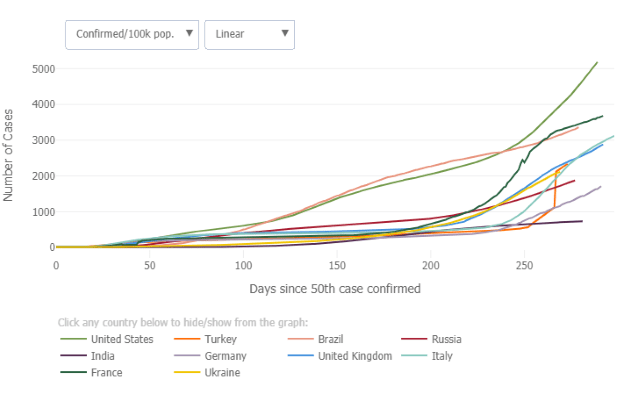
WHO  dashboard shows that as at 5:05 pm CET 17 December, there have been 72,851,747 confirmed cases globally with 1,643,339 deaths.

Source: John Hopkins University

It is with much sadness that I discuss the current situation. It is a bleak Winter in the Northern Hemisphere, to say the least, and the festive season is undoubtedly the most sombre in decades, probably since the depths of WWII. Sadly politics has impeded the pandemic response in many nations – usually based on a divide between conservatives placing higher importance on the economy (or at least perceptions of measures impacting on the economy) and parties left of that position placing a higher value on human life. When those differences are expressed across the layers of Government – e.g. Federal v regional – paralysis has been common. For example, the lack of leadership at the Federal level severely impeded the US response, and threatened to do likewise in Australia (but the vestiges of State autonomy ensured the Premiers could not be strong-armed by PM Morrison, thankfully), whereas Angela Merkel’s efforts in Germany to protect people from the ravages of the pandemic have been hampered by obstructionist regional politicians.

In my earliest reports I discussed potential seasonality to the pandemic as I was acutely aware that the Southern Hemisphere would be the first to face a full Winter with the global pandemic. Seasonality has very clearly been a major factor in the major temperate population centres in the Northern Hemisphere. The Summer lull in the pandemic, especially in Europe, was brought to a shuddering end as case numbers exploded in mid-Autumn catching virtually all nations off-guard. While the sharing of information on best practice for treating COVID-19 developed through the year has resulted in slightly better outcomes for severely ill patients, these gains are threatened by the sheer numbers of hospitalised patients such that hospital systems in most European nations and North American regions are on the brink of being totally overwhelmed. Exhaustion amongst the real heroes of this crisis – the health care workers – is a major concern everywhere.

National political leaders are attempting to balance the need to impose tougher and tougher restrictions to lessen the pressure on their health systems with pandemic fatigue, despondency or out and out anarchy amongst certain groups of citizens (in some cases which they, themselves, played a part in stoking – hey Borris?) While the overnight news that yet another national leader, French President Macron, has been infected is a reminder that nobody is immune, the knowledge that such elites within society will receive an entirely different standard of care to the majority only proves the necessity for change through this period, which I began to call in March “The Great Reset“.

Those who celebrate Christmas this December will be hoping that, while experiencing a grim festive season, they might find in their gift stocking not coal but a solar panel and the hope of a brighter future…


As foreshadowed in previous Coronavirus updates, this will be my final one.

Firstly I will point out that this is now the only update on this landing page. All previous updates are on the linked pages (in reverse chronology starting here) because I updated the material at the head of the page which had stayed constant since much earlier in the pandemic. 

In those first few weeks of the pandemic I initiated an “Optimism Scale,” which in my first update was at the penultimate level of pessimism until 24 February when I downgraded it to 1 indicating extreme pessimism, when the WHO Situation Report No. 34 listed 17 COVID-19 deaths outside of China. In doing so I stated 

this could be upgraded with some unexpected development, but the information emerging out of especially Korea, Italy and the middle-east is very concerning which confirms rapid and widespread transmission, including in well developed countries, with the clear suggestion of high mortality rate

Having left my optimism level at 1 for almost 10 months, I have now raised that rating to 2.

That is in no way indicative of the current situation with the pandemic raging globally, especially in the Northern Hemisphere, including in the developed nations within North America and Europe.

It is an indication of my optimism that, on a global basis, things may be set to improve once the Northern Hemisphere passes the critical Winter/early Spring period.

While my own optimism is genuine, I do need to note that it is not nearly as strong as sections of the Australian media and broader society have allowed themselves to indulge in. While a certain level of optimism is both “earned” and understandable, at times it has bordered on euphoric which is ill-advised.

What follows is my honest optimistic view for the way forward, but it is heavily qualified by significant nuance in both volume and salience.


In my 30 June Coronavirus Update I said that I knew the pandemic was a multi-year event from the outset, but leaving the year from the heading of my updates was intentional as “I simply had no intention of writing updates beyond the first year of the pandemic because I knew it would be too depressing”.

In my previous Coronavirus Update I said that for my final update I would recap all of my Coronavirus updates and other writing on the pandemic before going on to give my views on the year(s) ahead.

I have decided to drop the first part because I think to do so is inappropriate. Such a conspicuous lack of humility, in this difficult time for humanity, is not really authentic to my true self. In my writing, where I have quoted myself from earlier papers, it has mainly been to show that I have been prescient in relation to the COVID-19 pandemic to implore the reader to take on board my views.

Most importantly I prefer to devote my energies to looking forward to the future.

Before I do that, however, I do need to briefly mention an upcoming post. As a complete outsider it is difficult if not impossible to gauge the impact of my works and words. I noted in “Evidence of MacroEdgo Impacts” that an Australian researcher based in Singapore led a team which showed that the concerns that I raised earlier about the potential for meat processed in facilities where there are large numbers of infected workers is a risk for seeding clusters was justified.

Now I note that in June the World Economic Forum (WEF) launched an initiative they have titled “The Great Reset”. This initiative is essentially identical to the approach that I called for in my essay of the same title which I posted on 30 March.

I will discuss these developments in a post which I will release next week. But at this early stage let me just say that no, I have never had any contact with the WEF, or anybody else about the initiative or any other similar initiative; and yes, I am pleased to see that many global actors have increased their activities to argue openly about what shape we want to emerge from this major global humanitarian event.

Given the friable environment in which these discussions are occurring I feel I need to pre-empt some of what I will say in that upcoming post. To the conspiracy theorists on either and all sides, I need to tell you that you are barking up the wrong tree in believing others who tell you that all of this is part of an orchestrated strategy.

Rare and unpredictable shocks to individuals usually cause them to reflect on their lives, and when that shock occurs to societies collectively people will naturally question whether our societies are heading in the right direction.

That is nothing to be feared. It is to be embraced as a human being because much good can come from it when there is authentic open engagement. 

I will discuss this in much greater detail in my post, but it should be clear to all that joining a social media group that adopts extreme positions that are simple and clear-cut on these very complex issues, and where participants do not engage in open respectful dialogue with any and all others that show them respect and who raise valid points, is not a way to become genuinely informed and participation on that basis is unwise. 


The criteria for my optimism scale are mortality rate (i.e. infection fatality rate – IFR) and progress at developing cures (including vaccines).

The reason for upgrading my optimism level is based almost exclusively on vaccine developments.

The virulence (or lethality) of the novel coronavirus has been one of the most contentious issues from the earliest days of the pandemic, worsened by a disappointingly large number of political leaders downplaying this aspect. 

I chose a rather arbitrary (and round number) of 1% as the bar to fall below to raise my optimism level. Early estimates of the IFR varied significantly, but with a year passed I doubt that estimates will be any more accurate (though I expect that debate over these estimates will never be settled).

Of course, also, the IFR experienced in different regions will be impacted by an enormous range of factors from natural (e.g. weather/environmental) and socioeconomic (including dispersion/homogeneity of those factors  – i.e. societal inequality). Moreover, treatments (including “incomplete cures” or “cures under development”) and their interaction with these other factors will also affect the IFR over time. All of this has been discussed in early “Coronavirus updates” and my other reports.

I will point out, however, that even in developed countries in the Northern Hemisphere many countries are approaching full capacity in their intensive care wards from COVID-19 patients. I was shocked to learn that Sweden, a country known for having one of the highest standards of health care in the world, has recently sent patients to other Nordic countries. Of course, Sweden is well known for their adoption of very light social restrictions through the pandemic which they have persevered with until only recently. The point is that even in countries with excellent health systems the IFR can increase when their well provisioned and staffed hospitals are overwhelmed. And on that point, sadly Sweden now faces a crisis amongst their health workers who are resigning due to exhaustion.

I have consistently placed a high value on the research out of the Imperial College London, and this is from their latest report on the subject: 

we estimate the overall IFR in a typical low-income country, with a population structure skewed towards younger individuals, to be 0.23% (0.14-0.42 95% prediction interval range). In contrast, in a typical high income country, with a greater concentration of elderly individuals, we estimate the overall IFR to be 1.15% (0.78-1.79 95% prediction interval range).

I would not become less pessimistic based on these figures. Moreover, history would suggest that, and it will undoubtedly be repeated unless the world changes a great deal and rapidly, the IFR in low-income countries is unlikely to fall appreciably in the near future (though I am getting ahead of myself).

Now to the vaccines and I must start with an admission. A week earlier when I began thinking of drafting this final update I was toying with increasing my optimism level by 2 places to a level of 3. That was due to just how surprisingly positive was the run of data releases on the vaccines under development. There has been a run of setbacks since, which has brought us all back to Earth a little, and it was a lesson to me also on the need to keep optimistic emotions in check.

I will detail all of this below, but let me just say very clearly that even two months ago if you dumped all of these data on me to consider at the same time, I would have come away feeling cautiously optimistic and thinking that the vaccines show greater potential than I had dared to hope previously.

Perhaps it is unavoidable, but receiving updates in drips and drabs leaves us all prone to feeling like we are riding roller coasters. That is why I believe it is incumbent on political leaders and health officials to be calming voices of realism when positive developments occur, and to store the optimism mainly for use when we receive setbacks.

Unfortunately many modern politicians seem only capable of cheerleading and pulling blinkers over eyes in a vain attempt to create (consumer) confidence, whether it be justified or ill-advised. Here I do have to note that this refers mainly to male leaders and it reminds me of my desire to expand on the gender differences in leadership through the pandemic as an extension to my article “Toxic Masculinity and Political Footballs“.

The new class of vaccines based on mRNA (messenger RNA, a type of nucleic acid present in all cells of all living organisms in the world, like DNA) shows enormous promise with both the BioNTech/Pfizer vaccine and the Moderna vaccine achieving an efficacy of over 90% at preventing COVID-19 disease (but not necessarily preventing infection) across age groups and ethnicities.

There are flies in the ointment, however: will vaccinated people still become infected and transmit infection to others (including potentially unvaccinated people); how long will protection from developing COVID-19 last; because this is new technology significant quantities of this type of vaccine have never been produced so what will be the production rate over the next year or two; given protection might wane, will production ever be able to meet the demand for people who want/need to be vaccinated (including with booster shots); being a new class of vaccine and requiring quite specific handling which requires significant logistics, just what proportion of humanity could realistically receive this type of vaccination; on the first day of rollout in the UK two people who had severe allergies had adverse reactions – how common might this be, and what other complicating factors will emerge as the vaccine is rolled out to millions of people.

Note that I have little concern over safety for these vaccines, but we should always expect that we are going to learn of complicating factors, which hopefully will be relatively minor and/or rare, when hundreds of millions of people receive new treatments.

It is difficult to escape the view, however, that while this class of vaccine will likely become the gold standard for preventing COVID-19, it may only be given to the highest risk (of developing severe disease or of exposure to the virus) members of society in high-income developed countries. Even that is dependent on further developments being broadly positive which is not guaranteed. 

I found this to be a brilliantly clear explainer on early COVID-19 vaccine efficacy data and especially how the final efficacy could be markedly different depending on how long the immune response lasts.

But again, this is a great start and we would have much less reason for optimism without it!

It follows that the majority of humanity will likely be highly reliant on success with the other vaccines. And there are very many of them – almost 200 in fact – being developed both in Western developed countries as well as in India, China and Russia. I will just concentrate on what is known from the final stage trials that have been released as well as the pertinent to Australia UQ/CSL vaccine.

The most promising – to this point – of the remaining vaccines is one by Oxford/AstraZenica. Unfortunately its data release was not well handled, which given the febrile environment, has led to a degree of scepticism in even informed sections of the general and scientific community. The issue is that around 20% of participants who received the vaccine received a half-strength initial dose – which now appears to have occurred because of an error in manufacturing – and those who received the lower initial dose displayed a higher level of efficacy. However, there are further issues in that most of these were younger. In short, these missteps, that were always going to become public knowledge due to the extreme level of interest in vaccine development, have made it clear that we really are in an accelerated development mode and that mistakes and vagaries, especially when dealing with a pathogen known to mankind for just one year, are highly likely to occur.

Nonetheless, it should not be lost that the statistical significance and the overall efficacy rate of around 70% is quite acceptable. In fact, this was about the best result that I dared hope for before the data on the mRNA vaccines was released. Moreover, this is a cheap vaccine which requires no unusual storage or supply conditions so this may be a vaccine “for the masses” including in the developing world.

Researchers have started another full trial to determine the efficacy when all participants who receive the vaccine received a half dose initially, so that might suggest that the work is incomplete. But in reality all of the vaccines will continue to be the subject of further research to continue to determine the finer details, such as how effective they are at reducing infections and transmission.

The Russian and Chinese vaccines have been rolled out in their respective countries. To be used in most western countries I imagine that they will be required to undergo trials in those countries. Whether that occurs will largely be determined by success with the other vaccines. These will likely have a higher uptake in low-income developing countries as and when confidence grows in them from use.

Finally we have some more disappointing results. The GlaxoSmithKlein/Sanofi vaccine suffered a serious setback last week as it failed to produce significant protection in the vulnerable 60+ year cohorts, and this has knocked their timeline to release back by at least 6 months.

Disappointing for Australia especially, the UQ/CSL vaccine has been abandoned because its use resulted in false positives for HIV. I understand that researchers will persevere with the technology, but the setback was so serious that it is unrealistic that it will play a part in the management of the COVID-19 pandemic.

To finish this section on a positive note, it is great to see that within a year of the onset of this pandemic residents of the UK and USA are already receiving injections as a part of a national vaccination program. That is an enormous feat for humanity!

All of this was made possible by the excellent work of the scientists at the Wuhan Institute of Virology, led by Dr Shi Zhengli, who first identified the virus and made the entire genetic sequence available to the world within weeks. To those who have not read that original article in Nature, I suggest you do so even if you have no virology or even a science background – the enormity of the studies that these scientists performed in the space of just a few weeks is readily apparent and is nothing short of remarkable.

To conclude I will expand on my views on how the pandemic is likely to progress next year and after.


In “How Society Will Change If A COVID-19 Vaccine Is Elusive” I dared to wonder about an Australia where we have a new normal that is closer to the life that we have lived in 2020 than the one we had before it. Until the preliminary final stage vaccine trial results for the mRNA vaccines were released, I feared that such a reality was an uncomfortably high probability. And when I undertook to put together these thoughts I believed they would be more sobering.

Right now it appears that the more concerning scenario is less likely because scientists, standing on the shoulders of those around and before them, have performed an incredible feat in developing excellent and safe vaccines in under a year from the commencement of the pandemic.

That is not the end of the story, unfortunately, as above I discussed some of the many questions that remain unanswered about how the vaccine works and interacts with the human immune system. While these are significant questions, which will not be fully answered by the end of next year, even more critical questions relate to the virus itself.

From my earliest updates and reports I have discussed the reality that the virus will mutate as it spreads and these mutations could have implications for how quickly it spreads or how ill people become. Those mutated strains could be advantageous for our management, or they could complicate it and thus worsen the pandemic.

Scientists are finding that for an RNA virus this coronavirus is not mutating as much as it might have, which is good news. It is now so widespread, however, that the potential for mutation is very significant. That is further complicated by an additional factor.

In “COVID-19 Risks With Animals” I discussed that the virus has a very broad potential host range, meaning that the virus has infected many different animal species and predictions are that it could potentially infect very many more animal species if conditions for exposure existed. The more the virus spreads in humans, the greater the chance of exposure to a broader range of animals. And the more other animals are exposed, the greater the chance of them acting as reservoirs for further infections in humans, and the greater the chance of more significant mutations occurring so that more different strains re-emerge in humans.

While the news media is reporting vaccine successes, we are also learning about new strains of the virus that have been detected which may be different enough from the initial strains that they have implications either for how many people may become seriously ill and die, or, perhaps even more important now, how effective will be the vaccines against these strains because the vaccines were made using much earlier strains of the virus.

This quote from a UK scientist explains the urgency around a recently detected strain:

We think there’s a mechanism for the virus to start escaping,” said Ravi Gupta, professor of clinical microbiology at the Cambridge Institute of Therapeutic Immunology and Infectious Disease at the University of Cambridge. “We need to crack down on it. We don’t know what it’s going to do long term but we can’t take a chance on it. It’s unlikely it’ll make people sicker, but it could make it harder to control.

These mutations are being monitored by the scientific community. Of course the vaccines can be reworked to be more effective against emergent strains, but that will still take time even in a streamlined process. In an all too plausible scenario, and given the reality that we do not yet know the production rate for mRNA vaccines, we may find ourselves continually behind if the vaccines must be continually reworked (as is required for flu vaccines).

This novel coronavirus is now highly unlikely to ever be eradicated because that would require a very cheap and easily delivered vaccine effective against the full range of strains, which prevents infection, being delivered to almost all humans and potentially exposed animal populations.

That is highly improbable.

I do wonder what will be the way forward in low-income developing countries, where the effects of the pandemic are already under-reported in the media compared with wealthy developed countries, especially once the shock to humanity begins to subside.

History has shown that wealthy countries tend to quickly lose interest in assisting developing nations, because when citizens’ focus moves their elected officials feel no incentive to assist, and the hard work of engaging wealthy countries in vaccination and other health programs is left to activists and their organisations.

There is one factor, however, that currently exists which has not been the situation for decades; that is the battle for hearts and minds, and ultimate geopolitical influence, between Western nations and China that I discussed in “Investment Theme: Developing Asia ex-China“. (Briefly re-reading this post reminds me of how necessary it is that I quickly complete the post that I am drafting restating my views on China in light of the pandemic and Trump’s exit.)

For humanity in aggregate, and especially the wealthy developed nations with older age-structured societies making them more vulnerable to COVID-19, the best management strategy for COVID-19 is to minimise its spread everywhere on Earth, thereby cutting down its opportunity to mutate sufficiently to perpetuate or reignite a pandemic. However, if the pandemic were even briefly arrested in the developed world it would be consistent with history for the developing world to be left to their own devices to battle COVID-19 impacts. I am more optimistic than I normally would be that high-income countries will remain engaged with battling COVID-19 in low-income developing countries. But there are even bigger question marks on how successful those efforts might be.

As detailed above the vaccines that have shown the highest efficacy at preventing COVID-19 thus far are expensive and require logistics and facilities that will preclude their use outside of developed countries. How beneficial to the developing world will vaccination be is dependent on the effectiveness of vaccines that can be easily rolled out in challenging circumstances. And the significantly lower mortality rate (IFR) from COVID-19 observed in low-income developing nations may mean that, unless the efficacy is very high, the benefits of a vaccination program to the individual and the low-income nation may be limited.

Ultimately how widely COVID-19 vaccines are administered in the developing world will depend on the balance of costs and benefits of the vaccine program, and the willingness of the developed nations and other geopolitically active nations to derive goodwill from such programs.


We head towards the closing of 2020 in a truly terrible situation, and I constantly find it disheartening that still there are human beings who suggest that their own desires and beliefs outweigh the pain of so many other human beings.

Through this year my subconscious has struggled to come up with a single, simple statement on this and I only achieved that in recent weeks:

Those who argue for minimal or no measures against COVID-19 are in reality saying “the extra risk to everybody’s health is worth it to me”.

Obviously there has been much said this year about the collective good versus individual rights, and this debate will surely go on in earnest for many more years. My views are clear in my writing and need no further explanation here.

I will simply make two points. Firstly that the innocuous yet invaluable hygiene device of a face mask has become the symbol of individuals’ rights will in retrospect be seen for what it is – plain stupid – and not unlike burning books!

Secondly, the plain numbers of confirmed cases and deaths on various dashboards, while shocking in their enormity, can in no way ever begin to reflect the true loss to humanity. That loss extends well beyond the people who these numbers represent to the years of life cut shorter than otherwise, and to what they might have done and achieved in that time.

The British anthropologist Robin Dunbar is known for developing a guide for the typical number of relationships that humans maintain through their lives. He found that on average each human being maintains relationships with an average of around 150 people at any one time. Of course there are different depths of relationships that we maintain, with our nearest and dearest amounting to 3 to 5 people, and then a further very close 15 friends with whom we maintain ongoing close relationships. Nonetheless connection with all the approximately 150 people in our circle provides us with the feeling of connectedness with the community.

Of course as in all things research, others have come up with different numbers, some less, many larger.

The point that I am making, however, is that if one multiplies the number of people who have died from COVID-19, the official figures for which are likely understated, by their number of contacts then we will begin to develop a truer picture of our human loss. Of course the extent is greater again because the contacts of all who have faced serious challenges against the disease have been anguished. And I think all people of good character have felt a great deal of anguish and pain for their fellow human beings who have experienced direct loss.

I know that some will talk about the anguish and pain associated with apparently lost or diminished ambitions as a consequence of measures in response to the pandemic. To that I would say that perspective needs to be given to the fact that those ambitions are not necessarily lost or diminished but delayed. 

The ambitions of those people who pass in the pandemic most certainly are lost. And the pain of loss for those left behind will persist for their entire lives.

I have attempted to be clear and thorough about the issues that will determine how humanity progresses with this pandemic in the years ahead. Vaccines have always presented our brightest of hopes, and while progress there has been truly remarkable, we need to remain duly mindful that, without an unlikely level of luck, vaccines will not take our lives back to the way they were in 2019.

Besides the fact that we are forever changed for this experience – and that is something that I implored my readers in February to accept as soon as possible, that “the world has changed” – our road back to living a life without a thought of the novel coronavirus creeping into our minds on a daily basis, like when we greet somebody whether they be friend or acquaintance, or when we shop, remains several years away.

However, and it is a big however, I do believe that once this northern hemisphere Winter has passed then we probably have passed the worst of the pandemic impacts on us, if for no other reason than our expectations have been reset.

My predictions on how and when we might be able, or perhaps might feel safe, to do things such as travel internationally are pointless because the answers to those are in part related to politics and otherwise are dependent on our own views on risks and rewards.

What is clear is that increasing proportions of citizens – not necessarily inhabitants or residents – of high-income developed countries will have the opportunity to be vaccinated with vaccines that are highly effective at preventing disease at least in the short-term. What proportions of citizens in each country are (or remain) protected from either disease or infection at the end of 2021 is impossible to know.

The one thing that I do know for certain is that next year, and likely for several more years, high-income nations where residents want to minimise human loss will need to guard against complacency and be prepared to continue to be adaptive and innovative in responding to the pandemic, along the lines that I outlined in my campaigns “Make This Summer Count!” and “We Mask Because We Care“. 

While I realise that a reader disinclined to agree (in general) with my views is unlikely to have read through to this point, if they have I would point them to an article co-authored by Prof. Ian Frazer AC which makes some of the points that I have made above and strongly recommends the very same approach that I have been advocating since launching these aforementioned campaigns.

Thank you to the scientists who have given their all this year. Thank you, also, to the authentic leaders in this world who may be elected decision-makers, appointed Government officials, members of the business community, and members of the broader community. (Yes, implied in my statement is a view that those who do not believe in the primacy of human life do not meet my definition of authentic.) And finally, thank you to my fellow residents of Australia, and of many other nations, who in their great majority did authentically show that they cherished human life and connectedness.


Gained value from these words and ideas? Consider supporting my work at GoFundMe


© Copyright Brett Edgerton 2020
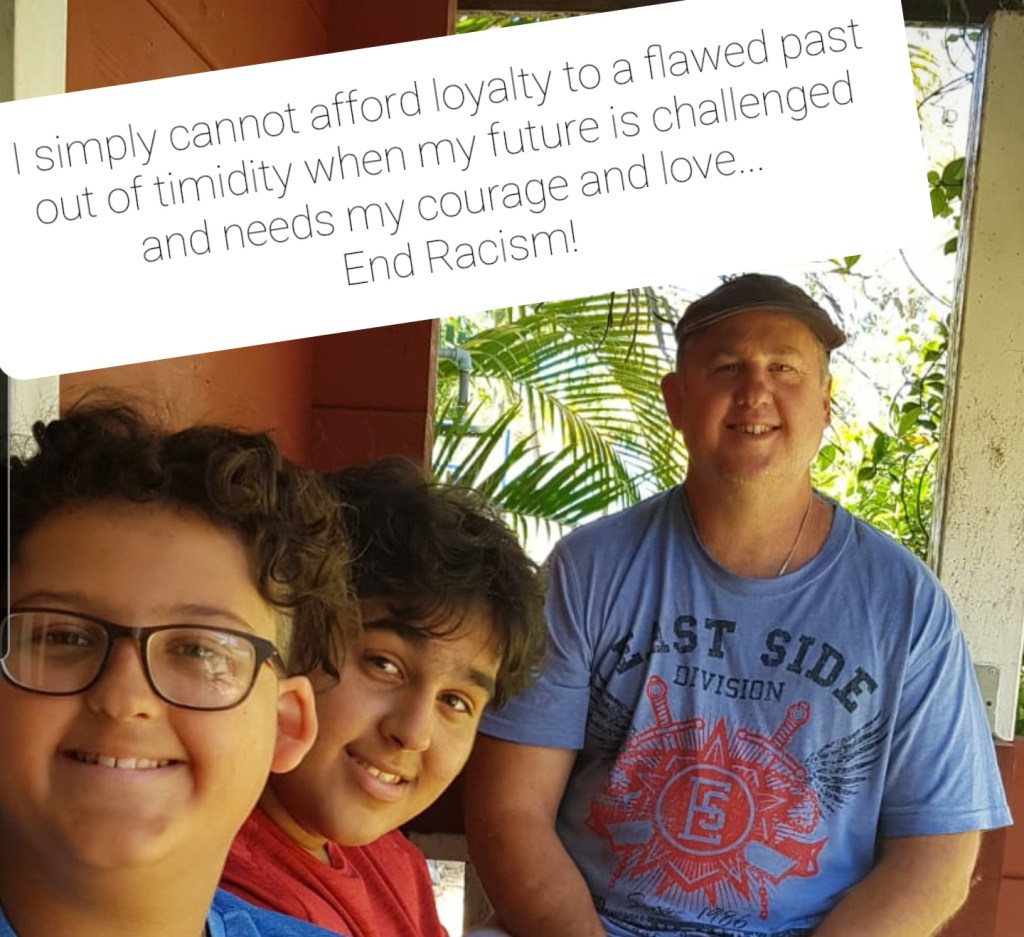
The Great Reset: A letter to my Father and my ‘Sliding Doors’ self

Dear Dad

It seems that lately we struggle to spend time together without quarreling. Neither of us are good at small talk, and the divergent path that I took in my life means that we no longer share much in common.

Most importantly, we no longer see the world through similar frames of reference. 

I left the farm, as well as the safe world of our conservative home region, well safe for those who “fit” into the tight social structure, meaning you look and behave similarly to the majority, for university and ultimately a PhD in science.

My scientific achievements, though, are not nearly as well known in our home town as those of Peter Ridd, heralded locally for his brave stance as a sceptic of the science around climate change. I have never met Peter, but I do have a high regard for his courage even if I do not share all of his views – free and open debate has and always will be a vital ingredient for human progress. And I well remember how his (maths) school teacher father was so proud of his son’s achievements at James Cook University – I often wonder at how brilliantly served we were in our small town by high quality teachers such as John Ridd, and I attribute my own maths teacher (Santo Russo) and my science teachers for much of my own successes. 

Meeting my wife in the final year of my undergraduate degree was my sliding door moment. The four years that I had spent at university had shown me that a less stressful, more happy life was possible. I had resigned myself, however, to fulfilling your expectations – which I had certainly been responsible for creating at the beginning of my undergraduate by begging to be permitted to come home – of devoting my life to running the farm with you.

Instead I devoted my life to science and then to raising my family.

I will never regret that decision because I know that my wife is the greatest factor in me taking the potential you instilled in me – my resilience, intelligence and enquiry, work ethic, desire to optimise and excel, and most of all my empathy and compassion for others – to truly become the best version of myself.

I married a young woman from another culture who looks different to most in our town, and when she celebrates in traditional ways with her family, she behaves differently and she eats different food. You have tried to be understanding but in recent years – perhaps with the gradual creeping influences of Hansonism and then Trumpism – you have seemed conflicted like you somehow needed to make a choice.

I guess in your most recent visit you showed me that you had made that choice and it is difficult to put aside a belief that your previous behaviour was actually tolerance rather than you being open-minded. That hurt me, and my family, deeply.

Perhaps an even greater challenge for getting along, however, is our different views over climate change. A few years back you argued that climate change was not real. Now you suggest it is essentially a natural phenomenon and that human actions are not the prime cause. You like to present me with Letters to the Editor from home showing how ordinary citizens, intelligent conscientious objectors, up there are prepared to speak out, often raising past episodes of global heating and cooling, and so on.

This argument bears many similarities to the arguments we used to have around banana imports from the Philippines while I worked for Biosecurity Australia, the biosecurity policy setting function within the Federal Government responsible for conducting import risk analyses on animals and plants and their products. In our discussions you always started out stating your concerns for the risk of importing diseases, but when I said that nearly always there is something that can be done to manage those risks so that the trade can occur, the conversation very quickly swapped to the real issue – competition and extreme anxiety that the Australian industry would not be viable if bananas were imported from low-cost countries. 

Often you would even pose the question, “How can we compete when they pay 10 year old children 12 cents a day for labour?”

On one occasion I was as blunt as to say that I do not want to live in a world where those 10 year old children work in fields. Perhaps we could do things to prevent it… perhaps… but what about the family that is so poor that it chooses for their children to work rather than have them educated? They know that it is better for their children, and ultimately for them, if they attended school, but feeding the family is a more pressing problem for many. The only way for that cycle to be broken is for those families to share in more opportunities that the global community offers, and one way for that to occur is through international trade, so that perhaps the children of people who work in the field through their childhood have a better life… much like how my sister and I went to university even though you left school at 14 to become an apprentice carpenter.

When it comes down to it, I believe that all of these issues are a symptom of the anxiety that you feel because the world is changing in ways you do not completely understand and now you reject that change. 

Even though you will never admit it, you wish you could go back to the easier days of when Australia had solid contracts with “mother England” for the majority of our primary products, including sugar, the mainstay of our farm which has been in our family for over 100 years. This would allow you to just concentrate on producing the best crop you could, which you excel at. After the sugar price collapse of the early 1980s you held off switching over to bananas, but eventually you made the leap – with the enthusiasm and energy of my brother – hoping that the gamble would pay off. But chronic low prices and cyclones took their toll. Knowing all of this, I understood why even the mere mention of the possibility of banana imports made your anxiety go through the roof. 

All along there has been a creeping increase in awareness of the impact of agriculture on the environment, including to the precious Great Barrier Reef, resulting in a continual tightening of regulation and standards with which you had to deal. 

I know well your deep love of the natural world – undoubtedly a major factor in me studying biology at university – gained from a lifetime of diving on and fishing off the reef, and in the 60’s your pioneering saltwater aquarium was legendary. I also know that you love the natural rainforest that still exists down the back of our property, and the amazing moments we shared together there were special like when we came across wildlife such as a cassowary with chicks.

I have to say, however, that on my most recent trip home the close encounter that we had with a 3+ metre Johnson River crocodile, as it crossed our path between us and close to my eldest son less than 10 metres away from us, after it had lay in wait in the spot where you went into the creek to pick a water lily for mum the previous day, well that scared the pants off of me. It made me realise that it is not any longer the environment in which I roamed as a boy, when I was young making hidden cubby houses along the creek, and when older fishing from the bank for barramundi and mangrove jack.

I also remember how a part of your farm purchase, from your uncle, was a special lease block which had a 100 year lease which had some 26 years remaining on it. I know that it was bitterly disappointing for you that you had to relinquish it. That disappointment was worsened by the fact that when you first tried to purchase it in the 80s the Government declined your request because you had done nothing to “improve” it – i.e. you had not cleared the rainforest – and then when you again tried to purchase it, in the early 90s, you were declined because its conservation value had been recognised. You never received any compensation for having been custodian of that piece of land for 26 years, the option to develop it being a part of the initial purchase price of the farm, and then having paid rates on the land for all of those years (though perhaps you recognised the hypocrisy in such a view since you reject the concept of Aboriginal custodianship and you have feared indigenous land rights claims). And I always remember how you refused to reactively clear the land as conservation regulations closed in, even though others did including neighbours of yours.

I know that you have borne a great deal of the responsibility, already, to set humanity and the planet on a better footing. And there has not been any thanks for that, from Governments nor the community, and you received little assistance to help you to make these continual adjustments. You were just left with the knowledge that there will always be something else and soon.

I also know that, like all dry Aussie humour, the favourite joke up home nowadays – that goes that you used to leave the farm to your favourite son, now you leave it to your least favourite – is based on an underlying truth that you all have come to accept. That a life on the land, always challenged by nature but still rewarding, has become an unprofitable burden which you would wish upon nobody for whom you cared.

Even though it hurts me personally, I can see how people pushed like that can become bitter and look for others to blame, and human history shows that at such times people who look and act differently to the majority are singled out.

Worse still, I am not really sure that when globalisation leads to shifting of jobs to poor regions those jobs improve the prospects for those poor people. I think we all are waking to the fact that the way Western Governments have allowed Globalisation to occur has just led to the elites in the world becoming even more wealthy while even more people feel that they do not enjoy the standard of living that their forebears experienced.

In other nations people have become so desperate for the situation to improve that they have turned to populist politicians who just talk of “making [things] great again” but offer no real answers. It seems that just recognising the pain felt by many has been enough reason to support them.

My impression of your attitude to climate change is not so much that you think that you are smarter than everybody else, and that you see what few others do, but I think you are inclined to object purely because in a democracy you have the right to do so. And you feel like you have been pushed as far as you can and have gotten nothing for it other than more worries and more debt.

On that I agree with you, wholeheartedly. 

You continue to object even though people living in cities think of you as “backward”, which of course you are not. Hansonism has not helped, but equally the egotistical quips at Pauline did not help either – after all she was not the only person who had not heard of the term “xenophobia”, nor is she the first to not know the more politically correct terminology for her own behaviours. In many ways the subtext of this divide says that in a democracy all votes are equal, irrespective of the IQ or worldly experiences of those casting their ballot. 

Through my life I have learnt many times that an open mind is not dependent on the possession of a passport but on an open heart.

I notice that during every election these days there is a discussion about how to provide rural jobs; often a mythical “10,000 rural jobs”. When I hear this I feel like running a campaign to alert all to the fact that there are at least 10,000 rural jobs readily available right now… in scraping off the topsoil of Queensland and shipping it to the highest bidder. Of course any rural person would immediately recognise that as selling your future, but in reality it is no more unsustainable than many of the ventures that are supported to provide jobs in the near term. 

I do not suggest that I have all of the answers for the future, but I do honestly believe that I understand the context in which we must progress. Instead of allowing ourselves to be divided and embittered, let us join forces and fight the real fight. We will never progress if we continue to fight amongst ourselves. All we are doing is playing into the hands of those who seek to use the turbulence and our pain to advance their own personal political agendas.

America’s recent close call with Trumpist fascism must be a warning to us all.

We are tired of elites garnering an increasing share of wealth in the world. And we are tired of politicians and bureaucrats falling under regulatory capture from these elites.

We want real leadership, not salespeople who say to our faces what sounds good only to behave differently at a time and a place when they have the opportunity to make a real difference.

We can deal with the truth because we can work together to ensure that fairness is at the basis of our decisions. When decisions hurt people there must be adjustments made to allow them to adjust their lives in a way that affords them the dignity and rights that should come with being a human being in a contemporary society.

Nobody wants to feel embittered or isolated or left behind. 

All human beings understand inherently that change is inevitable – it is the very nature of our own being – but fairness is not.

If we are to achieve an inclusive and united global community then fairness must be at the heart of all that we do.

I know my generation talks a different language, Dad; as much from the heart as from the head. But I assure you we are not drongos.

What do you say? Do you think we can work together to make this world a better place for your grandchildren and their grandchildren?

Your loving son,


Gained value from these words and ideas? Consider supporting my work at GoFundMe


© Copyright Brett Edgerton 2020

Super Hero Powers: 1918 and now

Right throughout this year comparisons to the 1918 flu pandemic have been unavoidable, so it is instructive to consider where our knowledge stands today – that provides the tools which we use to fight this pandemic – in relation to 1918.

This is something that really should be highlighted because it is a source of much optimism which goes well beyond the rapid vaccine development.

While it is true that much of the basics of infectious disease control is similar, which is hardly surprising since learning to deal with disease impacts on us directly and in species important to us has been important in our success as a species over thousands of years, the tools that we have at our disposal now are mind-blowing even to me having retired from research science 16 years ago.

At the time of the 1918 flu pandemic we knew that there were disease agents so small as to be undetectable with the light microscope. Two decades earlier, at the end of the 19th century, researchers proved that something so small that it could pass through a filter small enough to remove bacteria was able to transmit disease (e.g. a virus of tomatoes).

From then until well into the 20th century the definition of a virus was a filterable agent of disease.

So for all of that time, including when the global community fought the last pandemic of equivalent scale to COVID-19, the 1918 flu, fighting these diseases was akin to shadow boxing or fighting a ghost.

The electron microscope which allowed examination of the world at much higher magnification than permitted by the light microscope was not developed until the 1930s. It was only then that we human beings finally began to see one of our major foes to our existence on Earth, viruses (think about all of those “pretty” photographs of coronaviruses looking like a spikey ball heading many media stories this year.)

When we combine our contemporary ability to visualise viruses in great detail, with our ability to isolate and culture them in cultured living cells (or sometimes chicken eggs) in the laboratory, together with our explosion in knowledge about the building blocks of all organisms – the nucleic acids DNA & RNA – we have truly formidible tools at our disposal in comparison to 100 years ago.

To think that within weeks of my friend, Dr Shi Zhengli, and her colleagues receiving samples from sick and dying people they had isolated the novel coronavirus and sequenced its full RNA genome and posted the sequence online so that laboratories throughout the world, with equipment and techniques very commonly in use, could promptly develop RT-PCR (reverse transcription polymerase chain reaction) assays which can detect very small amounts of the virus genome in samples from patients is honestly mind-blowing.

These assays have been invaluable in researching and managing the pandemic, including by detecting its presence on surfaces or even in waste waters drawn from thousands of households.

These findings inform our understanding of best practice for infection control, so that it has developed rapidly in the year since the virus is believed to have first jumped into humans, which benefits all of us including those in less developed countries. And in Australia and other countries that have the logistical capability and desire to aggressively manage the pandemic it informs our adaptive management (including by further sequencing detected genomes to determine how different clusters relate).

The invisibility of disease threats has always frightened human beings through the ages. But while we ordinary humans cannot physically see the agent of this disease, our contemporary scientists are blessed with tools with special powers, no less “out of this world” than those available to Antman or some other Marvel super hero, or perhaps a comparison between the 1918 first Daredevil and the contemporary cinematic hero is more instructive. They have those super powers because they stand on the shoulders of generations of humans from amongst our global community who chose to specialise in scientific research and because we in society have supported and trusted them.

Boy have we all benefitted!

After reading this, it should also be clear why it is pointless in comparing COVID-19, and patently ridiculous to downplay it, with the 1918 flu in terms of case fatality rate or total mortalities. I truly shudder to think how humanity would have coped with this agent even a few decades earlier.

Even though it might not seem it at times, we really are in a fortunate position compared with earlier times and that is something we should always remember and be confident about.

It is a critical source of optimism.


Gained value from these words and ideas? Consider supporting my work at GoFundMe


© Copyright Brett Edgerton 2020

“We Mask Because We Care”

A business risk management strategy that benefits society

How a business is seen to respond to the COVID-19 pandemic – how much customers perceive the business cares about their wellbeing – will be remembered long after we have forgotten the difference between vaccine efficacy and effectiveness.

Last week I launched my campaign “Make This Summer Count” calling on Governments to put maximum effort into COVID awareness programs through this summer ahead of economic “rebuilding” because consumer confidence based on complacency is short-sighted and potentially devastating to society and the economy and thus businesses.

While scientific advancements especially on vaccines show enormous potential to end the pandemic, Australia is not likely to be significantly protected before our next critical period from late Autumn through Winter, and even then there are issues which may yet derail these programs.

Businesses that choose to go above and beyond in their COVID safety, in an authentic and transparent fashion, reduce their risk of standing on a “COVID landmine” due to the reduction of transmission risk on their premise and\or by their workers.

In a pandemic such as this, however, it is virtually impossible to reduce risk to zero. Still businesses that have been seen to go the extra distance to protect the health of their customers are likely to retain a greater proportion of clientele if the worst should happen and the business is named as a centre for a cluster.

Spending vast sums after an incident occurs to reduce the risk of transmission on the premise and to give the perception of greater safety is likely to be far more costly and may be less effective at retaining clientele.

An ounce of prevention is worth a pound of cure

Download my report and get on board now – there is no time to lose…


Gained value from these words and ideas? Consider supporting my work at GoFundMe


© Copyright Brett Edgerton 2020

Make This Summer Count!

An open letter to all Australian State and Territory Premiers, State and Territory Chief Health Officers, Prime Minister Morrison, Minister Hunt, and the Australian CMO


Hello distinguished group.

Firstly please allow me to thank you sincerely for collectively managing our response to the COVID-19 pandemic that has been very successful in comparison to most nations, and has prevented many deaths within our borders, and which has been a valuable contribution to international efforts and knowledge on many levels.

I especially wish to thank Victoria – their people and their leaders – for their exceptional response to what was a very threatening outbreak. I believe it was a powerful demonstration to other regions and nations that it is indeed possible to clamp down on an outbreak of COVID-19 in the depths of Winter with determined local leadership which concentrates on quality scientific and medical advice.

Premier Andrews and Prof Sutton, for the remainder of your years you will know that you saved Victorians an awful lot of pain and loss by your brave actions in standing strong in the face of vocal (at times bordering on hysterical) opposition!

As somebody who has not experienced direct personal loss in this pandemic, I can accept that errors will be made in a crisis like this one. What is key, however, is that we learn from our mistakes and that we continue to be motivated by the primacy of protecting human life.

I also wish to thank my own State Premier Palaszczuk for managing border closures well while the extent of reseeding events in the southern States have remained uncertain. Similarly I recognise that other States made good decisions on border closures, in the face of political opposition, for the same reasons.

I, personally, did not think that land borders would become critical to managing the pandemic, but I did not anticipate the level of disagreement at the political level over the primacy of protecting human life. (Perhaps the removal of a certain politician from his position of influence now will allow for the temperature to drop on some of those debates?) I also agree that a time will come for tentatively progressing to opening borders with the clear reservation of the right to close borders again if it becomes apparent that the primacy of protecting human life is not shared by other jurisdictions, or if another flare up otherwise necessitates their re-introduction (as the very recent Adelaide cluster shows.)

I recognise the strong efforts of New South Wales, and especially their contact tracing, but I need to express regret at how politicisation increased the pressure on these critical personnel.

I also need to recognise and offer my heartfelt thanks to the frontline responders throughout the nation who have been so vital to keeping us all safe and for caring for the sick and dying.

Finally I express my appreciation to the Federal Government for their proactivity in securing vaccine doses in advance of their production which is so crucial to our future strategies.

I wish to address how we move forward in our response to COVID-19 in Australia as I am concerned that at certain levels our success at managing the pandemic is giving rise to a view that our most pressing concern now is looking forward to rebuilding our economy. That would be an error as our most pressing concern for the foreseeable future will remain responding to the pandemic.

First, however, I should address why it is that I feel sure in my views to write to you all.

I operate a blog at http://macroedgo.com and there I list my full professional background in research science (pathobiology, virology, biosecurity, etc) along with my policy experience in national and international biosecurity.

Since January I have followed the pandemic closely and have posted regularly demonstrating a rare level of prescience to the pandemic and in appreciating the significance of developments. As a far from complete list (easily verified at my site and/or in your own records): 

  • At MacroEdgo in early February I said it was clear that the virus had escaped the biosecurity net around Wuhan;
  • in mid-February I said that the consequences of pandemic were unavoidable and that economic consequences would be severe but stimulative measures must be carefully designed to not worsen the pandemic;
  • in early March I implored the closure of our international border (including in my first open letter to PM Morrison);
  • in mid-March I warned that the full human cost of COVID-19 were not understood including potential long-term impacts from infections (hence how ill-advised was a strategy of herd immunity from natural infection);
  • end of April I warned of risks of spreading the pandemic geographically and temporally with processed fresh meat requiring management in high-risk facilities and potentially at the international border with imported fresh products (in an open letter to Premier Palaszczuk and second open letter to PM Morrison); and
  • in August I warned of risks posed by the broad host range of SARS-CoV-2.

I have not been correct on everything, obviously. As I said above I did not foresee the importance of land borders, and our experience has proven that school openings were handled well even though I disagreed at the time (as in my letters to Premier Palaszczuk and PM Morrison).

Still I am certain that any objective assessment would rate my record very highly in comparison with all others who have made their views public through this year.

Winter 2021 is a critical risk for Australia

The experience from the northern hemisphere has confirmed the concerns I expressed in my earliest writing that Winter would present a particular risk. That experience shows that if the virus is circulating at the end of Summer, because measures to limit spread were de-prioritised in favour of economic activity, then case numbers will explode as temperatures drop and people spend more time indoors (in more confined and lower humidity conditions).

I am as pleased as anybody about the preliminary data from the two groups developing mRNA vaccines. That Pfizer/BioNTech today have been able to confirm the very high efficacy is consistent across ethnicities and into the higher-risk older age cohorts is especially pleasing, and that early evidence exists that immunogenicity persists for a reasonable period, is extremely welcome news.

In my view this holds very significant promise to end the pandemic for populations where a high proportion of individuals have been vaccinated. I also note that according to public reports the Federal Government has already ordered sufficient doses to vaccinate 5 million people commencing March 2021. Moreover the Government envisages that all Australians who wish to be vaccinated, I assume with this or other vaccines, will have that opportunity prior to the end of 2021.

That is a commendable effort by the Morrison Government.

Nonetheless there are nuances to these developments, on which experts will undoubtedly have briefed Governments and, which need to be considered especially in a communication strategy with the public. These relate most significantly to the degree of protection against infection, not just disease, afforded by these first-deployed vaccines, and the timing of the roll out of the vaccination program.

Firstly, the earliest vaccination of Australians will occur in Autumn, too late to play any role in preventing community transmission through Summer.

Secondly, although vaccinations will likely commence with high risk categories, including those working in positions which come into contact with infected individuals, it may not result in a more robust barrier to the broader population if the vaccine does not prevent infections. Moreover, since vaccinated individuals will be protected from developing symptoms, and because asymptomatic transmission is known to occur, infected individuals may not be detected as rapidly as now when a higher proportion of infected individuals develop symptoms. Regular testing of asymptomatic vaccinated individuals in high contact positions will help but the barrier might prove more porous than at present. (And I have to admit to being shocked that not all in-contact or close contact workers are being regularly tested for infection at present – this must be remedied across all jurisdictions.)

If more vulnerable individuals are vaccinated the impact from a more porous barrier should be lessened but the preliminary nature of the data means that it is difficult to have great confidence on this at this stage.

Data on just how effective these vaccines will be at preventing infection in vaccinated individuals will not be forthcoming for a considerable period, and not likely before our Autumn.

Thus, while we all should be optimistic, the best strategy is to assume and prepare for the worst which is an acceptance that if we were to drop our guard then Australia could experience an Autumn\Winter period as dark and challenging as Europe and America is suffering.

Because Winter 2021 will be critical for Australia, this Summer is equally critical as it will determine how much the virus is circulating in our population as we enter this critical period.

That is why we must…

“Make This Summer Count!”

I note the political decision made in the recently released Federal budget to focus heavily on the rebuilding of the Australian economy along with advertising imploring Australians to look forward in order to increase economic activity. 

I appeal to you to please desist with this line of strategy. Or at least qualify it heavily in your messaging on the following basis. 

What is occurring in the northern hemisphere, and following the US election, it is clear that a far better strategy for all incumbents in position right now is to prioritise the protection of human life above all else. (And in recent days, with the strong response of the Liberal Premier of South Australia, Premier Marshall, to the newly detected cluster and the apparent support for it from Health Minister Greg Hunt, I am hopeful that conservative politicians on the whole might have pivoted in their reaction function.)

That wearing of masks was allowed to become politicised is an enormous pity. And having a reasonable understanding of economics I realise that such obvious signs of the continuing pandemic will have an impact on confidence and thus on consumer and business confidence. I have no doubt that has been the major driver of objection from especially those on the right side of politics.

I do not suggest that measures be made compulsory or stringent over Summer in States or regions that have not experienced community transmission for a significant period of time. To make our societal response enduring I agree that we need to enjoy these moments of respite from intense periods of response.

Moreover, these periods of respite for frontline responders are important to re-energise and re-provision, and to implement improvements based on learnings in an open national collaboration.

However, creating a perception that the major issue from here on is rebuilding the economy gives the impression to our community that we have already won the war. With that will come complacency which, in the event of (likely) further reseeding events, increases the potential for rapid spread prior to detection and, perhaps worse still, creates inertia within the community towards re-introducing containment measures to protect human life.

Now I realise that some, especially in the business community, will quietly be hoping for that complacency as they believe that consumers forgetting about their fears about the pandemic, and slipping back into old habits, is good for their business. Given that many businesses rely heavily even in normal years on Christmas trade, perhaps that is understandable. However, experiences in northern hemisphere developed countries, choosing near normal intra-European tourism in Summer, have shown this to be extremely short-sighted and, frankly, devastating to communities.

Ultimately that is a poor outcome for business and many businesses will not survive further serious outbreaks of pandemic.

I firmly believe that a far better communication strategy for the betterment of Australians collectively is one which eschews complacency amongst the community and builds confidence gradually by continually demonstrating that the full threat of the pandemic is understood and that all efforts will be taken to reduce the number and size of clusters we experience.

Along with a Government communication strategy based around the theme of “Make This Summer Count!”, I am proposing to businesses with significant customer-facing positions in enclosed environments a strategy of treating the COVID-safe plans for each State as just the starting point rather than a “tick a box” necessity to operate. 

Preferably these businesses would initiate the strategy “We Mask Because We Care” which at a minimum involves all staff wearing face masks (irrespective of whether they are mandated in the region) and potentially providing masks to customers in store or given as a reward for minimum purchases (perhaps even prospectively if the customer is unmasked).

I am currently drafting this proposal which I will post at http://MacroEdgo.com in the next few days.

I thank you for your time and your consideration.

Yours faithfully

Dr Brett F Edgerton (B.Sc., Ph.D., GradCertComm.)


Gained value from these words and ideas? Consider supporting my work at GoFundMe


© Copyright Brett Edgerton 2020

How Might Milton Friedman Respond To The COVID-19 Pandemic?

I have written extensively detailing my views on why conservatives are hell-bent on minimising introductions of stringent measures to retard the COVID-19 pandemic in their jurisdictions which would reduce preventable deaths.

It boils down to their political power base being the business class elite, and their greatest fear is that The Great Reset will lead to people in developed countries questioning their consumerist existence.

In my earliest writings, before a pandemic was declared, even before it was understood that the disease had escaped the biosecurity net around Wuhan, I was clear that I understood the global economic impacts would be severe (though admittedly I was a little cryptic initially – not wanting to be declared alarmist – in inferring that a depression may be the consequence).

When the rapid progression of events forced these conservative politicians to confront their cognitive dissonance, e.g. Morrison having to accept he would not be able to attend the opening week of the NRL, this fear of a depression was what gripped these conservative (mostly) men.

Such deep scarring to the psyche of people would lead to significant changes in society which leads to uncertainty for the business elites as to whether their powerful advantage would endure. At worst, for them, people might even turn away from materialistic consumerism, which had been the bedrock of their wealth and power, and people might instead place a higher importance on other aspects of their life which are not valuable or tradeable in market economies.

Moreover, if that paradigm shift were to occur it would spell the end of a political ideology espoused for decades by conservatives, and let’s face it, also espoused by many who declare themselves on the other side of the political divide, of ceaseless aspiration, which would leave a powerful and extensive global political aparatus rudderless and in search of a new narrative.

Thus this political apparatus continually pushes against introductions of stringent measures to minimise and slow their usage in an attempt to minimise that paradigm shift by people as they lose their previous habits and develop new ones, in many ways having had time and space, and in some cases sad shocks which caused them, to reflect on what it really is that enriches their lives.

For many years, and especially since the global financial crisis, this apparatus has focused on one factor perhaps above all others – confidence.

Confidence to spend. Confidence to invest. And most of all in recent decades, confidence to borrow.

As I said in “If After 30 years Of Unbroken Economic Growth Australia Can’t Afford To Protect The Most Vulnerable, Then Who Really Benefitted From That Economic Growth?“, fear of losing your own life trumps all other fears, logically. 

Thus it is impossible for people to be confident until they do not fear losing their lives. Note that this is also the finding of a report by McKinsey & Company, the premier consultancy to corporations, where they concluded that “only when the novel coronavirus is under control will economic growth resume”.

Now I realise that this political apparatus has spent a good amount of energy in misinforming and confusing people in order to pull the wool over their eyes since this pandemic began (I actually wrote that line before the WHO swung into damage control as they felt Dr. Nabarro’s comments about lockdowns were taken out of context which I will discuss in another post which I am now drafting).

However, the human reality of the pandemic continually asserts itself in a way that can not be ignored by the people no matter how much they might like to believe that they will be safe or that the risks to them are overstated by such reputable people as Dr. Fauci.

The shock that people are experiencing is real, and just as the shock from The Great Depression led to a deep scarring causing risk aversion that had repercussions even beyond that generation, these shocks are also likely to be long-lasting.

Strategists behind this political apparatus are very intelligent and sophisticated, and know that they are in a conundrum that cannot be solved.

Their political ideology and base of power will remain under threat until an effective vaccine is administered en masse, and to minimise the damage to them they will continually fight for minimal interventions (think of Tony Abbott’s views). When the sheer level of human pain forces increased measures, they will then immediately move to ruminate for rapid easing.

Everybody who genuinely believes in the primacy of protecting human life should be fighting against this apparatus, and should be prepared to continue arguing because it will not stop working to protect the privilege and power of the conservatives and elites.

In the second part of this essay I will pose the question on how might Dr. Milton Friedman, a hero to these conservative and elites, have responded to the COVID-19 pandemic.


In this age of tribalism, where everybody must be apportioned to a particular tribe with a specific agenda, I am well aware that I will already have been painted as a socialist and\or anti-capitalist. In fact in my earlier blogging for less manipulated and fairer Australian housing markets a decade ago I frequently received angry emails and posts describing me as such.

The truth is that I have a very high regard for many who might be considered business “elites”.

Very early in life I intuitively understood that a system built on little or even no reward for your own individual combination of hard and smart work is not sustainable, and I feel no amount of jealousy towards those who have earned a comfortable living. But note the definitive word is most definitely “earned”. Moreover, I make this statement with a heavy heart in knowing that we live in a massively inequitable world and there are very many who deserve so much more opportunity for a better life than they have and they would have it if the world were a perfect and genuinely equitable meritocracy.

Embedded in my use of the term “earned” is an expectation that a right to the benefits from society have been earned by paying through our taxation systems a fair and proportionate contribution to administering our society.

The elites that I respect, as I explained in “Your Life: Something The Elites Have Always Been Prepared To Sacrifice For Their Ends“:

are those who authentically understand the privilege that they have enjoyed, usually from birth by virtue of the luck of being born in a developed country or into middle class even if they consider themselves ‘self-made’, as well as respect and appreciate relationships with other human beings … 

I do not identify with those who list very wealthy individuals saying that it is obscene that they have accumulated such wealth. If they hurt people, either knowingly or by choosing to remain ignorant to it, in accumulating that wealth, then I would certainly consider them as deplorable. 

Of course I prefer that everybody on this Earth does what they can to assist other people, so obviously I would hope that people of greater means undertake genuinely significant philanthropic activities aimed at making a difference for others (rather than just promoting themselves in social circles, or only engaging in egotistical and vain projects with lesser returns to humanity, or to gain goodwill which will be cashed in later for personal advantage.) I must admit, however, that in my day to day life in the suburbs I regularly encounter people who say that they can not afford to donate to charities or give of their time or in some other capacity.

I believe that giving is relative to what you have, and I have learned many times over through my life and on my travels, especially in developing countries, that one has something to give as soon as one has something, and even before that we have ourselves to give.

While perhaps it is a greater pity that somebody with means to make a more significant difference, whether that is due to their wealth or their public profile or position, declines to do so, I do not care for any mean-spirited person irrespective of their means.

Foremost among the many undeniable elites who I admire would be Warren Buffett and Charlie Munger, Bill Gates, and George Soros. I also know, for certain, that there would be many, many more who I would like and respect if I were to know them personally or observe them often and closely enough to be able to develop an informed opinion.

As I look at that list it strikes me that they are all white American men. There are some Australian men I might include such as John Hewson (I mentioned my admiration before on these pages) and probably Mike Cannon Brookes (but I do not really know that much about him).

Interestingly much of the elite political leadership that I admire presently are women including Jacinda Ardern, Christine Lagarde, Ursula von der Leyen and Kristalina Georgieva – so mostly white European women.

I also have to say that I have been impressed by some more of these individuals, who belong to a very fortunate and privileged group within society, in how they have responded to the outpouring of emotion and drive for societal change through the Black Lives Matter protests following the murder of George Floyd. Here I would make special mention of the African-American businesswoman Ursula Burns, the former CEO of Xerox, who I knew little of before but who I found extremely impressive. But there were also other white men whose response was impressive and suggested that real, durable change is finally possible.

The truth is that I like people, and I want to believe the best in all people, so it fills me with pride when I see good people stand up to be counted and try to be the best version of themselves to the benefit of humanity. And I tend to be fiercely loyal to someone once they have shown themselves to be authentic.

My view is unequivocal that capitalism is the best system that mankind has developed to allocate resources for the betterment of humanity and I do find it difficult to believe that a better system is attainable.

I am in little doubt, however, that the form of capitalism that we practice in this early period of the 21st century has gone too far as I first began to articulate in my post “The Magic Sauce Of American Economic Dynamism Is Not Based On Personal Greed“. I see greed as a deleterious byproduct of wealth which leads to corruption of the capitalist system, and I do not see it as a basic core nature of human beings even though proponents of this extreme form of capitalism have co-opted biological theories, notably the Selfish Gene Theory, to justify its centrality to their preferred form of capitalism. The current form of extreme capitalism based on the centrality of personal greed is exemplified by the theory of Trickle Down Economics which is in reality no different from any other form of sequestering of wealth by the elites practiced down through the ages.

Taking superficially attractive ideas and extrapolating them to extremes is common in financial systems, in fact it is the basis for nearly all speculative bubbles. And I would suggest that the same can be said for the formative ideas of Dr. Milton Friedman who is a hero to the proponents of our current extreme form of capitalism. Reflecting on that recently, after reading his Doctrine  “The Social Responsibility Of Business Is To Increase Its Profits” for the first time, I was left with a ruminating question – How might Dr. Friedman respond to the COVID-19 pandemic?


Dr. Milton Friedman is proclaimed as a key architect of the current American economic paradigm which has been variously described as based on supply-side economics, Reaganomics and trickle-down economics, amongst other descriptors. Dr. Friedman wrote extensively of his views on dealing with economic problems that prevailed in the 1950’s through the 1970’s in western countries, and was awarded the Nobel Prize for economics in 1976. Dr. Friedman was a key economic advisor to President Reagan and to Prime Minister Thatcher in the United Kingdom, and their joint success at reforming their economies out from prolonged periods of low economic growth with high inflation earned Dr. Friedman widespread acclaim.

In reading Dr. Friedman’s words in his famous “Doctrine” I was struck with the perception that I share some views which are central to his doctrine as he expressed it in 1970. I even wondered whether these are so central to his doctrine that it is possible that my own views are more consistent to his, at that time, than are the views of many contemporary elites. As I read I realised just how much the basic premise of the essay had been co-opted by contemporary elites to justify their political motivations to garner more power and influence. I would go as far as to suggest that the man who sat down to write that essay likely would not be supportive of the way capitalism is practiced today even though he is venerated by it’s proponents – those who have prospered so greatly from it – for establishing the roadmap towards it, what President George W Bush described as the “moral vision”, and for being intimately involved in the early stages of reform.

(Obviously this situation is not uncommon, where many can agree on what are important problems and it is the solutions chosen, often with a political agenda in mind, where the problems arise. As one example I would admit that when I have listened to Steve Bannon speak I have been impressed by the way he has set out the issues and grievances of many in contemporary Western society. I even find common ground with some of the causes he identifies. But it is his solutions and especially his politics where we sharply disagree. That is precisely why these are the situations which can prove to be dangerous inflection points for society because the details and nuances are critical.)

The best way to discuss Dr. Friedman’s doctrine is to “reverse engineer” the document, commencing with his conclusion:

the doctrine of “social responsibility” taken seriously would extend the scope of the political mechanism to every human activity. It does not differ in philosophy from the most explicitly collectivist doctrine. It differs only by professing to believe that collectivist ends can be attained without collectivist means. That is why, in my book “Capitalism and Freedom,” I have called it a “fundamentally subversive doctrine” in a free society, and have said that in such a society, “there is one and only one social responsibility of business—to use its resources and engage in activities designed to increase its profits so long as it stays within the rules of the game, which is to say, engages in open and free competition without deception fraud.”

Many contemporary readers will immediately seize on the key words here unlike they might have done 50 years ago. Of course these are the final twenty-three words of the document, “so long as it stays within the rules of the game, which is to say, engages in open and free competition without deception fraud.”

Everything that is written in this doctrine is from the point of view – no, the assumption – that Government oversight of corporations will always remain robust, powerful, active and diligent.

civil servants… must be selected through a political process. If they are to impose taxes and make expenditures to foster “social” objectives, then political machinery must be set up to guide the assessment of taxes and to determine through a political process the objectives to be served.

It does not allow for the regulatory capture that is now so prevalent and pervasive in most of the western world.

Dr. Friedman wrote with a frame of reference of having been immersed in the heavily regulated and unionised 60’s and 70’s. He expressed a disdain for “pure and unadulterated socialism”. His views of the environment in which he had formulated his ideas are summed up in these key quotes:

In the present climate of opinion, with its widespread aversion to “capitalism,” “profits,” the “soulless corporation” and so on

The businessmen believe that they are defending free enterprise when they declaim that business is not concerned “merely” with profit but also with promoting desirable “social” ends… In fact they are – or would be if they or anyone else took them seriously – preaching pure and unadulterated socialism. Businessmen who talk this way are unwitting puppets of the intellectual forces that have been undermining the basis of a free society these past decades

speeches by business men on social responsibility… may gain them kudos in the short run. But it helps to strengthen the already too prevalent view that the pursuit of profits is wicked and immoral and must be curbed and controlled by external forces. Once this view is adopted, the external forces that curb the market will not be the social consciences, however highly developed, of the pontificating executives; it will be the iron fist of Government bureaucrats. Here, as with price and wage controls, business men seem to me to reveal a suicidal impulse.

Clearly Dr. Friedman considered that he was in an intellectual struggle against a foe, which perhaps he feared was in an entrenched ascendant epoch, but which, in no small part due to his own efforts, was on the cusp of terminal decline.

One has to wonder what that man would think if the minute he finished the final version of that doctrine he entered a wormhole and emerged from it any time over the twenty-tens, with the major developed economies having undergone continual deregulation – with only minor and temporary tracebacks – for half a century, and with the cold war having been won over two decades earlier, and with China having been welcomed to become so deeply enmeshed in the Global economy (even if that is currently undergoing adjustment – which I have previously stated was both necessary and overdue – but perhaps soon to be managed by more intelligent and adept hands.)

While the “iron fist of Government bureaucrats” and powerful labour unions have largely been relegated to historical accounts of nearly all western society, there are other ways in which economies have been managed which are antithetical to libertarian ideals.

Certainly fresh from exiting a worm hole a 1970 Dr. Friedman would question where are “free markets”, with Government institutions globally – the central banks – being the main purchasers of the main funding instruments of Governments (bonds), and increasingly of private business debt, and even stocks of publicly traded companies already in some countries and foreshadowed in others. Most developed countries have engaged in this in one form or another. In my own country, the distortions away from free markets are perhaps best exemplified by the continual “management” (i.e. manipulation) of our residential property markets given the extreme level of household debt based on this one asset class.

The reality is that markets have been increasingly manipulated in the first two decades of this millenium, and those manipulations have had the effect of benefitting the elites.

Dr. Friedman’s views on taxation are linked to the assumption of enduring robust Government oversight based on public values. But his views on taxation extend to improper or sub-optimal usage of funds for and by those who are not in a position to make such decisions.

In each of these cases, the corporate executive would be spending someone else’s money for a general social interest. Insofar as his actions in accord with his “social responsibility” reduce returns to stock holders, he is spending their money. Insofar as his actions raise the price to customers, he is spending the customers’ money. Insofar as his actions lower the wages of some employes, he is spending their money….

But if he does this, he is in effect imposing taxes, on the one hand, and deciding how the tax proceeds shall be spent, on the other.

This process raises political questions on two levels: principle and consequences. On the level of political principle, the imposition of taxes and the expenditure of tax proceeds are governmental functions. We have established elaborate constitutional, parliamentary and judicial provisions to control these functions, to assure that taxes are imposed so far as possible in accordance with the preferences and desires of the public— after all, “taxation without representation” was one of the battle cries of the American Revolution. We have a system of checks and balances to separate the legislative function of imposing taxes and enacting expenditures from the executive function of collecting taxes and administering expenditure programs and from the judicial function of mediating disputes and interpreting the law.

The difficulty of exercising “social responsibility” illustrates, of course, the great virtue of private competitive enterprise — it forces people to be responsible for their own actions and makes it difficult for them to “exploit” other people for either selfish or unselfish purposes. They can do good—but only at their own expense.

On the first point of taxation by Government I shall leave it to a Republican who was “present at the creation” of the current American economic paradigm, working for both President Reagan and President George HW Bush, Bruce Bartlett writing in 2007 in The New York Times:

Today, supply-side economics has become associated with an obsession for cutting taxes under any and all circumstances… [it’s advocates in Congress] support even the most gimmicky, economically dubious tax cuts with the same intensity.

…today it is common to hear tax cutters claim, implausibly, that all tax cuts raise revenue

Critically, Mr. Bartlett goes on to explain the context into which the present economic paradigm was spawned, and he was strident in his disapproval of these reforms being continued almost without boundaries. Essentially his point was that the ideas had become so embedded as to almost be redundant, and that continuing reforms on those same lines – in that case, relating to taxation – had become deleterious. (Sound familiar?)

The second point flows from the first. To borrow Dr. Friedman’s words, when the businessperson uses their political power to reduce taxes on businesses and the wealthy, they are in fact taxing the remainder of society, and then the businessperson is deciding where those proceeds will be spent.

Even when the businessperson uses some of those funds charitably, Dr. Friedman has already spelt out that it is not their right to make those decisions as they are society-wide decisions, and often such endeavours performed by individuals are done with additional objectives in mind including vanity or creating good will which elicits potential for extraction of favour at a later point in time.

Thus the “good” that they do is not genuinely at their own expense.

(And yes, in an Australian context, you can bet I have in mind the watering down of the resources rent tax and at the same time deposing of a sitting Prime Minister as a particularly poignant example.)

Thus there should be little doubt that a 1970 Dr. Friedman, too, would not look favourably upon businesspeople seeking to, disproportionately to the remainder of society, reduce their Government taxation obligations either directly or indirectly.

One of our greatest shared views is our belief in the power of human specialisation which is central to his 1970 doctrine. My favourite quote is this:

WHETHER blameworthy or not, the use of the cloak of social responsibility, and the nonsense spoken in its name by influential and prestigious businessmen, does clearly harm the foundations of a free society. I have been impressed time and again by the schizophrenic character of many businessmen. They are capable of being extremely far‐sighted and clear‐headed in matters that are internal to their businesses. They are incredibly short sighted and muddle‐headed in matters that are outside their businesses but affect the possible survival of business in general.

Dr. Friedman’s main argument against anybody else other than Government and eleemosynary organisations involvement in decisions around social responsibility are that they are not equipped to do so.

That has patent relevancy to the COVID-19 pandemic where the collective voice of business people works to undermine measures to protect life. While business people have a clear view of what are the impacts of stringent social isolation measures on their businesses, they are not capable of understanding the broad complexity of issues of relevance to society and thus how that mix of issues will ultimately affect their businesses. That has already been proven in this pandemic where businesspeople have allowed their visceral fears – which we human beings have all felt at times this year – to advocate, with their disproportionately loud voices, for policies which have been more deleterious to their businesses than swift and stringent measures to protect human life.

None of that would surprise 1970 Dr. Friedman, clearly, and if he were consistent he would be exalting all to ignore the short-sighted muddle-headed rantings of the business elite on what Governments should be doing to respond to the COVID-19 pandemic.

Importantly, Dr. Friedman also clearly endorses that in some human endeavours the profit imperative must be usurped by other objectives.

A group of persons might establish a corporation for an eleemosynary purpose—for example, a hospital or school. The manager of such a corporation will not have money profit as his objective but the rendering of certain services.

Health is an area where the profit imperative has penetrated especially in the last half century, in this pandemic leaving Americans at the point of being intubated in the battle to save their life concerningly asking who will pay for their treatment.

Clearly for many Americans there is indeed a fate worse than death – living to pay for the medical costs incurred.

From the Wikipedia page on Dr. Friedman I followed a link to an interview with Friedman on the Phil Donahue show in 1979 where he was pressed on whether the military could ever be privatised given the vast sums spent annually. He said “Very likely, if you could turn that over to private enterprise [an aircraft carrier] would cost half [what it currently costs], but we have to have a strong military” (his emphasis).

Clearly his view then was that some things were just too important to turn over to the private sector, with it’s profit imperative before all else.

Thus there is a line to be drawn in the sand, but where one draws that line will necessarily be subjective and thus will ultimately be politicised.

I do not think that it is at all controversial to suggest the severe impacts that COVID-19 has had on Americans and their society have shown that, where this line was drawn on health, it did not provide sufficient protection to the American people. Many will argue that this has been apparent for a long time and I certainly expressed early in the COVID-19 pandemic, on March 4, that I feared “all of these deficiencies of the US health system… [would] be revealed in a truly terrible manner”.

What Dr. Friedman failed to realise as he wrote in 1970 – so focused on arguing for his ideas in the face of his socialist foes, “monopolistic unions” and “iron fisted Government bureaucrats” – was how the balance of political power would shift as his reforms took effect. A cycle between reducing political power and increasing inequality caused a hollowed-out and precarious middle class with less political influence. The increasing political influence garnered by the increasingly wealthy elites, unsurprisingly, has not been driven by altruism seeking a reversal of these multi-decade trends – collectively, ironically, the political influence that this weight of wealth has bought has sought to entrench their advantage for subsequent generations as has been the pattern of human society through the ages.

I truly wonder whether the man who argued passionately in that doctrine, but before he became quite so acclaimed for his work as to receive a Nobel Prize and be taken in by the political elite to usher in a prolonged period of economic reform and societal change, writing the words quoted above, would wish to stake claim to the view that the system that so comprehensively failed so many people was based on his doctrine and views which together formed his “moral vision… which has changed America and it is changing the world”.


Perhaps it is a consequence of our social structures and how ideas spread, but my observation from my half century on Earth is that societal ideas and values, and thus policies and political trends, seem to act like a pendulum with the bottom of the swing the point at which there is most momentum to continue to move in that direction away from what in reality is the equilibrium (stable\sustainable) state until all of that (kinetic) energy is transferred and builds up inexorably into potential energy to swing back in the opposite direction with ultimately equal force.

Because I have an overall optimism in humanity I do believe that in the third dimension – imagine turning your view of the swinging pendulum 90 degrees – you will observe more easily that the pivot point is on a gradually rising trajectory, but experiencing the amplitudes of the swinging pendulum is why it can really feel like sometimes we are going backwards.

The secret for humanity is really to learn how to dampen those oscillations so that our progress can be more smooth and feel less disengaging for large swathes of society when the pendulum is at its least favourable so that positioning is not extreme.

This pretty much spells out the situation for contemporary extreme capitalism and the political ideology based on its value of greed and never-ending aspiration for materialism.

Here I should note that I do not consider aspiration in itself a negative as I am certain that those who wish to apportion me or paint me as belonging to an anti-capitalist tribe have assumed. It all depends on what the aspiration is towards. I think it is fair to say that each and every parent aspires to keep their family safe and to work towards maximising their moments of happiness in an uncertain world. But I think it is a reasonable argument to make that never-ending aspiration for more material wealth, power and influence is instead a toxic form of aspiration, and I would argue that it is encouraged within this contemporary extreme capitalism.

That we have reached this moment in time, and no doubt a major factor has been the pandemic providing a rare moment in time when many people will reflect on their existence as it has been in recent years and how they would like it to be in the future, is understood intuitively by very many. Some of us have intuitively understood that this moment would come at some point.

Trickle down economics never was a sustainable model on which to run society and the potential energy created within society to swing back in the other direction now has a certain degree of inevitability to it (writing by others indicates that they feel similarly, for example Ray Dalio, the head of the largest contemporary hedge fund, who perhaps I should have included on my earlier list of elites whom I respect.)

But it does make you wonder just what Dr. Friedman would have recommended for societal leaders to do in the face of this pandemic. To answer that one needs to decide to which Dr. Friedman we are referring – the contemporary perception of what he stood for, the man who wrote his doctrine as the pendulum reached its most extreme position disfavourable to his own views, or the man who was assisting President Reagan and PM Thatcher to reform their economies. 

I am prepared to accept that the 90 year old man that stood in front of President George W Bush to be conferred a Hero of Freedom, and so warmly embraced by the elites that had already benefitted so greatly from this movement towards extreme capitalism, might work at explaining and justifying the situation as his ego and conscience might dictate. However, I cannot help but believe that the 58 year old man that stood from his desk, after hand-writing the final draft of his doctrine, would feel disappointed and perhaps saddened that his writing and thoughts were co-opted in a fashion to arrive at such an extreme form of capitalism that has made only a very few so very wealthy and has failed so very many Americans, and many others around the world, as so devastatingly exposed in the COVID-19 pandemic.

As I pause to reflect on this piece I concede that some might suggest that I have not met my brief as indicated in the title, that I have not provided a plan for responding to COVID-19 which Dr. Friedman might have recommended. To my knowledge he had no special understanding of virology or any field of medicine, so any answer must centre predominantly on what is the state of the system into which the pandemic was seeded.

Just as in the old Irish joke, Dr. Friedman might have said “If I was going to formulate a response to this pandemic I would not be starting from here”.

As Dr. Friedman was venerated as a Hero of Freedom Present George W Bush said:

He has used a brilliant mind to advance a moral vision: the vision of a society where men and women are free, free to choose, but where government is not as free to override their decisions. That vision has changed America and it is changing the world. All of us owe a tremendous debt to this man’s towering intellect and his devotion to liberty.

But the economic system that his writing and early advice is credited with creating a moral vision of society for has led to a middle class on a knife edge, just one act of misfortune away from homelessness and destitution, and a chronic underclass of working poor with inferior outcomes across the range of critical social services and especially for health.

That is only freedom to the elite and to people blinded by unquestioned devotion to an ideology.

Any objective observer surely would ask whether this is a better form of “freedom” than in any contemporary autocracy which has lifted living standards for broad society by adopting some open market reforms.

It might be easily said that the problems in America’s response to COVID-19 is due primarily to one man, President Donald Trump. While I am in no doubt that history will show that President Trump failed Americans miserably in the COVID-19 pandemic, it would be a mischaracterisation if he and his administration attracted all of the blame.

Undoubtedly the power was in President Trump’s hands to respond more aggressively to the threat as explained to him and his administration by February, and he clearly chose not to do all in his power to protect human life. However, Donald Trump is most definitely a product of the system, both in the way he has lived his life and how that was widely perceived from his regular appearances on television and wider media, and in the messages that he expressed to the electorate which led to him winning the 2016 election. And even moreso for the messages that he gives the powerful business elites in the bubble in which he and many of them have occupied for all or large portions of their lives.

The evidence has long been in that the system has failed the health of Americans. Even if in February 2020 a decision was made to do everything possible to protect human life, the chronic failings of the system was going to be challenged in ways that would show greater similarity with developing countries than other developed countries. The disparity of living conditions between the haves and have-nots, especially along racial lines, have been shown up globally in the COVID-19 pandemic in the tragedy of infection and mortality rates and nowhere is that more true than in America.

That President Trump so callously disregards the realities of the failings of the American health system, especially on demographic and racial lines, emphasises that, while the blame for America’s poor performance in protecting the public during the COVID-19 pandemic is not entirely his, the necessary reforms cannot begin while he remains President.


As I draw to a conclusion, I already recognise what many – if my writing were taken seriously enough – would proffer in counter-argument. “In earlier writing he said Trump was standing firm against businesses profiting from China’s emergence, now Trump is too close to business elites!” – well, yes, but to suggest that Trump has not lived a life in a bubble of elitism is patently absurd. He is obsessed by wealth – measuring his Presidential success by the level of asset prices, chiefly the stockmarket – and he is most comfortable surrounded by other wealthy businessmen (intentionally gender-specific) as long as one condition is met, that they do not disagree in the slightest with him or suggest in any way that they are more anything (successful, intelligent, …) than he.

Perhaps more than ever before we citizens of Western countries – and possibly elsewhere – have developed a habit of believing what we want of what has been said or written by others. President Trump’s success has largely been built on asserting to his base that he knows perfectly what are others’ motives and intentions, and this has further stripped nuance from public discourse resulting in greater intolerance, misunderstanding and outright misinformation. Such behaviour detracts from public debate as the value of expressed opinion is diminished because there is a loss of faith that others will take the time to consider those views faithfully prior to responding.

Thus debating views in open fora on the internet can seem fruitless, especially when opponents are shielded by a fog of anonymity and might well be a paid troll (who has little conviction for what they are argue other than to earn an income) or even an artificial intelligence “bot”.

The one issue I do want to address, though, is the re-emergence of what Dr. Friedman referred to as “social responsibility” in the business sector, including through activist, impact and\or ESG (Environment, Social and Governance) investing themes, as well as what I mentioned briefly above, corporate leaders responding to critical social issues of the time.

These activities would certainly fit that description and thus be the prime target of Dr. Friedman’s main objections stated within his doctrine.

Again, the contemporary reality has moved on from the time in which Dr. Friedman wrote his doctrine. A leadership void has opened in the developed world. This void was growing before President Trump adopted an “America first” foreign policy. It is a result of the dearth of genuine political leadership over recent decades throughout much of the Western world.

In my own country of Australia discontent with poor political leadership has been growing through this millennium, and to me this issue reached a real low point earlier this year when Australia’s Ambassador to the United States, and former Australian Treasurer, Joe Hockey, appeared on 7.30 on the ABC:

LEIGH SALES:  Do you think that ministerial standards are at the same height that they were 20 years ago?

JOE HOCKEY:  I mean, it’s all changed, Leigh. Social media has changed everything. Social media has made the voice of the critic much, much louder than the voice of the advocate.

And the second thing that’s changed is disruption.

Everyone keeps calling for government to initiate reform, but really, what’s happening is the private sector is initiating reform, on a scale that we’ve never seen before.

LEIGH SALES:  Is there something fundamentally wrong with that though, if Government is not leading?

JOE HOCKEY:  No. Because it empowers individuals and we all believe that individuals should be their best.

When I heard Mr. Hockey’s intellectually feeble utterings I was immediately transported, to the words of a brilliant actor bringing to life a period that lingers long in humanity’s collective imaginations:

Gracchus: I think he [Commodus] knows what Rome is. Rome is the mob. Conjure magic for them and they’ll be distracted. Take away their freedom and still they’ll roar. The beating heart of Rome is not the marble of the Senate, it’s the sand of the Colosseum. He’ll bring them death…and they will love him for it.

From the motion picture “Gladiator” directed by Ridley Scott, a Dreamworks production.

I see social media platforms as modern day arenas; Facebook the Colosseum.

(I leave it to the reader to imagine who might be Commodus.)

The truth is that individuals can not fill that void and that is creating widespread insecurity and thus anxiety (no matter how much I and others, like Brene Brown, might attempt to inspire and\or cajole all to have the courage to lead). That is why behaviour on social media often resembles that of a mob.

In Steve Biddulph’s seminal book “Raising Boys” (Finch Publishing, Sydney, 2003) he describes how young males require structure.

Boys act tough to cover up their fear. If someone is clearly the boss, they relax. But the boss must not be erratic or punitive. If the person in charge is a bully, the boys’ stress levels rise, and it’s back to the law of the jungle. If the teacher, scoutmaster or parent is kind and fair (as well as being strict) then boys will drop their ‘macho’ act and get on with learning.

Biddulph further explains that without that structure males become insecure and fearful, and relationships within groups become turbulent as they attempt to establish hierarchies.

I find a lot of similarity between these descriptions and broader society where politicians have withdrawn from their leadership roles and thus from providing their vision on where our societies are heading.

Right now society in much of the developed world is behaving like the fearful teenage boys that Biddulph describes. The lack of direction provided by mainstream, conventional politicians has led to at first a flirtation with, and then an acceptance of, populist leaders because their willingness to express strong ideas made the anxious mob feel more secure. Many within the mob have become aggressively supportive because they do not want to go back to feeling insecure and directionless, and so are prepared to accept their leaders’ short-comings unless and until the consequences are very personal.

As I mentioned earlier, there are a few female politicians who have stepped into that leadership void. But they remain the exception.

Into that leadership void business leaders have also stepped forward. Whereas 1970 Dr. Friedman painted a picture of business leaders feeling that they were pressured by Government bureaucracy, or agents of socialism, to act with social responsibility, it seems clear this time around that businesspeople recognised the vacuum from the political withdrawal and stepped forward in part out of necessity. In many nations, including my own, that is especially the case with diversity and inclusion, and environmental policy.

On diversity and inclusion, there has been a growing awareness that more than just a social issue, diverse and inclusive cultures are more productive and innovative. Consequently, filling the void left by politicians in relation to diversity and inclusion within society, and even at times countering their divisive impulses, comes with significant benefits to business which will positively impact their financial performance.

It is important to note that businesspeople now acting on climate change is not antithetical to Dr. Friedman’s views as some will no doubt suggest.

Critically, this issue has not “blown up” overnight or even recently. Global warming from greenhouse gases had been identified and was being taught when I studied for my undergraduate science degree in the late 80’s. Businesspeople have observed the ebbing of global political leadership, even in areas of critical concern for humanity, and have become concerned by the impacts of that on business functioning and certainty.

More to the point, however, businesspeople are recognising that the collective view of the human beings that decided to specialise as scientific researchers is that our climate is changing due to humanity’s actions and that the consequences to us humans and our planet are severe and will be devastating if corrective actions are not progressed urgently.

It is this faith in human specialisation, a key underpinning of capitalism, that provides the majority of businesspeople with the surety that they need to act definitively on climate change. It would be better if politicians would leave behind their partisan political self interest, often due to lobbying from disaffected industry sectors, so that a truly global response could be formulated to guide businesses. Absent this, businesspeople now realise that taking measures alone or with the support of localised groupings which may assist in the battle against climate change is far preferable to continuing business as usual which they know will contribute to more climate change.

This is the political and social environment into which the COVID-19 pandemic was seeded.


Martin Wolf, a highly regarded Financial Times journalist, recently suggested that the critical distinction between populist leaders in their varying responses to COVID-19, thus the impacts on their people, is whether the leaders are more interested in the theatre of leading rather than actually governing. Perhaps whether they seek to be a modern-day Commodus. Mr. Wolf is clear that even theatrical populists definitely do want to effect change on their societies.

I would suggest a more relevant factor, however, is how closely these leaders are linked with the business elite. In the extreme capitalism in Western societies that linkage has become very close, but it does exist elsewhere. On the other hand, in a few other countries, especially autocracies such as in China and Vietnam, the link is not as strong and this separation has allowed their governments to act assertively to stamp out clusters.

The Chinese Communist Party, for example, clearly decided early that their political fate would be decided by how well they protected their people and as such have proven themselves to be the gold standard in stamping out a serious outbreak and at working at preventing the seeding of new clusters.

Just one example of their relentless efforts to identify and manage risks is remaining open-minded on the potential for re-introduction with processed meat, a risk that I have discussed on these pages since end of April with an open letter to Prime Minister Morrison and a detailed post, but which has been ignored throughout much of the world including in my own country. In recent weeks Chinese scientists have published data linking two clusters in China to frozen food imports.

It is noteworthy that the International Monetary Fund forecasts that it is only China amongst the major global economies that will make a genuine V-shaped economic recovery on the back of their ability to get the pandemic under control to the point that in a country with over a billion people they have had few clusters of community transmission in recent months. What is more, the only thing that appears likely to dampen that recovery at this stage appears to be the economic impacts from the uncontrolled pandemic in the majority of the rest of the globe and especially in important consumer markets in America and Europe.

Together with a growing appreciation of the severe pitfalls to many in society from the current extreme capitalism in the Western world, the better performance of countries prepared to protect human life above protestations from business elites has coalesced to suggest that the economic paradigm that Dr. Friedman and others heralded and initiated has been taken to an unsustainable extreme.

As with any change of paradigm, what occurs from here will be determined as much by the incumbents as the proponents for change. History suggests that incumbents do not willingly relinquish any of their favoured position, and given the current state of society in extremis (especially in America, patent to the most objective of observers), the pain that humanity is collectively suffering in the COVID-19 pandemic, and the pressure of a re-emergent geopolitical superpower, this transition to a new paradigm is shaping to be more disruptive than most in recent human history.

We should all hope that from the midst of the Western world comes a cohort of brilliant leaders, with intellectual rigor and iron fisted determination to sustain the effort to continue to carry humanity forward with the least possible disruption. Presently it is the European female leaders who are leading the way, though as great as they are, they cannot do it alone.

If assistance comes in the form of a re-awakened, progressive America, such that it retained the mantle of global leadership, then there would be nobody happier than I. What I have observed over recent decades, however, prevents me from being sanguine for America. I hope that that recency bias proves to be my error in the same way it was Dr. Friedman’s.


Gained value from these words and ideas? Consider supporting my work at GoFundMe


© Copyright Brett Edgerton 2020