Dr Shi Zhengli

It is an extremely sad state of affairs when an individual can become a lightning rod for a great deal of anxious feeling and outright fear of many. That can become extreme when it is a catastrophe that humanity confronts.

I am not going to repeat here the things that have been said about Dr Shi Zhengli that I have observed by searching her name on the internet. All I will say is that she felt so compelled to respond that she said on Chinese social media that she swore on her life that they were totally false. In the Anglophone press there have been further fallacious statements made which are utterly vile.

I am extremely proud to say that I am a personal friend and former colleague of Dr Shi Zhengli the scientist who leads the virology team in Wuhan who first identified the causative agent of COVID-19. If you look at my list of publications you will note that Zhengli very kindly included me in the list of authors on a paper that was published a short while after I retired.

Fifteen years ago Zhengli and her team made the key discovery that SARS originally came from bats and she has worked tirelessly to improve humanity’s understanding of these important viruses. It is in large part the work of Zhengli and her team on which the global scientific community is trying to build to produce an effective response to this natural disaster.

Zhengli and her team deserve our deep appreciation.

I am not going to pretend that we are best friends because in truth we lost contact when I retired as a research scientist in 2004 when I was 34 due to lack of opportunities to continue my career in Australia. The reality is that I lost contact with all of my friends with whom I worked – that was one of the greatest aspects of the grief that coalesced with other stressors to cause me to have a breakdown – that in my premature retirement I lost my community because I would no longer be collaborating on research and attending the same conferences and symposia.

In my Coronavirus (COVID-19) Outbreak update of 12 February I said the following of Zhengli:

I first met Dr Shi Zhengli over 22 years ago when I visited the laboratory where she was studying for her PhD with the brilliant and legendary aquatic invertebrate virologist, Jean-Robert (JR) Bonami, in Montpellier in southern France.

I had finished my PhD 18 months earlier, and I was visiting JR in the hope that I might be able to organise to do a postdoc with him in France. It took 2 years but I finally won a fellowship from the CNRS (the French equivalent of the CSIRO) to spend a year in JR’s laboratory learning from him and his team.

Indeed Bonami was brilliant. The techniques that he had developed were simplicity in themselves – just like brilliant Italian food – simple, good quality products used to perfection! – but you had to learn it directly to get them under your belt. 

In between time I visited Zhengli briefly in 2000 at her laboratory in Wuhan.

Zhengli had finished her PhD research when I spent a year in Montpellier in 2001, but she visited periodically through the year and for a while we lived in a flat next to her. And Zhengli was amongst the multicultural group of foreign postdocs, from China, India and Sicily, whose friendship was so important to us during this period.

I admired Zhengli deeply for her extremely strong work ethic and her commitment to her research and career. Like all of the PhD students and postdocs I knew from developing and lesser-developed countries, she made very real personal sacrifices to develop her skills to benefit her country, for certain, and for the whole of humanity.

Zhengli was more than a colleague, though; she was a friend. Zhengli has an enormous heart and is a wonderful mother and a very authentic and caring friend. That was vital for a period in my life when they were rare.

Living in France, without being able to speak the language, was incredibly isolating for my wife and I. As a mixed couple we felt comfortable because we saw many African-French mixed couples and families. However, even though French colleagues were very keen to make full use of my English writing skills to help them publish their work in high ranking journals, they would not talk to me at all at other times and in group settings I sat alone feeling very much in the dark. I tried to learn French, but I just could not pick it up quick enough while working full time on my research to have any sort of social interaction with my French colleagues.

Virtually all of the foreign students and postdocs I knew were miserable, some bordering on clinical depression.

When Zhengli was there, I had a friend with whom I could talk. And I soon knew that she was a special person.

Zhengli in the middle with JR Bonami on her right in 1998 on JR’s boat in La Grande Motte © Copyright Brett Edgerton 2020

I cannot help but believe that this scapegoating is a form of human arrogance. Many just cannot accept that we humans are nothing special on this beautiful planet – we are just another species and can be impacted by all of the same natural threats that other species confront.

At present, in this time of social distancing, I am grateful that I have a backyard with fruit trees, our chickens, and wild life that is plentiful there to the close observer. One afternoon I walked past my banana trees lining the back fence and saw nothing out of the ordinary, but then as I began walking back up towards the house for some reason I turned and noticed that I had just walked past a family of Tawny Frogmouths (with similarities to owls) on the fence camouflaged by the dried out banana fronds. For me I took it as a lesson of perspectives – that when one looks at things from multiple perspectives the interpretation can be completely different and surprising.

Tawny Frogmouth sitting on my back fence. © Copyright Brett Edgerton 2020

Walking in my yard provides the perspective that it is only humanity that is confronting this particular crisis, unlike the other crisis which we ourselves are causing for the planet. The plants and wildlife in my yard looking and behaving normally reminds me of that.

I had similar reflections when I lived in Europe. I vividly recall travelling on trains observing the amazingly beautiful wild poppies scattered across fields and realising that they still bloomed even through world wars when those fields might have been the sites of horrific pain and torture humans were inflecting on each other, while all of the other species carried on as normal. I personally believe that is why the poppy held such a strong place in the psyche of those who participated in those conflicts, and now in their commemoration.

This crisis was a catalyst to me reconnecting with an old friend, and I am glad that I have and have learned about her life over the intervening years. We exchanged family photos and it was wonderful to see Zhengli’s friendly face beaming in a selfie with her son towering over her.

Zhengli and her team have worked tirelessly for months now. My gratitude to them knows no bounds. I am also extremely grateful for all of the scientific community working around the clock to come up with solutions so that humanity suffers less from this particular natural disaster, along with all of the other essential workers doing their parts.

I am for a united humanity!


Gained value from these words and ideas? Consider supporting my work at GoFundMe


© Copyright Brett Edgerton 2020

What Really Scares The Global Elites

The greatest fear of the Global Elite is NOT you having insufficient money to buy from them new cars, investment products, houses both new or to renovate (into 4 bedroom, 5 bathroom, 2 kitchen, 3 car garage McMansions), other impressive toys (like motor boats, jet skis, motorcycles, flashy jewellery, you name it), impressive life experiences that may create envy in others, or the multitude of other ways that us “consumers” spend our “disposable income”. 

What the Global Elite really fear is you developing insufficient ASPIRATION to acquire all of those things!

That in this time of solitude, with painful loss experienced by so many families, when the Jones’s who must be kept up with are less visible to us, societies of people might reflect on what it is that nourishes souls and gives meaning, and that we collectively might decide that is not continual wasteful mindless consumerism hand in hand with higher consumer debt.

The Global Elite fear what I have termed “The Great Reset” because they know that major global events often are accompanied by this psychological reset.

That is why the Global Elite are so concerned to end the lockdowns as soon as possible. They want to get everyone back on their hamster wheels – of working more and more to earn more and more to buy more and more things with the aim of impressing others – before those habits are lost for a generation.

Don’t be a dope and allow yourself to be manipulated!

Although the light at the end of the COVID-19 tunnel remains a long way, together we really can make that light bigger and brighter than ever before if we only have the courage to grasp it.

MacroEdgo


Gained value from these words and ideas? Consider supporting my work at GoFundMe


© Copyright Brett Edgerton 2020

Anglophone Politicians Have Learnt Nothing

This is my Coronavirus (COVID-19) Outbreak update for today, 9 April.

Note that I specifically exclude New Zealand from the context of the title of this post as they are led by a courageous leader in Jucinda Ardern who has been prepared to make genuinely difficult decisions. With what has occurred in China and Europe to this point, and which is just ramping up in the UK and the USA (including makeshift graves in NYC parks), one has to wonder what on Earth would get through to these dinosaurs.


WHO Situation Report 79 for 8 April (released 9 April Brisbane, Australia, time)

Globally: 1,353,361 confirmed cases (73,639 new), 79,235 deaths (4,904 new)

Today I want to talk about the erroneous use of the term “curve flattening” which is the term du jour. This is an epidemiological term which refers to the spread of a pathogen through a population. By population, it assumes a closed or near closed system, and being theoretical it refers to the total number of infections.

So what is the problem in applying that theory to contemporary human populations, and especially Australia through this pandemic?

There are two. Firstly we have not been a closed population as the Government has been at pains to state that new (detected) cases have been mostly from travellers, i.e. those coming from other populations. Now that that introduction of the virus has (finally) been effectively ended – by strict travel restrictions and strict quarantine – it is becoming evident that there has been community transmission within Australia, as I warned there would be in “Politics Vs Society” published 21 February, when there were only restrictions on those entering from China, where I said:

I am of the view that there may be hundreds of people infected by the coronavirus in Australia as of the time of writing, that being 21 February 2020. (Note I always state such opinions beyond the first few paragraphs of my writing because I know the superficial masses will have stopped reading paragraphs earlier.) To make myself accountable, I will say that I will be very surprised – and wrong – if there are no reports of people ill with coronavirus in Australia by 7 March. And I would expect that many who present as unwell with coronavirus throughout March have not been to China.

The second point is that we still have no idea of how many people in Australia are infected because the testing criteria are still too stringent. Thus we have no idea of the shape of the curve in the broad population. To be clear, an infected person, who has not travelled overseas and has not been in contact with a known infected, could only be detected if they are symptomatic and are an essential worker or live in an aged care facility, or are so ill that they have developed pneumonia. Now the morbidity rates of this disease, across populations, has stayed fairly consistent since the outbreak in Wuhan – 4 of 5 infected people experience only very mild disease (so even most essential workers who are eligible for testing would NOT be detected let alone the broader public), and around 3 of 4 of the remaining people experience illness but not the most severe symptoms (so infections in those eligible for testing would be detected but NOT in the broader public), while around only 1 in 20 of those who are infected will develop more severe disease leading to admission to intensive care units which would lead to detection irrespective of the other eligibility for testing criteria.

The authorities are making a very big assumption that there is limited community transmission beyond what has been found because an explosion in cases of otherwise unexplained pneumonia have not been appearing at hospitals, to this point in time, in contrast with what has occurred in Europe and the US.

As I explained in “COVID-19 Elephants in the Room“, with a pathogen so new to humanity and consequently so very little understood, it is a serious mistake to make assumptions and prudent policy would continually choose the cautious path and apply the precautionary principle.

Unfortunately, nations, and especially the Anglophone countries, are so incredibly quick to jump on anything remotely “positive” on the pandemic progression, and that is mostly because of the predilection of their “followers” (their anti-leaders) to choose money before people, rather than vice versa.

I am not going to speculate on what is an infinite range of possibilities about what could trigger a greater expression of disease amongst Australians infected over the next few months as Australia moves into the winter season, but it is much, much too early to be talking about an opening up of the Australian economy without first undergoing an enormous ramp up in testing to determine where we really sit in terms of the incidence and prevalence of infection in our population.

We are still in the very early stages of this pandemic. Even in Spain, where recent research suggests that their population has the highest proportion of people who have been infected by this coronavirus, less than 15% of the population have likely been infected. While these studies showed a significant saving in lives due to measures implemented throughout Europe, the report states:

Our estimates imply that populations in Europe are not close to herd immunity (approx. 50-75% [of populations infected with known rate of spread of virus]). Further [with the rate of spread due to measures implemented] dropping substantially, the rate of acquisition of herd immunity will slow substantially. This implies that the virus will be able to spread rapidly should interventions be lifted.

No matter how much our national “followers” want the pandemic to be over, no matter how much the business elites want to re-open, no matter how much people are tired of the social isolation, the simple reality is that continuing these reluctantly introduced and late measures is necessary to minimise deaths which have been shown to be patently preventable.

Moreover, these “followers” are suggesting that they have made the “hard decisions” yet they squibbed on making the really hard decisions – going it alone and enacting strict quarantine measures earlier than others. Instead they try to frame giving $Billions to business to put the “economy on life support” as heroic when historically they have framed their left-wing counterparts as irresponsible when they have done the same, frequently taunting that it is never difficult to spend money.

This continual flirtation with “opening up” economies shows that these “followers” have learnt nothing through February and March, and that they are continually making the same mistakes of underestimating the power of this natural disaster, the impacts it is and will continue to have on humanity, and the consequences that that has on the way they can PLAY their politics.

Moreover, it is cynical in the extreme, when humanity is psychologically weakened, to toy with emotions and suggest that the light at the end of the tunnel is nearer than was feared. Without promising news on an earlier than expected vaccine or treatment, or an intention and capacity to step-up testing enormously along with biosecurity measures for infected people, that light is just as far away as it always has been.

A far, far better strategy for humanity would be to begin a discussion which shows that people are the genuine focus of the future which coalesces around inclusion and sustainability.

In other words, show that that light at the end of the tunnel is bigger and brighter than it ever has been before!


Gained value from these words and ideas? Consider supporting my work at GoFundMe


© Copyright Brett Edgerton 2020
The Great Reset

This is a post of hope. Of promise. Of potential within our grasp if we have the courage to reach for it. The commencement discusses markets because they give a verifiable account of the slow reaction to the threat that COVID-19 posed to humanity. The latter discussion opens up to encompass implications and aspirations for humanity.


Being a professionally trained scientist and also having a passion for economics, especially socioeconomics, and investing, I was already thinking about the likely economic impacts and the investment implications of the COVID-19 pandemic – and note that was before it had even been named COVID-19 and well before it was named a pandemic – as Global stock markets reached their bull market peaks. The S&P500 index of US stocks reached a peak of 3,397.50 17 days after my first report detailing my views on the coronavirus outbreak on 3 February entitled “Social Cohesion: The Best Vaccine Against Crises” and still 8 days after I said the following in my 12 February Coronavirus update:

People outside of Wuhan may be confused by the concern. You need to imagine it like an enormous tsunami, like the one in the Indian Ocean a few years ago. There has been an event that has triggered a chain of consequences – for a tsunami it is often an undersea earthquake – in this case it was a virus “jumping” species, to humans. Because we have no previous exposure to the virus it is highly virulent to us. Like a tsunami emanates outward from the epicentre, so too has this virus. At the moment we in most countries are at the stage where the sea is calm, but we know that it will arrive soon. Scientists from China and all around the world will be working feverishly to try to develop some tools – medicines, vaccines, procedures to minimise spread – to mitigate the impacts. Everybody needs to remain calm but be alert and be prepared, in your mind and in what you do.

In “Politics vs Society in the Coronavirus Outbreak” published on 21 February I stated my frustration (perhaps a little too strongly, in hindsight) at market and media commentators and analysts and the general public for being slow to realise the threat that the coronavirus presented:

I have to admit to being flummoxed by the response of markets, the media and by most people that I speak with about this outbreak.  I cannot understand why everybody is so slow to understand the rather obvious realities of the situation and the serious implications. It really does seem to me that the movie “Idiocracy” is not a Sci Fi but a work of non fiction and one would have to have travelled forward 50 years in a time machine to the present day to realise it. Is it that humans, when faced with a scary situation just cannot accept that it is real? Is it that our arrogance has reached such heights that we really believe nothing from nature can genuinely affect us until after the event?

Then in “Repeat After Me, This Is Not SARS: COVID-19 Is Much Worse” I broadened my discussion to help others to realise what a serious impact the coronavirus would have on markets, societies and humanity.

I can assure the reader that this event is unlike SARS in 2003 because the virus is all the more serious to humanity. Barring a miracle of nature, i.e. a surprising attenuation to lower virulence by the virus, or a highly unlikely rapid cure being developed, this virus will be with us for much longer than SARS was and its direct consequences on people will be far more serious (i.e. will produce greater numbers of mortalities) which will necessitate prolonged biosecurity measures.

…..The consequence to national and global populations of people should be clear to all readers. As the human cost of the pandemic becomes increasingly clear Governments will be forced to attempt to minimise those impacts in ways that I spelt out in my Coronavirus Outbreak update on 11 February, and these are increasingly in use in Japan, South Korea and Italy, which include school closures, discouraging/banning public gatherings, workplace closures, public transport curtailment, and/or further border restrictions. Besides the human costs, the direct impacts on national economies are obvious.

……If the reader considered me pessimistic above, then I am about to get down right depressing (pun intended).

For the last decade I have marvelled at how we have gotten so desensitised to extraordinary measures that Central Banks have taken to revive economies after the Great Recession or Global Financial Crisis (being an Australian I will use the “GFC” from hereon).

…..I would hope that a reasonable person having read the analysis above on COVID-19 would realise that this is no garden variety economic issue. This is undoubtedly a Black Swan event of nature’s making. This is a very, very big problem in a marketised world where everybody has been prepared to play the game of pretending that the central bankers are Gods while the profits and capital gains flow in.

All of that is going to be reversed, and because the natural event is characterised by exponential spread, this is going to happen a lot quicker than anybody can imagine.

….I understand that a financial panic on top of a growing panic about an increasingly obvious pandemic will be devastating.

I know that. And for that reason I do understand why Governments, even though they always prefer to egg on markets, will be right in trying to prevent it from happening. However, that propensity to always seek higher asset prices has led to great vulnerability in Global markets, and I think that the consequences of that are about to be revealed.

….To understand the ongoing impacts on people and thus on the economy we need to go back to the virus. Without the rapid emergence of an effective therapeutic treatment for COVID-19, amongst already developed treatments or those in the very late stages of development, the pandemic is likely to progress until either it spreads so widely that the majority of people have become infected or an effective vaccine is developed, produced and delivered en masse. This may take several years, so it is possible – probably even likely – that we will be living with this pandemic for a prolonged period.

Now, of course, almost everybody has caught up and the gravity of the challenge humanity faces combatting this pandemic has become patent to all. Almost, except for apparently the “followers” (the anti-leaders) of the major Anglophone nations, even if one of them is now infected. This post is not specifically aimed at these dinosaurs of a world we must leave behind.

I will, however, express again my disappointment at the lack of courage by the Australian “follower” Morrison to use our natural advantages and human capital in biosecurity to act earlier and more decisively as I implored him to do in “Australian Politicians Care More About the Health of Our Prawns and Bananas Than About People” which I published 28 February:

Australians need to wake up – your politicians right now are deciding between jobs and high house prices on the one hand, and a higher death rate amongst over 40 year olds on the other. Between economic activity and people’s lives.

In this time of global pandemic, Australia has a choice. Use our significant advantage of isolation and our adept biosecurity knowledge and skill to fight tooth and nail to minimise the impact of the rapidly spreading coronavirus pandemic on our citizens, thereby ensuring more of our parents and grandparents live out a full life. Or choose a “lighter touch” with lesser impacts on our economy while accepting that a consequence of that will be a higher level of mortality amongst our citizens and especially those over 40 years of age

…Australia’s isolation really is a huge advantage for us, and it is time that we made use of that very significant advantage. As COVID-19 begins to rage globally, we should strongly consider whether we should close our borders to people flows and tightly manage vessels carrying freight to and from Australia.

It really is as simple as that; we could close our borders and significantly cut down the opportunity to reintroduce the virus while we threw everything at containing the virus within the country. That would minimise the human cost while we wait for a vaccine to become available.

I repeated the same assertions in my open letter to PM Morrison after these opening comments:

Dear Mr Morrison

I am writing to inform you that I have left instructions for my estate to sue you personally if I die with COVID-19 before the term of your Government expires (if it serves the full 3 years).

As a 50 year old male with a pre-existing respiratory condition – asthma – I am in a higher risk category for suffering serious illness and death with COVID-19.

As Dr Tedros Adhanom Gebreysus, Director General of the World Health Organisation (WHO), said on Twitter on 29 February, “If you are 60+, or have an underlying condition like cardiovascular disease, a respiratory condition or diabetes, you have a higher risk of developing severe COVID-19. Try to avoid crowded areas, or places where you might interact with people who are sick”.

I note, Mr Morrison, that you are not in agreement with this advice because you are still encouraging all Australians to go about their business normally in order to delay or minimise the impacts on the economy.

The truth now is that if I was listened to, if the effective border closure and increased testing were implemented when I was imploring that to occur, then the following discussion about the economic bounce back from COVID-19 would be from a more favourable position than what will now be the case because a much lower prevalence and incidence of infection in the country would have allowed more of the domestic economy to remain open.

The following discussion on the way forward must necessarily start from where we are today, the last weekend in March with over 3,000 confirmed cases in Australia and certainly many more undiagnosed due to continuing restrictions on testing which preclude detection of asymptomatic infections and symptomatic infections not within areas of concern and where there has been no contact with a known case.


As shown above, early in this pandemic I stated my concerns about the economic impacts and made reference to the possibility of an economic depression occurring.

In the last week or two, after the violent reactions in the stockmarket to the human and consequent economic reality of this pandemic, more analysts and commentators are increasingly discussing the likelihood of a very severe recession globally.

Some journalists as well as some brave business and investment analysts are now even countenancing the possibility of a depression.

Unsurprisingly there is much mention in that context to the most memorable depression in Western Societies, the Great Depression that lasted from the collapse of stockmarkets in 1929 until World War 2 effectively brought it to an end.

In my post entitled “Let’s Wage War on Climate Change” I discussed an emergent undercurrent of thought, that I had perceived, which suggested that the problem of persistent low inflation threatening deflation and consequent very low interest rates, negative in some major economies, which was reminiscent of conditions during The Great Depression, typically in human history had been resolved only by a reset that occurs during a major war.

Concerned that some hard-hearted right wingers – who Pink Floyd, senza Roger Waters, may refer to as “The Dogs of War, and men of hate” – may ruminate for exactly that, I proferred the reality that humanity already had a war to confront:

Are we not already confronted with a crisis of our own making?

Is there not a majority of our scientific community not warning us that we face a dire climate change crisis?

Of course the answer to both questions is an emphatic yes!

…If our Australian and other global political leadership decide to grow into capital “L” Leaders and join with the few authentic Leaders working hard to take on the climate change crisis with all of the pride, passion, and determined fervour of a populace facing truly challenging circumstances with an uncertain outcome, the reality is that we will never know the counterfactual. The small number of skeptics that remain will always be able to say that it was never necessary and it was an enormous waste of financial resources and human effort.

But the very great majority of us, and our descendants, will forever know that any “waste” that might have possibly occurred along the way can never be in any measure anything more than infinitesimally small compared to the enormous waste of human lives by a power-hungry few, and compared with the enormous gift that is a quality life on this wondrous planet that we all share.

It is noteable that the same “followers” inclined to deny the reality of the climate change crisis were the same ones seeking to downplay the threat that COVID-19 represented. The difference, of course, is that the absurdity of their position was very quickly revealed by the explosive nature of the COVID-19 pandemic.

I now suggest that climate change can be a continuation of the war to reshape our world for the better for humanity, where we are currently fighting a battle against COVID-19, which now sees many others referring to it in conflict metaphors.

If we wish to see The Great Depression as analogous to the current situation, then perhaps there is a way of looking at things a little more positively. It may be more appropriate to consider the stockmarket collapse of 2007-09 as equivalent to the collapse from 1929. The central banks have done a better job of supporting the economy since the initial collapse in 07/08, even if I do think that in the recent half of the decade they have been responsible for over-indulging markets seeking continual capital gains out of fear of a repeat of what occurred in the 1930s when the depression intensified.

If this analogy were accurate then we are nearer the end of this episode than the start. Yes, things do seem bleak right now. They also seemed bleak in Europe in the very early 40s. Just like then, there is much more pain to be felt before we come out the other side. But we know there is another side from which we will emerge.

Once this battle is won, however, we will be in a strong position to take on the even greater battle necessary for sustainable human life on Earth.

I believe that if the current most urgent battle against COVID-19, followed by the equally necessary and increasingly urgent fight against the climate crisis, is handled with adept leadership, we have every chance of having a very rare psychological reset which could set up the global community for the next half century. It will be a much more humane and equitable one if we follow the edict of FDR as brilliantly articulated in his 4th Inauguration speech, and if the lessons of needing to stand up to hard-hearted right wingers and imperialists is heeded from the record of FDRs loyal and loving son Elliot Roosevelt in “As He Saw It” which recounted events immediately after FDR’s all too early passing as WW2 drew to an end and in the immediate post-war period.

In “Social Cohesion: The Best Vaccine Against Crises” I stated:

I consider the climate change crisis to be the greatest challenge to humanity, and I can see no sustainable and durable response that does not involve a more cohesive humanity built on equivalent access to the same standard of living irrespective of where on Earth one chooses to live and raise a (typically small) family.

Depending on how the Wuhan coronavirus outbreak progresses in the next few weeks and months, and how successful are the scientific and pharmaceutical communities in expeditiously developing an effective vaccine, this disease may prove to be the most serious immediate challenge to humanity. 

Moreover, if this outbreak is successfully contained and eradicated – primarily on the back of the impressive response by the Chinese authorities – it still gives an indication of the tenuous nature of our existence on this wonderful planet, and just how quickly the reality of our existence can be placed in danger.

Most significantly, it highlights that whether we are talking about acute or long-term crises, the reality of life on this Earth for humanity is that we have no choice but to face these challenges together.

Acting individualistically and with self-interest can not produce the sustainable effective response for which all people wish. 

Clearly there is little chance of humanity coming together and working towards solutions to the greatest challenges if the groundwork to build mutual trust has been neglected. 

Therefore, the best vaccine against crises is social cohesion within societies and across humanity.


Through the fog and shock of the current battle, it is imperative that people of good character engage with what is occurring in domestic politics and geopolitics.

I realise that cynics will immediately ask for all of the answers from me on reading this, and obviously I cannot provide all of them or even many. But the “followers” offer very few answers of their own as their tactic is mainly to attack people who want better from society by referring to us as “do gooders” or inferring that we are foolish dreamers.

This is undoubtedly a “big picture” concept, and it is only possible because collectively we have all suffered an enormous shock and consequently perceptions of contemporary lives and indeed what is possible are changing. Already we are proving what can be achieved when humanity is determined and working collectively towards goals bigger than ourselves and bigger than any one nation or continent.

I offer two points on why we can significantly change our course to tackle the big issues confronting humanity, which I would proffer relate to inequality and xenophobia and to the climate change crisis as I have detailed in reports such as “Xenophobia Must Be Challenged For An Effective Response To Climate Change Inclusive of Human Population Growth” and “The Conundrum Humanity Faces But Nobody Admits“.

Firstly, economies are being idled right back to bare essential services. It makes absolute sense that we would give a great deal of thought to how we want economies to function after the crisis. It is not enough to suggest that we want to get it back to where it was before. As Greg Jericho spelt out in the report linked above, that is going to be extremely difficult to achieve and not likely anyhow. So, if it is going to take a great deal of effort and support, financial and otherwise, to bring back our economy, it would be an enormous pity if there was not a great deal of thought and then effort that goes into bringing back the economy in the best possible ways to enhance sustainable human life on Earth. This leads to the second point I will make.

Such a reset in the way economies function are rarely possible because the status quo is always the safest option and major reforms are normally undertaken iteratively and typically occur very slowly. There is a great deal of human capital that has thrown its collective force behind the effort to be constructive in the COVID-19 crisis by producing necessary goods directly for keeping as many people healthy as possible in the pandemic, for supplying necessities in difficult circumstances, and for providing vital Government services. But still there is a lot of human capital idled, in isolation and social distancing initiatives, some working in their normal jobs, and some of those working below their full potential if we are to accept the thesis of David Graeber in “Bullshit Jobs”, and others recently made unemployed. And we have to add the retired and the high school students, also, with very valuable contributions to make.

One of the comments made in the press by a young person who lost their job last Friday was “if this is how vulnerable we are with capitalism, then perhaps we had better “F”ing think of a better way of doing things”. I sincerely believe that this underutilised human capital, together with that of the public servants working at home, and not in vital areas who are currently working almost around the clock, can be harnessed to brainstorm on what we want from our society going forward. If the political class can loosen their hands of control to allow people to dream – and here I am thinking about Rudd’s silly 2020 Summit where he tried to control the flow of ideas from the local meetings upwards (which I experienced personally attending his local electorate’s summit) – then it could be a very positive contribution to getting through this crisis, especially for younger Australians who have been disenfranchised by the “smashed avocado” smears.

Sure, it might seem a bit like the 60’s revisited, but the world could do with that bit of that optimism and hope for the future right now. And I have little doubt that a politician that did this with sincerity, prepared to act on the outcomes, would set themselves up for post-crisis success.

The alternative will be depressing for many more than just myself.


Be in no doubt that there will be hard-hearted factions that want things to go back as closely as possible to the inequitable and unfair world that existed before this war because that is the game that they know how to win. That is exactly what was occurring in the post-GFC period. There will even be others who want to tilt things further to their advantage. These are the people that like to say that “a good crisis should never be wasted” and you just need to read Elliot Roosevelt’s “How He Saw It” to understand how that occurs.

Ask yourself this: Do we really want to get through all of this hurt, of the realisation that we are all humans, fearing and hurt by the same things, and come out the other side of this battle against COVID-19 to enter into the same petty argument of the reality of the climate change crisis with hard-hearted right wingers behaving petulantly not accepting that they are in the wrong?

If this battle against COVID-19 proves nothings else it shows that all our fates on this beautiful planet are inextricably linked. The only sustainable way forward for humanity is united and time and effort spent moving in the other direction is an utter waste and dangerous to us all.

Let this be the Great Reset that puts humanity back on the track that perhaps the greatest US President ever wanted for us all!


Gained value from these words and ideas? Consider supporting my work at GoFundMe


© Copyright Brett Edgerton 2020
Redux: MacroEdgo’s Coronavirus Update of 11 February

I quote this particular update so frequently that I thought it prudent to have it in a separate post for quick and easy access. It also adds perspective to a great many aspects of the pandemic. Note that as of today I wrote this update 47 days ago. Then there had only been 1 death outside of China. In the WHO situation report for today the Global death toll stands at 30,000 with 26,700 outside of China. Just soak that in for one moment before reading on to my update from less than 7 weeks ago!

11 February

My optimism/pessimism level – from 10 to 1 in decreasing optimism – stable at 2

This is a scale that can move daily depending on latest developments. Extreme pessimism of 1 would entail confirmation that the virulence of the virus is such that infections result in a mortality rate of 1% or greater (10x the virulence of severe flu) even under optimal conditions, continued indications of very high transmissibility (a reasonable proportion of infected individuals infect several people), and a lack of effective treatment and/or prevention (vaccination).

WHO Situation Report 21 for 10 February (released at 6am 11 February Brisbane, Australia, time)

China: 40,235 (3,073 new); 6484 (296 new); 909 deaths (97 new)

Rest of the World: 329 (12 new); 1 death (0 new)

Because the WHO is compiling the data globally the Chinese Government data is more recent and I will include that here also:

Deaths in China in previous 24 hrs: 1,021

I get these figures from Bloomberg television when they are released at around 8am Brisbane time. Bear in mind that politics will play a part in how data are treated and publicly released. It is the case in all countries, though the degree of effect varies.

Significant developments over the last 24 hours:

  • another 66 people that were on the Diamond Princess in quarantine in Yokohama have tested positive bringing the total of cases to 136 (the total on-board population was around 3,700)
  • the WHO Situation Report 21 states that around 50% of confirmed cases in Singapore, of a total of 43, were cases “with possible or confirmed transmission outside of China”
  • UK has declared the coronavirus outbreak a serious and imminent threat to public health, meaning that people with coronavirus can be forcibly quarantined and will not be free to leave, and can be forcibly sent into isolation if they pose a threat to public health.

Those people on the Diamond Princess complaining about their conditions need to accept that quarantine is not about the people held in quarantine, it is about protecting the broad population, as the UK directive makes clear. Perhaps they should be grateful that if they do contract the infection then they are in about as favourable a position as one can be given it will be detected early and they will receive excellent treatment within a sophisticated and well resourced medical environment. Other people should be so fortunate!

We remain in a wait and see situation but everybody should be taking this threat very, very seriously.

I asked my 11 year old son yesterday whether the children at his school were talking about the outbreak. He said that initially there were jokes in the school grounds, but now nobody has said anything for days. I asked if he thought that was because they were not worried – he said he thought it was the opposite. He said he thinks that the parents are not talking about it so that is making the children more scared.

I can understand in some ways why the parents are not talking about it with children, because the Government is not talking about it, probably for political reasons (concerned about impacts on opinion polls coming after the bushfires, and concerned about the impacts on the economy which would also impact on views of the Government). 

It is time these people realised that anxiety builds in people when they sense a threat. (Jo Hockey might think it is OK to abrogate leadership to the Facebook masses which lead the politicians via them picking up on trends through focus groups – as he said on 7.30 recently – but unsurprisingly what people need most is real Leadership, with an intentional capital “L”.) Not talking about scary things only amplifies that anxiety because people assume that the threat is very serious (anyway) if they are not being told about it. And they have no information on which to confront those fears.

I understand that it is a very challenging situation to handle. But, as usual, prioritising political self interest will always result in inferior outcomes for the people. And I am concerned for the psychological damage being done to the young who sense the anxiety within society at present.

Finally, and I place this last because on the one hand the range of estimates is so wide to make the work very preliminary (as the authors note), and because those likely to see the glass half full will jump on the low range of estimates (as has been reported in the press today), while others more inclined to the see the glass half empty may be frightened by the high range of the estimates. The Imperial College London, the WHO Collaborating Centre for Infectious Disease Modelling, has produced their latest research providing case fatality ratio (CFR) for three categories of coronavirus infection from this outbreak.

“For cases detected in Hubei, we estimate the CFR to be 18% (95% credible interval: 11%-81%). For cases detected in travellers outside mainland China, we obtain central estimates of the CFR in the range 1.2-5.6% depending on the statistical methods, with substantial uncertainty around these central values. Using estimates of underlying infection prevalence in Wuhan at the end of January derived from testing of passengers on repatriation flights to Japan and Germany, we adjusted the estimates of CFR from either the early epidemic in Hubei Province, or from cases reported outside mainland China, to obtain estimates of the overall CFR in all infections (asymptomatic or symptomatic) of approximately 1% (95% confidence interval 0.5%-4%).”

The authors qualify these results with the following statements:

“All CFR estimates should be viewed cautiously at the current time as the sensitivity of surveillance of both deaths and cases in mainland China is unclear. Furthermore, all estimates rely on limited data on the typical time intervals from symptom onset to death or recovery which influences the CFR estimates.”

Those figures are concerning to say the least – I do not believe that I need to unpack these data any further.

Today I am going to discuss likely actions by Governments, likely economic impacts and discuss any reasons for optimism.

Likely Actions by Governments

Authorities in all countries will have been drawing up plans for many years on how to deal with this type of event. This represents the most serious challenge to that planning.

Presently every developed country will be asking themselves these questions:

  • what is our capacity to test everybody displaying flu-like symptoms and at what point do we start and at what point do we stop (and devote resources elsewhere)
  • at what point will we stop large public gatherings (sports events, conferences, concerts)
  • at what point will we close schools
  • at what point will we stop public transport and encourage employers to ask employees to work from home
  • how will we ensure that we can continue vital services such as health, water, electricity
  • at what point do we close the borders completely to all non-citizens or residents

As I said in my original post, being in the southern hemisphere – heading into the seasonal flu period – and our proximity and links to the original outbreak area – will mean that there will be greater pressure on our authorities to act decisively. They will be balancing up the impacts on society – the damage of scaring people when it is clear just how concerned authorities really are about this outbreak versus the significant benefits to slowing the spread of the virus within Australia. They will also be balancing things in relation to impacts on the Australian economy which is incredibly vulnerable (I have been talking on MacroEdgo and in earlier blogging activities for the previous 12 years about those vulnerabilities.)

I expect that this outbreak will take over a year to clear – we may well be living with it for several years if none of the current anti-viral drugs are effective and if there are challenges to developing and producing a vaccine.

Economic Impacts

Bad… very bad… under virtually all reasonable scenarios from where we are now.

I expect that central banks will try absolutely extraordinary actions (as opposed to the already “extraordinary” actions that we have become desensitised to over the last decade). The problem will be how to safeguard the economy by creating activity when most activity runs counter to the best way to reduce the spread of the virus. We hardly want more people out and about shopping, or even working together. As I said above, I believe most workplaces will need to either put people on paid leave or working from home.

Any stimulus to create activity will need to be activity that does not require people to come together. Thank goodness for electronic communication, if our networks hold up.

In the developing world, I wonder what might happen. It might be that they have no choice but accept the mortality rate as it is while their people go about their business relatively normally. As I said in my original report, these people need to work in order to eat. A 2% mortality rate is not such a huge departure from their normal life experience unlike those lucky enough to live on “islands of prosperity”.

This might even end up being the case amongst blue collar workers in China, though I suspect that nobody is going to want to take delivery of products out of factories where there has been no biosecurity efforts. So who will they produce for?

The realities of an inequitable world!

Reasons for Optimism?

At this stage I have not seen any data or anecdotal evidence that I would trust which increases my optimism. What is being said about a levelling off in case numbers in Wuhan and the relatively few deaths in the rest of China thus far does not provide a lot of comfort – the political situation in China now decreases the incentives for accurate reporting of any data which would suggest a worsening of the situation. In any case I would imagine that diagnostic capacity in China and definitely Hubei would be fully stretched (as I discussed in my initial report).

For me all eyes are now on what happens in countries where we can have more trust on the reporting of the outbreak (based not just on incentives to report accurately – or less inaccurately – but on capacity to do so). How quickly will it spread and how virulent is it really. There are no good indications on either of these points pointing to a more optimistic outcome, unfortunately, not yet anyhow.

Will any of the antiviral drugs currently available or in late stage development be effective? Will a vaccine be relatively straight-forward to develop, manufacture and administer?

I am certainly not qualified to estimate about pharmaceutical responses, but I am guessing that even experts within these fields will have a great degree of uncertainty around their views.

Eventually humanity will emerge from this event. We will never be the same, as I made clear in my initial report. That is sad.

We will all suffer loss. We already have. But humanity will go on. Even if the mortality rate turns out to be greater than 2%, the majority of people infected will survive the infection even if we (they) need to endure its spread for several years.

Nobody is immune and viruses do not discriminate. Our elderly and young are more at risk.

Let us hope that humanity can get its act together after this event.

I am for a united humanity!

Are you?


Gained value from these words and ideas? Consider supporting my work at GoFundMe


© Copyright Brett Edgerton 2020
People Before Money

Why are our right wing political “followers” so reluctant to choose society over economy – people over money – saving lives over more deaths?

The answer is simple…

Because their political power comes from the elites, the people who use their power within society to get what they want from it damn others, the people who send their children to the elite schools to build those powerful connections, the people who were bailed out in the GFC and then gave each other massive bonuses while the ordinary people felt the direct pain from their blunders, the people who do not send their own sons and daughters to war but agitate for expansion of influence and power to increase sales and wealth.

And these are the same people that will be in the front of the queue for any COVID-19 vaccine and/or effective treatments when they become available while others will have to wait in the hope that it arrives for them in time in an affordable manner.

There are few people in Australia who can talk with greater authority on this subject than me, and while that might sound brash, if you stick with me through this I will explain in personal detail why and I doubt that you will see it that way by the end.

When Morrison cries for business owners and employees I know it to be either crocodile tears or misinformed or naive.

Why do I know that? Because I grew up in a household which lived under the chronic stress of financial pressure so intense that we had become certain that any day the bank might foreclose on our business and our home, a family farm that had been owned originally by my Great Grandfather.

The pressure was so great that as a teenager I had to have the courage to stand up and literally save the people that I love from catastrophe. To save those people from embarrassment I will not go into detail of what I was called on to do, but believe me when I say that it is truly shocking and it has impacted my entire life and was a major factor in me having a breakdown and feeling overwhelmed by other life pressures as an adult.

What I kept repeating that night, while I was still yet to complete high school, was “how could you do this?”

For over a decade I did not process what had occurred, and it was never discussed again by the people involved. It was like a fuzzy dream, in reality a nightmare that even as I began to recall the events to a psychologist many years later were disjointed in my recollection. I began to understand the impact only in my 30s when visiting I lay awake all night alert to any movement throughout the rooms in case it was going to happen again.

Now I know that hard-hearted right wingers will be jumping for their faux tissues and suggesting that all of this supports their argument of needing to save the economy and livelihoods even if the cost of doing so is losing the lives of some more vulnerable people, the elderly or those with existing conditions.

Now that I have resolved all of what happened to me I realise that my repeated question that night – “How could you do this?” – was much deeper than related to that one incident.

In reality my question was how could you allow this to happen, that a family has been transformed into believing that what it does is more important than the family itself. 

That the external thing – the business, the farm (though in other families it could equate to infinite other things like the house) – was more important than the family. 

That somehow none of us was as important as keeping this “thing”, and that our lives and us as individuals was just collateral damage to that aim.

It took me a long time to stop being angry about that, and in truth there are times when that anger can be aroused again. 

Mostly I feel sad. Sad for what was lost; what I lost; and what we all lost.

So I tell anyone who is prepared to listen, I do not underestimate the stress that financial hardship causes for I know it well. But I equally know that we, especially in English-speaking countries, have progressively come under the spell of the “greed is good” credo that sees most of society competing to get one up on others.

We must realise that money and things are not the most important aspect of our lives. It is not our “things” that will be sitting next to us, tears streaming holding our hand to comfort us, when we depart this world. What we will have in our hearts is people and we will remain in theirs.

If there is anything positive to come from this pandemic, let if be that people are more important than money! And let humanity together live in that realisation!


Gained value from these words and ideas? Consider supporting my work at GoFundMe


© Copyright Brett Edgerton 2020

Investment Theme: Defence and Military Spending

The ordering of this investment theme after the environmental theme was intentional. While the first theme – geopolitics – plays a part, in my mind climate change will be the primary cause of defence-related spending going forward.

Some of this defence spending will be humanitarian in recognising the need for multi-national responses to increased climate catastrophes.

Unfortunately, much of it will occur through national security – i.e. insecurity – relating to increased pressures on national borders and sovereignties brought about from the severe impacts of climate change.

Any reader of my essay “Xenophobia Must be Challenged for an Effective Response to Climate Change Inclusive of Global Population Growth” would have read between the lines that, unless humanity is prepared to remember the lessons of history and become united to overcome this serious challenge to our way of life on Earth, then all of our futures are bleak.

While I am optimistic in humanity, current events suggest that divisive populism has the upper hand at present so defence budgets are going to be increased for this reason alone in the immediate to medium-term future. 

Certainly human history is splattered with the blood of hordes manipulated by megalomaniacs that wanted to transform the world to their vision. But a far more serious threat to humanity is desperation, a loss of faith in global order, and a loss of hope in the future.

If a young student in Sweden feels so desperate and at risk of being disempowered by the mostly grey-bearded Caucasian world order, then just imagine how angry and desperate millions throughout the developing world will become once the reality of climate change becomes undeniable. 

On the divided humanity course, those more fortunate ones who through the fortune of birth or earlier immigration live on an island of relative prosperity will seek to protect and defend that relative prosperity. That desire will only increase the more people become displaced from their homes due to climate change. Perhaps it is reasonable to assume that the openness of a sovereign’s border – through legal and illegal means – will be inversely proportional to the amount of resources spent on defence. 

On the other hand, sovereignties worst affected by climate change, when faced with serious weakening or total loss, may consider that there is little to be lost in using whatever means it has left at its disposal to attempt to use force to acquire more resources to give themselves a chance at survival by increasing defence spending.

The relative-fortunates are also likely to face more turbulence within those islands of relative prosperity, whether at home or when travelling to other islands, originating from the increasingly desperate “unfortunates” which will require increased defence spending within national borders.

I cannot escape the conclusion that a divided humanity ensures a truly awful future for all of us, and even anti-immigration proponents will find difficulty in arguing that we have a genuine quality of life when we feel far less safe than we have for the last 70 years and our relative prosperity is maintained at the point of a gun and is relative to a widespread misery that has not been experienced in centuries, perhaps millenia.

United or divided, humanity will demand very significant defence-related spending for many decades. 

Whether you wish to invest in this theme, that is a question for you.


Gained value from these words and ideas? Consider supporting my work at GoFundMe


© Copyright Brett Edgerton 2020
Australian “Followship”

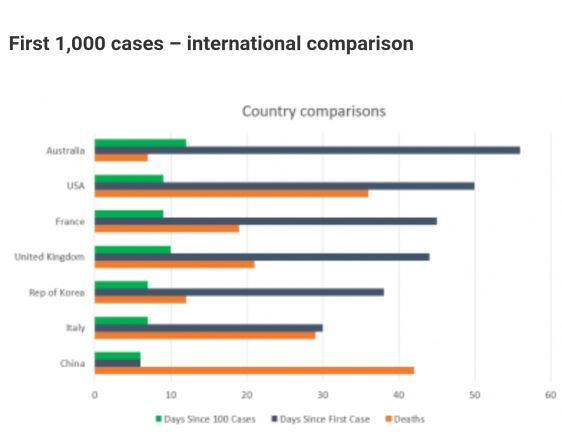
The majority of material in this report was the basis of Coronavirus (COVID-19) update 22 March. For me, it tells the story of Australia’s response thus far to COVID-19. Independently, these disparate data and opinion pieces add up to damning evidence in support of what I have argued on this site for 6 weeks that the Australian Government has failed to reasonably protect Australian lives.

Firstly, let’s start with some raw data. Now my family had been noticing a fading out of national data being reported in Australia – instead individual state data was being reported – but that has reversed in recent days, in part because the media was complaining about having difficulty in accessing these data.

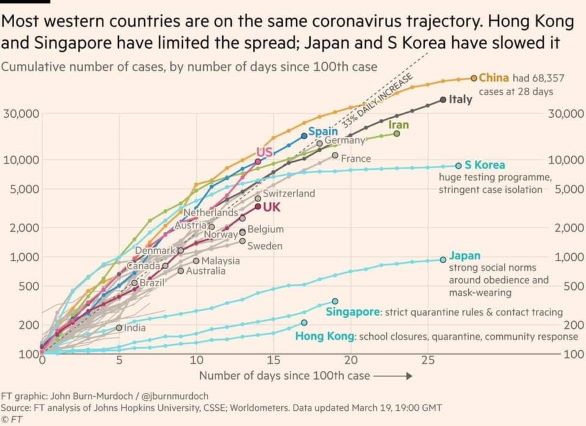
According to WHO situation reports, on 19 March Australia reported 199 new cases, an increase of 39% to 709. On 20 March that increased another 164 to 873. And on 21 March the latest reported number of cases stood at 1,081. So within 3 days the number of cases more than doubled from 510 to 1,081. And remember – remember! – that the Government strict rules on who can be tested precludes people being tested unless they have travelled overseas or had contact with a confirmed case in the previous 14 days (though on Friday it was broadened to allow testing of people in aged care facilities).

So how do we stack up compared to other Countries?

Answer – not well, and remember, these data are dependant on how much testing is going on. (Please note source of this graphic is FT).

But if you listened to Mr Morrison on television last night, on 22 March, you heard a different story, one of a bureaucracy at the top of their game and responding well. So let’s address that.

The information on which he based those comments are contained within AHPPC coronavirus (COVID-19) statement on 22 March, published early morning 23 March.

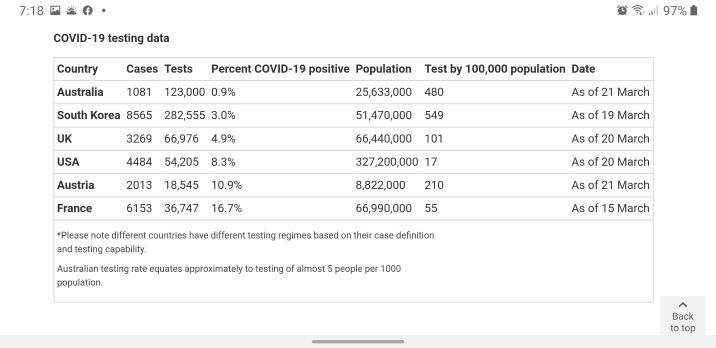
This report contains much information on how Australia has done an excellent job thus far, and concentrates heavily on testing efforts. It contains these graphics supportive of that contention.

So far so good, and I do have to give credit where it is due – this is a great job by the people on the ground doing the testing!

But look at the note on the table “different countries have different testing regimes based on their case definition and testing capability”. In Australia it remains the case that in order to be tested the patient either needed to have travelled overseas or had known contact with an infected person, and only last Friday was it extended to include people from nursing homes irrespective of fitting the other criteria.

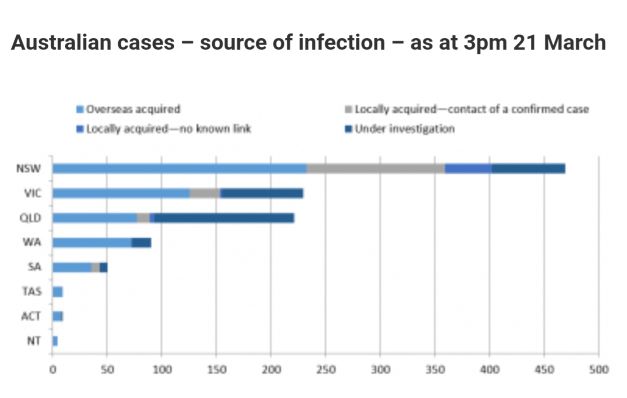
Technically other people who acquire the virus from unknown sources can not be detected by the testing regime, but many are beginning to be detected now based on these graphs, first from the NHPPC update on 17 March and the latest one on 22 March.

Either this growth in cases is due to the testing of people in aged care homes, which would be a real worry, or doctors are making the call themselves – against comments by the Chief Medical Officer in recent days due to a concern for running out of test kits.

And you would think that this would all be important news to inform the public on. No. Buried in this report, towards the end of the text is this passage:

Nationally, Australia is close to 50% community transmission at this time

Also note in the two graphs immediately above that the indication in the ramp up in local transmission from unknown sources in recent times was readily visible in the first (the reduction in the blue portion of the bars denoting “overseas acquired” and the growth in the green portion for “under investigation” which is essentially a synonym of locally acquired source unknown). However, the later graph is a cumulative graph of ALL cases detected thus far so it gives no indication of how COVID-19 is increasingly spreading within Australia. So, when it is said that the majority of cases remain to be from travellers that is factually correct but it is getting less and less the case every day.

And here is the thing about politics and spin these days. Everybody knows that information will be cherry-picked to tell the story that suits the politicians, and anything that is detrimental to the case they are presenting is either not reported, is reported in a confused and difficult to decipher manner, or is buried to be less visible and less likely detected.

Another key point, let’s play a little game of “which one of these things is not like the other” from my favourite childhood television program: in the table comparing the testing intensity of all countries, which country is unique? Regular readers should know this because I have stated it repeatedly from my very first report “Social Cohesion: The Best Vaccine Against Crises“. Hint: think hemispheres. Yes, Australia is the only southern hemisphere country and we are heading into what will be a very long and challenging winter period where other respiratory viruses will be circulating making the COVID-19 response all the more challenging.

This is a much understated issue, in fact I have not heard any of the officials mention it! We need to be on our game!

Here is a graphical representation of how our response measures match up around the world.

Increasing intensity – yellow-green-blue – denotes increased containment measures.

This graphic indicates that our containment measures at 19 March were better than PNG and central Africa, and on a par with Brazil, Mexico, Burma, Russia and UK.

So we did not act with caution and implement anywhere near stringent-enough biosecurity protocols to clamp down on the introduction of COVID-19, even though concerned voices were attempting to be heard. As I explained in “Politics and Biosecurity” and my open letter to PM Morrison, and I said it above but it really does bear repeating, Australia has certain geographical advantages that would have been extremely useful to preventing pandemic here – most notably being an island and our biosecurity infrastructure – but were not fully utilised.

So where to from here?


These are the options still available to us as laid out in a great piece by John Daley of the Grattan Institute, and my regular readers will notice a very clear echo in the Option C which Daley chooses as the prefered way to go.

Still Australian political and bureaucratic followers dither and either fail to grasp the full scale of what is heading our way or refuse to react in a way which would ensure minimising lives lost in Australia.

Next an article from George Monbiot, a columnist at The Guardian UK, explaining why the politics of Australia, the UK and America “isn’t designed to protect the public from COVID-19” (and note that right through my discussions on these pages I have lumped these major Anglophone countries together, as recently as in my post on Friday “The First Victim of War is the Truth” which I wrote and published before finding Monbiot’s great piece).

Finally to what has been the effect in Australia to the dithering, confused and self-interest-predominating response of our Australian politicians.

This is a video that I recorded from live television, CNBC, on Saturday morning (Australian time, from New York early evening Friday) where a business person operating across 11 countries notes the extreme level of nanchelance from key Australian team members.

As I said in “COVID-19 Elephants in the Room” with reference to the GP in Victoria who was criticised by their Health Minister for treating people when unwell after returning from the US before the depth of their problem was understood, the level of complacency in Australia is a direct result of the political and bureaucratic followers deliberately seeking to understate the risk that this pandemic poses to Australia to lessen economic impacts.

So on the one hand professional people who are failing to comprehend the scale of the problem heading our way is understandable, along with young people heading to Bondi for day at the beach, and on the other hand a public only now coming to grips with it and fighting over toilet paper and stripping shelves bare to stockpile in case of shutdown, is all related to inept leadership in Australian which has become “followship” (as Mr Hockey actually admitted during his last visit to Australia).

OK, I have just about exhausted myself in prosecuting this case. I do not know whether I will manage it, but my aim is to cease pointing out the defincies in the Australian response because I fear it is all pointless at this stage. Our advantage in battling the pandemic was not taken. And some times it is just too difficult to fight against the reality that “The First Victim of War is the Truth“.

I aim to add some more positive pieces to assist my nation and broader humanity endure this our toughest immediate challenge.


Gained value from these words and ideas? Consider supporting my work at GoFundMe


© Copyright Brett Edgerton 2020

The First Victim of War is the Truth

The world is at war. Not within humanity but against a common foe – a disease, and more specifically the virus that causes the disease COVID-19.

That makes it difficult for families to decide what is best for them, especially with regards to important decisions around schooling for children.

On these pages I have been scathing of the Australian Government’s response, and I have included some choice comments for the American administration under President Trump.

The latter in particular has been quick to point blame to China, the first victims of this lethal virus new to mankind, and in recent days he has returned to this strategy by referring to it as the “China virus”.

The major Anglophone countries of the USA, UK and Australia all appear to have been slow to respond to the emerging pandemic, even though it was clear early on just what a threat this virus represented, and as I showed in my first report on 3 February 2020 “Social Cohesion: The Best Vaccine Against Crises” the virus had characteristics which ensured that it had already escaped the biosecurity efforts to contain it to Wuhan and China.

The reason for the slow response by these Anglophone countries is clear – not only did they observe the impacts of this virus on the Chinese people, they noted the obvious economic impacts that would ensue from the biosecurity measures that were necessarily employed to contain and/or slow its spread. In an Anglophone world where “greed is good”, and human beings are always considered foremost as “consumers”, that threat clearly predominated the thinking of the national “followers” (I can no longer even call them leaders with lowercase l’s – these people are anti-leaders – followers).

Stepping outside of the Anglosphere propaganda, and listening to the World Health Organisation (WHO) and others, there is a valid narrative emerging that the Chinese people – under the direction of the Chinese Communist Party – made enormous economic and social sacrifices to slow the spread of COVID-19 out of its borders to buy the entire world time to get prepared for the onslaught.

Over the last fortnight the WHO has continued to express dismay at the response by some nations and has implored nations to “not hoist the white flag” and to “pull out all stops” in their fight to contain the virus, and in the last few days has added to those messages by saying nations must “test, test, test” for the virus. This is an area that all of those aforementioned Anglophone countries have fallen short, especially the USA, but none has even come close to achieving what South Korea, Singapore and Hong Kong has managed in this vital task to track the prevalence and incidence of the virus in populations.

Instead in the UK, and a lesser degree Australia, there has been the emergence of a concept of “herd immunity” which involves minimal responses to protect the wider public, while enacting biosecurity to protect the most vulnerable, so that a proportion of the population becomes infected and then presumably develops immunity so that there will be no recurrent waves of infection. In my previous post “COVID-19 Elephants in the Room” I discussed some issues which throw serious concerns over such a strategy, and many epidemiologists and physicians have stood up to argue against the wisdom of such a strategy. And my comments about the elephants in the room are being reinforced.

My view is that this is usual political self-interest. These national followers baulked at rapid implementation of the necessary biosecurity measures out of fear of the economic impacts, and now fearing a backlash against them as the societal consequence become clear in other jurisdictions, they have gone in search of and latched onto this narrative to justify their (in-)actions.


I do not think that anybody could accuse me of favouring the politics of any particular country – I would not visit China again because I imagine that the CCP would be displeased by at least some of what I have written – and I recognise that I am fortunate to reside in a country where I am free to point out the failings of my own and other political followers with virtual impunity. 

Moreover, I am under no illusion that any of this is happening in a vacuum somehow separate from the cold war with China that has been ongoing but has only recently come into our collective consciousness – and that relates equally to actions by Chinese politicians as well as Anglophone politicians.

This is how, I believe, we landed at a point where the Australian political editor of the left wing paper “The Guardian” wrote a piece yesterday largely giving Australian Prime Minister Scott Morrison a big free kick over his past failings on the response to COVID-19 and almost suggesting that we need to wipe the slate blank in this crisis and get behind him. (And yes, I remain a little skeptical on why they did not publish any of my early material on COVID-19.)

I, for one, can not because, besides an obvious change in tone, following a similar move by Donald Trump at the weekend, and indications that he is thinking a great deal more about providing political coverage for his actions, I see little change in Mr Morrison’s actual performance and outcomes.

That view was all the more reinforced in watching the debate at the National Press Club Wednesday where Dr Kamalini Lokuge clearly had the better of her (much more bureaucratic-focused – political insiders) opponents Jodie McVernon and Vanessa Johnston. 

This suggests to me no change in focus from the top – just more political spin. And I have to say what really annoys me when some intelligent people debate it just becomes about winning, not necessarily nutting out ideas that can be of value to society. Dr Lokuge debated with great compassion, humility and intelligence – my impression was that her two opponents lacked the former two qualities.

So while I remain open-minded to Morrison finding his road to Damascus, I see no genuine evidence of it as yet. And for that reason I am entirely satisfied in myself on how I am handling this crisis for myself and my family. That is what I will discuss next especially within the context of decisions over school closures.


As I discuss the strategies that I have chosen for my family there are a few things that are specific and which inform my decision-making. All families are unique and these factors need to be carefully weighed.

Firstly, we were not young parents so I am now 50 with a child each in primary school and high school.

Secondly, with family histories of asthma several of us are especially prone to developing severe asthma, requiring courses of the strong corticosteroid Prednisone, whenever we contract a upper respiratory tract viral infection.

This places our family in a higher risk category, and me especially so.

As is clear from my writing on MacroEdgo I was very early to realise the threat that this virus poses to global humanity. The WHO recommends that people in high risk categories undertake social distancing strategies, and they list high risk categories as people of 60 years or older, OR people with underlying health conditions including hypertension, diabetes and/or respiratory conditions (including asthma).

In my Coronavirus update of 11 February (note carefully that date and that of the next quote) I said the following:

Presently every developed country will be asking themselves these questions:

– what is our capacity to test everybody displaying flu-like symptoms and at what point do we start and at what point do we stop (and devote resources elsewhere)

– at what point will we stop large public gatherings (sports events, conferences, concerts)

– at what point will we close schools

– at what point will we stop public transport and encourage employers to ask employees to work from home

– how will we ensure that we can continue vital services such as health, water, electricity

– at what point do we close the borders completely to all non-citizens or residents

The sooner these measures are enacted the greater the chance of limiting the human impact on Australians, and, in fact, playing a role in preventing the spread throughout broader human populations. However, the politics of these actions are significant and even the WHO can not avoid them in that they did not recommend the closing of borders with China even though they knew that not doing so would lead to increased dispersion of the virus.

On the other hand, the sooner these measures are enacted the greater the impact on the Australian economy and especially some specific businesses. And economic impacts certainly do have society and human impacts.

And in my update of 18 March I said:

I am privileged to have close contact into one very small Italian community by virtue of the fact that I own a holiday home there – hence my upcoming post – so I am able to gain a view on the challenges that they face in confinement. And remember this is an impoverished area that has done it tough for a long time. But even so, when we are asked whether we in Australia are yet in lock down, and respond that we are not, they find it difficult to believe given the examples that are abundantly clear on what has happened in China and now in Italy and broadening in Europe.

Last week I decided I was placing my family at a level of risk that I was uncomfortable with by following the Australian Government directive to continue to send our children to school, without qualification other than if required to self-isolate according to the Public Health Act 2020, rather than following the WHO recommendation of higher risk people (thus families) initiating self-isolation strategies.

As I stated in my paper “Social Cohesion: The Best Vaccine Against Crises” that first weekend in February we shopped early and we bought a little more than usual. We have continued doing that since – we shop much less often, and when we do we go early before many people are present and when surfaces are less likely to contain viable virus than later in the day, and we have continued to buy a little more than usual so as to build up a bit of stockpile of necessities gradually so as not to impact others who have only recently been alerted to the need to do so.

Again, this is something that I warned about, especially in comments at The Conversation in early February, because it was always clear that this was going to be a major problem and the longer that the Government downplayed the issue the sharper was going to be the realisation to people that unprecedented actions would be required by the Government and by households.

Equally important to discuss is how to talk to somebody who does not understand the deep implications of what has and will occur. The WHO is being more frank about the situation than all Governments. Our world has changed – I have spoken up about the consequences of that (see “Social Cohesion: The Best Vaccine Against Crises”) – but keeping people in the dark while praying for a (political?) miracle will only increase anxiety not decrease it. Politicians have cynically divided people for too long and the consequences of that are already on display with the numerous reports of increased xenophobia since the outbreak. Information on the outbreak (and my background) at macroedgo.com

So last Thursday I informed my sons that Friday would be their last day at school for a while. Even though they were aware that this might happen, they were still shocked to learn that we had arrived at that point. And it is fair to say that they experienced a few days of grief that their lives as they knew it had changed.

Obviously I made this decision, and begun to enact it, before PM Morrison’s new communication strategy was implemented which included an all out assault on those arguing for a lockdown of Australia where school closures have become the key area of debate. Instead this grouping of political followers, including state premiers, have argued that social distancing can be achieved within otherwise normal school environments, which was immediately dismissed as unworkable by those who would have to implement.

I will not wipe the slate blank so quickly and acquiescently as the Guardian’s Australian political editor, and I can confirm that my family remains of the view that the Prime Minister is accountable to families personally impacted by the COVID-19 pandemic by the loss of a loved one as I detailed in my open letter.

I will say this, however. In Queensland we are two weeks away from the end of term school holidays. If we are following the trajectory that Italy followed, which I fear we are, then we are at a time where there is significant community transmission going on which will be expressed by a rapid acceleration in the number of unwell people presenting at hospitals and other health care facilities in two to three weeks. This is why Dr Lokuge was so stridently arguing for increased testing as the WHO has implored of nations.

I cannot see any real reason why schools could not be shut 2 weeks earlier than otherwise to see how things develop over the period until when school would normally be commencing term 2. If there is no acceleration in the number of cases and seriously ill people, then what is lost – really? But if there is a serious deterioration in the situation then we can all be thankful that the decision was made earlier than it would otherwise have been made.

And if the potential length of confinement is really an issue, with mention of it potentially lasting 6 months, is an extra 2 weeks really significant, especially when we are observing through the media what were the consequences elsewhere in jurisdictions that enforced lockdowns later in their own pandemic curve?

My view is that this is all a very clear indication that the political followers absolutely will die in a ditch over this. But if you look back through all of my writing of the last 6 weeks, you will notice that I have called all that has happened well in advance, and the Australian PM has found it necessary by circumstance to acquiesce – including closing the borders – as the human reality confronts the public. 

School closures will be no different. 

In concluding my post “politics vs society” I said:

I want to be clear – I am in no way qualified to make these calls on how the cost/benefit of economic impacts to actions can be weighed against human and societal impacts. Then again I do not really believe that anybody is qualified. Sometimes people find themselves in extraordinary situations and they need to make a call not knowing whether it is even likely to be the right one. Sometimes in life decisions just need to be the best that can be made at the time.

Even if we do strip things down to a bare cost/benefit analysis for society – if it were ever possible to totally eliminate politics, both broad systematic politics and interpersonal, social politics (essentially of egos) – how does one weigh up the costs and benefits of a certain level of economic activity versus a certain level of deaths amongst a society. And even then there are cross-contaminating issues, where economists will quickly point out that the stress of economic hardship results in costs to the health of populations and then to deaths.

I just wish that I had witnessed behaviour worthy of faith and trust in the political [followship] of this country instead of a continual erosion of it over the last two decades…

While I am not qualified to make decisions on behalf of the nation, I am qualified to make decisions on behalf of my family and I have done so.

And while I say I acknowledge that I am not qualified to make decisions on behalf of this nation, I comfortably put forward the historical account of my forecasts on the development of this pandemic against historical comments by those of this nation’s political and bureaucratic health followers.

I am far from convinced that the human tragedy has yet gotten through to the Australian political and bureaucratic followers, and my fear is that shock at the consequence of their slow and reluctant decisions will only confront them when our physicians are drawing up arbitrary decision trees to determine which Australians will be given a respirator and thus a chance at survival.

Morrison will need to backtrack to find his road to Damascus, but it is still there for him if he chooses to wise up.

Even if or when he does, though, there is no question he is on the hook for lives lost because he was much, much too slow to choose society over politics.


Gained value from these words and ideas? Consider supporting my work at GoFundMe


© Copyright Brett Edgerton 2020

COVID-19 Elephants in the Room

Something has been in the back of my mind – a nagging concern – that I did not really want to acknowledge even to myself.

This is a new viral disease to humanity. The very basics are barely understood such as what type of disease does it cause and how severe is it, how does it transfer, and how do people become unwell and how many will become so unwell that they will die. There is still very much unknown. My friend Dr Shi Zhengli only discovered the viral cause of the new pneumonia-related disease, now referred to as COVID-19, just over 2 months ago.

Now think about HIV and how long it took for scientists to get a reasonable understanding on how it caused disease in humans. Sure, our tools have improved since early in the HIV pandemic but that virus was tricky compared with other viruses then known to science.

So what has been in my mind is that the superficially apparent aspect of disease visible as the pandemic ramps up may not be the only aspect of how this virus causes disease in humans. If we were unlucky, there could be some more chronic element – perhaps more chronic disease leading to mortalities or disability, or foetal defects – who knows, almost anything is possible.

Now many politicians would already consider me to be non-constructive – to their politically-oriented messaging – so I saw no point in talking about left field hypotheticals which are essentially infinite and of little value discussing other than to say that anything is possible.

That was until I went looking for an update on my friend, Zhengli. (I have not had a response to my emails over the last 2 weeks and I was a little concerned, hence my googling for recent activity by her – the last activity by her was some weeks ago when she found it necessary to defend herself from baseless accusations that she or one of her colleagues was the cause of the outbreak, from a lab accident or some other nefarious activities – that may be the subject of another post soon.) In doing so I came across a Lancet preprint from 2 March, which Zengli co-authors, entitled “Caution: Clinical Characteristics of COVID-19 Patients are Changing at Admission“. The concluding statement is:

All [of the mentioned observations] provide clues that the new coronavirus may gradually evolve into an influenza-like virus, or it may be latent in some asymptomatic carrier for a long time.

What will be the consequence of those latent infections will not be understood for some considerable time.


Having addressed that rather large elephant in the room, I want to go on and address the other elephant in the room – the mortality rate due to COVID-19. I am not going to discuss it in epidemiological terms, i.e. what current data suggests it might be – with the all of the inherent caveats including confidence over the quality of those data – and what may be the consensus views in several years when the dust has settled on this pandemic. Obviously, I am not qualified to do so, and whatever anybody suggests about the value of my writing here, I am trying to be constructive and not go beyond what my experience – in science (through my professional training) and economics (through my long passion during my adult life as shown in my public contributions over a decade or more) – allows me.

Firstly, surely common sense must tell any observer that this clearly is more serious than any other respiratory pathogen that has emerged in recent decades, and certainly more serious than the typical flu. Not anywhere in the world have we witnessed, to put it crudely but accurately, people dead in the street due to a respiratory virus.

This is the problem for deniers – like Donald Trump – where the obvious reality does not tally with what he is saying. Perhaps these types can get away with it on a medium-long term issue like Climate Change, but this crisis is so fast moving that these denials are quickly shown to be both ridiculous and dangerous.

Perhaps the markets like to work on narratives, and smart money likes to have ebbs and flows in narratives so that money can be made from volatility within medium to long term trends, but this is too fast-moving for such management of participant psychology to maximise profits to ticket clippers.

What I want most to talk about is the narrative that is being portrayed to the citizens of countries and I am going to use some examples from the UK because they do seem to be having a public debate about the right types of issues, even if there are some mixed messages.

There the Chairman of the Commons Health Committee and former Tory Health Secretary, Jeremy Hunt, on 28 February spoke on national radio of the need to balance the societal costs in terms of lives lost and the economic impacts. Mr Hunt spoke about how China managed to stem the spread of the virus in Wuhan and limit infections to 5% of the population, and made the point that that represents an enormous number of lives saved compared with it infecting 70% of the population.

On 8 March Prof Tom Solomon of the Walton Centre NHS Foundation Trust said that the coronavirus causing COVID-19 may ultimately infect 50-80% of Britons.

Thus based on these two comments there seems to be a view in the UK that the worst case scenario indeed may involve 70% of Britons infected by COVID-19.

Also on 8 March The Sunday Times reported that Government Ministers were preparing for up to 100,000 Britons to die with COVID-19 and were trying to make plans without spreading panic. Note that this was said to not represent the worst case scenario, but it is considered their “central scenario”, presumably meaning that it is considered a likely outcome.

That sounds like an awful figure, and there is no doubt that 100,000 deaths of group of people for any reason is absolutely a human tragedy.

Let us look at how the numbers run out on this to see how they have arrived at this figure.

The calculation for the proportion of people in a population who will die will be the proportion of people who become infected (let’s call this X) by the proportion of these people who die from the infection, or mortality rate (let’s call this Y). Thus:

X x Y

To arrive at the number of people in a population who will die you then have to multiply this by the total number of people in that population (N). Thus:

X x Y x N

As we know the population of Britain is 66,000,000 and we know the number that the Government has calculated may die from the infection, we can easily work out the proportion of the population which they are suggesting may die.

= 100,000/66,000,000 which equals 1 in 660 people or 0.15% of the total population of Britain.

To arrive at this figure, if it was actually calculated as opposed to it just being pulled from thin air (which is always possible, too), we know that it is the product of X and Y. So what may be some of the combinations of X and Y that may arrive at a figure of 0.15%.

Before we do that, however, note that it is vastly different to the figure that I used in my comment on The Conversation Australian website (which I repeated on Facebook) last week when I multiplied 70% of population infected by 3% mortality rate = 2.1%. In fact, the figure which UK officials are using is less than 10% of this figure, and it would be interesting to know what was their worst case figure, but in reality there is low value in publicly discussing worst case scenarios other than in trying to focus attention on pulling out all stops to throw the kitchen sink at the response.

Here are some combinations that will produce 0.15%

Infection rate/mortality rate

10%/1.5%

30%/0.5%

50%/0.3%

70%/0.21%

If I had to have a guess they might be working on 30% of the population infected with a 0.5% mortality rate, but it really is just a guess.

Given that COVID-19 is more infectious than the flu, and that is abundantly clear from the history of this pandemic without reading any analysis or modelling by epidemiologists, it is clear that to limit infections to under one-third of the population is going to require a very significant and ongoing quarantine effort.

Remember, also, that nobody really knows what will be the actual mortality rate.

So now we arrive at a discussion about my own country, Australia.


To pick up on one of the main issues of recent days, unlike the Health Minister for Victoria, I can understand how a GP recovering from what he thought was a cold which he acquired on a trip to the US would turn up to work and consequently interact with large numbers of patients and others.

Let’s think this through in the context of what I have written here over recent weeks about especially the consequent dangers of understating the risks associated with this pandemic.

The GP acquired the infection in the US which has been extremely slow to respond to the pandemic and with a leader who has continually sort to downplay the risks. The US has allowed this pandemic to get a good head start on it by bungling their diagnostic kits and that has meant that there has been little awareness of the circulation of the virus in American communities. So it is only recent visitors to the US that have been aware of the wide geographic spread of COVID-19 in the US.

The Australian GP only tested himself out of curiosity. As these health officials are continually telling us, 80% of cases have very minor symptoms if any symptoms at all. This much has been well known for a long time, so if we do not have blanket screening protocols, then why would someone with minor symptoms even consider the need to test for COVID-19. Moreover, there were press reports at the weekend of people feeling quite unwell and being refused testing for COVID-19. It is reasonable to say that the only reason why this gentleman was tested is because he is a GP and he did so in the belief that it was a very low probability that he had COVID-19.

How many people over recent weeks in Australia have had what they thought was a minor ailment, after travelling from a country that then was considered a very, very low risk for acquiring COVID-19, have gone about business as usual and may never know that they were infected. This GP would not have known himself but for his curiosity, and if he did not do the test he would have been none the wiser. And even when some of his patients fell sick, in trace back analysis it might never have been clear that he was the original source of infections.

The health officials and politicians really should not be pointing the finger at others for not having taken the threat seriously when they have sort for weeks to calm people by giving all indications to the effect that it may prove to be a storm in a teacup.

GPs are members of society as well, and they also receive those calming messages. It took a conversation with me for my GP to be woken to the risks posed by COVID-19 a few weeks back. And in a conversation with a mate who did his PhD on flu vaccines, no less, I was amazed by how complacent he was about the threat.

A lesson for me is just how much people are willing to accept at face value the messages put out by Governments and bureaucrats, and how little of their own intellect people put towards critically thinking through those messages.

It is certainly very rich for politicians and/or bureaucrats to then turn around and to suggest that anybody should have known better than to be lulled into a false sense of security when that has been the intention of the communication strategy that they, themselves, are prosecuting.

Finally, all of the above only goes to highlight how critical it is that Australia pulls out all stops and throws the kitchen sink at containment of COVID-19 as we head into winter. It should have been done on the precautionary principle, now it should be done on a growing weight of evidence of just how serious COVID-19 has proven to be, even before we begin to consider all of the unknowns.


Gained value from these words and ideas? Consider supporting my work at GoFundMe


© Copyright Brett Edgerton 2020