Why is a compassion culture better for all stakeholders in capitalist societies including shareholders?
Besides the threat of unheralded injury claims from toxic workplaces that put businesses in jeopardy (as I explained in “The Great Reset At Work“)…
it is my thesis that a great deal of work done by white collar workers is ‘just in case’ work which is really about making self-interested managers look good, or addressing their anxiety over potentially appearing bad to their domineering managers, rather than actually adding value to the business.
I have witnessed the rise of ‘just in case work’ from many sources over many years.
And yes, this is highly related to David Graeber‘s famous “Bullshit Jobs” thesis where he argues that over half of work is pointless and knowing this does harm to those who are made to perform this work.
After the extended period of Extreme capitalism, many workplaces are operating manically, and managers down through the hierarchy are thus incapable of making good decisions to increase productivity by genuine efficiency measures. Executives have continually initiated restructures to achieve efficiencies which in the main are a euphemism for smaller workforces.
Headcount cuts just drives that viciously manic cycle and actually decreases pure productivity (quantity of work adjusted for quality relative to effort) thus burning out workers trying desperately to, at best, appear to be as productive as before the headcount cuts by increasing their own effort even further.
All of this is worsened by ubiquitous communication technology eliminating separation of work and home life.
This explains the negative stimulus behind the Great Resignation/Reshuffle and Quiet Quitting.
(Of course the positive stimulus is Great Reset era thinking that a better work life balance, and an identity less entwined with ‘what I do’ for income, is indeed attainable.)
This describes the reality of many large organisations, and the consequence has been an enormous experiment to see how long before large numbers of human beings ‘break’.
The evidence, from many sources including from insurers, suggests that point was surpassed in the past decade.
Of course in small businesses the reality is somewhat different in that actively involved owners will immediately seek to eliminate inefficient ‘just in case’ and other pointless work if detected.
The more tenuous nature of the small business workplace, however, incentivises small business owners to exploit workers and owners use this to justify their own poor behaviours to themselves.
This behaviour is systematically supported in two ways. After decades of Extreme capitalism, regulatory capture by business groups including small business means that regulation and enforcement is not as active as it should be to protect workers from exploitation.
Secondly, when the worker knows that there is as high a chance of being overworked and burnt out in a large corporate business as a small business, ‘better the devil you know’ becomes a strong factor in accepting exploitative practices.
If large corporations develop a ‘compassion culture’, and if Governments regulate and enforce for it, then small businesses will have no choice but to follow, and businesses that are viable only by exploiting workers will be exposed as unsustainable.
This will lead to much better allocation of resources in economies, and thus will actually strengthen our capitalist societies.
Gained value from these words and ideas? Consider supporting my work at GoFundMe
In “The Great Reset: An explainer” I gave a brief description of the political and economic backdrop that led to humanity entering the pandemic at a moment of social extreme with a paradigm shift due or even overdue.
I explained that trends in society tend to occur in cycles that can be conceptualised as a swinging pendulum.
The truth is that this concept is simplified because it infers that trends oscillate around a stationary point but we know that – no matter how much conservatives seem to dislike the idea of it, at least over shorter time frames – human society has progressed an awful lot since we mastered fire and put circles to work (as wheels and then gears).
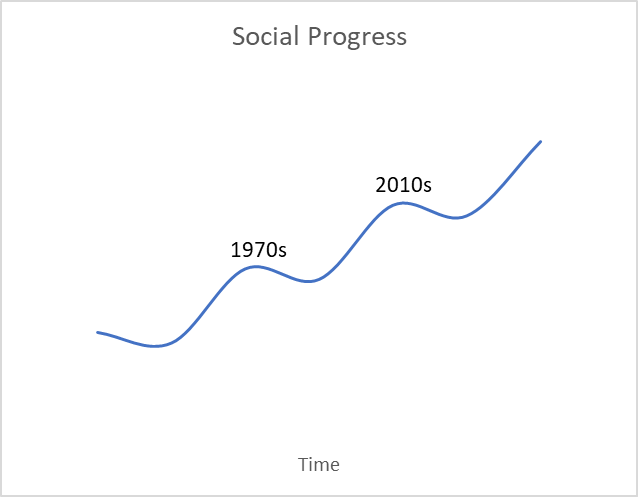
So intuitively most of us understand that our societies progress over time, but most of us also recognise that there are periods where change seems to happen quickly, and there are other times when change happens slowly, or perhaps conditions even go backwards. In many ways we see societal progress over time as the diagram below shows, a wavy line but generally heading up to the top right hand corner of the graph.
Wavy line of social progress over time
To make the situation even more complex we all understand that societal progress is in reality a whole host of factors ranging from major issues such as how we view inequity in wealth (the major idea discussed in the ‘explainer’) to relatively minor factors such as how we choose to dress and present ourselves, though older members of society through history have often treated these as far more significant issues (for example in the 1960s when young people as a cohort really began to express their individuality). That is in part an over-reaction from those who feel insecure that they are no longer a part of the demographic that sets trends within society, but it is also a reflection that all of these trends intersect to produce an overall view of societal progress.
In other words, if we were to narrow in on that wavy line of progress we would notice that it is the overall trend, but that there are an infinite number of trend lines – some more significant, some less significant, some oscillating more slowly, others more rapidly – that together make up the overall trend. This is a little like zooming in on a Google map revealing progressively smaller roads which are less and less significant to the overall way people move around, but that does not mean that those very minor roads are less significant to all of us (e.g. those who live nearby in the case of roads).
Of course the relationship between capital and labour – those who have large pools of resources and wealth at their disposal, both personally and/or as a consequence of status or position within society, and those who do not – has always been one of the most critical trends affecting human progress.
Now these wavy lines of social progress can still be reconciled with the swinging pendulum concept if we think two-dimensionally, or in the second derivative as some who like maths prefer to say.
If you are not a fan of mathematics, let me explain it this way. Imagine that you have an animation of a singing pendulum on your phone which you are looking at on the face of your phone. Turn the phone a quarter turn so it is at a right-angle to you and then gradually raise your phone as you move it from left to right while visualising in your mind the position of the round end of the pendulum. Hopefully you can visualise it tracing a wavy line like the one above.
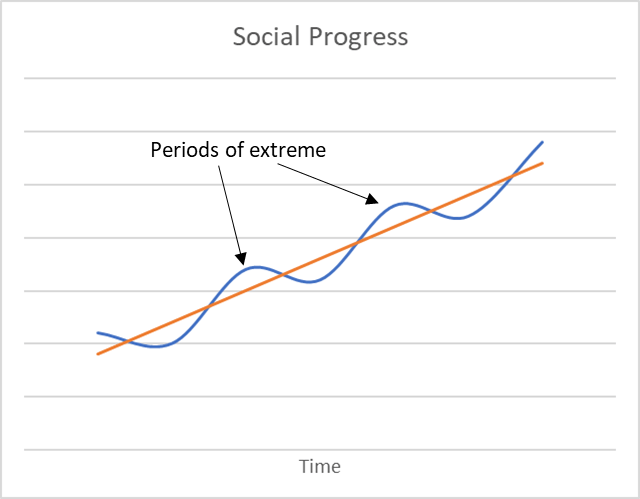
Now in this concept I intentionally chose a pendulum singing widely and above the centre point because that is how progress has occurred for humanity to this point as I described in my explainer. The path of the centre point of that pendulum swing is drawn on the next diagram to show that it indeed rises at a constant stable rate but that there are moments of extreme when the pendulum approaches a course change at the top of its swing.
Wavy line of social progress showing periods of extremeSide view of a pandulum at various positions indicating its centre (the orange line) moving upwards at a constant rate over time.
I referred to this concept of an upwardly rising pendulum for societal progress in an earlier essay entitled “How Might Milton Friedman Respond To The COVID-19 Pandemic“. Friedman is considered a hero of conservatives as it was in large part his intellectual rigor that led to the reforms of the 1980s most famously implemented in the US by President Reagan and in the UK by Prime Minister Thatcher due to their veneration by Anglophone conservatives. In Australia reforms around this time were implemented by the centre-left Hawke/Keating governments.
The main point of that essay was to say that I believe that the Mr. Friedman who wrote “The Social Responsibility Of Business Is To Increase Its Profits” in 1970, if he were brought forward in time to assist humanity in responding to the COVID-19 pandemic by allowing his economic rigor to intersect with recommendations of medical experts, would not have recognised the economies that he was dealing with because it would be unfathomable to him the extreme to which his ideas had been taken. Thus I posited that he would have said that if he was to formulate a response to the COVID-19 pandemic he would not be starting from here!
There is no need to rehash exactly where we are, in my view, in an observational sense as it would be a repeat of that essay and much else that I have written over the past 3 years including most recently in “The Great Reset: An explainer” and in “The Great Reset At Work“. Instead I will label the most recent half century of that wavy line of social progress with dates as below showing how through the 2010’s the pendulum was at an extreme and its direction change has created the perception that our progress is actually retarding.
Just as the 1960s and 70s was a period of social extreme, so too was the 2010s as the pendulum reached its climax especially in the way our Extreme capitalist system favoured capital over labour.
However, if we narrow in on the model for the present day and through the next few decades this model explains exactly why I am ultimately very optimistic.
As the pendulum reached its extreme in the 2010s social conditions were extreme. But the pendulum has begun its swing back and is gathering momentum. This is the Great Reset Era and the rate of change will continue accelerating as ideas spread from early adopters to influencers to the broader public.
I firmly believe that we are setting ourselves up for a golden Great Reset era where social progress will accelerate on the back of significant reform which is possible because humanity is primed for that change no matter how much conservative and other right wing political actors attempt to scare the population away from the idea of social progress (again, which I will not discuss as I have on many occasions, most recently in “The Great Reset Era At Work“).
The evidence of this is pervasive through society in the way that we communicate and tell stories, i.e. through all of our media, and is apparent to anyone perceptive to it. And my perception is that this is indeed accelerating as I would expect to happen.
Much of that change will centre around how we identify with ourselves in the Great Reset era, and at the centre of that will be the role of paid employment and creating a better balance between it and our broader lives and roles in society. Thus industrial relations is shaping up, once again, to be a focal point.
Given the level of inequality, debt, and middle-class erosion, however, the breadth of dissatisfaction expressed and change desired will surprise many corporate and organisational leaders and leave many flat-footed and unable to adjust. The impacts will not be felt just in poor performance of organisations under their influence, it may prove fatal if toxic workplace culture is exposed through the legal systems as I anticipated in “The Great Reset At Work“.
Simply Milton Friedman’s profit imperative is being replaced by a compassion imperative.
The corporate leader who has best articulated this change to this point is Indra Nooyi and I recommend this video to all.
In my next post I will describe one idea which I believe its time has come and which has the potential to unleash human potential in unimaginable leaps and bounds – the introduction of universal basic income.
Before I close, however, I feel I need to go negative once more because that is still the mood of this phase of the Great Reset era, and it is appropriate because it spells out exactly what is at stake.
As this model of social progress shows, and as most of us know intuitively when we think over the very long term, humanity is continually at its most progressed state even though there are periods where we perceive we may be regressing, sometimes for long periods such as in Middle Ages (for a brilliant blog post on this see On Progress And Historical Change at Ex Urbe).
We look back and wonder – either actively or subconsciously – how was it that we lived without developed language skills and proper shelter, without knowledge that mercury and lead were poisonous, without electricity and modern mechanisation, and without labour and human rights protections.
Many of us take that one step further and wonder how our current societies will be viewed in centuries ahead, and as our science continues to progress, what commonly used substances and practices will ultimately be proven to do us more harm than good.
I am of the opinion that this period over the past half century will be viewed dimly because, for all of our smug contempt for our ‘primitive’ forebears, we have lost our sense of community as self-interest has led to the ‘democratisation’ of human beings harming human beings as people have fallen for the Extreme capitalist propaganda that status benefits (materialism and ego) from ‘winning’ outweigh the benefits of deep and rich connection with our societies.
There are no real winners in Extreme capitalism, just an unquenchable aspiration for more wins and more things.
Even the ‘winners’ and ‘owners’ are hurting, they just cannot admit that to themselves let alone others.
A culture of domination nourishes nobody.
And when it comes to the unsustainable use of our finite resources, we are all losers even if many still refuse to admit their error.
The extreme self-interest exhibited by our leaders within the political and corporate spheres has been especially harmful. It is hardly a surprise that this type of behaviour has been imitated widely throughout society, after all, there is a reason why the term ‘leader’ developed.
For my entire life I have lived in a society where nothing is valued, not an action, thought or thing, unless at least one other is prepared to pay for it. Now that the mental health impacts of all of this are becoming understood, mainly because it is impacting the profitability and functioning of businesses, there is growing acceptance of the critical need to address mental health. But there is no market value in acknowledging that this crisis stems from the unquenchable aspiration at the heart of Extreme capitalism.
The evidence now shows that diverse, equitable and inclusive workplaces are more profitable. So finally we have sufficient reason to be fair to all human beings within organisations, if only we would genuinely commit to achieving it!
And what about equality on a global basis?
That our society has devolved to the point where human beings being good to other human beings is only prudent when it is profitable says everything about us as a modern society.
The most striking peacock is equally vulnerable to the same diseases as the rest of the flock, the toughest fighting male salmon soon meets the same fate as the vanquished, and the hardest working bee will survive not one day without a hive.
The success of humankind was not built on the individual, it was built on the collective support of individuals within our society. If we wish to unleash humanity’s full potential we need to collectively support all individuals with compassion and love.
That is at the heart of the Great Reset era…
Gained value from these words and ideas? Consider supporting my work at GoFundMe
In organisational and formal social culture, nothing speaks more to an imperialist white-supremecist patriarchal system based on domination than the handshake.
There is so much social expectation and perception associated with the handshake. Virtuallly every person living in a western nation has had the feeling of having their hand twisted into a more passive position (with their palm facing more upwards) by someone intentionally or subconsciously asserting dominance.
I have heard body language professionals give advice on how to respond in such a situation.
When greeting by handshake a hand extended in the upright position indicates equality – a willingness to meet as two equals. So when the hand is extended with it twisted over beyond the upright position – indicating inequality – rather than responding by being passive and submitting by turning your hand with your palm facing upward, you can place your hand atop theirs and shake.
Much is made of handshakes because of the importance of first impressions.
Those particularly polished in etiquette and diplomacy train themselves around this, intentionally altering their handshake for the circumstance. If they wish to appear warm and non-threatening they will extend their hand with their palm more open and facing upwards so that they can embrace the other person’s hand, often then cupping it with their other hand or touching them further up the forearm to accentuate that warmth. If they wish to appear firm but fair, the hand is extended upright at 12 o’clock. And if they wish to assert themselves they extend it in the dominant form, twisted over beyond 12 o’clock to a varying degree depending on the level of strength or dominance that they wish to express.
The force exerted in grasping the hand is also important with obvious correlations.
It is as common for people to criticise others’ handshakes for being too weak or limp as it is to criticise them for being too firm. In my experience women often speak of males’ handshakes being weak suggesting a level of learned or hard-wired expectation of masculinity.
Personally, I was taught how to shake hands when I was 5 by my father when he refused to continue kissing me when I went to bed at night, telling me that men shake hands.
I am certain this behaviour, stemming largely from homophobia, is repeated in many cultures. I remember my brief but great mentor JR Bonami (also a very important mentor to my friend Dr Shi Zhengli, the brilliant “Batwoman” scientist from the Wuhan Institute of Virology) explaining to me local social etiquette during my time in Montpellier, France telling me that in the south of France men don’t kiss like the (apparently less macho) northern French men.
In the new Great Reset era, where we are developing a compassion culture to replace the culture of domination, where for instance heteronormative men are expressing themselves by wearing clothing formerly associated only with women, it is appropriate that we develop a new custom of greeting in formal situations in parallel with the fluid informal expressions of affection that accompany friends greeting.
However, because what is being discussed is a formal greeting, and people often feel uncomfortable over-expressing warmth such as by hugging or kissing, and often females especially feel pressured to comply when someone leans in to kiss or hug, it must take a form that is truly inclusive.
Developing a new mores (I admit I needed to search for the right word) for formal greeting is important because it gives us agency to express immediately in a formal setting that we are woke and will not accede to imperialist white-supremacist culture of domination.
The greeting should be strength expressed as warmth and compassion.
Do you think we can learn from other non-imperialist matriarchal or more passive cultures and adopt that custom, and if so, please share your suggestions.
Otherwise should we develop a totally new style of greeting?
Head to LinkedIn to let me know your thoughts in the original post, and please share… thank you
Published on LinkedIn 25 August 2022
Gained value from these words and ideas? Consider supporting my work at GoFundMe
At this point in the Great Reset era we have heard most about the Great Resignation (or Great Reshuffle) which is unsurprising as businesses wonder aloud why they are finding it challenging to retain their workers and how to attract talented workers.
Some employers are even sceptical, and have suggested workers may regret their actions, especially as interest rate increases result in more challenging economic times which employers believe will give them more leverage over their workers.
Those who lead organisations would be wise to accept that the Great Resignation is just one, albeit important, feature of this new Great Reset era.
What is occurring is much deeper and goes to our identity and our perceptions of self-value.
Collectively we are all acknowledging that our lives are short and precious, and that we want to live the best versions of ourselves.
While the majority of us continue to trade for income our most valuable time and energy of our lives – for over 40 hrs each week for 48 to 50 weeks each year from our late teens or early 20s through to our 60s – we are going to continually assess whether that situation is working for us and whether it allows us to be who we really want to be.
Organisations that thrive in the Great Reset era will be those whose leaders engage authentically and deeply in compassionate wellness with their fellow human beings.
Published on LinkedIn on 9 August 2022.
Gained value from these words and ideas? Consider supporting my work at GoFundMe
After walking amongst humanity for a while, cycles beyond the seasons or clothing and hairstyles become noticeable.
These cycles are noticeable also in political beliefs, and although that can seem boring to understand, it’s important because the political system affects all of us.
Perhaps the most important political cycle that affects everyone is the balance of power between those who have a lot of resources or ‘capital’ – that is the wealthy and privileged within society – and those who have few resources beyond their own natural attributes – that being their unique combination of intelligence and physical abilities – which they trade as ‘labour’ to employers.
In our modern capitalist societies the balance between various groups is arbitrated by our democratic rights to share our views freely and vote based on them.
In my lifetime over the past half century that cycle between capital and labour has swung from one extreme to the other as if we were on a widely swinging pendulum. When I was young the balance was in favour of labour, the majority of people, as trade unions had significant support and power within the political system.
It was a time of many strikes, high inflation and poor economic growth as priority was given to providing good incomes to the majority of people. In truth the system was not very efficient and it became unsustainable.
But from the 70s the pendulum swung back and a lot of necessary reforms happened. It’s important to note that these changes were agreed and often enacted by centre-left governments as well, which occurred in my own country of Australia.
Unfortunately humanity has not really worked out how to know in real-time when we have reached the point when too much of something is a bad thing because the balance has shifted too far.
By the time we entered the new century the balance between capital and labour had shifted too far and the signs that we had reached a form of Extreme Capitalism were showing, especially in the extreme level of inequality even in the most prosperous societies.
The middle class was shrinking and the working class poor were numerous and growing.
At the human level these deficiencies were mainly expressed in the impact on the mental health of people in the system where most felt that they were on a hamster wheel, sprinting and reaching out for juicy carrots but getting nowhere fast. The only thing in their hands were a few crumbs that had trickled off the table from the privileged one percent.
People were increasingly expressing their exhaustion but were feeling trapped, partly because they believed the saturation advertising that the rewards would be worth it if they just ‘hustled’ enough on their hamster wheels.
So by the end of the 2010s the system was due for a paradigm shift; the swing in the pendulum back from that extreme form of capitalism.
The unceasing drive for efficiency in the system, which led human beings to treat each other as if they were already machines, was unsustainable because it was literally breaking people.
Human beings were breaking other human beings!
Enter the COVID-19 pandemic which, in an attempt to minimise human impacts, or at least manage impacts on hospital capacities, led to isolation measures which for many forced separation from their hamster wheels.
Many still worked, either at home or onsite in essential services, which in itself highlighted for many that the rewards from this form of extreme capitalism were not tightly correlated with the importance of those roles in society.
This forced physical separation allowed a unique opportunity for reflection for everyone. It allowed psychological separation to varying extents.
While we were isolated from most others in society, for those who sheltered with others closely related to us, including family and other loved ones, it was an intense period of connectedness with those who matter most in our lives.
Right through this period we all searched for updates on the pandemic, watching the news or scrolling through social media, which served as constant reminders of the reality of human life and of sad loss experienced by so many.
It was always going to be the case that through this period many people would reflect on their lives and whether they felt that trading the majority of the quality time and energy of their lives for the rewards of the hamster wheel was really a fair trade.
Some parents and families realised that they had not been all that closely connected in recent years as the parents were on those hamster wheels convincing themselves that they are doing best for their families, and even children were kept busy with extracurricular activities almost as training for their own future hamster wheels.
Others realised that they had made compromises and moved away from their earlier aspirations and ideals.
Still others reconsidered whether the cost of earning extra income for now or later in retirement was worth the cost to them in the here and now while their health is good, especially as they understood that life expectancy was falling with this new ultramicroscopic threat which just highlighted one of the many omnipresent threats to human lives that have always existed.
With the pendulum at its extreme in favour of capital – the wealthy and privileged – our societies were due for a reset.
That it coincided with, and in many ways was catalysed by, the first global pandemic in a century meant that it would be a very significant Reset.
Given the potential for it to lead to the addressing of some of the longest lasting or most devastating issues humanity has confronted, in the form of social cohesion and in the climate crisis, optimistically from March 2020 I began to refer to this era as the Great Reset!
As I have consistently stated since the first few weeks of the pandemic, the more of us that engage with these changes and share our views and aspirations for a better humanity, the better – dare I say, the Greater – will be that Reset and the more cohesive our societies.
By working together towards compassionate societies we will reduce the oscillation of the pendulum and prevent the turbulence and heartache that the extremes cause. This will improve the quality of life for all of humanity and the space that this peace provides will allow us to address new crises from nature as they are certain to continue to arise.
Gained value from these words and ideas? Consider supporting my work at GoFundMe
The underlying premise of what many say here at LinkedIn – especially those employed in the corporate wellness sector, either embedded in organisations or as external consultants – is that addressing wellness is good for the bottom line.
While I recognise the accuracy of this statement, I find it confronting.
Since work culture is a result of the behaviours of groups of human beings, what is really being said is that human beings should care about human beings because it is good for company profits.
While this argument might act as justification for a salary or a consultancy, from a societal perspective there is something fundamentally very wrong with that statement.
Moreover, while these measures may lead to improvements, I really do wonder at how enduring change will be when it is so correlated to monetary and market-based rewards. We all know that organisation/managerial fads are commonplace in contemporary workplaces.
I can say this because I am not driven by a profit imperative or self-interest. I simply want to play a role in helping society towards a better future by engaging and sharing my views.
That we have devolved to a society where it makes most sense for human beings to be good to each other, and within our broader interactions in the world (i.e. our impacts on the environment), if the market rewards it monetarily or in some other manner (typically related to societal status) is a consequence of the form of extreme capitalism that we have swung towards over the last half century.
This is at the heart of emotion and logic behind major changes, such as #thegreatresignation , we are seeing in this new era we have entered which I refer to as #thegreatreset .
People are tired of this world of transactional relationships as they crave authentic and deeper connection.
In the Great Reset era work-centric rhetoric and responses are seen as lacking and impotent.
Compassion is the only sustainable answer, and that is true in all settings
The irony is that those who understand and enact that in the way they live will reap the full rewards from engaging in society, including from capitalist markets as the underlying premise of the statement is correct, though they probably will not notice it since it is no longer their main goal.
For example, over many years I have closely observed one of the greatest capitalists ever in Warren Buffett and it is very clear to me that he was never driven to be powerful. Instead he was driven to excel at whatever he did, no doubt partly to provide security for he and his family, but also as a contribution to his society, and since he was especially good at capital allocation in a capitalist system he became wealthy almost as a byproduct of his passion and skill.
The short answer: if your motives are true, your actions will also be, and everything else will fall into the place it should be…
Published on 2 August 2022 on LinkedIn
Gained value from these words and ideas? Consider supporting my work at GoFundMe
Anybody who wishes to monetise their ‘social’ activities on the internet knows that they should frequently remind the human beings they are engaging with of the value of those activities. In other words, they must post frequently lest their engagement metrics decline along with their potential earnings.
I said from the outset that I was not about seeking financial reward for sharing my views at MacroEdgo, even though the pandemic provided a timely opportunity to do just that given my related experience and uncanny ability to accurately forecast how the pandemic progressed which caused my readership to explode in early 2020. I recognised this opportunity, but my motivation remained true to providing a service to my community rather than seeking to profit from what was a very sad and unfortunate development for everyone.
Now I have been especially quiet in my writing this year and that is primarily because I have had to deal with some very serious personal issues. In truth these issues were present at the beginning of the pandemic, requiring a great deal of balance to pour energy into everything I needed to at that time. Then early this year, as the pandemic issues settled – note carefully, not the pandemic itself, but the rate of new issues of relevance settled considerably – and as my personal issues reached a crescendo, I needed to prioritise care for my loved ones and myself.
Now that those issues have also settled I am able to engage again with social issues that I see as critical and which I feel passionate to write about.
I continue to be more and more convinced of my views about humanity having entered the Great Reset era, and in fact I am noting how this phrase is growing in use through society, in entirety or with an alliterated R-word following ‘Great’, as in the Great Resignation, Reshuffle, Reassessment, Rethink, etc, etc.
Much of this usage to this point relates to changing power dynamics at workplaces as workers enact plans for change to balance their lives better as I foresaw early in the pandemic – this search by people for balance and purpose in their lives is, after all, one of the main underlying premises of my ‘Great Reset’ thesis.
Since career and workplace dynamics is a major focus of change, I have decided to become active on LinkedIn. Below is a recent post which was spawned from some thoughts that I shared in a comment on LinkedIn.
The underlying premise of what many say here at LinkedIn – especially those employed in the corporate wellness sector, either embedded in organisations or as external consultants – is that addressing wellness is good for the bottom line.
While I recognise the accuracy of this statement, I find it confronting.
Since work culture is a result of the behaviours of groups of human beings, what is really being said is that human beings should care about human beings because it is good for company profits.
While this argument might act as justification for a salary or a consultancy, from a societal perspective there is something fundamentally very wrong with that statement.
Moreover, while these measures may lead to improvements, I really do wonder at how enduring change will be when it is so correlated to monetary and market-based rewards. We all know that organisation/managerial fads are commonplace in contemporary workplaces.
I can say this because I am not driven by a profit imperative or self-interest. I simply want to play a role in helping society towards a better future by engaging and sharing my views.
That we have devolved to a society where it makes most sense for human beings to be good to each other, and within our broader interactions in the world (i.e. our impacts on the environment), if the market rewards it monetarily or in some other manner (typically related to societal status) is a consequence of the form of extreme capitalism that we have swung towards over the last half century.
This is at the heart of emotion and logic behind major changes, such as #thegreatresignation , we are seeing in this new era we have entered which I refer to as #thegreatreset .
People are tired of this world of transactional relationships as they crave authentic and deeper connection.
In the Great Reset era work-centric rhetoric and responses are seen as lacking and impotent.
Compassion is the only sustainable answer, and that is true in all settings 🙏
The irony is that those who understand and live that will reap the full rewards from engaging in society, including from capitalist markets as the underlying premise of the statement is correct, though they probably will not notice it since it is no longer their main goal.
For example, over many years I have closely observed one of the greatest capitalists ever in Warren Buffett and it is very clear to me that he was never driven to be powerful. Instead he was driven to excel at whatever he did, no doubt partly to provide security for he and his family, but also as a contribution to his society, and since he was especially good at capital allocation in a capitalist system he became wealthy almost as a byproduct of his passion and skill.
The short answer: if your motives are true, your actions will also be, and everything else will fall into the place it should be…
Brett Edgerton (Stay at home Dad at MacroEdgo) at LinkedIn published 3 August 2022
I have also written an essay entitled “The Great Reset Era At Work” which I published exclusively at LinkedIn.
I will still publish here at MacroEdgo, but please consider coming and following me at LinkedIn. I have a few more pieces in draft ready to be published there.
Gained value from these words and ideas? Consider supporting my work at GoFundMe
This is my attempt to increase the momentum in support of the Uluru Statement From The Heart especially amongst us non-First Nations Australians.
This past year I have opened my eyes and heart more than ever to the need for progress towards true reconciliation. As the Uluru Statement From The Heart website says, First Nations people make up only 3% of our population and progress will remain slow and prone to setbacks unless greater numbers of non-First Nations people openly and actively accept the beautiful and generous invitation extended to us.
The Uluru Statement From The Heart talks about Makaratta, the coming together after a struggle, which encompasses truth telling. In this spirit I have written my own statement of regret, and as is my own way to attempt to show leadership, I have chosen to share it below.
I would like all to consider writing their own statement of regret for themselves – it does not need to be published because I don’t know what good it would do for each and every one of us to confess our failings publicly.
I offer mine as much as anything as a guide to help others to accept our truths and complicity in wrong-doings.
The most important act any of us can do is honestly open our hearts to our truths – only then can we publicly affirm our acceptance of the generous gift within the Uluru Statement From The Heart.
I have guilt for my wrong doings, but I refuse to be silent in my guilt. As Mohammed Ali famously said “the man who views the world at 50 as he did at 20 has wasted 30 years of his life”.
I chose not to waste mine.
I ask all of my Australian friends and contacts to commit to the objectives in the Uluru Statement From The Heart and be guided by Makaratta to make peace and mend all our hearts and heal our nation.
Simply, and in the same way that much of the power in the statement Black Lives Matter is the absurdity in this day and age that it NEEDS to be stated – laid bare in statistics from life expectancy to incarceration rates including juvenile incarceration to deaths in custody – let’s all agree that there are no Australians amongst us MORE IMPORTANT than those who trace their ancestry here back 60,000+ years!
Write your own truth telling – share it if you wish – but the most important act is to do the work for and with yourself, and then publicly commit to supporting the Uluru Statement From The Heart by sharing this post or by writing your own declaration.
In unity with First Nations people and all people of good character, Brett
Redeeming Imposter
Oh guilt. I cannot let go of his words “What happened to you? When we first met [at 17] You were more racist than me!”.
It is not him that I struggle to move beyond. He is trivial and long forgotten. Pruned. It is me I struggle to forgive.
“I saw the world and it changed me”.
Never one to be outdone, “I also saw the world. It never changed me!”
My greatest shame is that I was no longer a child when he first knew me. I was a lad. A weak, confused fool. A traumatised young man, But still an adult.
I realised, however That my guilt is no reason to stay silent. Yes, I am an imposter. I wish I wasn’t, But I cannot deny it.
I was always an imposter. As a lad my indigenous team mates never understood the prejudice I harboured. If they did they never called me out. Instead they showed me admiration I did not deserve from them. And at uni a group of beautiful, vivacious young indigenous women took me under their wing. They never called me out. They showed me affection and acceptance that I did not deserve from them.
I never felt like a greater imposter than the night these beautiful, caring women honoured me by inviting to a kup murri to feast on dugong and turtle And other traditional foods And share in their culture At university. I now understand just how special that was And what an honour it was that they chose to share that with me. I deeply regret that my immature heart was not properly open to that wonderful experience.
Racism is weird Because the truth is that growing up I did feel bonded with these people. It was always more about what I perceived Others would think of me. That was my weak character.
These guys I always admired and felt connection with, And they were often who I considered the coolest in the school yard Or in the footie club Chinny, Freddie, Jack and Johny Sav, Namok, and many more. And at uni beautiful and funny Wilma, Zelda smart and hard-working, Nola’s wit could run rings around anyone. All brave, funny and inspirational. I don’t know why I allowed there to be barriers within me Which hindered our connection.
In truth I do know why I did – Conditioning by my elders.
Racism is stupid because it continually calls for the disregarding of the observed obvious. The continued judgement of a group Or ‘type’ Of people irrespective of your own personal observation and experience. Worse still, The disregarding of your own feelings.
During my recent reading of bell hooks’ masterful “The Will to Change: Men, masculinity, and love” It was very clear to me that Racist conditioning Is an extension of the “Psychic self-mutilation”, The killing off of the emotional parts of ourselves, The “first act of violence that patriarchy demands of males”, In fact it is demanded of all of us.
Away from home for the first time, I saw the shock in other young eyes When I repeated the filth that my elders had said, Unchallenged by others, In front of me. Truthfully I was just as shocked Because the hurt was written on the faces Of the Caucasian youth Never before exposed To such strong racist comments.
I was never a clever imposter. I was gutless and afraid. It was that cowardice which motivated my deception. And if I got pulled up, I would have shit myself.
I suspect it was the hearts of my indigenous friends Which saw mine And some innate wisdom in theirs told them to look past my failings To see the potential that I possessed To be a future ally. An authentic and strong ally.
As a descendent of a pioneer of the sugarcane industry I must acknowledge that I personally benefitted from your displacement from your custodial lands, And it is further likely that I benefited from the exploitation of First Nations and other minoritised peoples.
For that I wish to extend my heartfelt apology.
My failings extend beyond these, I know, In ways that I now understand And in ways that I am yet to. I know that I have experienced privilege all my life Which means that conversely, Each and every one of you has faced obstacles that I did not.
I cannot change any of this now, So I will always feel like an imposter. It is better to feel like an imposter, And use that to spur me on to be a better person, Than be afraid to admit it to myself Thereby continuing to be one.
I will always try to use that guilt To maintain my humility To be the best kind of ally. An ally that listens And is guided by your voice.
For over half of my life, now, I have considered myself your ally. I have listened to your voices And advocated for you based on what I discerned from those voices. I spoke up against elders and contemporaries when they criticised indigenous culture and practices. Or when they have expressed overt racism. And I have sort to role model to my sons a deep love and respect for all First Nations peoples, Especially our own.
But I know I have been too passive. Too inactive.
I offer this expression of regret In the spirit of Makaratta Described in the ‘Uluru Statement From The Heart’ as “a process of conflict resolution, peacemaking and justice”.
It is my personal response to First Nations peoples’ “aspirations for a fair and truthful relationship with the people of Australia.” It is my truth in the hope that I can make genuine connection with my lifelong friends And with the culture That I love And am so proud has existed in you The custodians of these lands For Over Sixty Thousand Years!
For all of my life I have beared witness to The “torment of [your] powerlessness”. What is more, As above makes clear, I have, regretfully, been a party to Perpetuating your powerlessness. And even when I realised it, I was far too passive.
I know I, too, must Get up Stand up, and Turn up.
And I will!
If we cannot treat right the people who have lived in this country for over 60,000 years, Then really, who can we do right by?
Gained value from these words and ideas? Consider supporting my work at GoFundMe
Obviously Morrison never had my vote by the time he reached the top job. Someone whose biggest claim on ‘leadership’ was ‘stopping the boats’ was never going to wash with me, and his performance as PM has only strengthened my disapproval of him especially through the pandemic (and worse, actually, as he is our first national leader of my generation and I am deeply disappointed he has represented us – especially men – in the way he has chosen to).
I gather many now think along these lines, too, but they are unsure of the alternatives.
I have voted informally in the past as a protest and my letter explaining my reasons for doing so – the lack of leadership, and race to the bottom politics of just trying to be the LEAST BAD option rather than the best – was read on “60 Minutes” over a decade ago. But I consider that after 2 decades of more of the same Clayton’s leaders, and emerging from a once in a century pandemic, we need to be more optimistic and hope for better.
Other forms of protest need to be deeply considered prior to voting – Palmer’s mob is good at telling people things that they are angry about or fear, but are extreme, create division, and worse still, offer no real answers.
Good quality independents are certainly worth close consideration as are the Greens.
My vote, however, will go towards assisting Anthony Albanese to become Prime Minister.
For one I am confident he will be a better leader than Morrison – the pandemic has taught us that things can always take a turn for the worse, but I have seen enough of both of them to be confident Albanese will be a much better leader.
I am certain that Albanese is a decent person. I can’t say the same of Morrison.
And yes, if by some chance the Morrisons invited me to some function I would go – especially if a friend and someone I admired deeply was being honoured – but I would not be there to give the Morrisons a photo op, and unlike them, I would be authentic and act true to my opinions. As did President Macron to Morrison, by the way.
I do recognise that just how good a leader Albanese will be is yet to be determined. But that is always the case. Annastacia Palaszczuk MP was not well known, often described as the ‘accidental’ Premier, but she has been a very good leader and by working closely with Jeanette Young has steered Queensland well through the pandemic.
Premier Palaszczcuk has proven herself to be a good strong leader, absent an aggressive, hard edge that a lot of male leaders have, and I believe that Albanese will be similar.
It would be remiss of me, however, to not be clear that I have been disappointed with some Labor PMs. While I consider Witlam (for societal reasons), and Hawke and Keating (for economic and societal reasons) the best leaders in my lifetime, recent Labor PMs have not met those same lofty standards.
Rudd proved inauthentic and a showman PM – not unlike Morrison – and was a great disappointment to me when he, together with Wayne Swan, made it clear to me personally at an early Community Cabinet meeting in Brisbane that ‘bringing back the fair go’ did not mean truly solving the cost of housing for young and vulnerable Australians. Rudd was deeply irritated with my question in the open forum, and Swan told me to my face I was dreaming if I thought anyone would end negative gearing.
Rudd did, however, lead well through the GFC unlike Morrison through the pandemic. When people saw through Rudd’s inauthenticity he was toppled, but Gillard never got out from the shadow cast by how she became PM.
Albanese, to my mind, may well become a very good Prime Minister – goodness knows we are due one! I expect he will be an open-minded, fair, non-micromanaging leader. My only advice to him is to maintain his authenticity and be real – e.g. minimise the use of ‘boofhead’ – we don’t need a ‘Hoges’ or ‘Strop’, we need someone prepared to step up and lead us to a place where our women and minoritised people feel safe, included and equal, and where our children can feel like they have a future in what has always been a harsh land but is getting harsher every year with the climate crisis. We also need to be constructive and generous members of the international community where our word and our good character can be depended upon, once again, as geopolitics becomes more challenging than it has been for decades.
Once again we have been lucky to escape these ‘lost decades’ without too much damage, but we cannot afford any more of the same – i.e. governments who spend all their energy on retaining power and have forgotten that it is their privilege to lead the nation to a better future.
For me Anthony Albanese has the potential to be the right leader for the times, and I will be very pleased if he is given a chance to remind Australians again what is authentic leadership so that we can once again trust it is possible in this nation.
More than that, actually – that we deserve good leadership, and should insist on nothing less!
Gained value from these words and ideas? Consider supporting my work at GoFundMe
Lately I have noticed something that I find strange and, well troubling, really. I have noticed in a lot of open spaces around the city people gathered in white clothing, some wearing war paint (like many First Nations people traditionally did) or even like Georgians in England. They seemed to be enacting strange rituals bursting into loud cheers and chants every now and then, before all dispersing and spreading out in silent contemplation. At times some ran oddly with straightened arms – not like ‘river dancing’, but more like a windmill. Others seemed to have deformed legs which were thickened their full length – perhaps that is why some were rubbing and scratching intensely (even with rocks) at their groins, thighs, and backsides. Some of them appeared to be bleeding from the groin. I have seen short wooden spear-like things there, but what they throw at each other is a rounded, red rock which some fend off with a flattened, wooden stick. There seemed to be two people who they worshiped because at times suddenly everyone stood still and turned towards these two and yelled ‘how’s that!’ at them. I cannot decide whether these people are friendly to each other or not, or indeed hostile to others who also had gathered with me watching in great concern, but it all seems really strange and I am afraid it might spread and people I am friendly with might start to be taken into this emerging new culture.
Of course this is a parody of cricket, instantly recognisable to anyone who grew up in a commonwealth country when they observe the game being played. Others might not recognise the game, but would recognise it as a sport because it is clearly organised in a park, and so on. If you have ever tried to explain cricket to somebody entirely unfamiliar with it you will understand how strange it seems to them. I often marvel at how strange baseball appears, when I have no idea of what all the signals to each other mean.
What’s the purpose in this? Well imagine if I started explaining here a scientific process like conducting a PCR test. PCR stands for polymerase chain reaction and it amplifies a specific DNA (deoxyribonucleic acid) sequence, if present, exponentially to a point where it can be detected when a dye is included. It can be done also for the other type of nucleic acid, RNA (you guessed it, ribonucleic acid, just drop the ‘deoxy’ from DNA), by first doing a reverse transcription stage which is where a DNA analogue is made of the RNA sequence. This process of transcription occurs in all living cells in nature. Therefore a PCR test for RNA is called rt-PCR (reverse transcription polymerase chain reaction). Obviously the more cycles of exponential amplification in a PCR process, the greater the chances of detecting fewer and fewer copies of the DNA that was present in the original sample…
I am guessing anybody that was still reading after the cricket parody is now bored. Yep, me too. This is old science – it was being done routinely throughout the world well before I retired as a scientist almost 20 years ago.
I am not suggesting that any of this is difficult or tricky. The very great majority of people I have known in my life are more than capable of understanding the theory of it and then following the procedures to do a PCR themselves if they had an interest in it and/or they needed to. (Certainly if you understand how to play cricket you could!)
But most of us are unfamiliar with these endeavours. In fact most don’t understand what is DNA and RNA, other than seeing pictures of it resembling a giant spiral staircase. With no experience in working in laboratories, also, I am sure it all seems very odd and foreign to most.
Then if you add on top of that the major shock that everybody in humanity has received just being alive at this time and experiencing the pandemic, well it feels to everybody a confusing and challenging time.
I have noticed that these conspiracy theories that are being spread, and people who spread misinformation, pick up on little pieces – buzz words like PCR, cycles, etc – to make them seem knowledgeable, but what they say is disjointed and nonsensical to anybody with a background in this work.
However they gain attention because people are afraid of the uncertainty, and in many cases these conspiracists are telling people what they want to hear.
Who would not prefer to go back to our lives as normal after the disruption of the last 2 years?
I truly hope that people can read this and stand back to understand that it is OK that they do not understand all of this but it is still in their best interests, and in everyone’s best interest, to do the things recommended by the people who do.
We can’t all be scientists – indeed, not all scientists can be virologists and immunologists. Neither can we all be doctors or nurses or forklift drivers or grocery assistants or stay at home parents. In fact, we can’t all be the same of anything, no matter how important the role, because we all need a broad range of things to be done for us by others to have the better lives that we have come to expect (which is why everyone craves ‘normal’).
The really important thing that this pandemic has shown us – and the learning that I hope outlasts all others – is that all of our roles, all of us are important! Even the people who are no longer ‘producing’, i.e. the elderly, and those with additional physical and/or mental challenges.
I understand very well that impacts on people have been great, and many may be frightened when deciding what is best for them and/or people they love.
So, if it seems like trusting people on some of these things is a big step because you are confused and scared, can I suggest you sit down and write a list of how many people every day you trust with your life?
Here is my very quick list:
The builders of my home in which I sleep and live,
The people responsible for supplying electricity and water to my home,
The police who enforce property laws and general societal behavioural expectations on people who might otherwise think they should have the Freedom to enter my home and occupy it and do what they like,
The people involved in the production of the food that goes into my meals,
The factory workers that produced any electrical appliances that I used to make breakfast, lunch and dinner
If I travel by bus, the bus driver, and if I travel in my own car my mechanic and everybody else driving on the roads with me or impacting on the road system,
If I work in a high-rise in the city, or as a worker, the individuals who carry out maintenance on lifts and cooling systems, etc, or who make machinery and facilities safe,
My GP and all health care providers who help me to maintain my health,
etc, etc, etc
Over all of that lies the societal system in which I live which provides the governance and regulation that makes it so that all people (working for companies or acting on their own) who do all of the things that I depend on in my life (that I no longer have to do for myself) know that if they do not do things in a way which is safe to me then they will be held accountable.
That’s not to say anything is or ever well be perfect. That is why free speech is so important, and why I am grateful to live in a democracy. But I also accept that if I believe strongly in improvement to societal functioning then I need to convince others with logic and words rather than intimidation and aggression.
The point is this – if we did not trust the society in which we live, the people and the systems we have developed (with governance, regulation and enforcement), then we would have to do everything ourselves. We would have to move back to the middle ages and live on our own plots and become self-sufficient.
Although the pandemic was a great shock to us and many things still seem confusing and challenging because it is largely dependent on what the virus does, and that is up to nature and is not in our control (even if we can do things to aim for better outcomes), the truth is that our systems have been robust and protected us from the worst ravages of the pandemic.
Australians, especially, can be proud of how we have worked together and cared for each other to try to minimise the human loss from this natural disaster. I hope that we can continue to do that, recognising that the conspiracists are very much in a minority of their own making, and people can use the logic I show above to be less confused and more trusting for themselves and for others who they know are struggling.
Others who are embedded in the conspiracist culture of course will not be open to the simple logic herein. They have invested a lot of their identity and ego in their opinions, and we all can understand that they may feel vulnerable and embarrassed if they were to acknowledge that they allowed their fears to overcome rational logic. That’s OK, too.
Please let us all show each other the compassion and space that we all need to move on in our lives, to be curious, well-meaning and caring.
Take care and stay safe
Brett
Gained value from these words and ideas? Consider supporting my work at GoFundMe






You must be logged in to post a comment.