The Great Reset Era At Work

The perfect blossom is a rare thing. You could spend your whole life looking for one, and it would not be a wasted life

Katsumoto from the motion picture ‘The Last Samurai’​ from Warner Bros

I am not the writer who coined the term ‘the Great Resignation’.

More significantly, I am the writer who sort to coin the new era in human development which we have entered of which the ‘Great Resignation’ is but one of many wide-ranging demographic and societal changes emerging. I refer to it as the ‘Great Reset’ era, and have done so since writing my seminal essay “The Great Reset” which I published 30 March 2020 at MacroEdgo.com.

Within this context, the ‘Great Resignation’ is indicative of broader changes in individuals’ identity and association with paid employment. 

Now I am presenting you with the opportunity to read the most important article you will read this year. I know that sounds like a sales slogan, or at the least arrogant in the extreme, but I admit I want to grab your attention. This is no campaign for subscriptions or anything of the like. I just want the opportunity to capture your thoughts for a moment so that together we might participate in making our existences immeasurably better.

All of the changes we are witnessing as a part of the Great Reset era revolve around a growing dissatisfaction with the individual rewards from the extreme form of capitalism as it had been ‘practiced’ in the new millennium and as we entered the paradigm-altering COVID-19 pandemic.

I foresaw this new era earlier than others for one simple reason – although now a stay at home Dad, I am a former research scientist with a background in infectious disease (in aquatic animals). By some coincidence, I count Dr Shi Zhengli of the Wuhan Institute of Virology – famously referred to as the ‘Batwoman’ for identifying bats as the primary hosts for the SARS family of coronaviruses – as a former colleague and a personal friend, though I did not re-establish our connection (which was lost when I retired from science in 2004) until after I had begun to write on my concerns about the imminent pandemic on 3 February 2020 in “Social Cohesion: The best vaccine against crises” published at MacroEdgo.com.

Understanding what lay ahead for humanity, and now with broader interests ranging from socio-economics to investment markets, I realised that the pandemic would cause a psychological shock to survivors that would result in major changes in our societies in ways that war, famine and pestilence have throughout human history. In those early days of February and March 2020 I countenanced a possibility where the mortality rate from infection may be as high as 4% – just over 3 times greater than that which was observed in the first year of the pandemic in wealthy nations with societies having older age structures – and given the human loss, suffering and social disruptions experienced, we all should be incredibly grateful for each of those three percentage points of lower virulence!

(It is important to understand that the mortality rate for the original SARS virus was 10%, and for the similar middle eastern respiratory virus it was 50% – ponder for a moment on that…).

From February 2020 I implored all readers to accept that our world had changed and to think forward to how we wanted to emerge from this serious challenge, especially with the larger looming threat of the climate crisis. I especially challenged my own Federal Government in Australia to think broadly to offer greater optimism for our younger generations by making substantive progress on these major issues.

Our relationship with work is changing for good

We have all emerged from that cognitive dissonance of the early pandemic period to understand that we are living a ‘new normal’. Few, however, really understand the breadth of change that has been experienced, fewer again understand the directions those changes are taking our societies, and yet fewer again have the capacity to think forward and discuss how we all might want to engage with those changes to bend the ark of change for the betterment of all of humanity.

That is what I am aiming to do here in what I believe is one of the most critical aspects of the changes that are occurring in our society – the fundamental shift in the way we identify with ourselves through what we do to earn a living. And, yes, the conditions for many of these changes were in place as we entered the pandemic, but the psychological reset caused by collective ‘pandemic reflecting’ is interacting with these trends to cause major change and thus an opportunity for significant improvement from a path that was growing increasingly toxic for the majority.

I sincerely believe that we are on the cusp of a tidal wave of health issues, especially mental health issues, stemming from poor psychological safety at work that will lead to claims on corporate and public institutions the likes of which capitalism has never seen. It will dwarf any other collective claims for damages that can be thought of, and it is in plain sight and obvious for all to see.

When I explain it, the natural thought process will be disbelief because it is the way things have always been – power disparities, from feudal overlords to toxic bosses and managers bullying and harassing subordinates, has been part and parcel of what humans associate as ‘work’ since humans first gathered into societies.

Similarly, I wonder how many people even in the 90s would have thought that concussion would be something that ‘football’ codes, of the type that carry the ball in the hands, in all of the major Anglophone nations are struggling with. After all, concussions – and much worse – were no doubt commonplace many hundreds of years ago when our British ancestors first carried the pig skin “through town and village streets over fields, hedges and streams” (see “History of Rugby Football“)

(Even fewer would have pre-empted the need to address concussion in professional female rugby competitions 😉 – if you ‘missed’ the ‘joke’, it is a reference to the rapid progress on gender equality in rugby codes undoubtedly taking many by surprise.)

The point is that when society recognises that something must be corrected, especially with the threat of huge financial if not societal imposts in capitalist societies, then change can happen very swiftly so that many find it difficult to believe that conditions were ever any other way.

Moreover, any organisation that fails to recognise the significance of the change may find itself a victim of ‘creative destruction’, or more accurately the ‘invisible hand’ gently guided by good governance aimed at better outcomes for the human beings that make up our societies.

What makes me so certain of this bold statement?

I am close with 3 individuals whose mental health in recent years has been very severely impacted by their careers, or more specifically their relationships within their workplaces, and most significantly with their managers. After all, organisational culture forms from the cumulative actions of many individual human beings.

Now three people does not sound like a lot, I accept, but I have to be clear that this is a very high proportion of my closest social contacts. In our adult lives together my wife and I knew we were not the type of people who wanted to spread ourselves thinly spending time and energy socialising with large numbers of acquaintances. Instead we preferred to connect deeply with a few special people who deserve our love and full attention, and that has been especially the case as we raised our family, and even more so in recent years as stresses have taken a toll on our energy reserves and resilience.

Friendship is a privilege that is earned and re-earned through empathy and selfless giving, and it is never taken for granted. And deep connection of the type that nourishes the soul is only possible between two higher-order beings (I did not want to exclude the vital connection some humans feel with their companion animals).

These three people are all authentic, compassionate, highly intelligent and accomplished people. All reside now in Australia but were born overseas, two in developing nations (and are people of colour), and one is a female.

I worry for each one of them because I know the toll that these stresses have had on their mental health. All of them have hung on for prolonged periods in these toxic conditions in the hope that key personnel changes might alleviate the situation. They each perceive themselves as vulnerable, in my view accurately, for at least one reason. Though not a trained psychologist, I fear that the threat to their psychological safety that all have experienced will have lasting impacts as well as to those nearest to them.

I am certain that in the situations that have been described to me, my close connections are not the only people in these toxic situations that are suffering. I know that their colleagues are also suffering working under the same conditions. And I am certain that even the aggressive and/or bullying managers are hurting and that must be affecting their own mental health as well as those closest to them.

What these close connections of mine describe is a workplace culture that is so toxic that survival strategies are necessary for all. Those who are authentic face the metaphorical equivalent of hitting their heads against concrete and we all have a breaking point in such situations. The danger is that perspective is lost so that these authentic human beings become trapped, almost institutionalised (as do long term prisoners), and Australia’s high personal debt levels make people more vulnerable and susceptible to this. 

It must be acknowledged, however, that financial vulnerability is commonplace throughout the developed world as well as the developing, and it has increased in recent decades in many modern societies through extremely high personal debt levels or where lower and middle-class incomes have not nearly matched those of the elites.

Less authentic individuals compromise their integrity inside the workplace culture believing – from observed and learned experience – that it is the only way to succeed. Those same individuals within fairer, more compassionate workplace cultures would likely have chosen a better path.

Ultimately those who succeed, perhaps more accurately are perceived to succeed, in toxic workplaces do so at a cost to their mental health because many know that they have come to view treating people poorly as acceptable. After all, no parent teaches their child to behave with psychopathic/sociopathic traits, instead what is taught to children typically is co-operative, ideal (what ultra conservatives might describe as idealistic) sharing and caring behaviours, even if much less ideal behaviour may be role modelled to their children as parents have ‘carried’ their work stress with them into broader society for example at sporting events, in supermarkets, or when behind the wheel of their car.

Early in the pandemic I recognised that elites in society would want everything to return as near as possible to pre-pandemic conditions as soon as possible as they wanted to reinforce the privilege to which they had grown accustomed in the system that had favoured them so greatly (see “What Really Scares The Global Elite“). I also understood that everyday people, off the hamster wheel even for a brief period, would reflect on their existence and may decide that it is falling short on what they had hoped for or perhaps even expected in societies that relentlessly promote hard work and ‘side hustles’ to grease a cycle of material accumulation and ever-growing aspiration.

As lockdowns wore on people, in both nations that followed an elimination or heavy suppression strategy and those that balked at strong measures only to find them necessary to prevent the total breakdown of their health systems, we heard much about growing mental health concerns as if this were caused solely by lockdowns. I do not minimise the social anguish that minimalised human connection caused, but I do suggest that there was much more to it.

I believe that many saw a binary nature to the situation, the only problem being that neither option was all that fulfilling let alone enriching to them.

A life isolated to a dwelling is sustainable only for a period, but how much room to grow into the person that they wanted to be was available to them before the pandemic?

So we entered the Great Reset era, and others recognised the ‘Great Resignation’ which many elites have sort to trivialise, minimalise or outright dismiss as a normal delayed rotation ever since the phrase was first uttered. Again this an attempt to influence perceptions amongst society to take things back as close as possible to how things were pre-pandemic.

Is it really a surprise that individuals and families, especially in urban areas (with less opportunity or access to resources for self-sufficiency), require an income (usually incomes) to survive and/or pay down high levels of personal debt, and thus sort another job after resigning? 

Is that a triumph for contemporary extreme capitalism? I think not.

Those who wish to see that as part of a normal rotation, I say fine, let them believe that, or at least let them publicly express that as being their belief.

Those who lead organisations and reject the message that many are sending place their organisations at risk of obsolescence or outright failure. What is more, a recent Bloomberg article found that the largest number of CEOs, themselves, left their (US) posts between January and May 2022 since records began in 2002 (see “The West Is Facing a Followership Crisis“). And of course Sheryl Sandberg, one of the most ‘successful’ and influential female corporate leaders as Facebook COO and former Google executive, and the author of “Lean In”, was one of the most famous adopters of the Great Resignation. 

It is clearly a case of needing to observe actions rather than be influenced by meaningless words.

Workplaces in the Great Reset era

A manager is a human being who manages at least one other human being at work.

Already there are AI robots that are hiring and firing human beings. And a human being does not ‘manage’ robots or software – these roles have been around a long time and they are described as that of programmers and technicians.

In many ways it is irrelevant how technically competent somebody is – if they are not capable of connection, compassion and kindness, then they are not capable of being a manager.

Good managers select quality team members to carry out technical aspects of workflows.

Every human being has stresses and concerns in their normal lives – their children, parents, other personal relationships, health, their pets, etc, etc.

In every single interaction we as human beings have with another human being we need to have this in mind, and that is especially the case with people whom we interact with on a regular, often daily, basis.

If we do not, and we see other human beings purely on a transactional basis, in terms of workflows or tasks that are being performed ultimately for our benefit, then we are treating each other as if we are all machines.

Generally the current crop of managers that have been selected through the extreme capitalist system see subordinates’ problems purely in terms of impacts on them – how they will achieve their own KPIs or otherwise impress superiors when this person is not ‘leaning in’ to the workload that has been allocated for them.

Clearly such an environment is not conducive to bringing the best out of every individual working within that organisation. In fact, such a culture is dehumanising and antithetical to individual development and achievement.

Rather than being a warm and fuzzy concept of a future utopia where nobody is ever mean to another person, as in the movie “Demolition Man” with Sandra Bullock and Sylvester Stallone, it should be clear that as well as beneficial to broader society, workplaces with healthy, compassionate cultures are organisations which are set free to maximise their potential by allowing their true greatest asset – their people – to be the best they can be.

And the culture I refer to does not involve sitting in a circle and singing songs, religious or otherwise. Of course if there are groups that want to do that, it should be respected. But inclusion is recognising, respecting and embracing diversity. 

What matters most is the authenticity of the compassion we show each other.

The pendulum swung far

I recently viewed an interview on Bloomberg Television with Bernard Loonie, CEO of BP, where he discussed the workplace culture he fostered. What Loonie said superficially sounded promising and progressive, but after stating the compassion ‘credentials’ of that culture, he felt the need to assert that this culture does not preclude difficult discussions about performance.

Well of course it does not, but the fact that Loonie felt the need to be explicit in this shows that this frame of reference is coming from someone who is concerned about appearing ‘too soft’ – or ‘insufficiently dominating’ – to certain factions of stakeholders, presumably within the investor community.  

Every human being searches for meaning in their lives. We all want to believe that what we do matters. When it comes to paid employment, what we do is very important to us because in our current lives it still consumes the majority of quality energy and time of our lives, and that is why ‘what we do’ is so critical to our identities.

Therefore, dissatisfied employees is nearly always a failure of leadership and management, even though self-interested and egocentric managers often blame ‘lazy’ subordinates for ‘underperformance’.

Managers’ perceptions of ‘under’ performance are thus related to unmet expectations of those managers through either ‘over’ expectation or a mismatch between the worker and the role. Of course there are many reasons, relating to both managers and workers, on why a mismatch might occur. However, when there are issues on the worker’s side then the most compassionate course that a manager can take with them is to counsel empathetically to unearth whether the mismatch can be resolved or whether the best course of action for their wellbeing is to move on to another role.

Now I know that a lot of current managers will read the above and say something like “I don’t have the time to hold the hands of my subordinates and treat them like children”. Any manager who had those thoughts should perhaps devote some reflecting time on whether they are mismatched in their own role. The reason for why I expect a lot of current managers, both male and female, and even potentially those of diverse genders, will be of this opinion is because they have been selected through a long history of “imperialist white-supremacist capitalist patriarchy” workplace cultures in which “denomination is the organising principle” which has only become more extreme since bell hooks first began to use those words (as in “The Will To Change: Men, masculinity, and love” which I read recently – I must confess that I was only introduced to the writing of bell hooks after her passing).

The problem within organisations over recent history has been how to reward those who are technically very competent but are not necessarily passionate about managing others. The easy answer to retaining these technicians, to justify promotion and higher salaries, has been to promote them into managerial positions in spite of their lack of proven competence at managing or even relating with people. Higher managerial remuneration itself is acknowledgement that those with a genuine capacity to manage others is a high value add to organisations. However, promotion into management due to technical competence without competence or passion for developing personal relationships is a sure fire way towards value destruction, and ultimate disillusionment of subordinates and the manager, themselves. 

Again, what ‘we do’ has been critical to our identity and self-esteem, and even a superficially impressive job title does not compensate for the truth that all individuals know whether or not they are doing that job well.

While the damage to the organisation is significant, the damage to individuals – and thus society – is even more important to consider as the impacts may be extreme. Recently I read about a man with a young family who became ‘locked in’ from work stress, entirely unresponsive to those nearest him, and thus depriving him of almost all of his quality of life.

Amongst my personal connections I have personally witnessed chronic decaying of personal wellbeing in the form of mental health deterioration expressed in work-related nightmares, depression with bouts of extreme depression, physical cramping, feelings of helplessness and catastrophising, isolation and disengaged/disconnection from loved ones and support networks, loss of self esteem, loss of energy to perform normal daily and personal tasks, and general reduction in capacity and decision-making. Another connection has spoken of altered personality including yelling at colleagues and atypical irritability with loved ones. Perhaps the most concerning connection is the one who is reserved about how they are feeling when the stress and pain is obvious when looking into their eyes.

I must also be clear that rather than worsening the situation, the at first forced, now desired, separation from the workplace through working from home initiated early in the pandemic has had a positive impact on my connections, generally. Certainly in the case of one of my connections it prevented an acute period of trauma from resulting in a nervous breakdown. Still for each connection it is true that even certain names at the header of an email, or flashing up on screen for an incoming telephone call, is enough to retraumatise them and send adrenaline coursing through their bodies as their autonomic fight or flight response is activated.

“I’ve seen the trauma and the damage done, a little part of it in everyone; but every toxic workplace is like a setting sun”*

Workplace safety is said to be paramount in all contemporary workplaces. Yet the resistance by many leadership teams towards attempting to genuinely address psychological safety in workplaces exposes the reality of the triumph of lip-service over substantive action.

There is no doubt that every mention of toxic workplaces in the press must elicit Pavlovian responses in the major injury law firms and it is a virtual certainty that background work is already in progress. Group actions will provide a safer avenue for redress for many victims of toxic workplaces.

Once there is a major win, there will be an avalanche of collective claims.

Moreover, the option to join a group claim will be a relief for many victims as the stress of individually standing up to bullying is so much more intense, let alone the retraumatisation inherent in prosecuting a case, with the added prospect of judgement by external parties, surely prevents the majority of victims from taking individual action. Most who manage to gather sufficient courage and strength to move away from the toxic environment surely spend the majority of their reserves in doing so, and wish to move on with their lives and not risk prolonging injury and impacts from retraumatisation involved with taking further action including legal action.

Those who have found the courage to stand alone are rare, impressive human beings who deserve all of our respect, support and love. One need only consider the extreme stress under which the brave women in Australia who stood up to blow the whistle on toxic workplaces in parliament house – Brittany Higgins and Rochelle Miller – and in Australia’s resources industry.

These brave individuals surely are massively outnumbered by the silent victims. However, just as the #metoo movement encouraged other brave individuals to come forth and discuss their pain, class actions involving very large numbers of victims will encourage many to stand collectively and expose wrong-doings.

Of course, those wrong-doings affect not only those directly exposed to the behaviours but impact others dependent on and closely connected with the primary victims.

In October 2021 Tesla was ordered to pay a 12 figure sum as compensation to an employee who was subjected to a racially hostile environment for under one year (see “Tesla must pay $137m to racially harassed former worker“). Although that figure was reduced subsequently to an 11 figure sum – which the former employee, given two weeks to accept, has rejected – it is clear that potential liabilities from toxic workplaces are more than ‘material’.

Conservative futurism – now there’s an oxymoron!

I cannot leave this discussion without a brief mention of Elon Musk, CEO of Tesla and SpaceX, who is thought of by some as one of the most important contemporary futurists. While the progress of teams working on the energy transition and space industries – which themselves seem at odds to me – under his leadership is clearly impressive, his own views expressed sometimes hint at a deep vein of conservatism. Or was it just propitious at that moment, when his move on Twitter was still in the works, to appeal to conservatives at that point in the political cycle?

Musk’s recent forceful comments supporting presenteeism – stating that Tesla employees not prepared to be present in the office on a full time basis should look for work with another organisation – is hardly befitting of a leader of people in the new Great Reset era. Either Musk entirely misunderstands the future that workers are articulating, or he intentionally aims to subvert their desires for greater work flexibility because it is antithetical to his own views and perceptions of what is best to achieve his own aspirations.

Moreover, with much recent discussion of digital surveillance to enforce presenteeism even when working from home, I certainly hope that workers take the opportunity to consider who might be better employers. For example, Atlassian co-founder Scott Farquhar took the opportunity to respond to Mr. Musk and highlight his flexible work conditions philosophy.

In my view, the Tesla founder has shown himself to be a very ‘conservative futurist’.

A futurist from 100 years ago by the name of Henry Ford had a far better understanding that what was good for his workers was best for him when he instituted the 48 hour work week which he further reduced to 40 hours shortly afterwards (see “Labor Day: During FDR’s New Deal, America debated between a 30-hour and 40-hour workweek“). It is truly amazing to think how little progress has been made in this important aspect of society in the intervening century!

Feedback channels in workplaces

Any genuine attempt to address workplace culture must involve feedback channels that operate with the aim of protecting worker psychological safety rather than acting as an information gathering exercise to protect the organisation from reputational or legal liability.

Another aspect worthy of consideration is how there can be feedback channels broader than employees directly, especially for support networks when they are aware that their loved one’s managers are the cause of the toxic environment.

I have even heard an ‘urban legend’ story of a partner who became so concerned for the mental health of their partner that they sent a book on Asian prejudice in Australia to the CEO of a huge multinational because they knew, from what their partner had shared with them, that no local executive was able to look beyond their own self-interest and had little concept of inclusion. Back-channel communication then alerted the CEO to the toxic work environment in their Australian ‘outpost’.

Not everyone has that level of chutzpah to write to a CEO, and not every CEO would be open-minded enough to listen. So there must be easily accessible channels for loved-ones to mention their concerns so that organisations abide by their duty of care to their employees.

There also needs to be thought given to how to care for those without strong support networks, including those who ostensibly appear well supported with families, an increasing issue as two-income families deal with the pressures from maintaining two stressful careers.

This is a global issue

It has always been my belief that all of this holds internationally, and there have been mentions of the Great Resignation in most western media. In China a related phenomenon is referred to as “lying flat“.

Recently through the privilege of joining with an international community (of local Italians and European ex-pats) I have made new connections and those, too, have similarly struggled. One quit due to stress-related health issues after a 30+ year career in what many would have perceived as significant success in a ‘dream job’. Colleagues even rang them in hospital while they were being treated for these issues asking for more work-related tasks to be performed. Another connection quit while on vacation out of utter frustration that colleagues were calling them frequently for work-related assistance.

This also shows how modern ubiquitous communication has broken down barriers that naturally separated work and personal lives, and desensitised colleagues to the desirability, if not need, for such separation. 

One of my closest connections in recent years supported colleagues on parental leave by taking on their duties for extended periods. Although my connection was not fortunate to have benefitted from such support themselves in their own career, they enforced a strong separation ethic so that the family was able to maximise their bonding through this special period, and never contacted them for assistance. There are always ways to achieve the necessary outcome as long as the colleague is prepared to take the extra care and time to respect the separation rather than taking the easiest option of contacting their colleague and intruding on their personal time.

A pendulum has greatest potential energy at its extreme

Burnout has long been recognised as a serious issue in workplace cultures. It is important to define burnout as mental exhaustion, not just from the quantity of work expected of someone, but also from the quality of work tasks which must be performed, and any additional stresses from workplace culture. Increasingly it is understood that minoritised people expend much emotional energy just proving that they belong or deserve a place in many workplaces.

Early in the Great Reset era, the Great Resignation is proving that burnout is an issue that can no longer be ignored because it has become so widespread that it must be a serious consideration for organisations, and because it has such serious impacts on individuals.

Again, workplace culture is the environment created by past and present employees of organisations. It is a result of behaviours by human beings.

As a fan of the television show “Survivor” I am often taken by how many cast members state that on the show they behave in a manner which they never would in their ‘normal lives’. Through the evolution of the show, however, it has increasingly become ‘acceptable’, even respected by other contestants and fans, to use stronger and stronger psychological manipulation to achieve one’s goal of progressing in the game ahead of others. It is difficult to ascertain whether this is reflective of change in society which has become more accepting of such behaviours, whether contestants are increasingly less concerned about post-airing perceptions (in the age of increased scrutiny and public discussion through social media with very binary outcomes of either fandom or infamy), or whether such television shows are both reflecting and influencing these changes.

What is particularly interesting with “Survivor” is how its creators are so obviously embracing many of the themes of the Great Reset era of diversity and inclusion, and ultimately compassion and caring, and how that plays out against these other trends will be fascinating to view as the Great Reset era progresses. The societal ‘discussion’ is certainly obvious in the social media feeds for the show!

In my essay “How Society Will Change If A COVID-19 Vaccine Is Elusive” published 9 July 2020 at MacroEdgo.com I said:

“The Great Reset… has already begun and it is irreversible. High quality, effective leadership will nurture it so that the best outcomes are realised to the benefit of humanity. Scoundrels will try to harness it to bend society to a more warped and less inclusive version. We all must show leadership and engage with the process to achieve the best outcome for ourselves and those we love, and those who succeed us. And we should all prepare to be flexible and supple in thought to make the best decisions that we can with the information that we have as we emerge from the shock of our altered existence and as our future comes into clearer focus.”

I think everyone now can agree that there is a very obvious and intense competition to set the agenda in the post-COVID world as I foresaw before most understood that we were entering the first truly global pandemic in a century. Perhaps the timing was opportune for American conservatives in that the most backward-looking of all recent politicians was the American President at the time. Yet his actions (and inactions, especially in responding without urgency to the pandemic) only served to enforce for many people around the globe all that is wrong with conservatism and the extreme capitalist system they supported and which played a role in bringing Trump to power (interestingly that final link may be faltering as Trumpist ideological messages fit better with less well educated and thus less wealthy voters than the powerful, wealthy business interests).

I am not as pessimistic as many may be following the Supreme Court’s overturning of Roe v Wade which was certainly a blow to female rights and thus progressivism. In my own country our recent Federal election was a choice between a self-described bulldozer (i.e. a dominating male of my own generation, Gen X) and an obviously more caring candidate who is an inclusive team-builder. We chose the inclusive candidate and their first few weeks in Government have been a breath of fresh air that I believe all Australians have felt, none more so than Australian women and minoritised people!

The insurgency at the US Capitol on 6 January 2021 and the overturning of Roe V Wade may give the appearance that the Conservatives are in the ascendency over societal progress. Indeed conservative members of the Supreme Court of the United States have stated that they aim to turn back other rights long enshrined in US law.

It is my view, however, that these are the final gasps of this period of aggressive conservatism. In fact, I suspect the haste to undo these laws is in many ways a sign that these extreme conservatives know that their time has passed.

Nonetheless, my warnings at the very start of the Great Reset era from March 2020 stand – if we want change then we must be prepared to act with enduring commitment, and pacifism I might add for clarity, because in human history privilege has never been ceded easily.

Earlier I quoted a passage from “The Will To Change: Men, masculinity, and love” by bell hooks. In the same title bell hooks tells us:

“Men who make a lot of money in this society and who are not independently wealthy usually work long hours, spending much of their time away from the company of loved ones. This is one circumstance they share with men who do not make much money but who also work long hours. Work stands in the way of love for most men then because the long hours they work often drain their energies; there is little or no time left for emotional labour, for doing the work of love. The conflict between finding time for work and finding time for love and love ones is rarely talked about in our nation [America]. It is simply assumed in patriarchal culture that men should be willing to sacrifice meaningful emotional connections to get the job done. No one has really tried to examine what men feel about the loss of time with children, partners, loved ones, and the loss of time for self-development. The workers Susan Faludi highlights in ‘Stiffed’ do not express concern about not having enough time for self reflection and emotional connection with self and others.”

AND

“As women have gained the right to be patriarchal men in drag, women are engaging in acts of violence similar to those of their male counterparts. This serves to remind us that the will to use violence is really not linked to biology but a set of expectations about the nature of power in a dominator culture”.

This is essentially a restatement of the arguments I am making within this essay, that work in our extreme capitalist system is dehumanising, but since contemporary women are almost as likely to be working as hard in paid employment, and surveys show even harder relative to men at unpaid work (especially during the acute phases of the COVID-19 pandemic), all genders are struggling with these issues and are prone to these behaviours as a consequence of working within dominator workplaces.

Consequently, all are vulnerable to severe impacts from these toxic work environments which worsened through the era of extreme capitalism.

The right wing political ideology surrounding individualism and aspiration was articulated on “7.30” (on ABC Television) by former Australian treasurer and Ambassador to the United States, Joe Hockey, as the ‘novel coronavirus’ was spreading globally in February 2020 unappreciated by most. When justifying the fall in ministerial standards during the new millennium, and the lack of leadership shown by Governments, Hockey said that it was now all about the individual, that “we all believe that individuals should be their best”. However, because that is also wrapped around the right wing ideology of aspiration, in our extreme capitalist system what is really being encouraged is self-interest, greed and never-quenched desire for ‘more’ of everything. 

This is the nature of individualism in extreme capitalism and it goes hand in hand with domination of others.

Hockey is correct in that the individual must be the basis of our society, but it must be because our society recognises the value in each and every individual, and that we each are at our best as individuals when we care for each other and our collective societies, and especially our global village.

Some final words…

As I said at the beginning, I am not pushing for views or subscriptions to monetise my ideas and opinions. I do have a gofundme page, but it’s yet to receive a deposit, even though I am well aware that I influenced money managers and many others who passed themselves off early in the pandemic as all-seeing and knowing, never acknowledging the stay at home Dad in Brisbane that shook them out of their entrenched dissonance (for example, see comments from 6 Feb 2020 on this article, and in my comments on “The Conversation” site from 20 Feb 2020 and there again a week later when the views that I expressed ultimately formed the basis of Australia’s policy response rather than those expressed in the article by the politically well-connected authors).

My influence led to changed and saved lives, and no award or reward could ever match the satisfaction and pride I feel for the role I have played.

Progress is achieved with humility, compassion, determination, and clear-eyed thinking, not self-interest and slavish devotion to a mythical present or near past.

I understand that it might be seen as absurd that an unknown keyboard diplomat in the suburbs of Brisbane – a nobody stay at home Dad – could be such an ‘upstart’ as to tell everyone that there is a better path to follow to a better life for all. But I am certain in my discernment and in my written words, and more importantly, I trust my ideas will outlast all of us. What is important is that you spread those words, and if not the words, at least the ideas. And that you, yourself, live them to make your existence better, positively impacting those closest with you, and ultimately making humanity the best we all can be and securing a sustainable planet.

Written with love and in unity

I must close with a confession. None of my connections know of this piece and this has been a moral quandary for me. I know that there is retraumatisation for them involved in reading and even acknowledging trauma has occurred, and I wished to spare them that. This guilt is a burden I must bare alone. While it is true that my close connections will recognise themselves in a few key passages, it is also true that very many others will recognise themselves – that is the major point of the article. I have faith that my close connections will trust in my love for them and in my intention to do good for them, for those we and they love, and for all of humanity.

I’m just sitting here watching the wheels go round and round, I really love to watch them roll.

No longer riding on the merry-go-round, I just had to let it go

Lyrics by John Lennon to “Watching the Wheels”

For more of my writing on this topic I recommend first reading “Full Thoughts On Prof. Michael Sandel’s Meritocracy Discourse: Part 2

Most of my writing at MacroEdgo.com relates to the Great Reset era, but the following essays are specifically from my The Great Reset series (in chronological order)

The Great Reset

The Great Reset: Teaching what we left behind

The Great Reset: A letter to my father and my ‘sliding doors’ self

The Great Reset: Momentum builds with the World Economic Forum agenda

The Great Reset: Building the bridge

The Great Reset: Humanity demands that leaders walk while chewing gum in the 21st century

The Great Reset: Inevitable, irreversible, deep-rooted in connection

* An adaption of lyrics by Neil Young from “The Needle And The Damage Done”

This essay was initially posted on LinkedIn 13 July 2022


Gained value from these words and ideas? Consider supporting my work at GoFundMe


© Copyright Brett Edgerton 2022

Life Is Like A Box Of Chocolates

In latter years I have occasionally wondered at how in some ways my life has resembled Forrest Gump’s, though at a lower profile, and I have never bared my rump to a national leader on television. 🙂

I have found myself at the cross-roads of many of the important social trends of our times, and my professional experience provided insights into major contemporary issues.

I was raised in a colonial family in the conservative North Queensland town of Innisfail, and I married into a Sri Lankan migrant family recently arrived to the mining town of Moranbah (only the second Asian family in town, and my wife was one of few people of colour at school, another being Cathy Freeman who was in her class).

We met at university in Townsville and so I resisted the pull from my parents to return to the farm after completing my degree, instead completing a PhD in marine science (pathobiology), which opened my eyes to the broader world and humanity and led me to join a cosmopolitan lifestyle and join the rural-urban migration.

Before leaving North Queensland we endured the emergence of Pauline Hanson and experienced family members proudly announcing their support for her. I also have endured regular subtle and overt racism within my family (the most recent examples being my father telling me “who would want to live next to Indians!”, and my parents relaying how they strongly objected to the commencement of a meeting beginning with an Acknowledgment of Country with “we don’t want that shit here!” which brought to tears the speaker, the mother of a school friend).

Professionally I worked in pathobiology and in biosecurity, spending 2.5 years in Canberra in biosecurity policy development (for prawns, crayfish, and other aquatic invertebrates).

Here again I found myself at the crossroads of globalisation and resistance to it as my family began growing bananas in addition to sugarcane, so the import risk analysis on bananas from the Philippines put us in conflict (as I was concerned for a fairer more equal world while also caring about my roots in farming).

Government policy development was not for me, and at the turn of the millennium – while it was the trend of the period – I joined the brain drain and took up research fellowships in France and then Germany. I was even mentioned in Australian Federal Government and industry reports on the brain drain.

Being an unofficial representative of this nation as a research fellow in Europe in the aftermath of the children overboard election was a low point. In Germany in 2002 we lived next to the US counsellor General in Munich and walked past machine gun-armed guards daily (always being slow to remove our keys from our pockets). 🙂

Returning to Australia two years later the then new housing bubble had pushed home ownership in Brisbane beyond the reach of a one income family dependent on a scientist academic wage, and after 1.5 years of unemployment, I retired from my profession at the age of 34.

I was considered an emerging world leader in aquatic pathobiology, but I failed to obtain financial security sufficient to support a family. We had delayed starting a family while I tried for that security, but when my wife fell pregnant time was up on my career.

I then became a stay at home Dad and have been for the past 17 years while I was the primary caregiver to two sons and the major support to my wife who has struggled to gain the professional recognition and reward she has deserved. The toll to her and our family has been profound.

Besides volunteering at school and at our sons’ sports, I have tried to contribute to society through blogging activities first from 2007 on the housing bubble including at a Community Cabinet meeting challenging Rudd and Swan to ensure their Government did not entrench a two-tiered, inequitable society. Rudd got annoyed, and Swan arrogantly told me face to face that anybody who thought negative gearing would be ended was dreaming.

After finally buying our own home in 2011, I concentrated on my family and working on our home.

In 2019 I founded MacroEdgo.com which was to be a blog about socioeconomics and investing. But I realised in late January 2020 the challenge humanity faced with the impending COVID-19 pandemic and I intensified my blogging to influence public concern about our response and to pressure Governments to respect the value of human life (arguing for borders to close and rapid lockdowns over a herd immunity strategy by natural infections).

Soon I realised that a former colleague and friend was at the centre of the storm. In 2000 I had visited Dr Shi Zengli at the Wuhan Institute of Virology after meeting her in 1998 at the laboratory where she did her PhD – the laboratory where I received a fellowship to work in 2001. We had lost contact since these times, but I soon learned that she was the scientist credited with proving the link between bats and the original SARS virus, and in fact she was affectionately (at the start) known as the ‘Batwoman’.

Very early in the pandemic I recognised that this would be a major shock to the psychology of humanity, and I believe it is fair to say that I was the first to publicly speak up on the likelihood of a ‘reset’ in the way we would collectively perceive our lives pre- and post-pandemic.

I called it “The Great Reset” based on my essay of that title published 30 March 2020.

Presently I am writing about these impacts and especially as we search for greater balance in how we live our lives, our mental health and impacts on the environment, along with how we identify in this new era.


Through my writing I have been clear that I am progressive and ‘left-leaning’ but I came from a very conservative right of the political centre upbringing where racism towards First Nations people was endemic.

What I have not really discussed is how I undertook that personal growth. The truth is that, like anybody raised in a colonialist society with deeply ingrained systemic racism, this personal growth will never be complete until the day I leave this world.

The critical element, I believe, is to discuss the experiences and events that made me realise that I wanted to change.

It is natural to assume this came when I met the beautiful young woman of colour who recently migrated to this country and who has been the love of my life, but that is only part of the story.

I believe that three specific events – actually 3 conversations that I had – were key to opening my mind and heart.

The first was when I had just turned 18, 2 years before I met my wife, at college at university when I stated the most racist thing that ever came from my mouth. It was a statement that revolved around genocide of First Nations Australians – something so vile I am too ashamed to repeat it even for this retell – which I had heard said many times by my senior male mentors and which I had never witnessed them held to account for saying so I assumed most Caucasians (at least from North Queensland/Innisfail) agreed.

I believe I probably knew it to be provocative saying it aloud amongst first years and other second and third years in orientation week, though of course no non-Caucasians were present (including the group of First Nations women I had developed close relationships with in my first year).

I felt the righteousness surge through my stiffening back as the words left my mouth, as I had observed in my male mentors.

My words were not met with a response by the other young Caucasians, they were just met with awkward silence.

But the real message was in their eyes. I immediately saw their hurt and shock, perhaps even welling of tears which these teenagers tried to abate to hide their natural vulnerability in that intensely image-conscious phase.

My initial response, like I had observed from my mentors, was to maintain my righteousness and stiffness in my body as the conversation quietly moved on to another topic.

That moment lived on in me for much, much longer, however.

Though I was not especially introspective at this stage, primarily an avoidance mechanism from the trauma which I had experienced in my early teenage years as my family fractured under the weight of trying to save the family farm from financial foreclosure, that feeling that came from seeing their hurt sparked the impetus for change.

I knew I did not want to be the type of person that caused such hurt to other people. And I knew that the hurt felt by these people would be dwarfed by the hurt it would cause to the objects of the vile statement – indigenous Australians.

The second and third conversations happened after a further 7 years.

After marrying we honeymooned in Singapore and then went on to Finland where I stayed on for 10 weeks as a research fellow still studying for my PhD.

The group of Finnish postgrad students who I befriended were the brightest and most open-minded people I had ever met, and I soon realised the negative impacts of Australia’s relative isolation in terms of how the everday person understands the broader world. All of my friends were around 10 years older than me which exacerbated that gap.

I was in the centre of Kuopio with an especially liberal-minded friend and, again, I repeated a very conservative – clueless – statement that I had often heard said, in support of capital punishment. Immediately I was met with an eloquent and intelligent response to which I had no counter, which I find is often the case for conservative viewpoints which then elicit the retort “that’s my view and I’m entitled to it!”

I quickly realised that whereas I could hold my own very well in discussions with peers at home, out in the broader world my very narrow view would show me up to be naive and, frankly, ridiculous.

In that moment I truly understood the need to think through situations before forming an opinion and expressing it.

The third conversation happened a year or two later. My wife was working in the centre of Townsville (in the mall) and came home a little late at busy periods. One evening around dusk she went behind her building to go to our car parked in a public car park and a group of young indigenous boys were entering the carpark at the other end. My wife assumed they were associated with a group of indigenous people commonly referred to as the ‘park people’ – homeless and prone to substance abuse and violence.

When she saw the boys she quickened her pace, as did they, and as she got to our car and locked the door, the boys slid their hands on the windows as she reversed out and drove off.

By the time she got home she was shaking with fear and anger. And she was beginning to say angry things – things which in my experience are commonly said about aboriginal people in North Queensland.

My initial impulse was to join in with her. But something stopped me. I knew that being angry was not an answer. It was not reflective of the reality of why these people are living in this way. And I knew that if we were to continue that hate, then it never stops – it just keeps on growing. I recall saying to my wife that if we want a society where you/we can feel like you/we belong, and our future children, then we cannot give in to anger towards others, and we need to understand the reasons why these things happen.

At this time I really began to understand the importance of opening my heart as well as my mind to what is happening in the world, so much so that I understood that no mind is truly open if the heart is not also open.


I chose the photograph at the head of this post as my profile photo on my MacroEdgo page on Facebook because it has always had very special meaning to me.

It is me sitting on my Dad’s GTS Monaro, one of the original 200 made identical to the Bathurst-winning car, at my uncle’s home where we had an extended family and friends BBQ every Sunday.

When I was younger its meaning lay in connection with my Dad. Now it has also grown to express the journey I have travelled from that little boy.

You see, that uncle was one (of several) of my male mentors who role-modelled strong racism. Moreover, that extended family network fell apart when his brave grandchildren revealed he was a paedophile.

The photograph is a reminder of just how much life can and does change.

I do not know if it shows in the photo, but in it I can see my innate shyness mixed with internal strength (and the metaphor in holding the fly squat) that might emerge if I was fortunate enough to find myself in the right environment.

I am proud of my journey, and of my contributions to humanity and especially to those closest to me and the love we share.

But I live with the burden that many who were most important to me in my early life are not.

Knowing how my story went is the only way that I have learned to love that 18 year old boy that spoke vile racist words.

Sadly my own family (of origin) consider that I was at my peak or best when I was 18, and have told me in numerous verbal and other ways that I am not the person I once was.

Life changes – at my core I have not – I just found the courage to be authentic and live with the principles I learned through my entire life.

Not many have covered the ground I have, and that is why I always believed there was value to humanity in me sharing my journey in the best way I could.


Gained value from these words and ideas? Consider supporting my work at GoFundMe


© Copyright Brett Edgerton 2022

Pernicious Envy

“The world is not driven by greed. It is driven by envy”.

Charlie Munger, Feb 2022, aged 98, Vice Chairman Berkshire Hathaway, Chairman Daily Journal Company, Billionaire, Genius.

The pandemic-time reflecting that I first foresaw in February and March 2020 and discussed here at MacroEdgo revolves a great deal around envy.

Envy has become integral to our modern identity – how we see ourselves, and especially whether we are ‘worthy’ of envy by others, and how we identify others, or how we perceive our relative ‘envy-worthiness’ in comparison to others.

Pandemic reflecting was always going to revolve around two things – first, what sacrifices have we been making to be more envy-worthy, and then are these sacrifices really worth it and ultimately are they making ‘me’ content in my life and proud of who I am.

I believed that the answer to that final question for very many would be ‘No’, and that is why I predicted a ‘Great Reset’ in attitude and behaviours.

Since much of this reflection revolved around envy, which obviously is intimately involved with income and employment, this Reset has involved a progression of observed worker behaviours from the Great Resignation, then Great Reshuffle, then Quiet Quitting, and now the Great Breakup.

This is where greed intersects with envy, and especially how the greed of the Global Elite 1% intersects with and encourages the envy of many of the remaining 99% of us or 7.92 Billion people (note that the global population right now is surpassing 8 Billion!)

I expressed this view in my brief essay “What Really Scares The Global Elite“, as humanity was beginning to struggle with the consequences of the first truly global pandemic in over a century, on 14 April 2020:

What the Global Elite really fear is you developing insufficient ASPIRATION to acquire all of those things [defined earlier as impressive life experiences and things that may create envy in others]!

That in this time of solitude, with painful loss experienced by so many families, when the Jones’s who must be kept up with are less visible to us, societies of people might reflect on what it is that nourishes souls and gives meaning, and that we collectively might decide that is not continual wasteful mindless consumerism hand in hand with higher consumer debt.

The Global Elite fear what I have termed “The Great Reset” because they know that major global events often are accompanied by this psychological reset.

That is why the Global Elite are so concerned to end the lockdowns as soon as possible. They want to get everyone back on their hamster wheels – of working more and more to earn more and more to buy more and more things with the aim of impressing others – before those habits are lost for a generation.

I concluded that piece by imploring people to continue their honest reflections and not be manipulated back into that downward spiraling envy cycle.

Still two and a half years later we are doing just that en masse as the Global Elites – exclusive of Charlie Munger and his partner Warren Buffett – try all of the tricks at their disposal to get us back on our hamster wheels, imbalanced, discontent, many angry others hurting for reasons they do not understand…


Gained value from these words and ideas? Consider supporting my work at GoFundMe


© Copyright Brett Edgerton 2022

Families And Work

I am always up for a real talk – whether it be ‘gritty’ or ‘feel good’.

And I think it is wonderful you shared your depth of emotion, Georgie Dent, in this post – I appreciated it greatly. I also wish to express gratitude for you working so hard to gain progress for families which the expanded parental leave [announced in the Australian Federal Budget on 25 October 2022] undoubtedly is.

In my writing I regularly express my vulnerability over what my family has faced, also, but for good reasons I cannot be as open as I want to be. Not at present, anyhow.

Let me just say, in total and complete honesty and sincerity, I don’t think we (all) would have survived what we have been through these past 3 years (totally unrelated to the pandemic) somewhat ‘intact’ if I were not a fulltime home parent and able to give all of my support and energy to keeping our ‘pieces together’ at home.

If I were carrying my own work stress on top of what we have faced, I am certain the impacts of what we confronted (and still do as recovery remains uncertain) would have been even more devastating, especially to our sons.

Yesterday I wrote in an email that when I think of what happened to Aishwarya Venkatachalam I am just grateful we are all still together. It then struck me what a profound statement that is to make.

What we faced, perhaps, was extreme, but the very high rates of burnout occurring globally show very many are struggling with contemporary work-life imbalance.

However, this discussion needs to be much broader than just about burnout and work-life balance.

While facing these extreme challenges I also contributed to society through blogging about and impacting policy around the COVID-19 response due to my highly relevant prior professional experience.

And before that I volunteered extensively at our sons’ primary school where they are increasingly dependent on the shrinking pool of school hours volunteers to give the children special and rich experiences from excursions to swimming lessons to sports carnival food stands to classroom learning in reading, maths, crafts, etc.

These are critical contributions which are necessary for these opportunities to go ahead for the students since regulations are necessitating increased adult participation and/or oversight while at the same time parent volunteering is decreasing.

Hand on heart, on behalf of my family, as a fulltime parent I have contributed fully to society and to the next generation.

Where are the voices to support those of us who make these contributions?

Where is the support, including from two-income families whose children have benefitted greatly from these voluntary contributions, to reduce precarity and reduce the financial impacts on families that make these sacrifices forgoing income?

It seems there is a delusion that time spent in paid employment earning for the individual, including individual families, is more valuable than time spent contributing to all.

Why is work + family always about both parents working more hours, meaning more hours disengaged from family and community?

Ultimately that is what the extra parental leave aims to achieve, also.

Why do we not give greater support to investment in families and community in the form of greater engagement, and not just for their early years but for the whole of a child’s schooling?

If I wanted to be extra ‘gritty’ I would say that it seems to me that contemporary feminism has been subverted by this virulent form of Extreme capitalism that says everything is about money and winning.

We cannot lose sight of the truth that a mother does not need to work to prove they are a ‘real’ feminist any more than a father must work to prove he is a ‘real’ man.*

I consider both views equally toxic and derivatives of toxic masculinity since the system remains an “imperialist white-supremacist patriarchy based on domination” as bell hooks told us in “The Will To Change: Men, masculinity, and love”.

I have considerable sympathy for single parent families, and I know there are a lot of sad stories out there that mean that working long hours in paid employment is necessary and was not a choice for many.

But a lot of Australians with two new(ish) cars in the garage of million dollar plus homes will tell you they have no choice but for both parents to work long hours in paid employment.

The truth is there was a choice, and it was made based on parents’ priorities.

Moreover, plenty of parents say that they would go ‘around the bend’ staying home fulltime with kids; that for themselves they require the extra stimulation from working.

That’s an admission that fulltime parenting is a challenging sacrifice to make.

I agree. I have found it extremely difficult at times.

I just wonder why it is that that sacrifice is no longer respected or valued in our society?

And, perhaps most importantly, I do note that worker-led phenomena in this new era, including the Great Resignation, Quiet Quitting, and the Great Breakup, suggests that many have serious concerns that they were indeed heading ‘around the bend’ in any case trying to balance a ‘normal’ life with the demands of working in Extreme capitalism.

Please note that this post is not directed at any individual – I just hope that we can be open-minded enough for a real conversation to emerge.

And please take extra careful note Prime Minister Anthony Albanese and Jim Chalmers, if you do not broaden your approach on this you leave yourself (and all of us) susceptible to a culture war over family values led by the conservatives, and that would be a very unfortunate circumstance…


* As a Caucasian, heteronormative, middle-aged man I probably would not have had the courage to make such a statement if I did not have the words of bell hooks in “The Will To Change: men, masculinity, and love” to support my views.

In truth, I agreed almost entirely with this work even before I knew it existed – before I had even heard of bell hooks (which was at her recent passing).

On page 55 (first paragraph of “Chapter 4: Stopping male violence”) bell hooks says “As women have gained the right to be men in drag, women are engaging in acts of violence similar to those of their male counterparts. This serves to remind us that the will to use violence is really not linked to biology but to a set of expectations about the nature of power in a dominator culture”.

With another 2 decades of Extreme capitalism since these words were first written, many of hooks’ points of criticism have worsened in an increasingly dominator culture.

Her “Chapter 6: Work: What’s love got to do with it” is incredibly valuable to the reader. I thought to include large swathes of it here but will suffice to pull out a few key passages and implore all readers to buy the book or reread it.

“Work stands in the way of love for most men then because the long hours they work often drain their energies; there is little or no time left for emotional labor, for doing the work of love. The conflict between finding time for work and finding time for love and loved ones is rarely talked about in our nation. It is simply assumed in patriarchal culture that men should be willing to sacrifice meaningful emotional connections to get the job done.”

I would suggest that final sentence now stands accurately gender-neutral.

Later in the same discourse: “Most women who work long hours come home and work a second shift taking care of household chores. They feel, like their male counterparts, that there is no time to do the emotional work, to share feelings and nurture others. Like their male counterparts, they may simply want to rest. Working women are far more likely than other women to be irritable; they are less open to graciously catering to someone else’s needs than the rare woman who stays home all day, who may or may not caretake children.”

I truly wonder at how many contemporary parents working fulltime – irrespective of gender – this passage resonates with. Answers are always looked for in terms of the other parent working more in the home, or to access more and better childcare, and while I have little doubt that these are important considerations, I do wonder how many people are truly capable of assessing the real and full causes of these feelings.

Perhaps, just perhaps, the answer lies in working less hours in paid employment by one or both parents…

Finally, I cannot leave this without acknowledging one of the few areas where I think bell hooks is not so much wrong, but missed an opportunity to be more expansive in her views. Then again we all have the benefit of hindsight of viewing in the intervening 2 decades how Extreme capitalism has worsened these trends.

Further in this discourse bell hooks points out:

“Sexist men and women believe that the way to solve this dilemma [of mother exhaustion from working in paid employment and at home] is not to encourage men to share the work of emotional caretaking but rather to return to more sexist gender roles”.

So she is highlighting the point that I make to our left wing Government, that they failing to be more open-minded on this issue invites a culture war from the conservatives.

She goes on “Of course they do not critique the economy that makes it necessary for all adults to work outside the home”.

I have done “the work of homemaking and child rearing” – and yes, I have had to put up with stigma that it “is still viewed as ‘unnatural’ by most observers”. From some it stung, like from my father, but I mostly ignore it because I am so confident in my choices knowing how my family benefits from these decisions.

However, I have never suggested that I am doing any more than anybody should do in a loving, caring relationship.

In fact, I am critiquing not just the economy but the society that has led people to believe that it is necessary for all parents to work outside the home.

And I will say this: I say proudly but with humility that I believe that if bell hooks knew us she would think that we are a good, well-functioning family that lives a life close to that which she describes as the way forward for society.

I share our experiences not to boast or to lecture but to help when I see that many are struggling, not just day to day, but to understand why they feel tired and discontent when by all appearances they have so much.

Published first on LinkedIn on 24 October 2022


Gained value from these words and ideas? Consider supporting my work at GoFundMe


© Copyright Brett Edgerton 2022

If Quiet Quitting Results in Reduced Production – A Big ‘IF’​ – Then It Was Production That Never Was Paid For

The despondency many feel captured in pre-release comments by a friend, immediately agreed upon by another…

Since my comment on LinkedIn about David Westin’s sub-par coverage of Quiet Quitting on Bloomberg Television, I am pleased to observe that he has lifted the bar to his normal high standard. Even articles on Bloomberg’s website with titles ostensibly indicating opposition to the trend on deeper reading point at all of the reasons for why it is an important and necessary development.

On Bloomberg Television’s Wall Street Week from 23rd September David Westin had a much better discussion over these developments with Larry Summers, introducing the topic through Tom Brady’s announcement he is taking each Wednesday off from work.

Larry discussed his concern over the potential impact of these trends on productivity, which is a regular concern mentioned by business leaders and economists, and by politicians in general talking about policies aimed at increasing workplace participation.

It was suggested by Larry that a drop in hours worked by employees of say 3% equated to a pay increase of 3% and a 3% drop in productivity.

It was unclear whether Larry was talking about overtly working fewer hours for the same pay, which is obviously a related issue as it addresses improving work life balance, or whether he was talking about Quiet Quitting which meant the reduction was in reality setting a boundary and that the time being reduced was never paid for by the employer.

If it were the latter, I would find it jarring that there would be concern about a loss in productivity that was obtained as a gift from workers at best, and by exploitation of workers at worst.

Yes, when all of the labour businesses use must be paid for, productivity per dollar spent producing a product will decrease.

But is there not fundamentally something wrong with not paying workers for the labour they supplied to produce the product?

Is that not something that the West has railed against for over a century since slavery was abolished and has objected to with regards to other nations?

There is another problem with this simplistic view, however, and it is made obvious by the data emerging from trials around the world at reducing paid weekly work hours while maintaining the same level of weekly salary. Consistently these case studies are showing that the level of production is maintained even though people are working fewer hours per week, i.e. real labour productivity increases, that being production relative to effort as measured by time.

It is confirmation of what David Graeber said in “Bullshit Jobs”, along with others, and of what I have been saying about ‘just in case’ work consuming large portions of workers’ effort and time.

Many may have trouble accepting this reality. So, as I like to do, I am going to break it down with a concept to show how this all was predictable based on changes in the workplace that have occurred over the past half century of Extreme capitalism.

Implicit in capitalism is a view that each worker will contribute towards the bottom line of the enterprise, whether it be profits for businesses (as in Friedman’s Profit Imperative) or outcomes towards goals for not-for-profits and Government agencies. Of course, as greater acceptance of these Friedman’s precepts spread in management culture, the not-for-profits and Government agencies were reorganised to more closely resemble in function and in culture profit-based organisations so that outsourcing and all sorts of initiatives were undertaken in the name of efficiency (even when experiences were often showing these to result in inferior outcomes).

But the point is that this culture spread so that there is not much cultural difference between workplaces, in general, and that the rare workplaces that standout for being good employers for workers are a result of actively and decidedly swimming against that current.

(Don’t believe me, well check this article out and while I readily admit to being impressed by the Founders, the reader should note I did not even realise that the article I was about to mention in my post was actually on the Atlassian blog until I copied the link.)

What has been the biggest element of these culture changes through the long period of Extreme capitalism?

I would suggest it has been the increased competitiveness between colleagues and the acceptance of a view that the ends – of achieving promotion and other individual rewards – justify almost any means.

This explains a large part of my interest in the reality show “Survivor”, and especially how the show has developed – i.e. competitor tactics or behaviours – over the past two decades, as I have mentioned often in my blog posts.

The belief in the importance of the individual over the collective good has been central to this change. The misbelief that greed is the greatest natural motivator of human beings was used as justification and led to broad acceptance that self-interested actions are a natural and, to some, even admirable modus operandi.

I also have it on good authority – actually several authorities – that recent and temporary migrants from developing nations are especially sort after within strongly domineering organisations as such individuals typically retain a stronger ethic of working towards a collective goal, culturally they are inclined to believe (and are less likely to challenge) their boss and higher executives on what is that goal, and because their extra vulnerability makes them especially compliant and hardworking, and thus less likely to object to their exploitation.

Where did this self-interest culture come from?

Well ask the average person whether they believe many politicians are acting in the interest of the broader community, and whether CEOs deserve pay packets equivalent to 100x the average remuneration within the organisation and then receive a sweet golden handshake when leaving after just a few years at the helm even when their performance was sub-par.

In Australia we even had a recent ex-politician (and Ambassador to the US) admit that the government he was a part of had given up on doing the job of leading the nation, justifying their dereliction of duty with some waffle about private enterprise and the individual.

When people observe those entrusted to lead exploiting the system for their own advantage over the collective good, then the concept of working towards something greater than oneself is not just severely eroded – it is entirely lost!

Why would they be a dope and work for something greater than themselves when nobody else is?

Now I am not for a moment suggesting that ambition to ‘get ahead’ is new, but I would suggest that whereas that saying once indicated a desire to get ahead of regular bills and financial commitments to give a little breathing space in life, now it is given to imply a great deal more about outcompeting colleagues and others in society.

And along the same lines, I will get in quickly before the doubting reader retorts, “but aggressive and dominating bosses have been around since day dot”, and say that the fracturing and individualisation of the workplace – along with strict control of information sharing between colleagues, with legal implications – has weakened those collegial links and made everybody more vulnerable to psychological and other impacts from dominating bosses.

So here is the concept. Whereas 50 years ago there was an assumption that everyone in an organisation knew that they were working towards maximising the bottom line outcomes, and understood within the organisation there would be a spectrum of ambitions held across the workforce, most people believed that the leadership – if not always sympathetic to individual concerns – was invested in those outcomes.

Conceptually that might be depicted as below with all levels of the organisational triangle from the CEO (or highest placed executive) at the peak right down to the newest and most junior members (the bottom level of the hierarchical pyramid) of the workforce committed to working for that outcome. In this model with 6 hierarchical levels above the base level (left triangle) each person has 6 direct reports so that the level below the CEO is responsonsible for the resources below them in the triangle (the middle triangle) and each subsequent heirarchial layer has responsibility for resources below them (as shown in the right triangle for an employee on the second level below the CEO) and so on downwards to the base layer. Thus, this model organisation is composed of 46,656 employees below the CEO.

In the pre-Extreme capitalism period there was an implicit assumption that employees’ motivations were well understood – everyone was working towards the same goals (below left, a portion of the above hierarchical triangle depicting every worker at every level in the organisation motivated to drive towards the desired ‘bottom line outcomes’ for the organisation as indicated by green arrows) while there would be variation in the level of aspiration for promotion amongst the workforce (as indicated on the right in the same portion of triangle, thus the same employees, with various sized red arrows pointing upwards indicating varying aspirations for promotion).

Now from a half century of increasingly Extreme capitalism few really believe that everyone is working primarily towards the stated bottom line outcomes because it is not their lived experience or what they see from people in privileged positions within society.

Yes, I realise that compensation frameworks for high level executives attempt to match remuneration with stakeholder expectations, especially of the owners of capital (large and powerful shareholders), but we all know the whole system has become very short-sighted. Shenanigans that lift share prices rapidly or are at least seen to rapidly achieve other goals, irrespective of long term needs or even consequences, win out with the owners of capital and other influential stakeholders who are more often than not looking for quick gains. But you don’t need to believe me on that, just observe Warren Buffett’s commentary over much of this period (I realise some infer he is a relic who does not understand the modern business world… or is the reality that he imposes a level of authenticity to contemporary business practices that most insiders would prefer left unstated?).

In a very individualised system, where greed is thought of as not just natural but a necessary ingredient for success, where there is no trust that anybody near or around you is authentic and genuinely working primarily towards the bottom line of the organisation, it is very obvious what a person in charge of resources – including labour resources – is going to do…

Of course they see those resources as theirs to get for themselves additional winnings including remuneration and bonuses, promotions, and other status-related trappings of their position which they can brag about internally within the organisation or externally within their social groupings and display to broader society.

The people with greatest self-interest in the system are primarily motivated by using the resources at their disposal for their own purposes, and the degree to which this self-interested motivation outweights organisational bottom line goals is inversely correlated (as below showing the same portion of the organisational triangle as above modified to reflect the situation in Extreme capitalism).

That is where ‘just in case’ work erodes the bottom line of all medium to large organisations – those in charge of these resources fill much of the time of those working under them with extra tasks that might just be handy to make that manager look good, as if they have gone ‘above and beyond’, to those in a position with influence that just might increase their case for rewards including promotion.

This works just the same for those (many) managers with dominating bosses – their anxiety over being picked apart leads them to have their staff following all sorts of red herrings ‘just in case’ their boss has had a bad day and is intent on finding something wrong in what has been done knowing that continual setback will impact their chances of receiving rewards.

Now here is another thing – of those businesses that I mentioned earlier that have been trialing reduced weekly work hours for the same weekly pay, I wonder where these businesses open-minded enough to participate in the trial might be on the spectrum of workplace cultures.

I think most would agree that they are likely to already be some of the better workplace cultures.

And if these ‘better’ workplaces are seeing significant benefits, then you can be sure that workplaces with very dominating and destructive cultures will see very significant benefits.

So I ask anybody thinking deeply on Quiet Quitting and the other broader changes happening in this new era which I refer to as the Great Reset, which revolves around significantly greater self-care through redefining our identities through our broader connection in society, what is the most important task for leaders today…

Convincing workers to go back to the office and doing all of those extra unpaid work hours?

Or implementing a Compassion Culture so that the workforce buys into the authenticity of the bottom-line goals of the organisation?

Now, just as the answer to this question is obvious, so too is the biggest stumbling block – that the escalators of budding executive leaders within organisations are full of the same type of self-interested, hyper ambitious individuals – affinity bias in action – which need to be made to understand that the culture has changed; that the resources that they have been privileged to oversee are living breathing human beings with lives more diverse and complex than their pure utility in the workplace.

This is where I actually was encouraged by the recent widely discussed Gallup research which found that fully two-thirds of managers were not engaged. That supports my thesis because it shows that these people trying to ride the escalators of ascension are also hurting, and I would have been disappointed and discouraged if the findings were at the other extreme.

This means that these managers know that they are not thriving as individuals within such competitive and dominating environments, and many likely are seeking change but feel powerless to achieve it by staying in place, while believing that a shift is unlikely to be to a better workplace culture.

This has actually been a common retort of employers through the workplace changes noticed in the Great Reset era thus far from ‘the Great Resignation’ through to ‘Quiet Quitting’ now.

My response is simple – you are not better off with the devil you know!

Think about what you said. You are dealing with a devil!

And we all need to have greater optimism in humanity and that the best we can aim for is to be accepting of our exploitation.

It has long been my view, based on vicarious observation, and ultimately trauma, that for many who spend time in a deeply toxic work environment their behaviour migrates from civil to increasingly boorish as they learn from observation and experience that such behaviour is more frequently rewarded within the culture.

Such compromises to character and values are not done without a psychological cost to those who plasticise their personality for personal gain.

The bottom line is this – managers will buy into a Compassion Culture if the leader is authentic. And those who resist, those truly psychopathic managers out there (I recall one Australian survey found that 1 of 6 managers had psychopathic traits) who have been favoured by the selection process and affinity bias applied through the Extreme capitalism period, will simply need to be culled.

And if senior decision-makers baulk at the thought of paying out the phsychopathic managers to remove them, just consider for a moment the cost of not doing that in terms of productivity loss from their negative impacts, and worse still, costs from injury claims and legal costs that I stated are likely to explode over the years ahead especially for organisations slow or resistant to implement a Compassion Culture.

Perhaps the biggest question is exactly how many of the psychopaths made it to the real seats of influence within our organisations. As my close connection made clear in their comments to me in the photographic header to this post, and another who read their comments and immediately agreed, there are many who have been in these environments for several decades and are deeply despondent in their belief that there are far too many psychopaths in influential positions to even countenance that positive change is possible.

But I think you will agree, Larry Summers, perceived drops in productivity from Quiet Quitting is really quite trivial when we consider the prospective unleashing of the full creative potential of humanity in the Great Reset era where work life balance is sustainable and people identify fully with their broad contributions to society …

Published first on LinkedIn on 30th September 2022


Gained value from these words and ideas? Consider supporting my work at GoFundMe


© Copyright Brett Edgerton 2022

Quiet Quitting, Quiet Firing and Loud Quitting: Explainers

Quiet Quitting – An employee doing what they are paid to do to the best of their ability, but doing no more. At its basis this is about a worker setting boundaries to not be exploited by an employer and is thus a rejection of Extreme capitalism that assumes an employee will accept any and all ‘opportunities’ for a chance to ‘get ahead’, i.e. build more wealth in competition with colleagues and in broader society to acquire more material and status goods. Some QQs may be prepared to do more work, to the best of their ability, if paid. Others are not interested in doing more work, even if paid fairly for it, because they recognise the extra costs to them of that work in terms of their broader roles in society and the impacts on their health, and because they have deprioritised the acquisition of material and status goods.

Quiet Firing – An employer, most often a manager or group of managers, deciding that a worker or group of workers is no longer beneficial to them – or perhaps the worker(s) has tried to improve the culture which threatens the manager(s) as in the case of ‘whistleblowers’ – so the workplace is made intentionally hostile to that worker or group of workers to psychologically coerce them to leave rather than them being overtly fired with potential costs including, but not limited to, legal action or bringing extra attention to the manager(s) internally or externally. Results in greater toxicity, because those implementing such a strategy are inauthentic and incapable of the authentic compassion and empathy necessary for a healthy work culture, which may be counteracted by offering (real or illusory) enticements to others to encourage the isolation of those being quiet fired so that colleagues lose their own empathy and compassion for their colleagues who are being mistreated.

Loud Quitting – Is when an employee has become so disillusioned with a workplace that they will leave but will not do so quietly taking to social media and other means to expose the toxic workplace culture responsible for traumatising them. Many career advisers suggest that this is an error for the worker, and while there is some validity to the view that there may be career consequences, it is important to not trivialise the trauma to which the employee has been subjected especially when their voice (cries/pleas) was disregarded. I do not profess to know what was going through that dear, precious woman’s mind, but it would appear to me very obvious that by taking her life by jumping off the Ernst & Young building where she worked, for very long hours in an environment she had told friends she was mistreated, Aishwarya Venkatachalam’s final statement to the world was a piercingly loud one against toxic workplace culture and racism. As a society we cannot let that statement pass without action – we must not remain tone deaf to these cries for help from very many amongst us! #sayhername

First Published on LinkedIn on 21 September 2022


Gained value from these words and ideas? Consider supporting my work at GoFundMe


© Copyright Brett Edgerton 2022
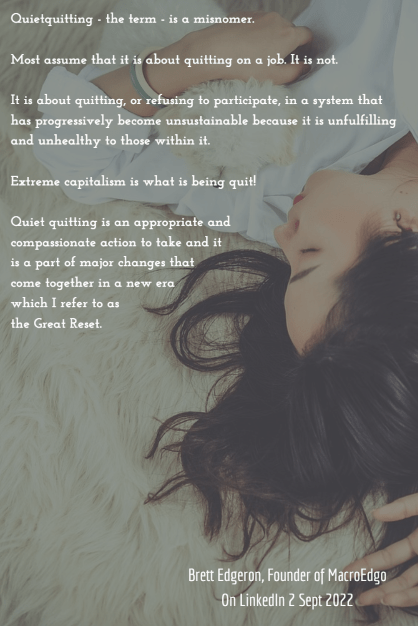
Quiet Quitting

Actually, it looks like I have lost my posting ‘privileges’ on LinkedIn so it remains to be seen whether this will be published on LinkedIn today – I have tried several times, although it says posting was successful, it does not appear in my list of posts or in my activity … addendum – amazing what mentioning here and in an email did – post up now…

Quiet quitting – the term – is a misnomer. 

Most assume that it is about quitting on a job. It is not.

It is about quitting, or refusing to participate, in a system that has progressively become unsustainable because it is unfulfilling and unhealthy to those within it.

Extreme capitalism is what is being quit!

Quiet quitting is an appropriate and compassionate action to take and it is a part of major changes that come together in a new era which I refer to as the Great Reset.

What needs to be asked is not whether it is acceptable that a colleague does just what they are paid to do, nothing more, nothing less.

What really needs to be asked is whether a colleague should be permitted to outcompete others purely in terms of hours worked.

If someone feels insecure at proving their value from a set number of working hours, with their unique combination of hard, intense and efficient work (relating to intelligence including EQ), should they be permitted to work uncapped hours to outcompete others who may not be able to work extra hours because of any number of reasons related to their broader lives (i.e. parenthood, other caring roles, and other giving roles within society including self-development and self-care)?

Of course the employers and self-interested managers within the system are not going to recognise this and support or even agree with the need for this change; Extreme capitalism benefits their self-interests and many feel they are due this from subordinates or employees because it is what they did to achieve their status.

With no cap to permitted work hours, within a system based on domination from imperialist white-supremacist patriarchy, insecure workers in large organisations take on more and more meaningless, ‘bullshit’ (from David Graeber’s work), just-in-case tasks that are pointless and soul-destroying, while in small business they remain vulnerable to exploitation as there are few other options where a compassion imperative is enacted.

Like all Real change this is being driven by people power. 

It requires self-reflection on what is really important in your life. Many have done that work for themselves through the pandemic and have decided to quietly quit on Extreme capitalism.

There is nothing to be afraid of, you just need to be honest with yourself on one question – Did I feel fulfilled with the life that I was living in 2019?

If the honest answer is No, then you need to ask yourself whether you really want to return to it as pandemic measures become forgotten and employers push for a return to ‘normal’, the normal that favoured them so greatly.

Perhaps quiet quitting is the most compassionate thing you can do for you.


Gained value from these words and ideas? Consider supporting my work at GoFundMe


© Copyright Brett Edgerton 2022

Compassion Culture Benefits All Stakeholders Including Shareholders

Why is a compassion culture better for all stakeholders in capitalist societies including shareholders?

Besides the threat of unheralded injury claims from toxic workplaces that put businesses in jeopardy (as I explained in “The Great Reset At Work“)…

it is my thesis that a great deal of work done by white collar workers is ‘just in case’ work which is really about making self-interested managers look good, or addressing their anxiety over potentially appearing bad to their domineering managers, rather than actually adding value to the business.

I have witnessed the rise of ‘just in case work’ from many sources over many years.

And yes, this is highly related to David Graeber‘s famous “Bullshit Jobs” thesis where he argues that over half of work is pointless and knowing this does harm to those who are made to perform this work.

After the extended period of Extreme capitalism, many workplaces are operating manically, and managers down through the hierarchy are thus incapable of making good decisions to increase productivity by genuine efficiency measures. Executives have continually initiated restructures to achieve efficiencies which in the main are a euphemism for smaller workforces. 

Headcount cuts just drives that viciously manic cycle and actually decreases pure productivity (quantity of work adjusted for quality relative to effort) thus burning out workers trying desperately to, at best, appear to be as productive as before the headcount cuts by increasing their own effort even further.

All of this is worsened by ubiquitous communication technology eliminating separation of work and home life.

This explains the negative stimulus behind the Great Resignation/Reshuffle and Quiet Quitting.

(Of course the positive stimulus is Great Reset era thinking that a better work life balance, and an identity less entwined with ‘what I do’ for income, is indeed attainable.)

This describes the reality of many large organisations, and the consequence has been an enormous experiment to see how long before large numbers of human beings ‘break’.

The evidence, from many sources including from insurers, suggests that point was surpassed in the past decade.

Of course in small businesses the reality is somewhat different in that actively involved owners will immediately seek to eliminate inefficient ‘just in case’ and other pointless work if detected.

The more tenuous nature of the small business workplace, however, incentivises small business owners to exploit workers and owners use this to justify their own poor behaviours to themselves. 

This behaviour is systematically supported in two ways. After decades of Extreme capitalism, regulatory capture by business groups including small business means that regulation and enforcement is not as active as it should be to protect workers from exploitation.

Secondly, when the worker knows that there is as high a chance of being overworked and burnt out in a large corporate business as a small business, ‘better the devil you know’ becomes a strong factor in accepting exploitative practices.

If large corporations develop a ‘compassion culture’, and if Governments regulate and enforce for it, then small businesses will have no choice but to follow, and businesses that are viable only by exploiting workers will be exposed as unsustainable.

This will lead to much better allocation of resources in economies, and thus will actually strengthen our capitalist societies.


Gained value from these words and ideas? Consider supporting my work at GoFundMe


© Copyright Brett Edgerton 2022

The Great Reset: The concept and the passion

In “The Great Reset: An explainer” I gave a brief description of the political and economic backdrop that led to humanity entering the pandemic at a moment of social extreme with a paradigm shift due or even overdue.

I explained that trends in society tend to occur in cycles that can be conceptualised as a swinging pendulum.

The truth is that this concept is simplified because it infers that trends oscillate around a stationary point but we know that – no matter how much conservatives seem to dislike the idea of it, at least over shorter time frames – human society has progressed an awful lot since we mastered fire and put circles to work (as wheels and then gears).

So intuitively most of us understand that our societies progress over time, but most of us also recognise that there are periods where change seems to happen quickly, and there are other times when change happens slowly, or perhaps conditions even go backwards. In many ways we see societal progress over time as the diagram below shows, a wavy line but generally heading up to the top right hand corner of the graph.

Wavy line of social progress over time

To make the situation even more complex we all understand that societal progress is in reality a whole host of factors ranging from major issues such as how we view inequity in wealth (the major idea discussed in the ‘explainer’) to relatively minor factors such as how we choose to dress and present ourselves, though older members of society through history have often treated these as far more significant issues (for example in the 1960s when young people as a cohort really began to express their individuality). That is in part an over-reaction from those who feel insecure that they are no longer a part of the demographic that sets trends within society, but it is also a reflection that all of these trends intersect to produce an overall view of societal progress.

In other words, if we were to narrow in on that wavy line of progress we would notice that it is the overall trend, but that there are an infinite number of trend lines – some more significant, some less significant, some oscillating more slowly, others more rapidly – that together make up the overall trend. This is a little like zooming in on a Google map revealing progressively smaller roads which are less and less significant to the overall way people move around, but that does not mean that those very minor roads are less significant to all of us (e.g. those who live nearby in the case of roads).

Of course the relationship between capital and labour – those who have large pools of resources and wealth at their disposal, both personally and/or as a consequence of status or position within society, and those who do not – has always been one of the most critical trends affecting human progress.

Now these wavy lines of social progress can still be reconciled with the swinging pendulum concept if we think two-dimensionally, or in the second derivative as some who like maths prefer to say.

If you are not a fan of mathematics, let me explain it this way. Imagine that you have an animation of a singing pendulum on your phone which you are looking at on the face of your phone. Turn the phone a quarter turn so it is at a right-angle to you and then gradually raise your phone as you move it from left to right while visualising in your mind the position of the round end of the pendulum. Hopefully you can visualise it tracing a wavy line like the one above.

Now in this concept I intentionally chose a pendulum singing widely and above the centre point because that is how progress has occurred for humanity to this point as I described in my explainer. The path of the centre point of that pendulum swing is drawn on the next diagram to show that it indeed rises at a constant stable rate but that there are moments of extreme when the pendulum approaches a course change at the top of its swing.

Wavy line of social progress showing periods of extreme

Side view of a pandulum at various positions indicating its centre (the orange line) moving upwards at a constant rate over time.

I referred to this concept of an upwardly rising pendulum for societal progress in an earlier essay entitled “How Might Milton Friedman Respond To The COVID-19 Pandemic“. Friedman is considered a hero of conservatives as it was in large part his intellectual rigor that led to the reforms of the 1980s most famously implemented in the US by President Reagan and in the UK by Prime Minister Thatcher due to their veneration by Anglophone conservatives. In Australia reforms around this time were implemented by the centre-left Hawke/Keating governments.

The main point of that essay was to say that I believe that the Mr. Friedman who wrote “The Social Responsibility Of Business Is To Increase Its Profits” in 1970, if he were brought forward in time to assist humanity in responding to the COVID-19 pandemic by allowing his economic rigor to intersect with recommendations of medical experts, would not have recognised the economies that he was dealing with because it would be unfathomable to him the extreme to which his ideas had been taken. Thus I posited that he would have said that if he was to formulate a response to the COVID-19 pandemic he would not be starting from here!

There is no need to rehash exactly where we are, in my view, in an observational sense as it would be a repeat of that essay and much else that I have written over the past 3 years including most recently in “The Great Reset: An explainer” and in “The Great Reset At Work“. Instead I will label the most recent half century of that wavy line of social progress with dates as below showing how through the 2010’s the pendulum was at an extreme and its direction change has created the perception that our progress is actually retarding.

Just as the 1960s and 70s was a period of social extreme, so too was the 2010s as the pendulum reached its climax especially in the way our Extreme capitalist system favoured capital over labour.

However, if we narrow in on the model for the present day and through the next few decades this model explains exactly why I am ultimately very optimistic.

As the pendulum reached its extreme in the 2010s social conditions were extreme. But the pendulum has begun its swing back and is gathering momentum. This is the Great Reset Era and the rate of change will continue accelerating as ideas spread from early adopters to influencers to the broader public.

I firmly believe that we are setting ourselves up for a golden Great Reset era where social progress will accelerate on the back of significant reform which is possible because humanity is primed for that change no matter how much conservative and other right wing political actors attempt to scare the population away from the idea of social progress (again, which I will not discuss as I have on many occasions, most recently in “The Great Reset Era At Work“).

The evidence of this is pervasive through society in the way that we communicate and tell stories, i.e. through all of our media, and is apparent to anyone perceptive to it. And my perception is that this is indeed accelerating as I would expect to happen.

Much of that change will centre around how we identify with ourselves in the Great Reset era, and at the centre of that will be the role of paid employment and creating a better balance between it and our broader lives and roles in society. Thus industrial relations is shaping up, once again, to be a focal point. 

Given the level of inequality, debt, and middle-class erosion, however, the breadth of dissatisfaction expressed and change desired will surprise many corporate and organisational leaders and leave many flat-footed and unable to adjust. The impacts will not be felt just in poor performance of organisations under their influence, it may prove fatal if toxic workplace culture is exposed through the legal systems as I anticipated in “The Great Reset At Work“.

Simply Milton Friedman’s profit imperative is being replaced by a compassion imperative.

The corporate leader who has best articulated this change to this point is Indra Nooyi and I recommend this video to all.

In my next post I will describe one idea which I believe its time has come and which has the potential to unleash human potential in unimaginable leaps and bounds – the introduction of universal basic income. 

Before I close, however, I feel I need to go negative once more because that is still the mood of this phase of the Great Reset era, and it is appropriate because it spells out exactly what is at stake.

As this model of social progress shows, and as most of us know intuitively when we think over the very long term, humanity is continually at its most progressed state even though there are periods where we perceive we may be regressing, sometimes for long periods such as in Middle Ages (for a brilliant blog post on this see On Progress And Historical Change at Ex Urbe).

We look back and wonder – either actively or subconsciously – how was it that we lived without developed language skills and proper shelter, without knowledge that mercury and lead were poisonous, without electricity and modern mechanisation, and without labour and human rights protections.

Many of us take that one step further and wonder how our current societies will be viewed in centuries ahead, and as our science continues to progress, what commonly used substances and practices will ultimately be proven to do us more harm than good.

I am of the opinion that this period over the past half century will be viewed dimly because, for all of our smug contempt for our ‘primitive’ forebears, we have lost our sense of community as self-interest has led to the ‘democratisation’ of human beings harming human beings as people have fallen for the Extreme capitalist propaganda that status benefits (materialism and ego) from ‘winning’ outweigh the benefits of deep and rich connection with our societies. 

There are no real winners in Extreme capitalism, just an unquenchable aspiration for more wins and more things. 

Even the ‘winners’ and ‘owners’ are hurting, they just cannot admit that to themselves let alone others.

A culture of domination nourishes nobody.

And when it comes to the unsustainable use of our finite resources, we are all losers even if many still refuse to admit their error.

The extreme self-interest exhibited by our leaders within the political and corporate spheres has been especially harmful. It is hardly a surprise that this type of behaviour has been imitated widely throughout society, after all, there is a reason why the term ‘leader’ developed.

For my entire life I have lived in a society where nothing is valued, not an action, thought or thing, unless at least one other is prepared to pay for it. Now that the mental health impacts of all of this are becoming understood, mainly because it is impacting the profitability and functioning of businesses, there is growing acceptance of the critical need to address mental health. But there is no market value in acknowledging that this crisis stems from the unquenchable aspiration at the heart of Extreme capitalism.

The evidence now shows that diverse, equitable and inclusive workplaces are more profitable. So finally we have sufficient reason to be fair to all human beings within organisations, if only we would genuinely commit to achieving it!

And what about equality on a global basis?

That our society has devolved to the point where human beings being good to other human beings is only prudent when it is profitable says everything about us as a modern society.

The most striking peacock is equally vulnerable to the same diseases as the rest of the flock, the toughest fighting male salmon soon meets the same fate as the vanquished, and the hardest working bee will survive not one day without a hive.

The success of humankind was not built on the individual, it was built on the collective support of individuals within our society. If we wish to unleash humanity’s full potential we need to collectively support all individuals with compassion and love. 

That is at the heart of the Great Reset era…


Gained value from these words and ideas? Consider supporting my work at GoFundMe


© Copyright Brett Edgerton 2022
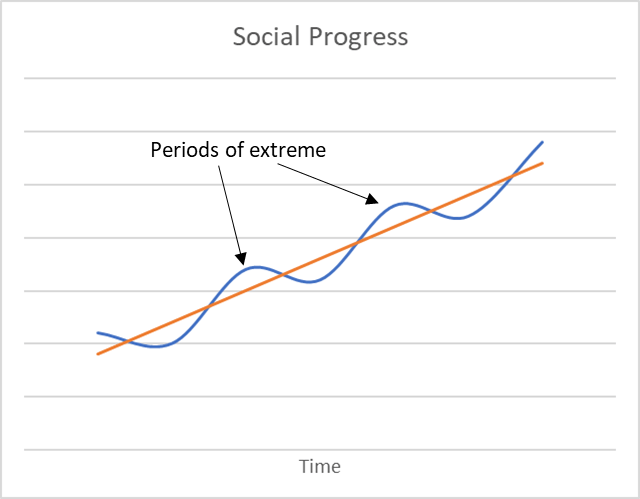
To Reset To a Compassion Culture A New Global Formal Greeting Is Necessary

In organisational and formal social culture, nothing speaks more to an imperialist white-supremecist patriarchal system based on domination than the handshake.

There is so much social expectation and perception associated with the handshake. Virtuallly every person living in a western nation has had the feeling of having their hand twisted into a more passive position (with their palm facing more upwards) by someone intentionally or subconsciously asserting dominance.

I have heard body language professionals give advice on how to respond in such a situation.

When greeting by handshake a hand extended in the upright position indicates equality – a willingness to meet as two equals. So when the hand is extended with it twisted over beyond the upright position – indicating inequality – rather than responding by being passive and submitting by turning your hand with your palm facing upward, you can place your hand atop theirs and shake.

Much is made of handshakes because of the importance of first impressions.

Those particularly polished in etiquette and diplomacy train themselves around this, intentionally altering their handshake for the circumstance. If they wish to appear warm and non-threatening they will extend their hand with their palm more open and facing upwards so that they can embrace the other person’s hand, often then cupping it with their other hand or touching them further up the forearm to accentuate that warmth. If they wish to appear firm but fair, the hand is extended upright at 12 o’clock. And if they wish to assert themselves they extend it in the dominant form, twisted over beyond 12 o’clock to a varying degree depending on the level of strength or dominance that they wish to express.

The force exerted in grasping the hand is also important with obvious correlations.

It is as common for people to criticise others’ handshakes for being too weak or limp as it is to criticise them for being too firm. In my experience women often speak of males’ handshakes being weak suggesting a level of learned or hard-wired expectation of masculinity.

Personally, I was taught how to shake hands when I was 5 by my father when he refused to continue kissing me when I went to bed at night, telling me that men shake hands.

I am certain this behaviour, stemming largely from homophobia, is repeated in many cultures. I remember my brief but great mentor JR Bonami (also a very important mentor to my friend Dr Shi Zhengli, the brilliant “Batwoman” scientist from the Wuhan Institute of Virology) explaining to me local social etiquette during my time in Montpellier, France telling me that in the south of France men don’t kiss like the (apparently less macho) northern French men.

In the new Great Reset era, where we are developing a compassion culture to replace the culture of domination, where for instance heteronormative men are expressing themselves by wearing clothing formerly associated only with women, it is appropriate that we develop a new custom of greeting in formal situations in parallel with the fluid informal expressions of affection that accompany friends greeting.

However, because what is being discussed is a formal greeting, and people often feel uncomfortable over-expressing warmth such as by hugging or kissing, and often females especially feel pressured to comply when someone leans in to kiss or hug, it must take a form that is truly inclusive.

Developing a new mores (I admit I needed to search for the right word) for formal greeting is important because it gives us agency to express immediately in a formal setting that we are woke and will not accede to imperialist white-supremacist culture of domination.

The greeting should be strength expressed as warmth and compassion.

Do you think we can learn from other non-imperialist matriarchal or more passive cultures and adopt that custom, and if so, please share your suggestions.

Otherwise should we develop a totally new style of greeting?

Head to LinkedIn to let me know your thoughts in the original post, and please share… thank you

Published on LinkedIn 25 August 2022


Gained value from these words and ideas? Consider supporting my work at GoFundMe


© Copyright Brett Edgerton 2022